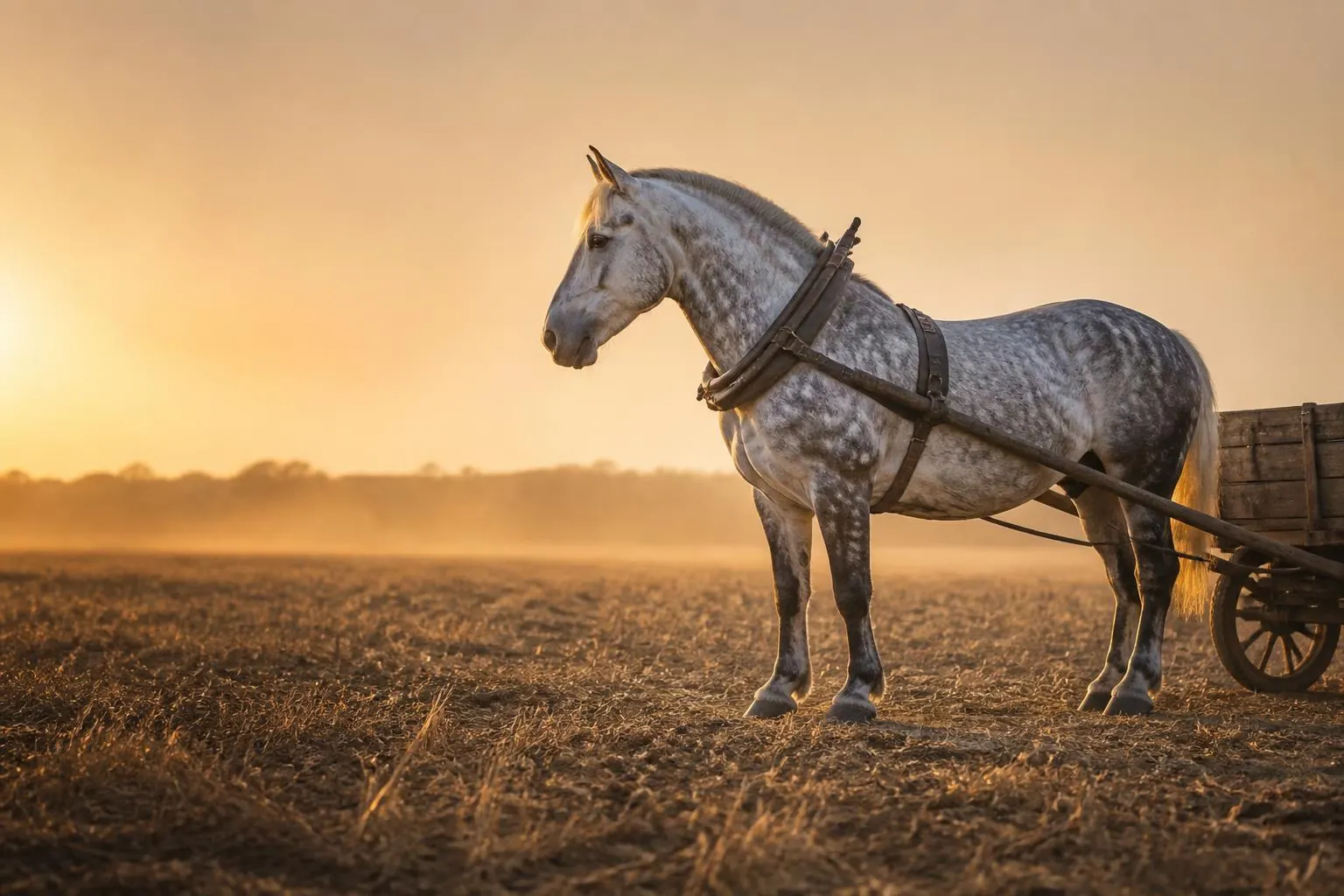

An adult draught horse typically weighs between 1,430 and 2,200 pounds (650 and 1,000 kg), with the heaviest exceeding a ton. This figure impresses, but it measures nothing about strength. The effort a horse exerts at the collar during a working day represents only a fraction of its own weight: animal traction manuals establish this at around 10 to 15 percent. A 1,980-pound (900 kg) animal therefore works at approximately 220 to 300 pounds (100 to 135 kg) of continuous effort. Yet it displaces loads many times heavier than itself. The two figures measure entirely different things, and therein lies the confusion.
What an adult draught horse weighs
The term “draught” encompasses some twenty French and international breeds, ranging from heavy ponies to colossi exceeding a ton. The ranges published by stud books and the IFCE are broad because a single breed standard accepts both light working animals and considerably heavier competition specimens.
| Comtois | 1,430, 1,760 lb (650, 800 kg) |
| Boulonnais | 1,430, 1,980 lb (650, 900 kg) |
| Breton | 1,540, 1,980 lb (700, 900 kg) |
| Ardennais | 1,540, 2,200 lb (700, 1,000 kg) |
| Percheron | 1,540 lb to over a ton (700 kg plus) |
| Shire, Belgian (outside France) | often exceeding 1,980 lb (900 kg) |
These ranges serve to place an animal, not judge it. Real weight depends on bloodline, age, body condition, and work performed. Breed-by-breed detail appears on our page about draught horse weight.
A draught foal is born heavy already: roughly 10 percent of its dam’s weight, often 154, 198 pounds (70, 90 kg) at birth. Its growth unfolds far more slowly than in a riding horse. Breeders consider a draught horse unfinished until five or six years old, which explains professional caution about demands placed on youngsters.
The scales do not measure strength
A horse does not lift the load it moves, it pulls it. What matters is the horizontal effort it exerts on its traces, measured in kilogram-force or decanewtons. This effort is measured with a dynamometer, and it bears no relation to the animal’s mass on a weighing scale.
Effort at the collar
Animal traction literature, adopted by agricultural standards and the IFCE, establishes continuous effort at around 10 to 15 percent of live weight during a normal working day. A 1,980-pound (900 kg) Percheron thus sustains approximately 220, 300 pounds (100, 135 kg) of pull for several hours, with breaks. During brief peaks, starting loaded or wrenching a stump, effort climbs far higher, but it does not endure.
The load displaced
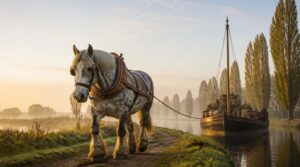
This is the other figure, the one that sets records and fuels misunderstanding. On wheels, over hard, level road, the rolling resistance of a well-maintained vehicle represents only a few percent of the load transported. With 100 pounds (roughly 45 kg) of useful pull, a horse therefore moves a load several times its own weight. Nothing magical: the wheel does the work, the horse supplies just enough to overcome resistance.
Ground and gradient decide for the horse
Change the ground, and the same team becomes impossible. On loose earth, freshly tilled ground, sand, or waterlogged pasture, resistance climbs significantly because wheels or skids sink rather than roll. This is why ploughing demands two horses where a cart on road needs one.
Gradient piles on top. Climbing a slope forces the horse to carry a portion of the total rig’s weight, proportional to the incline, in addition to rolling resistance. A comfortable load on level ground becomes peak effort over 300 metres (1,000 feet) of climb. Experienced drivers always dimension their load for the hardest stretch of the route, never the average.
The harness does part of the work
Two identical horses, two different harnesses, two different results. The breast collar distributes effort across broad musculature and leaves the windpipe clear: the equipment for heavy, prolonged work. The simpler, lighter traces suit modest loads and faster speeds, but press on a narrow band.
A collar too wide slips and pinches the withers, one too narrow compresses the trachea and cuts breath short. In either case, the animal reduces its effort of its own accord, and we blame temperament. An attelage’s efficiency depends as much on harness fit as on the horse’s frame. A horse that refuses, breathes unusually, or stiffens under effort deserves a veterinary inspection and a blacksmith’s assessment before any judgement on its work.
- Actual live weight, measured not estimated by eye, which sets the ballpark for continuous effort.
- Maturity: a three-year-old draught horse has neither the frame nor the capacity of a six-year-old at equal weight.
- Physical condition: a fat animal is not a strong one; fat mass does not pull.
- Training: pulling power builds progressively, like any endurance work.
- Harness and its fit, collar suited to the individual’s shape, not simply its size.
- Ground, gradient and distance, which multiply resistance many times over.
- Duration of effort: ten seconds of peak exertion differs completely from a day of skidding logs.
- Hoof and shoeing condition, the only contact point with the ground at the moment of strain.
Estimating weight without scales, and why the tape falls short
The weight tape gives an estimate from girth measurement. Convenient, free, and originally calibrated on riding horses. On a draught frame, with a deep chest, heavy bone, and massive neck, the formula loses reliability and the gap between estimate and reality widens.
For an accurate figure, three options exist. A livestock scale, often available at agricultural cooperatives or gathering centres. A weighbridge, by weighing the loaded horsebox then empty. A veterinary clinic scales, during a routine call. Between weighings, body condition scoring remains your best tracking tool: it shows trend, which weight alone cannot reveal. Our full method is detailed in the draught horse guide.
What this changes in today’s work
Operations returning horses to work reason in continuous effort, never in scales weight. A logger dimensions his logs by slope and skid distance. A market gardener sets his cultivator to remain in his animal’s comfortable zone. An urban waste collection route plays on relays, stops, and water rather than horse size.
Choosing between a single horse and a pair follows the same logic. Two harnessed together do not exactly double available strength, because they never start in the same millisecond, but they weather resistance spikes far better. This dimensioning, more than breed, explains the horse’s return to certain terrains. Current uses are listed on our page about draught horse uses.
Records do not tell the same story
Pulling competitions distort perception. A trained team displaces several tons over a few metres, which amounts to explosive peak effort, on prepared ground with the load on skids. It says nothing about what the same animal sustains for eight hours straight.
Size records confuse the picture further. The largest horses ever recorded were draught breeds, and their height at the withers justly captivates. It did not make them more durable at the collar, because an oversized frame brings joint constraints and heavy maintenance. The subject is covered in our article on the world’s largest horse.
The Percheron as the textbook case
The Percheron serves as reference because it combines heavy frame with an ability for extended trot that many draught breeds lack. At the same pulling effort, it covers more ground daily. This versatility earned it successive careers, from urban transport to leisure driving, not raw strength advantage. Its full profile is here: the Percheron.
The reasoning applies to all breeds. Before comparing two horses on the scales, watch what they accomplish with the same effort over a full day. The ranking often shifts. To find your way among sizes, aptitudes, and costs, start with our feature on the draught horse.
- An adult draught horse typically weighs 1,430, 2,200 lb (650, 1,000 kg), the heaviest exceeding a ton.
- Its continuous pulling effort counts as a fraction of live weight, roughly 10 to 15 percent over a working day.
- The load displaced is far greater: the wheel and ground do much of the work.
- Ground, gradient, harness, and duration matter as much as size in the final result.
- The weight tape remains imprecise on these builds. A scale gives the true figure.
References drawn from breed standards and publications by the IFCE and national studs, as well as animal traction literature. Pulling values are reference ballpark figures to adjust animal by animal with your veterinary surgeon and your driver.