
The riding trousers you pull on before saddling up did not originate in English stables. Their distinctive cut, which offers freedom at the hip whilst hugging the lower leg, was developed in India, in the state of Jodhpur, around 1890. The style arrived in London in 1897 in the luggage of a prince who accompanied his polo team to Queen Victoria’s diamond jubilee celebrations. Two years later, the word jodhpurs entered the English dictionary.
This is no mere wardrobe footnote. It is the story of a technical garment that solved a precise mechanical problem at a time when fabric did not stretch, and whose solutions remain almost unchanged on the models sold in saddleries today. Our guide to riding trousers compares current models. This article traces where they came from.
Before 1897: riding in short breeches and tall boots
The nineteenth-century European rider wore breeches in the strict sense: a pair of trousers that ended roughly mid-calf. They were cut from firm fabrics, buckskin, twill, whipcord, chosen to resist saddle friction rather than offer comfort. Beneath them, long stockings. Over them, a rigid leather boot that climbed to the knee.
The system worked, but it was expensive and restrictive. The tall boot was a bootmaker’s object, time-consuming to craft, requiring lengthy softening, difficult to replace. It was also the only protection for the lower leg, since the breeches ended before it. Remove the boot, and nothing remained to hold the leg against the saddle flaps. This was precisely the constraint that the Indian cut would shatter.
The Prince of Jodhpur who redressed the polo fields
Pratap Singh was born on 22 October 1845, youngest son of Takht Singh, maharaja of Jodhpur, in the kingdom of Marwar. A leading political figure, he served as regent of Jodhpur three times, including from October 1895 to February 1898. He was aide-de-camp to the future Edward VII from 1887 onwards, travelled frequently in Europe, and would still lead the Jodhpur Lancers in France during the First World War, well into his sixties. He died on 4 September 1922.
Around 1890, he had a riding garment tailored in India, inspired by the churidar, a traditional Indian trouser that is tight at the calf and voluminous at the hip. He rebalanced its proportions: he increased fullness across the thighs and hips, kept the tube tight from knee to ankle, and reinforced the fabric on the inner calf and knee, at the exact points where wear occurred from contact with leather.
In 1897, Queen Victoria celebrated her diamond jubilee. Pratap Singh travelled to England and brought his entire polo team with him. The Indian riders played, and more notably, they dressed differently: British high society immediately noticed their riding attire. The cut was adopted by English polo players, who married it to their own breeches. The modern garment was born from this fusion, not from any isolated invention.
The starkest proof of its impact lies in a dictionary date. The earliest occurrence of the word jodhpurs recorded by the Oxford English Dictionary dates from 1899, from the pen of journalist G. W. Steevens. Two years after the jubilee, English had already absorbed the name of a Rajasthani city to describe a pair of trousers.
Why the thighs were full and the calves fitted
The bat-wing silhouette seen in old photographs was not an aesthetic whim. It was an engineer’s answer to a material constraint.
The fabric of that era did not stretch. Yet the rider’s hip joint worked continuously: it opened and closed with every stride, it absorbed the motion of the horse’s back, it braced the seat position. Without elasticity, the only way to allow this range of motion was to add fabric. Hence the volume across thighs and hips.
Conversely, the lower leg had to remain smooth. A fold beneath the boot or against the calf created a pressure point that caused injury within kilometres. Hence the fitted tube from knee to ankle, directly inherited from the churidar. Fullness above, refinement below: one pattern solved two contradictory needs.
Then there was the internal reinforcement at knee and calf. It protected the fabric, stabilised the leg, and increased grip on the saddle flaps. The leather patches of classic breeches descend directly from this, and the silicone patches of modern models fulfil the same function today, in a different material.
The ankle boot that went with it, and the end of the tall boot’s reign
A trouser that descended to the ankle changed the entire lower leg kit. Since the fabric now protected the calf, the tall boot ceased to be essential. An ankle boot sufficed.
This was the jodhpur boot, the round-toed ankle boot with a low heel and a buckled strap circling the ankle. Anglo-Saxon sources place its appearance in India in the 1920s among British polo players, and note that a major New York department store was selling them by 1927. In other words, the ankle boot postdates the trouser by a good generation, contrary to what the jubilee legend often claims.
This shift has a very practical consequence for today’s beginners: it made possible the trio of long trousers, boots and chaps that the vast majority of riders now wear. To choose between the two families, our comparison of riding boots and our selection of boots detail what each genuinely offers.
What to assess when judging riding trousers today
- The grip seat. Leather patches, silicone dots or full coverage, at the knee alone, three-quarter length or full seat. The larger the surface, the more secure the seat and the less the rider can slip deliberately, which troubles some over fences.
- Elasticity and recovery. A fabric that stretches but does not return to shape will bag at the knees within weeks. This is the first sign of a budget model.
- Seams. They must be flat and never placed on the inside of the thigh, at the contact point. This is the most frequent and most preventable cause of chafing.
- Waistband height. A low waistband gaps at the back when seated. A high waistband offers better support and sits more discreetly under a jacket. This is a matter of fit, not fashion.
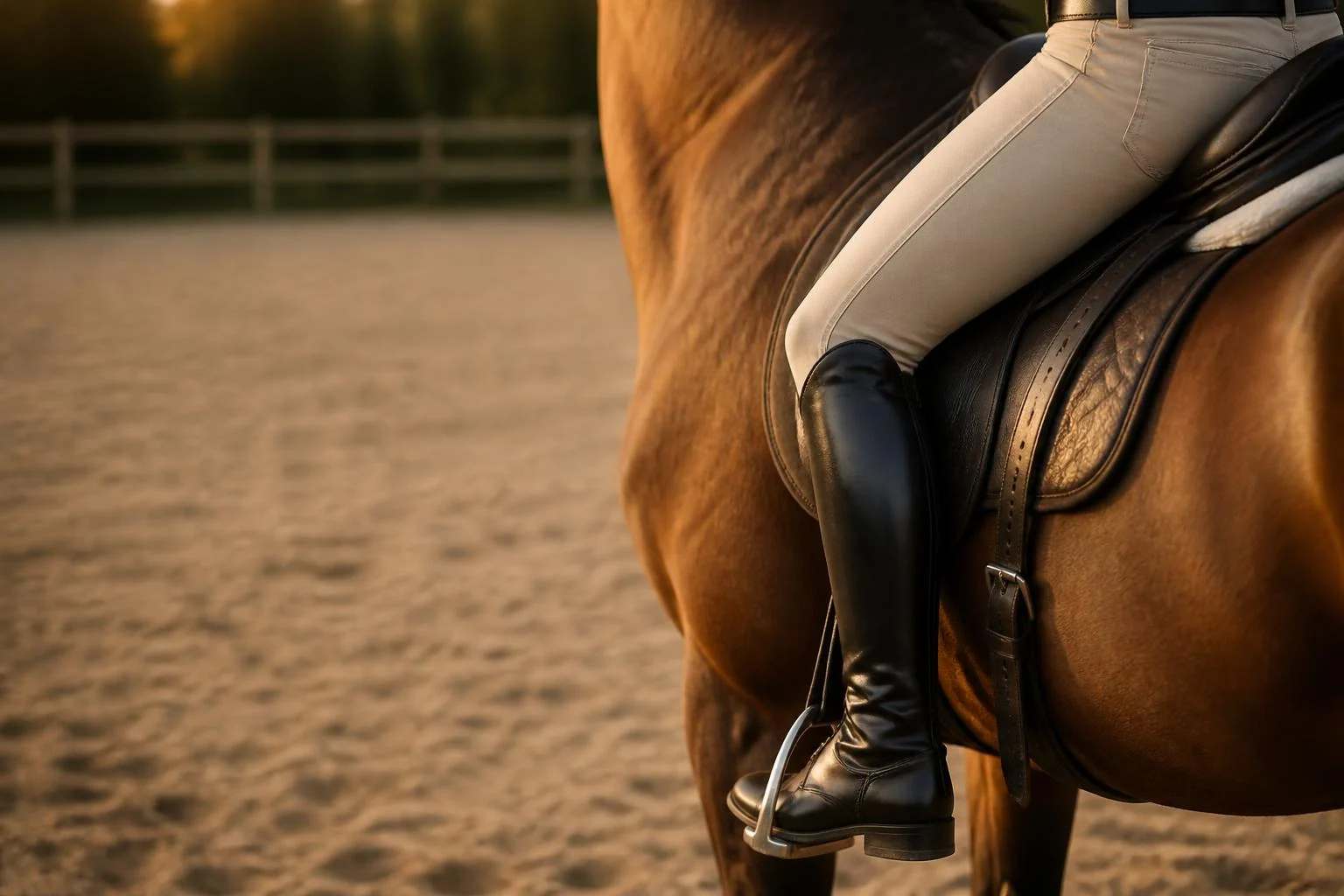
- The lower leg. A smooth tube without excess bulk, integrated sock or leg pass, so nothing rides up into the boot or under chaps.
- Breathability. In summer, fabric that does not wick moisture sticks and burns. Check the weight and the presence of open mesh at the back of the knee.
- Wash durability. Silicone grip seats dislike high heat, tumble driers and fabric softener. A model requiring impossible care will not last.
- Compliance with regulations. Before buying for competition, read the rulebook for your discipline: the permitted colour is not the same everywhere, and it is not negotiable on the paddock.
What elastane erased
The voluminous silhouette disappeared for a chemical reason. In 1958, a chemist at DuPont, Joseph Shivers, developed an elastic fibre that stretches several times its length and returns to shape. It was commercialised in the early 1960s under the name Lycra.
Once fabric could stretch, the surplus material across the thighs served no purpose. It became a defect: volume that bunched under the saddle flap, caught the wind and added bulk to the silhouette. The riding trouser contracted onto the leg and became the second skin we know today.
What remained of the Indian pattern, however, was more subtle and more persistent: the length to the ankle, the smooth tube of the lower leg, the reinforcement at the contact points, and the very principle of a garment designed for a moving joint rather than standing still. Recent innovations, compressive fabrics, heat-sealed seams, printed silicone, merely revisit this specification. You can follow this evolution in the trends in equestrian fashion, where marketing recycles each season solutions whose logic is over a century old.
Jodhpur, culotte, breeches: who is who in a French saddlery
The vocabulary blurred in crossing the Channel, and it is worth clarifying before you buy.
In English, the distinction is clear. Breeches end around mid-calf and are worn with stockings and tall boots. Jodhpurs reach the ankle and are worn with ankle boots.
In French saddlery usage, the word culotte describes the classic riding trouser, and jodhpur has become specialised to mean the long trouser with a straight lower leg, often with a turnup, sold mostly in children’s sizes and worn with boots and chaps. An adult riding in long technical trousers is therefore, technically, wearing a direct descendant of jodhpurs without ever using the word.
The white of dressage is written in black and white in the rulebook
A trace of this history remains in the official texts. The dressage rules of the International Equestrian Federation, in the article on dress, impose on civilian riders a short and mandatory list: correctly fastened protective helmet in black or dark colour, white or off-white trousers, white or off-white shirt front or tie, white, off-white or jacket-coloured gloves, black or dark boots.
These days, at the world championships in Aachen, civilian riders entering the arena all observe this rule, whilst military and police riders retain the right to compete in service uniform. The garment has changed materials three times in a century, but the colour requirement has not shifted. In other disciplines, colour is governed by separate rules, which explains the more varied shades seen on the paddock. The only reliable approach remains to read the rules for your discipline and the current year, since these texts are revised regularly. Our page on rider equipment summarises the relevant pieces.
What this story tells us about polo, and everything else
Polo appears twice in this narrative, and it is no accident. It was the sport that served as a laboratory: fast-paced play, violent directional changes, long hours in the saddle, multiple horses in one day. Anything that hinders shows itself within an afternoon. It was also through polo that the word itself travelled, as our article on the origins of the word polo recounts.
The lesson extends beyond textiles. Much of what the rider considers immutable tradition is actually dated technical solution, born from a specific constraint, and sometimes become unnecessary without anyone noticing. The full thighs survived thirty years after the advent of fabric that made them redundant. The interesting question, faced with a rack of saddlery, is therefore not what is done, but what problem each detail claims to solve, and whether that problem still concerns you.
Choosing your trousers without getting the criteria wrong
Grip seat, waistband height, fabrics, men’s and women’s cuts, budgets: our guide compares available models and explains what genuinely changes in the saddle.
Key points
- The modern riding trouser descends from the Indian churidar, tight at the calf and voluminous at the hip, adapted in Jodhpur around 1890.
- Pratap Singh, youngest son of the maharaja of Jodhpur, made it known in England in 1897 by bringing his entire polo team to Queen Victoria’s diamond jubilee celebrations.
- The word jodhpurs is recorded in English from 1899 according to the Oxford English Dictionary.
- The full thighs were not a fashion choice: they compensated for fabric that did not stretch. Elastane, developed in 1958, rendered them unnecessary.
- The internal reinforcement at knee and calf of older models is the direct ancestor of leather patches and silicone grip seats.
- The long trouser reaching the ankle made the tall boot optional and opened the way to the ankle boot, then to the combination of boots and chaps.
- In international dressage, the International Equestrian Federation rules require white or off-white trousers.
Sources
Origins of the garment, connection to the churidar, role of Pratap Singh and the 1897 diamond jubilee: encyclopedic reference entries on jodhpurs and the jodhpur boot. Biographical dates for Pratap Singh, Jodhpur regencies, Jodhpur Lancers: reference biographical entry, though it does not mention the garment. First recorded use of the word in English in 1899: Oxford English Dictionary. Invention of elastic fibre in 1958 by Joseph Shivers at DuPont and commercialisation as Lycra in the early 1960s: manufacturer documentation and National Inventors Hall of Fame. Mandatory dress for dressage: International Equestrian Federation dressage rules, article on dress. This article is independent and is not affiliated with the International Equestrian Federation, the French Equestrian Federation, or any brand mentioned.