
On 9 June 1973, Secretariat won the Belmont Stakes by 31 lengths in 2 min 24 sec over 1.5 miles (2,400 metres) on dirt: that record stands still. Sixteen years later, on 4 October 1989, the veterinarian who performed his autopsy estimated his heart at 22 pounds, roughly 10 kilograms, against 4 kilograms for an ordinary thoroughbred. It was never actually weighed, and therein lies the whole story.
This chestnut, nicknamed “Big Red”, had accomplished in five weeks what no horse had done in twenty-five years: the American Triple Crown, with a record in each of the three races. Yet the most celebrated part of his story would be written on an autopsy table, in a Kentucky stud farm.
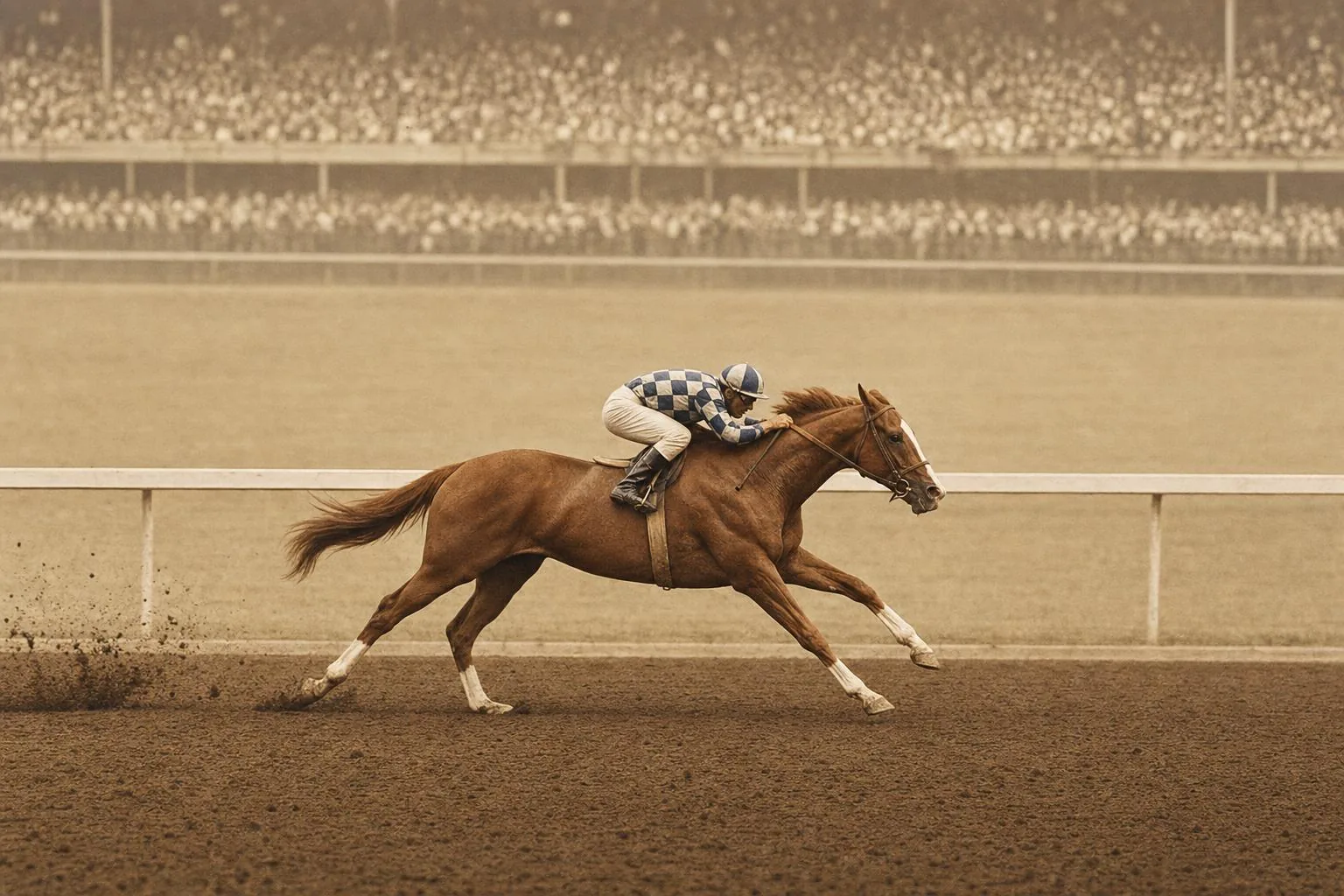
Belmont Stakes 1973: Secretariat alone on the track, 31 lengths clear
When Secretariat crossed the wire at the Belmont Stakes, the camera had to pull back to find the second-place finisher, Twice a Prince, 31 lengths behind. Sham, his rival throughout the spring who had dogged him at the Kentucky Derby and Preakness, tried to follow but then collapsed, finishing last of the five runners.
The time posted, 2 min 24 sec for 1.5 miles (approximately 2,400 metres), remains, in 2026, the world record for that distance on dirt. CBS commentator Chic Anderson delivered the line that American racing has repeated ever since: “He’s moving like a tremendous machine”. That same week, the horse graced the covers of Time, Newsweek and Sports Illustrated.
Five weeks earlier, he had run the Kentucky Derby in 1 min 59 sec 2/5, a Churchill Downs record that has never been broken, with a particular distinction no other winner has replicated: each quarter-mile faster than the last. He was accelerating at the finish. Our article on the thoroughbred reminds readers that a racehorse reaches 43 mph (70 km/h) at full stretch.
Video: 102 seconds
Secretariat: the 10-kilogram heart discovered at autopsy, the secret behind his 31-length Belmont victory
Sixteen years later, the veterinarian who performed the autopsy estimated his heart at nearly 10 kilograms, two and a half times the norm. It was never weighed. The story of the horse, his two French-speaking connections, and his end.

Secretariat’s heart: 10 kilograms estimated, never weighed
Secretariat died on 4 October 1989, aged 19, at Claiborne Farm in Kentucky. Dr Thomas Swerczek, from the University of Kentucky, performed the autopsy. He had opened thousands of horses. That day, he recounts being left speechless by the heart: not diseased, not deformed, simply enormous, with chambers and valves that appeared normal but at a scale he had never witnessed.
The figure that has circulated since then, 22 pounds (roughly 10 kg), was an estimate made by eye and hand by Swerczek. He did not weigh it, and he acknowledged this on several occasions. An adult thoroughbred’s heart weighs on average 8.5 pounds, just under 4 kg. Secretariat’s heart thus represented, at the very least, two and a half times the normal size.
One detail lends credibility to the estimate: in 1993, the same Swerczek performed an autopsy on Sham, the perpetual runner-up of 1973. This time he weighed the organ: 18 pounds, just over 8 kg. The horse that possessed the second-largest heart ever observed in a thoroughbred had spent the spring finishing behind Secretariat.

Lucien Laurin and Ron Turcotte: the two French-speakers behind Secretariat
It is often forgotten on this side of the Atlantic: the two men who trained and rode Secretariat both spoke French. The trainer, Lucien Laurin, was a Québécois from Saint-Paul, a former jockey himself. The jockey, Ron Turcotte, was an Acadian from New Brunswick, the son of a lumberjack. The lad who lived with the horse was named Eddie Sweat.
Turcotte told the same story about the Belmont for the rest of his life: he never had to ask the horse for anything. The colt matched Sham’s pace, dropped him before the halfway point and never slowed again. The jockey merely turned once in the stretch to glance at the electronic timer. Five years later, on 13 July 1978, a fall at Belmont Park left him paralysed at age 36. He died at home in Drummond on 22 August 2025, aged 84. This profession offers no mercy: other Derby-winning jockeys have learnt that differently.
A thoroughbred syndicated for $6.08 million before racing at three
What Secretariat also changed was the money. In January 1973, before his first race of the year, his owner Penny Chenery sold 32 shares of the stallion for $6.08 million, an absolute record at the time. She was forced to do so: the estate taxes on her father’s death in January exceeded what the family stud farm could pay. The horse had covered the debt before winning the Triple Crown, and the contract stipulated he would retire at season’s end: 21 races in total, 16 victories. To contextualise these figures in modern terms, our feature on the world’s most expensive horse provides the benchmarks, and our overview of the world’s greatest horse races situates the Kentucky Derby and Belmont.
Laminitis: the disease that killed the fastest horse in history
Secretariat did not die from his heart. He died from his feet. In summer 1989, he developed laminitis, the inflammation of the foot that separates the coffin bone from the hoof wall. Treatment failed, pain became unmanageable, and Claiborne Farm decided to have him euthanised on 4 October. It is the same disease that threatens an overweight pony in spring: it makes no distinction between a champion and a hack. We describe the early signs and causes on our page about equine laminitis.
The stud farm accorded him a rare honour. In the United States, the tradition is to bury only the head, heart and hooves of a racehorse. Secretariat was buried whole in Claiborne’s cemetery. This is also why the heart was never weighed: no one wanted to remove it.
What Secretariat’s heart explains, and what it does not
The theory is beguiling: a heart two and a half times larger than normal would mean extraordinary blood flow, muscle oxygenation and recovery. An American journalist, Marianna Haun, developed in the 1990s the theory of the “X factor”, a large-heart gene that would be transmitted via the X chromosome, thus through mothers. Secretariat, a disappointing stallion but an exceptional sire of mares, fitted the thesis. It remains an hypothesis, never demonstrated by a published genetic study.
The heart does not explain everything either. Phar Lap, the Australian champion of the 1930s, had a heart weighing 6.35 kg (14 pounds), now displayed in Canberra’s national museum, and he never raced at Secretariat’s speed. Kincsem, the Hungarian mare unbeaten in 54 starts, or Frankel, unbeaten in 14 outings, left no comparable measurements. The 10-kilogram figure fascinates because it offers an explanation for the inexplicable. What was measured with certainty were the times, and they suffice.
Secretariat, racehorse: what matters most
- Times, measured: Kentucky Derby 1 min 59 sec 2/5 (Churchill Downs record still standing), Preakness 1 min 53 sec (officially recognised record as of 2012 after correction), Belmont Stakes 2 min 24 sec and 31 lengths (world record over 1.5 miles on dirt).
- The heart, estimated: 22 pounds (nearly 10 kg) according to veterinarian Thomas Swerczek, unweighed. Normal: 8.5 pounds (under 4 kg). Sham, weighed in 1993: 18 pounds.
- What remains unknown: whether a large heart is genetically inherited (the “X factor” theory, never validated by published research), and what proportion of performance it accounts for relative to training, stride and conformation.
- Sources: BloodHorse, Paulick Report and Washington Post (Ron Turcotte obituary, August 2025), Belmont Stakes and Kentucky Derby archives, interviews with Thomas Swerczek as cited in American racing press.
Secretariat by the numbers: what to remember about the 1973 Belmont horse
- Born 30 March 1970 in Virginia, by Bold Ruler and Somethingroyal; died 4 October 1989 at Claiborne Farm.
- 21 races, 16 victories, 1973 Triple Crown with three track records.
- Heart estimated at 10 kg, approximately 2.5 times the average thoroughbred’s, never weighed.