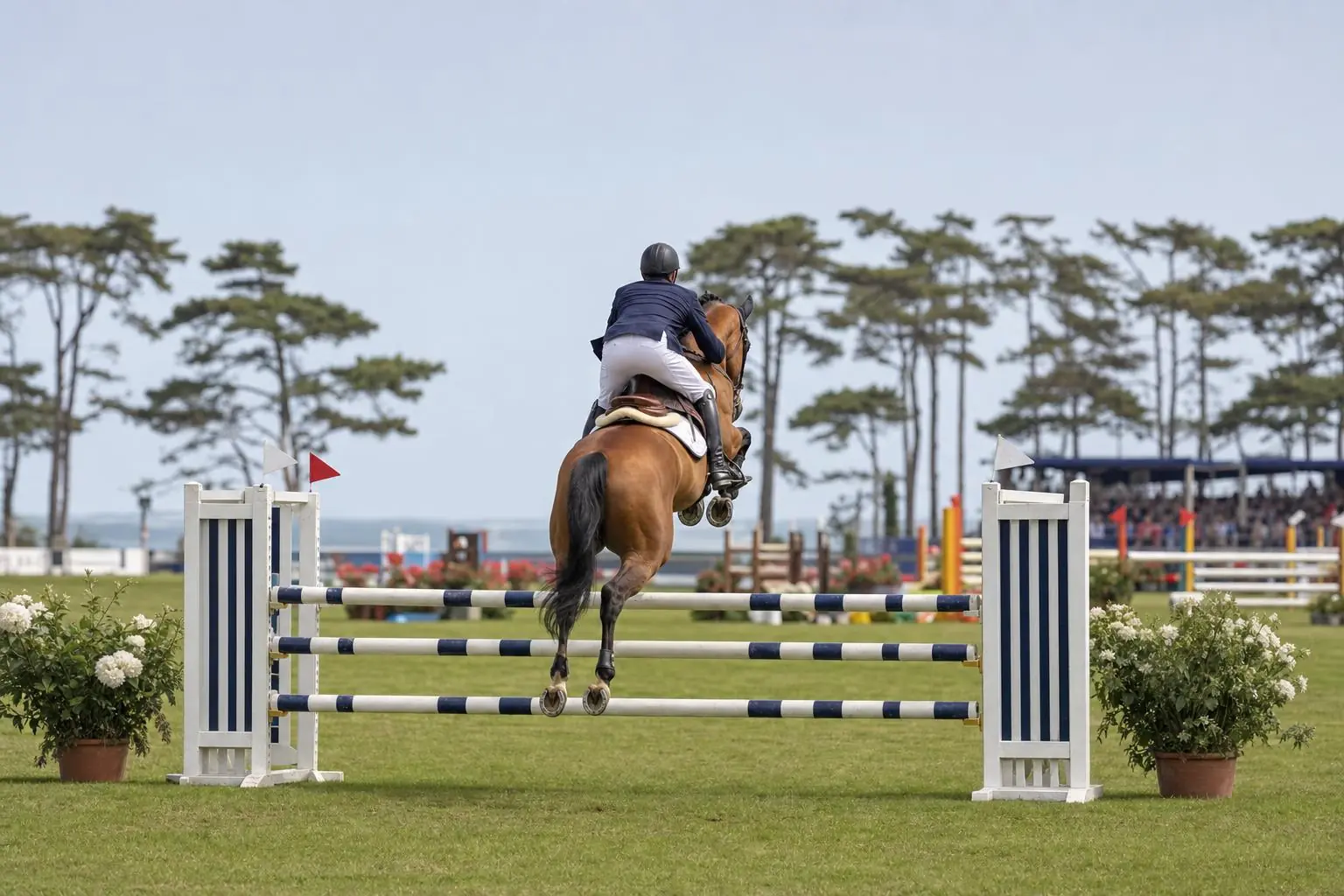

In 1990, at a show jumping competition near La Baule in Mesquer, 17-year-old Guillaume Canet asked his horse for an impossible stride. The horse jumped too early, pecked at the fence, fell, and trampled him: wrist shattered into fragments, dislocated shoulder, broken ribs and foot, and puncture wounds across his back from the horse’s studs. He rode for a year in plaster, then hung up his boots for cinema. He returned to competition more than twenty years later, because of a film: whilst preparing to play Pierre Durand in Jappeloup, he rediscovered his taste for competition. Between 2012 and 2017, he competed in 623 classes and won 33. In June 2023, he returned to La Baule, less than twelve and a half miles (twenty kilometres) from the fence that had broken him, riding a horse called James Bond du Bec.
This is the story of a rider who wanted another life and eventually returned to his first one. It rests on what Guillaume Canet himself has recounted on television and in the press, and on the evidence of his competition results.
Guillaume Canet, born to breeders: the ambition of a young show jumper
Guillaume Canet was born on 10 April 1973 in Boulogne-Billancourt, into a family of horse breeders: his parents ran a stud farm in the Rambouillet region, south-west of Paris. He grew up around stables and paddocks, and started riding early. As a teenager, cinema was not his plan: he wanted to become a top-level show jumper, and he was on that path, competing weekend after weekend. Show jumping is the most widely practised equestrian discipline in France, from local clubs to the international circuit. To understand what a young rider of Canet’s calibre aimed for at 17, our guide to show jumping (CSO), with details on levels, heights and how classes work, tells you what was at stake. By that age, Canet’s trajectory looked like that of a professional: a competition horse, placings, and dreams of going higher.
In video: 100 seconds
Guillaume Canet and horses: trampled by a horse at 17
He chose cinema instead. Twenty years later, Jappeloup put him back in the saddle: 623 classes, 33 wins, and a return to La Baule in 2023 with James Bond du Bec.

Mesquer, 1990: the fall that broke the right side of Guillaume Canet
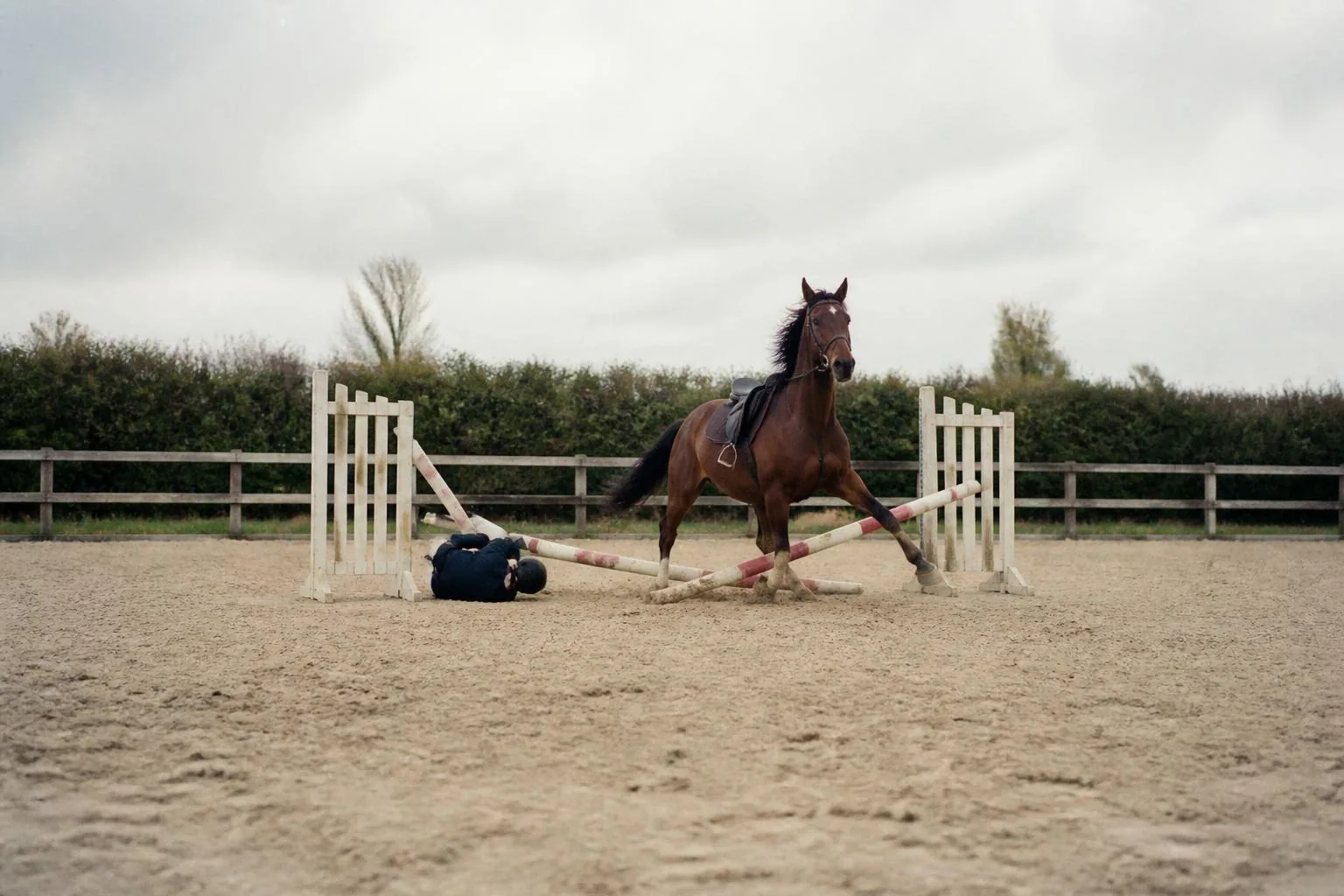
Everything stopped one day in 1990, at a show jumping competition in Mesquer, a village on the Guérande peninsula, a few kilometres from La Baule. Guillaume Canet had just finished second in one class. In the next, he made a rider’s mistake, which he has described with precision: “I asked the horse for an impossible stride, he took off a stride too early, and couldn’t get over the fence, so he pecked at it, I fell and he trampled me.”
The injuries he lists are those typical of a rider pinned under his horse: fractured wrist, “shattered into fragments”, dislocated shoulder, broken ribs, broken foot, and puncture wounds to his back from the studs, those steel points screwed into the shoes for grip in wet going. “It was quite a violent fall. I took stud wounds on my hand, down my back. I broke the whole right side of me.” He was 17. He has given this account on camera in an INA archive programme, and repeated it in several interviews since.
A year in plaster on horseback, then cinema over riding
What is striking is that he didn’t stop immediately. Guillaume Canet has said he continued to ride for a year “in plaster”. Then he decided to stop, not only because of fear, but because the fall had made him want something else: “I wanted to know a different life from this.” He left horses behind, enrolled at the Cours Florent drama school, and moved to Paris. The rest is well known: Dawn Breaks, La Plage, Tell No One, Little Gossips.
A fall from a horse in competition is not rare, and most riders carry some mark from it. What sets the Canet case apart is the timing: the fall happens at the very age when you either commit to the top level or you don’t. For a 17-year-old rider, the question is brutal. And his answer matters, because it is neither an admission of fear nor a grievance against horses: he simply chose a different life.
Jappeloup: the film that put Guillaume Canet back in the saddle, with Frédéric Cottier
Twenty years pass. Guillaume Canet has become an actor and director, and he is pursuing a project: to tell the story of Pierre Durand and Jappeloup, the small French saddle horse of 5 foot 2 inches (1.58 metres) who refused a jump at the Los Angeles Games in 1984, unseated his rider, then won Olympic gold at Seoul in 1988. Canet co-writes the screenplay and plays Pierre Durand in the film by Christian Duguay, released in March 2013.
To ride himself on screen, he returned seriously to riding with Frédéric Cottier, a former French national show jumping team rider. Finding the right horses took eight months: Jappeloup had eight doubles, validated by Pierre Durand himself with his friend Patrick Caron, including Sympatico, a very small horse that closely resembled the real Jappeloup but was already 22 years old, and Incello, taller and younger, who jumped the big fences in the Games sequences. Canet said his main difficulty was adapting to each horse: “it’s not easy to change horses once you’ve found your rhythm with another one”.
The true story behind the film is even richer: in 1986, at the World Championships in Aachen, a Canadian rider won the title riding Jappeloup in the final with rotating horses. We tell that story in Jappeloup and the 1986 World title. It was whilst training for this role that Canet, in his own words, rediscovered his taste for riding and for show jumping competition. Our entry on Pierre Durand, show jumping rider, in our wiki, adds to the portrait of the champion he played.
623 classes, 33 wins: Guillaume Canet’s return to show jumping competition
The return was no vanity project. Between 2012 and 2017, Guillaume Canet competed in 623 show jumping classes, won 33, and accumulated over 66,500 pounds (66,500 euros) in prize money, according to results compiled from national and international competitions. He rode several horses, including Pomme du Valon, Babèche, with whom he won at Chantilly, Sweet Boy d’Alpa and Wouest de Cantraie Z, at one to three-star international competitions.
His wins came at fixtures well known to riders: the Chantilly Jumping, the Paris Eiffel Jumping at the foot of the Eiffel Tower. In May 2017, he was named ambassador for the International Jumping Championships at the Palace of Versailles. The French saddle horse, Jappeloup’s breed, is French sport horse excellence: our entry on the French saddle horse explains why it dominates national show jumping.
He is not the only French celebrity to have quietly pursued horses: we have told how Kendji Girac found his true passion on horseback. What sets Canet apart is the level: he does not ride to relax, he competes in timed classes against professionals.
La Baule 2023: Guillaume Canet and James Bond du Bec, twelve and a half miles from his fall
The detail that closes the circle lies in a date and a place. In June 2023, after five years away from the ring, Guillaume Canet entered the International Jumping at La Baule, one of France’s biggest dates in the sport, at the François-André arena, riding a horse named James Bond du Bec. The programme included the CSI1* Derby at 3 feet 9 inches (1.15 metres) on Saturday, and the CSI1* Grand Prix at 3 feet 11 inches (1.20 metres) on Sunday. At the same venue, the same weekend, world number one Henrik von Eckermann and three individual Olympic champions were competing in the CSI5*.
Mesquer, where he fell in 1990, is less than twelve and a half miles (twenty kilometres) away. One-star classes are not the pinnacle of the sport, but they are international competitions with a clock, jump-offs and rankings, and a 50-year-old rider who competes in them in public accepts being judged by the same criteria as everyone else. La Baule continues every year: we covered the 2026 Jumping at La Baule and its French victory.
Guillaume Canet as a rider: what the record shows
- What he has said himself: the Mesquer fall in 1990, the “impossible stride”, the horse that “pecked” at the fence and trampled him, the wrist “shattered into fragments”, the shoulder, ribs, foot, studs in his back; a year riding in plaster; “I wanted to know a different life from this”. Account given on camera in an INA archive, repeated by the press.
- What the results show: 623 show jumping classes between 2012 and 2017, 33 wins, over 66,500 pounds (66,500 euros) in prize money; named horses (Pomme du Valon, Babèche, Sweet Boy d’Alpa, Wouest de Cantraie Z, James Bond du Bec); La Baule in June 2023, CSI1* Derby 3 foot 9 inches and CSI1* Grand Prix 3 foot 11 inches, after five years away.
- What remains unclear: his exact age at the time of the fall (17 in his account, born April 1973, fall dated 1990; some biographies say 18); the name of the 1990 horse, which he has not publicly given; the maximum height of classes he competed in, sometimes claimed at 4 foot 11 inches without precise results to back it up; his placing at La Baule in 2023, which we have not found in a reliable source.
- Sources: INA archive (“adn” programme, account of the fall); AlloCiné, behind-the-scenes of Jappeloup (Frédéric Cottier, Sympatico, Incello, eight doubles); Grand Prix, “What became of Jappeloup’s doubles?”; here / France Bleu Loire Océan, 10 June 2023 (return to La Baule, James Bond du Bec); public biography (2012-2017 results, horses, Versailles 2017).
Falls from a horse in competition: what Guillaume Canet’s injury reminds riders
The injuries he describes, wrist, shoulder, ribs, back, are typical of a rider pinned under a horse after a refusal at a jump. The helmet was already compulsory in competitions in 1990; the protective vest, mandatory in cross-country, and the equestrian airbag, increasingly common in show jumping, protect precisely the thorax and back. After a fall with impact, you do not ride again the same day without medical clearance, and a painful wrist or shoulder should be examined. Our guide to show jumping, from pony club to podium, covers equipment and progression through levels.
Guillaume Canet and horses: what matters about his fall and his return
An adolescent who wanted to be a top-level rider, a horse tramples him at 17, a year in plaster, then another life. Twenty years later, a film about Jappeloup, months of work with Frédéric Cottier, and 623 classes competed in five seasons. Finally, at 50, a return to La Baule, just down the road from the Mesquer jump, riding a horse called James Bond du Bec. Guillaume Canet has never said he was seeking revenge on 1990. He has said he rediscovered his taste for it. Perhaps that is the best description of what a horse does to those who left it too soon.