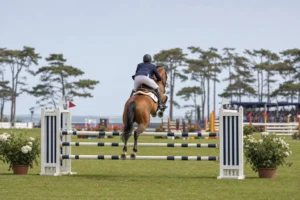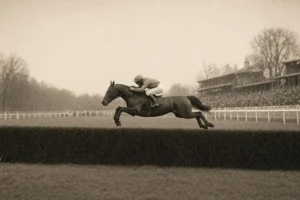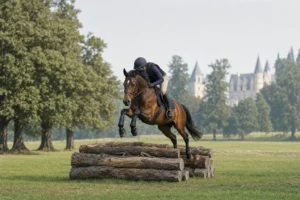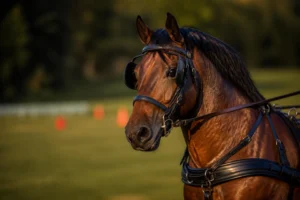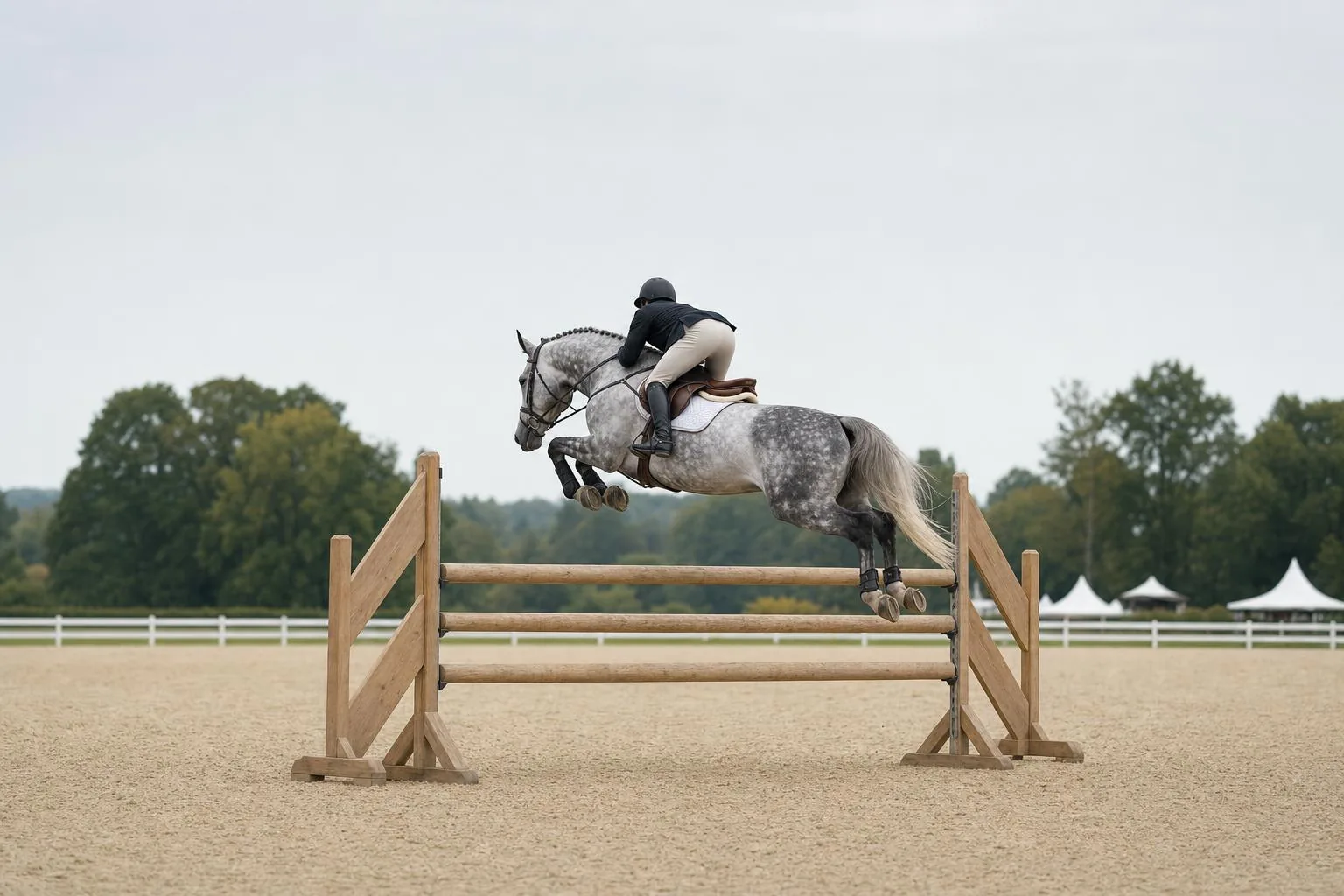

From Wednesday 16 to Sunday 20 September 2026, the Zangersheide estate in Lanaken, Belgium, will host the 31st World Young Horse Jumping Championship, organised under the auspices of the FEI and the World Breeding Federation for Sport Horses. Three titles will be contested on Sunday, for five, six and seven-year-olds. This year the rulebook has changed: the fences for five and six-year-olds have been lowered by 5 centimetres (2 inches), every horse must have ridden three clear rounds to earn its entry ticket, and the five-year-old final will no longer be ridden against the clock. Admission is free.
At Fontainebleau in late August, French four-year-olds on the jumping circuit were not timed, as we reported in our article on the four-year-old jumping final. Lanaken is the next step, and the highest: here these are not national finals, but the only competition in the world where stud books measure themselves against one another, horse against horse, on the same course and under identical conditions.
World Young Horse Jumping Championship at Lanaken: dates, schedule and free entry
The championship is held every year since 1995 on the same site, the Zangersheide estate, a few kilometres from Maastricht. The organiser has announced the 2026 edition runs 16 to 20 September, with the FEI dating the actual championship 17 to 20, Wednesday being largely occupied by the first round of the Belgian Young Horse Championship. The three world finals take place on Sunday 20 September: five-year-olds at 08:30, six-year-olds at 12:15, seven-year-olds at 15:15, with qualifying competitions on the preceding days for each age group.
The number of horses entered in 2026 has not been published clearly on the organiser’s website at the time of writing. Previous editions set the scale: in 2022, 242 five-year-olds, 276 six-year-olds and 190 seven-year-olds started in the qualifying rounds, more than 700 young horses over a week. To understand how the scales of these competitions are read, penalty points, time allowed and jump-offs, our guide to show jumping and our factsheet on show jumping penalty scales detail the rules.
Why the five-year-old final lost its stopwatch in 2026
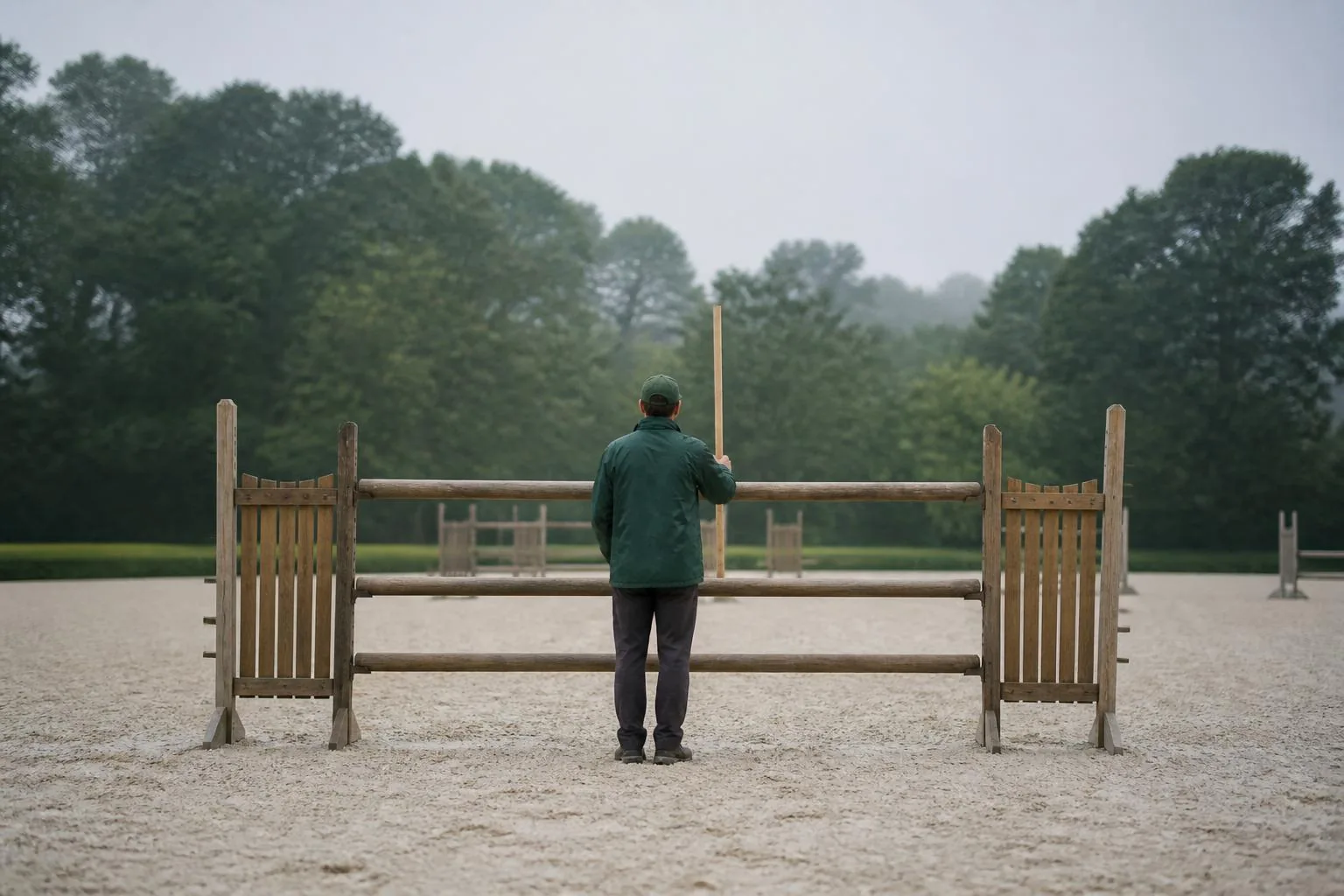
This is the most debated change of this edition. Until 2025, the five-year-old final was contested at 4 ft 3 in (1.30 m) and decided by a timed jump-off: last year, Michael Pender won it on HHS Private Ryan in 38.23 seconds, more than a second ahead of Dutchman Doron Kuipers, before a field of 49 finalists. For 2026, the FEI and World Breeding Federation for Sport Horses have reviewed the format, in an update announced in May 2026: the five-year-old qualifying rounds are contested at 3 ft 11 in (1.20 m) and the final at 4 ft 1 in (1.25 m), and this final is now judged by the time allowed scale, without a timed jump-off. The decision followed criticism from the 2025 final, where many felt that five-year-olds should not be ridden against the stopwatch. For six-year-olds, qualifiers move to 4 ft 3 in (1.30 m) and the final to 4 ft 5 in (1.35 m). The seven-year-old format remains unchanged.
The stated reasoning boils down to three words: preparation, welfare, progression. The governing bodies explain they want requirements suited to the horse’s age, to reduce the pressure of the stopwatch on five-year-olds, and to reward correct, educational horsemanship rather than a race against seconds. In other words, exactly what the French Fontainebleau finals have long practised for four-year-olds. The difference is that Lanaken applies this to a world championship, where a title determines the value of a horse, its sire and its stud.
Three clears required: the new entry ticket for young jumping horses
The other novelty of 2026 is an entry filter. Each horse must have ridden three clear rounds in the season in classic competitions of its age category: at a minimum of 3 ft 9 in (1.15 m) for a five-year-old, 4 ft 1 in (1.25 m) for a six-year-old, 4 ft 5 in (1.35 m) for a seven-year-old. These minimum eligibility criteria did not previously exist in this form; selection was based on quotas assigned to stud books and national federations and their own selection regulations.
What three clear rounds say about a five-year-old
Three clear rounds at 3 ft 9 in (1.15 m) do not prove a five-year-old is a champion. They prove it has been out several times, that it jumps honestly, that it has stayed sound all season, and that it has been ridden by someone who did not rush its training. It is a filter for consistency, not brilliance, and that is precisely the point: a young horse that arrives at Lanaken without this foundation has more to lose than to gain on a championship course. For a breeder, following this season of outings, with dates, heights and clear rounds, is also the raw material for a sales dossier; our horse record book is designed to keep this journal, care and performance included.
The selection regulations of the SHF for Selle Français
In France, the Société Hippique Française publishes its selection regulations for Lanaken each year, across the three age groups, based on the young horse circuit we describe in our presentation of the Société Hippique Française. The nominated list of Selle Français selected for 2026 was not accessible on the SHF website at the time of writing; the order of magnitude from previous years is known, with for example 48 Selle Français in 2018, fifteen among the five-year-olds, eighteen among the six-year-olds, fifteen among the seven-year-olds.
Selle Français against KWPN and Zangersheide: what the world championship reveals about breeding
The recent honours roll reads like a map of European breeding. In 2025, all three titles went to two stud books: the Dutch KWPN among the five-year-olds with HHS Private Ryan, and among the six-year-olds with mare Ortane, ridden by Dutchman Max van de Poll, the only one to sign a double clear in the final, in 42.26 seconds; and the Zangersheide stud book, that of the organiser, among the seven-year-olds with Augustus Z, ridden by Irishman Eoin Brennan, bred and owned by his own father, winning the jump-off in 35.20 seconds. In 2024, the titles went to Orange de Baugy (KWPN) among the five-year-olds, Sascinora NRW (Westphalian) among the six-year-olds and HHS Mercedes (Irish Sport Horse) among the seven-year-olds. In 2023, to HHS Ocala (Irish Sport Horse), Cascajall (Westphalian) and Kumina Della Caccia (Italian register).
No Selle Français in the honours from the last three editions. French horses have their place there, and not merely in numbers: in 2018, Canabis d’Albain, son of Baloubet du Rouet, won the reserve championship among the six-year-olds, and Bayla de la Roque was second in the small final of the seven-year-olds. But a world title is another matter. And the paradox, often noted by the specialist press, is that the best Selle Français at Lanaken are frequently ridden by foreign riders: in 2022, Flagship de Hus finished fourth in the seven-year-old final under Belgian Grégory Wathelet, while French riders that year had not signed a single clear in the final. The sport horse breeds present, and their differences in type, are described in our overview of horse breeds.
Michael Pender: three world titles in three years with young Irish horses
One name stands out in this honours roll: Michael Pender. The Irish rider won the five-year-old title in 2023 on HHS Ocala, the seven-year-old title in 2024 on HHS Mercedes, then again the five-year-old title in 2025 on HHS Private Ryan, all three under the same stud, whose HHS prefix signs each name. Three world titles in three consecutive editions, on three different horses: it demonstrates that in this discipline, the training of young horses is a specialism in its own right, with its own riders, yards and methods. The question for 2026 is simple: does the new format, without a timed jump-off for five-year-olds, favour or disadvantage this type of specialist rider?
Sires of the World, foal and stallion auctions: Lanaken, the sport horse market in five days
The championship is only half the week. On Friday 18 September at 16:00, the estate hosts the Sires of the World, a Grand Prix at 4 ft 11 in (1.50 m) reserved for stallions, preceded by an opening class at 4 ft 7 in (1.40 m) on Thursday. Thursday evening, the Zangersheide Quality Auction offers three-year-olds and seven embryos for sale. Friday and Saturday, 86 foals are offered for sale, including 17 from mares that have competed at 5 ft 2 in (1.60 m) and higher. From Thursday to Saturday, the Zangersheide stud book holds its stallion selection.
This concentration is no coincidence: a world title at five, six or seven years old is the best sales argument a young horse can carry, and buyers are on site. We saw what this market is worth in August, when a six-year-old was sold for 1.1 million euros at Deauville, and what becomes of the best of these horses ten years later, in our article on the Rolex Grand Slam at Calgary. The peaks of this pyramid, the most expensive horses in the world, have almost all started with a young horse final.
The same weekend, on the French side, young event horses compete for their finals at the Pompadour Grand Week for Young Event Horses, and all the week’s competitions are kept up to date in our equestrian competition calendar.
How we judged this world championship of young horses
The dates (16, 20 September 2026), the edition number (31st), the times of the three Sunday finals, the supporting programme (Sires of the World, auctions, stallion selection, Belgian Championship) and free admission come from the organiser’s presentation and the So Horse article of 15 September 2026. The new 2026 heights (3 ft 11 in and 4 ft 1 in for five-year-olds, 4 ft 3 in and 4 ft 5 in for six-year-olds, seven-year-olds unchanged) and eligibility criteria (three clears at 3 ft 9 in, 4 ft 1 in and 4 ft 5 in) come from the official World Breeding Federation for Sport Horses page and the regulation update announced by the FEI and WBFSH in May 2026, which also specifies the move of the five-year-old final to time allowed scoring, a change subsequently relayed by national breeding federations to their breeders. The honours from 2023, 2024 and 2025, the jump-off times and the figure of 49 finalists among the five-year-olds in 2025 come from the World Breeding Federation for Sport Horses, World of Showjumping and the Irish press. Participation figures (2018, 2022) come from the SHF and GrandPrix. What we could not establish: the number of horses and nations entered in 2026, the list of Selle Français selected by the SHF for 2026, and the details of the seven-year-old regulations, announced as unchanged. The FEI dates the championship 17, 20 September while the organiser opens the site from 16: we have noted both.
Lanaken World Young Horse Championship: what you need to know
- 16 to 20 September 2026 at Zangersheide, Lanaken (Belgium), 31st edition, free admission; three finals Sunday 20 September at 08:30 (five-year-olds), 12:15 (six-year-olds) and 15:15 (seven-year-olds).
- New 2026 regulations: qualifying at 3 ft 11 in (1.20 m) and final at 4 ft 1 in (1.25 m) for five-year-olds, 4 ft 3 in (1.30 m) and 4 ft 5 in (1.35 m) for six-year-olds, seven-year-olds unchanged; three clears required in the season to be eligible.
- The five-year-old final moves to time allowed scoring, without a timed jump-off, in the name of horse welfare and young horse training.
- In 2025, titles went to HHS Private Ryan (KWPN), Ortane (KWPN) and Augustus Z (Zangersheide); Michael Pender has three world titles in three years; no Selle Français in the honours from the last three editions.
- Around the championship: Sires of the World at 4 ft 11 in (1.50 m) Friday, auctions of three-year-olds, embryos and 86 foals, Zangersheide stallion selection.