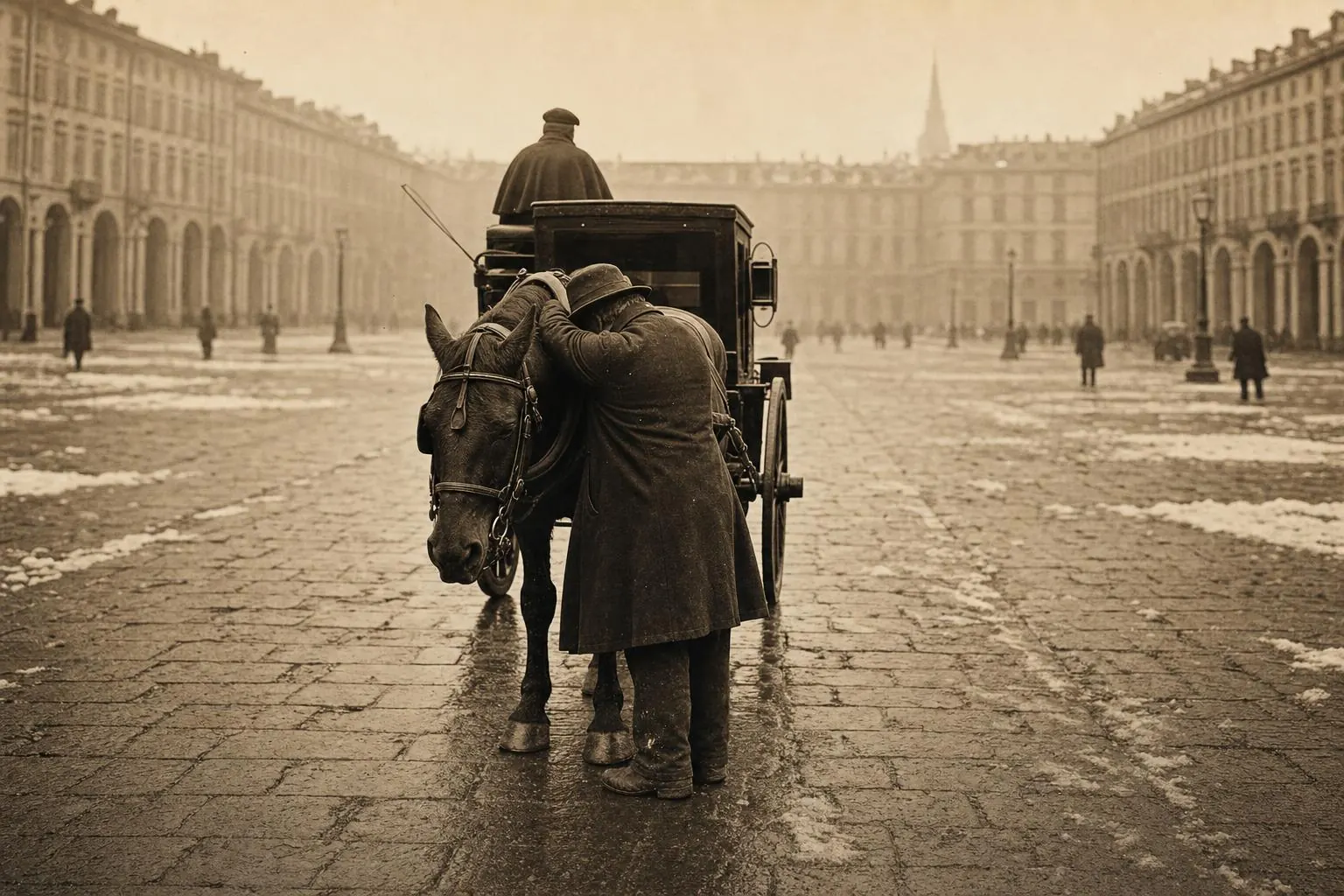

On 3 January 1889, in Turin, Friedrich Nietzsche supposedly witnessed a cabman beating his cab horse on the Piazza Carlo Alberto, threw his arms around the animal whilst sobbing, then collapsed. In the days that followed, he sent notes signed “Dionysus” or “the Crucified” to his friends; on 8 January, Franz Overbeck came to collect him; he would publish nothing more and died eleven years later, on 25 August 1900, in Weimar. All of this is true, except perhaps the horse: the scene is not told for the first time until September 1900, by an anonymous journalist, eleven years after the fact and one month after the philosopher’s death. Here is what is attested, what is not, and why the horse of Turin holds nonetheless.
The man who had written against pity collapses into the arms of a beaten horse: the image has nourished novels, a film, paintings. It rests on a single source, late and at third hand. We tell it here with its gaps.
Turin, autumn 1888: Nietzsche within sight of the cab horses on Piazza Carlo Alberto
Nietzsche discovered Turin in spring 1888. He arrived on 5 April, left for the Engadin in June, and returned on 21 September for what he believed would be a permanent stay. In a letter to his friend Heinrich Köselitz (Peter Gast) in April, he called the city a “capital discovery”. He rented a third-floor room at No. 6, Via Carlo Alberto, from Davide Fino, a newspaper vendor, at the corner of the piazza of the same name. From his window, he could see the arcades, the Palazzo Carignano, and the cab rank where the hire horses waited.
This Turin autumn proved the most productive of his life: he completed Twilight of the Idols, The Antichrist, Nietzsche contra Wagner, and wrote Ecce Homo in a matter of weeks. His letters speak of an euphoria that was already troubling his correspondents. He was 44 years old, almost blind, prone to migraines, alone, and believed himself at the summit of his powers.
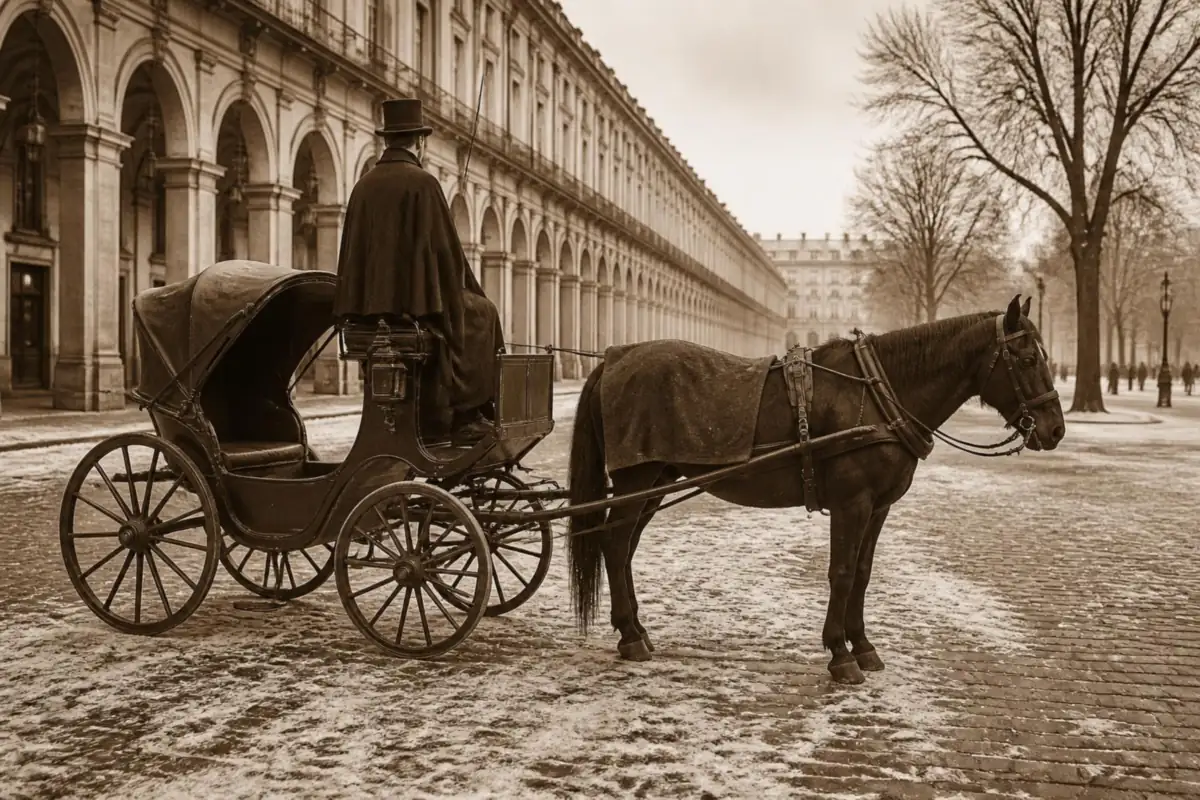
In video: 97 seconds
The Horse of Turin: Turin, 3 January 1889
A cabman strikes, a philosopher weeps at the neck of a cab horse, then eleven years of silence: the scene of 3 January 1889 is told only in 1900.

3 January 1889: the scene of the beaten cab horse, as it is told
On the morning of 3 January 1889, Nietzsche left his lodgings. On the Piazza Carlo Alberto, or at its edge, a cabman was laying into a cab horse with his whip, the animal refusing to move. The philosopher ran across the square, threw his arms round the horse to shield it from the blows, burst into tears, and collapsed. Passersby, or two municipal guards depending on which version you hear, picked him up and carried him back to Fino’s place. From that day on, Nietzsche was no longer the same man.
The scene had all the makings of something unforgettable: the author of The Antichrist, completed just weeks earlier in that same room, had written therein that pity was the most dangerous of weaknesses. And his reason would be extinguished in a gesture of pure compassion, for a horse. A cab horse at that time was often a worn-out animal, bought secondhand, working until exhausted in the cold, like those encountered in the history of the working horse in nineteenth-century cities.
What remains unknown about the horse of Turin: a single source, eleven years on
The problem is straightforward: no direct witness told this story in 1889. Neither Davide Fino in what he said to those close to Nietzsche, nor Franz Overbeck, who arrived five days later and wrote at length to Peter Gast about his friend’s condition, nor Nietzsche’s own notes mention a horse. The first printed account appeared in the Italian journal Nuova Antologia on 16 September 1900, one month after the philosopher’s death: an anonymous journalist reported what Fino supposedly said, who claimed to have heard it from a police officer. Three intermediaries, eleven years of distance, not a single name.
It was the Turin philosopher Anacleto Verrecchia who, in La catastrofe di Nietzsche a Torino (1978), traced this chain of transmission and showed that the direct sources from January 1889 do not agree with each other on how the collapse occurred. The biographer Curt Paul Janz also reports divergent versions: in some, Nietzsche is brought home by two guards after creating a disturbance in the street, with no mention of a horse. The cabman striking, the horse refusing, the tears: these details seem to have been added through successive retellings.
As with the legend of the mining horse blinded at the bottom of the shaft, a striking image has replaced the facts. But absence of proof is not proof of absence: no one has established that the scene did not happen; we know only that no one who saw it told the story.
The madness notes: what Nietzsche himself wrote, without a word of the horse of Turin
Between 3 and 6 January 1889, Nietzsche sent to his friends and a few strangers a series of brief notes that tradition calls the Wahnzettel, the “madness notes”. To Cosima Wagner, the composer’s widow, he wrote: “Ariadne, I love you. Dionysus.” To Franz Overbeck, he announced that he was “having all antisemites shot”. To Jacob Burckhardt, his former Basel colleague, he sent on 6 January a longer letter in which he said he would have “far preferred to be professor in Basel than God”, but had not dared push his egoism so far as to renounce, for that reason, creating the world. Most are signed “Dionysus”; a few “the Crucified”.
These notes are dated, preserved, published in the critical edition of his correspondence. They prove that at the very beginning of January 1889, something broke. They say nothing of the horse, the square, or the cabman.
Franz Overbeck in Turin on 8 January 1889: the philosopher taken back to Basel, his horse not
The letter to Burckhardt triggers the rescue. The old historian brings it to Franz Overbeck, professor of theology at Basel and Nietzsche’s most loyal friend. Overbeck leaves at once and arrives in Turin on 8 January. He finds his friend in his room at Fino’s, sometimes prostrate, sometimes exalted, singing and playing the piano. The account he gives to Peter Gast is the only direct testimony of those days, and it speaks only of the apartment, not the street.
With the help of a German dentist living in Turin, Overbeck persuades Nietzsche to take the train on 9 January. By the 10th, they are in Basel, at the Friedmatt psychiatric clinic, directed by Professor Ludwig Wille. A week later, his mother Franziska comes to fetch him and takes him to the university clinic in Jena, with Otto Binswanger. The diagnosis made then, general paresis, remains disputed by doctors.
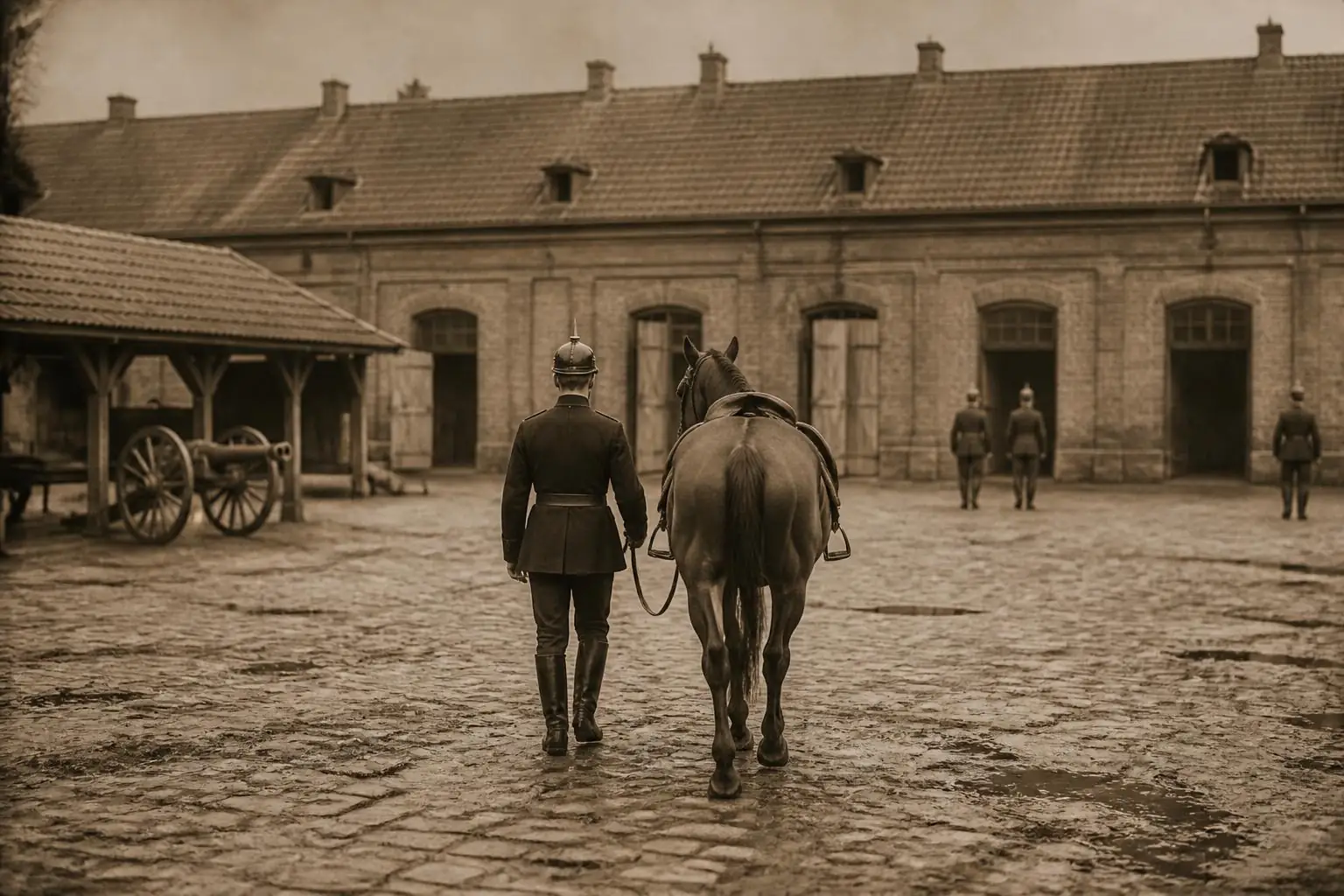
Nietzsche the rider: the injury of March 1868, the saddle pommel and months unable to walk
The horse of Turin is not the first horse in Nietzsche’s life. In October 1867, aged 23, he enlisted for one year of voluntary service in the mounted artillery of Naumburg. He learned to ride, until a quite ordinary riding accident. In March 1868, mounting his horse, he struck his chest violently against the pommel and tore two muscles on his left side. The wound became infected, he remained bedridden for weeks, unable to walk for months, and was eventually invalided out. He returned to his studies and obtained, the following year, his chair in philology at Basel, at just 24 years old.
This detail matters: Nietzsche knew what a horse was, what the weight of a neck felt like, what an animal in labour was worth. Philosophers have often encountered the horse at the wrong moment: Montaigne was thought dead for two hours after a fall from his horse, and drew from it one of his finest chapters. Nietzsche, meanwhile, wrote nothing more after his own.
Eleven years of silence: from the Basel clinic to Weimar, far from the horse of Turin
After Jena, Nietzsche is placed in his mother’s care, who takes him back to Naumburg in 1890. He no longer recognises his own books, whose success is beginning nonetheless. When Franziska dies in 1897, his sister Elisabeth Förster-Nietzsche installs him in Weimar, in the Villa Silberblick, where she organises a cult around him that visitors describe with unease. He dies there on 25 August 1900, aged 55, of pneumonia followed by a stroke. Three weeks later, the first account of the horse appears in print. Eleven years without a line: that is the true measure of January 1889. Whether the horse existed or not, the rupture is documented day by day, by his letters and then by their absence.
Béla Tarr’s Horse of Turin: when cinema returns to the horse, not the philosopher
In 2011, Hungarian director Béla Tarr, with Ágnes Hranitzky, opens his last film, The Horse of Turin, with a voiceover recounting the scene of 3 January 1889, then observing that we know nothing of what became of the horse. The film, in black and white, never shows Nietzsche: it follows for six days a cabman, his daughter and their horse that refuses to eat, on a wind-swept farm. Silver Bear, Grand Jury Prize, Berlin Film Festival 2011.
Tarr does what legend had never done: he takes the horse seriously, as a being who has a life after the square. The horse of Turin touches us because we know what a beaten horse costs, to itself and to whoever witnesses it. What we know today about the care and welfare of the working horse is nothing like a fable: a harnessed animal that refuses to move is almost always an animal in pain, cold, or afraid.
The horse of Turin: what we can judge
Attested by dated documents: Nietzsche’s stay in Turin (April-June then September 1888 to January 1889); the room at No. 6, Via Carlo Alberto, at Davide Fino’s; the notes signed “Dionysus” and “the Crucified” of 3-6 January 1889, including the letter to Burckhardt of 6 January; Overbeck’s arrival on 8 January and return to Basel on 9-10; the Basel clinic then that of Jena; Naumburg in 1890, Weimar in 1897; death on 25 August 1900; the mounted artillery accident of March 1868.
Not attested: the scene of the cab horse itself. First printed mention on 16 September 1900 (Nuova Antologia, anonymous author, reporting Fino who reported a policeman). No direct witness, no name of the cabman, no trace in Nietzsche’s letters nor in Overbeck’s. The exact date of 3 January is that of tradition, consistent with the date of the first notes, but not that of an official report.
What this changes: nothing about the collapse, which is certain; everything about the image.
Why the legend of the horse of Turin endures nonetheless
A thirdhand story, written eleven years after the event, ought to fade. This one does the opposite. It endures because it condenses into a single gesture what Nietzsche spent fifteen years writing: pity as temptation, madness as the final word of a thought that never wanted to stop. It endures also because a beaten cab horse on a winter square is an image anyone understands without having read a page of philosophy. It is the same mechanism that keeps alive the late account of Genghis Khan’s fall from his horse or Rosa Bonheur’s police permit to paint the horses at market: the source is fragile, the image is true.
One fact remains that no one disputes: in early January 1889, a man who had staked everything on strength collapsed, and the only image posterity has kept of that moment is that of a horse being struck and an arm protecting it. We have no proof. We have the choice that generations have made to believe it, and that choice says something about the horse as much as about the philosopher.
Nietzsche and the horse of Turin: what to remember
Nietzsche’s collapse in Turin, early January 1889, is one of the best-documented episodes of his life: notes from 3 to 6 January, Overbeck’s arrival on the 8th, Basel clinic on the 10th, Jena the following week, eleven years of silence until 25 August 1900. The beaten cab horse on Piazza Carlo Alberto appears only in September 1900, under an anonymous pen and at third hand; Anacleto Verrecchia established this in 1978. The scene is a legend in the proper sense: what one reads and repeats, not what one has seen. Yet it produced a major film and an image that nothing erases, because it speaks true about what a mistreated horse does to whoever witnesses it. Nietzsche, former artillery rider wounded by a saddle pommel in 1868, knew this better than most of his readers.