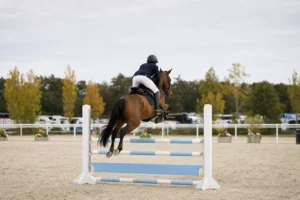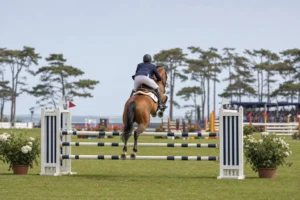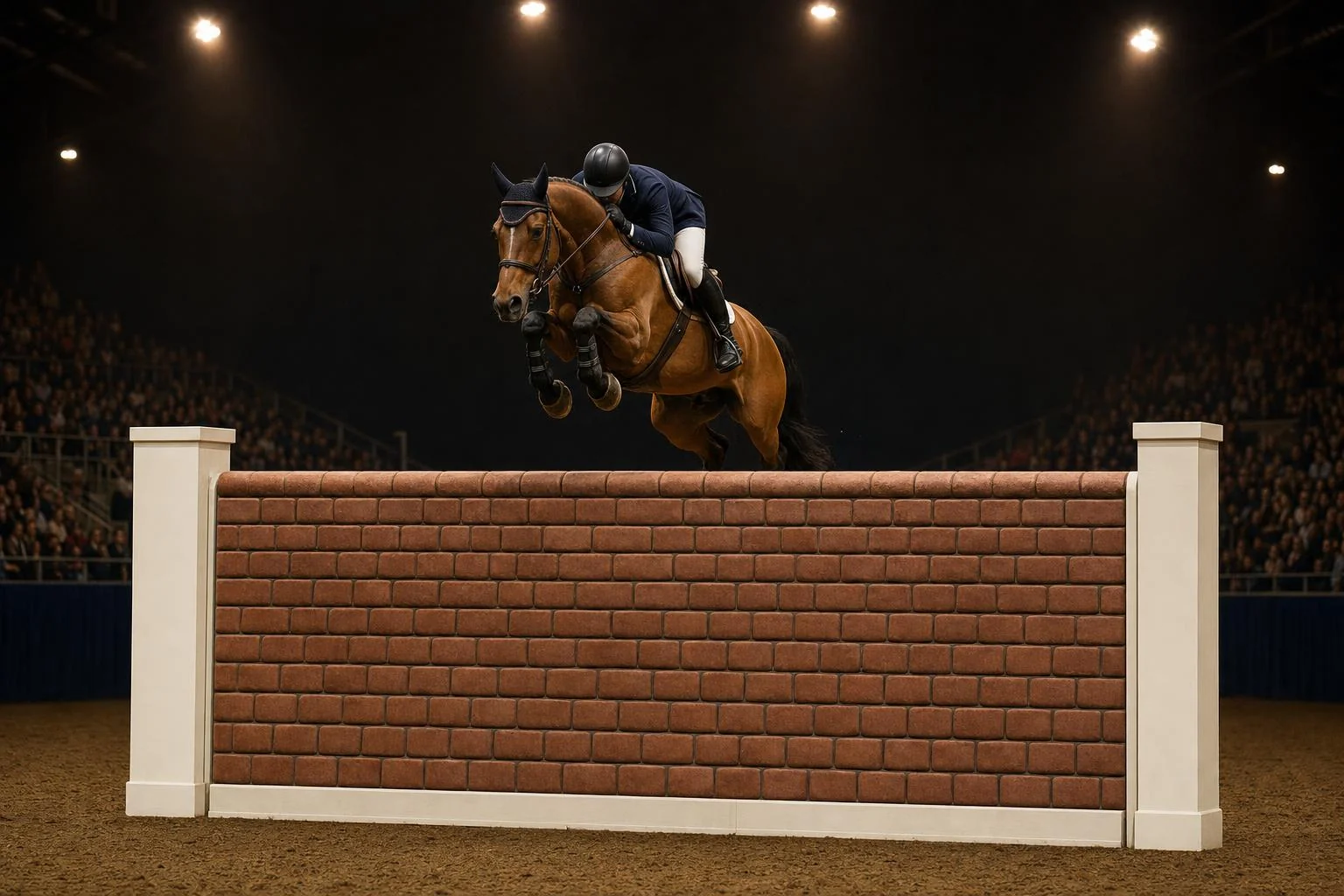

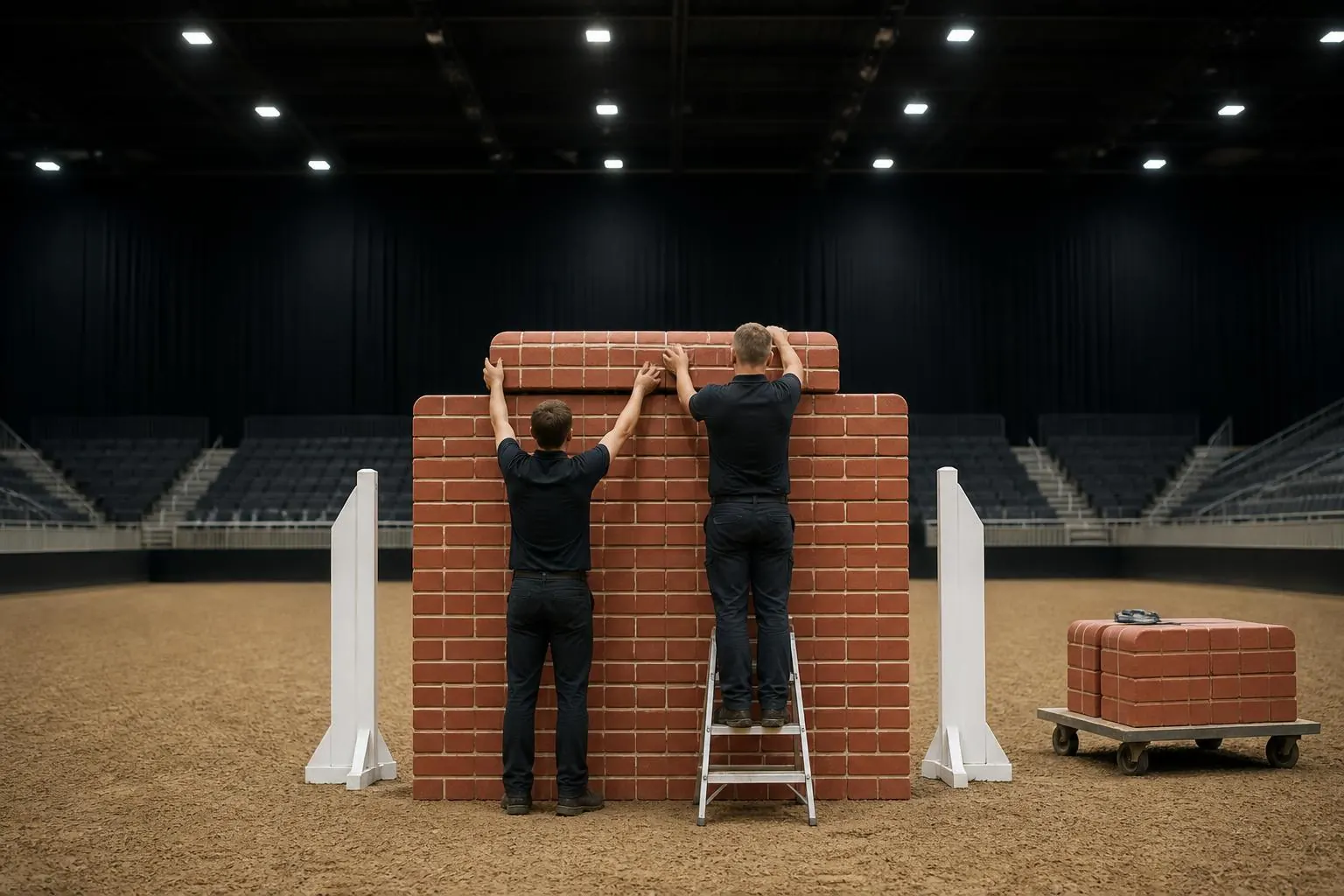
On Saturday 10 October, at around 9.10pm, an indoor arena in the English Midlands will fall quiet around a single fence: a wall of red blocks, with no pole and no spread, standing in the middle of the ring. The horses will jump one by one. Between rounds, two arena party members will add another row of blocks to the top. They will keep going for as long as at least one pair can clear it. This is the puissance at the Horse of the Year Show, and it is decided without a stopwatch, without a time allowed, and without any measure other than height.
Horse of the Year Show 2026: the puissance is scheduled for Saturday 10 October at 9.10pm
The Horse of the Year Show runs from Wednesday 7 to Sunday 11 October 2026 at the National Exhibition Centre in Birmingham, England. The organiser’s published programme places the puissance on Saturday 10 October at 9.10pm in the main international arena, as the final class of the evening, with a finish expected at around 10.40pm.
The rest of the weekend is cut from the same cloth. On Sunday 11 October, the evening session leads into the Supreme Horse of the Year championship at 6.25pm, the Supreme Pony of the Year at 6.40pm, and then the show’s leading show jumping rider title at 7.25pm. Five days, two rings running in parallel from 7am until late, and a season finale that the British treat as a national final.
For a French rider, the comparison of heights is the most telling part. In our Amateur divisions, the scale runs from 0.95 m to 1.25 m (about 3 ft 1 in to 4 ft 1 in) depending on the level, as set out on our page on the levels and heights of the Amateur division. The puissance wall generally starts roughly where Grand Prix classes leave off, and from there it only goes up.
On video · 115 seconds
The puissance: on Saturday night, the big wall returns to Birmingham
The horses jump one by one, two arena party members add a row between each round, and the class carries on for as long as one pair is still clearing it. The puissance is judged without a stopwatch and without a time allowed: height is the only measure. Here is how it unfolds, why a solid wall can be jumped higher than an oxer, and why the high jump record on horseback has not moved since 1949.

How a puissance class works: five rounds, one wall, no stopwatch
The puissance is a show jumping class apart. The first round is jumped over four to six single fences, all of them already substantial. The clear rounds are then called back for a jump-off reduced to two fences, usually an oxer and the wall. The fences go up, and the process repeats.
The format set by international rules caps the class at five rounds in total: the opening round and four jump-offs, all jumped without a clock. Nobody is ever separated on speed. When several pairs remain clear after the last permitted jump-off, they share the victory, and the result sheet carries two names, sometimes three.
That small point of regulation changes how the evening reads. A rider may decide to stop there, on a clear round, rather than send a horse at a height that feels out of reach. That is not giving up: it is a management decision, and the British crowd applauds it as such.
The rest of the vocabulary is that of the sport itself, which you will find in our guide to show jumping competition: approach, take-off stride, jump-off, fault. What disappears is the idea of a course. There is no track to negotiate, no turn to ride, no time allowed. What remains is one horse, a straight line and a height.
Why the puissance wall lets a horse go higher than an oxer
A puissance wall is not really a wall. It is made of hollow, lightweight blocks in moulded material, stacked without any binding and held in cups. They fall at the first firm contact, and that is the point: the fence is meant to come apart, not to resist. From the ring, though, it presents a solid mass with no gaps, which the horse reads from a distance as one continuous surface.
That is precisely what makes such heights possible. A solid upright is easier to jump than an oxer of the same height, because there is no spread to cover at the same time. The horse can gather itself underneath, take off short and put all its energy into the vertical rather than lengthening its trajectory. The solid silhouette also helps it judge the height, where a lone pole floating in the air is harder to read.
The movement itself is the one described in the five phases of the jump, simply pushed to the extreme: a very collected approach, a take-off placed close to the foot of the wall, forelegs folded up high and tight, a pronounced rounding of the back and neck, and then a landing that comes from far higher than usual. The delicate point of the puissance is never the climb, it is the descent.
7 ft 2 in at Birmingham, 7 ft 10 in indoors: the puissance records
The heights reached at Birmingham in recent years give a sense of scale. In 2017, the class was won at 7 ft 0 in (2.14 m). In 2018, only two pairs cleared 7 ft 1 in (2.16 m). In 2019, Guy Williams and Robert Whitaker were left alone at 7 ft 2 in, a height that British reports round to 7 ft 2½ in (2.20 m), and shared the win. This is a fence that stands about sixteen inches (40 cm) above the head of a man standing beside it.
Above that sits the absolute indoor record for the class: 7 ft 10½ in (2.40 m), cleared by Germany’s Franke Sloothaak on Optiebeurs Golo in June 1991, in Belgium. It has not been beaten in thirty-five years. None of the major annual puissance classes comes close, and that stagnation says something about the sport: beyond a certain height, the number of horses able to see off four jump-offs in a row shrinks to almost nothing.
The horses that do this are not Grand Prix horses retrained for the evening. They are often specialists, brought out a few times a year for this format and nothing else, with long careers. It is a world away from the classic progression of young horses, the kind you can follow in the four-year-olds in the final at Fontainebleau.
Huaso, 8 ft 1 in in 1949: the horseback high jump record has stood for 77 years
The world record for the high jump on horseback is higher still, and far older. On 5 February 1949, in Viña del Mar, Chile, Captain Alberto Larraguibel Morales cleared 8 ft 1 in (2.47 m) on a horse named Huaso. The performance was ratified, and nobody has come near it since. It is now seventy-seven years old.
There is also an Olympic precedent, and half of it is French. At the Paris Games, on 2 June 1900, the high jump on horseback appeared on the programme for the only time in Olympic history. Nineteen competitors from five nations took part. The title was shared at 6 ft 0¾ in (1.85 m) between Italy’s Gian Giorgio Trissino, on Oreste, and France’s Dominique Gardères, on Canéla. The same Games also included a long jump on horseback, won at 20 ft (6.10 m).
Put side by side, these figures tell a simple story. The height that won an Olympic gold medal in 1900 is now lower than the opening height of a puissance jump-off. And the 1949 record still stands, because the sport has stopped looking in that direction.
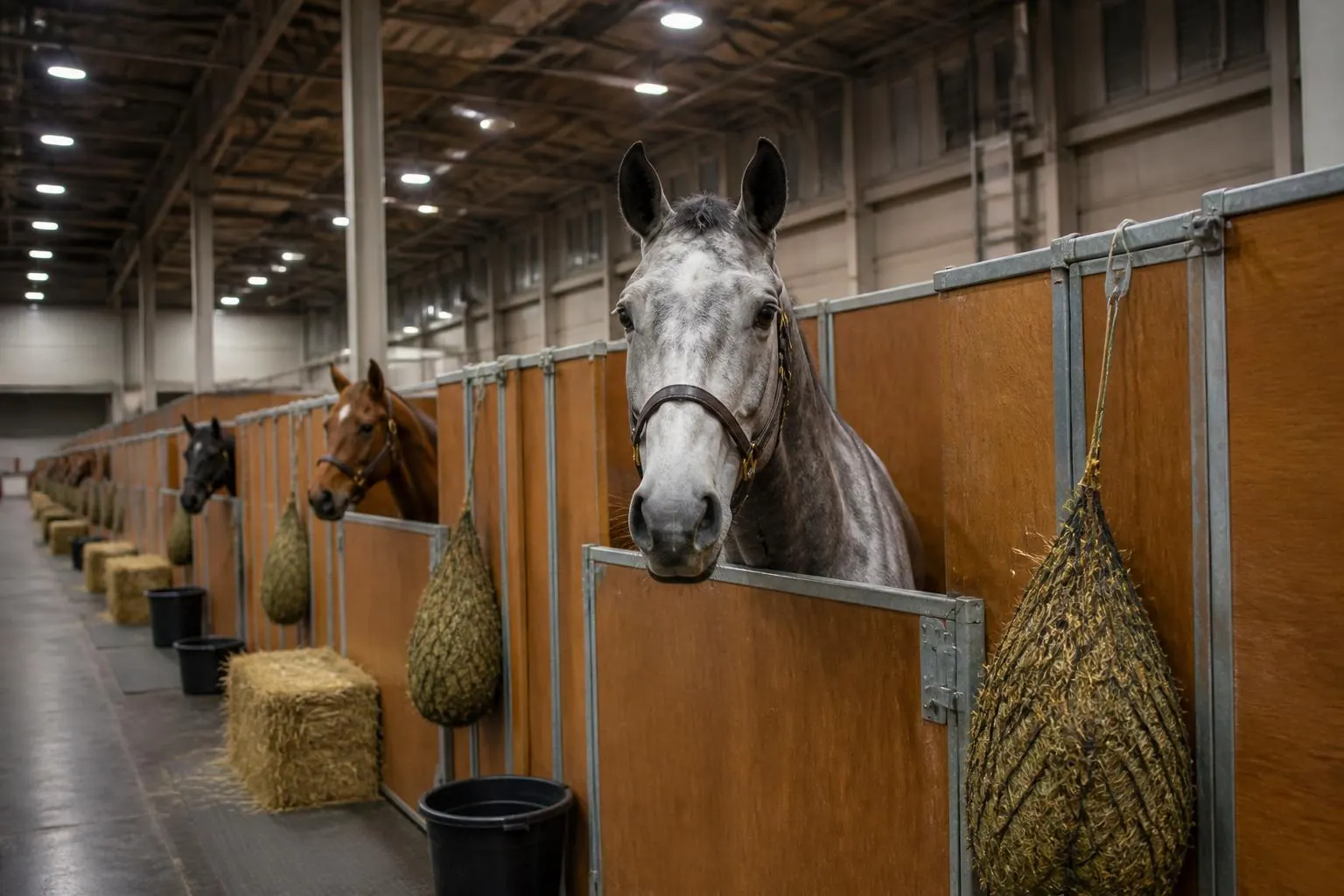
Horse of the Year Show: how 1,600 horses fit into an exhibition centre
The Horse of the Year Show was not born in Birmingham. It was created in 1949 at Harringay Arena in London as an indoor close to the British equestrian season, a fresh idea at the time. Ten years later it moved to Wembley, where it settled for four decades, before joining the National Exhibition Centre in 2002.
The venue is not an equestrian stadium but an exhibition centre, which calls for trade-fair logistics: demountable stables put up by the hundred, protected flooring, forage and bedding delivered in bulk, and rings built on a concrete slab. The British magazine Horse and Hound cites around 1,600 horses housed across some fifty acres and close to 60,000 spectators over the five days.
Above all, you cannot simply enter. The show works as a champion of champions: you have to earn your qualification during the season, at one of the regional and county shows that serve as gateways, around a hundred in all. For many British riders, an entire year comes down to a single phrase: qualified or not qualified.
The Supreme Horse of the Year championship at Birmingham is not won by jumping
On Sunday evening, the most coveted title at the show has nothing to do with a fence. The Supreme Horse of the Year championship belongs to showing, that family of British classes in which a horse is judged on its conformation, paces, turnout and manners, ridden or in hand. The judge does not count poles: they look at a horse.
France has a version of this with the conformation and movement classes of the stud books, but without the status of a nationally televised title. The nearest cousin in our own programmes is probably the hunter, where style and consistency come before the clock.
This coexistence is the show’s signature: in the same arena, two hours apart, one crowns the most correct horse in the country and the one that jumped the highest. For a French audience used to keeping sport and breeding separate, it is the most disorienting thing about it.
What the puissance asks of the rider and what it costs the horse
The question of welfare is a fair one, and it deserves a calm answer. A horse landing from 7 ft 2 in absorbs a load on landing out of all proportion to an ordinary round. That is why the format is locked at five rounds, why the wall blocks are designed to fall without causing injury, and why the specialists are only brought out a few times a year for this kind of class.
It is also why the decision to stop belongs to the rider, who knows how fresh their horse is between jump-offs better than the crowd does. As for monitoring the back and locomotion after this kind of effort, the reflex is the same as for any jumping horse: observation, rest, and the opinion of professionals such as the vet or the equine osteopath whenever something changes in the way the horse moves.
For the rider, finally, the puissance is a reminder of something obvious about the discipline: the fall comes from higher up than anywhere else. An approved riding helmet is not negotiable, and we have shown elsewhere that the most dangerous equestrian discipline is not the one you might think.
- The height cleared, the only figure in the result, with no clock and no marks for style.
- The number of jump-offs survived without a fault, five rounds at most, opening round included.
- The quality of the canter on the approach: short, bouncing, carried, and not lengthened.
- The take-off distance: too far back and the horse can no longer climb, too close and it flattens over the fence.
- The folding of the forelegs and the rounding of the back, which decide the last few inches.
- The landing and the balance on the way down, the only real source of fatigue in the class.
- Stopping at the right moment, when the rider prefers to retire at a height they can hold.
- The horse’s freshness between jump-offs, assessed by the rider and watched by the officials.
What we still do not know about the 2026 Birmingham puissance
Three things are not known at this stage, and we will not invent them. The starting height of the wall is not published before the class: it depends on the course designer and the field entered. The list of starters has not been finalised either, and we have not confirmed the presence of any French rider in this particular class.
Lastly, the times quoted here come from the programme issued by the organiser and may change right up to the last moment. The commercial names of the classes shift from one year to the next with the sponsors, without altering the sporting rules.
- See you on Saturday 10 October at 9.10pm, in the international arena at the Birmingham show, which runs from 7 to 11 October.
- The format fits in one sentence: five rounds at most, no stopwatch, and a wall that gains a row of blocks at every jump-off.
- Recent heights at the show hover around 7 ft 0 in to 7 ft 2 in (2.14 m to 2.20 m); the indoor record has stood at 7 ft 10½ in (2.40 m) since 1991.
- The horseback high jump record, 8 ft 1 in (2.47 m), dates from 5 February 1949 and has never been beaten.
- Ties are shared: two riders can win together, and knowing when to stop is part of the craft.
Jump-offs, heights, fence ratings, approaches: if the vocabulary of show jumping still escapes you, our guide takes you through the discipline from the first round to international classes.
Sources: official programme and information pages of the Horse of the Year Show (2026 dates, class times), rules for the puissance format in show jumping, Horse and Hound reports for the heights cleared in 2017, 2018 and 2019 and for the show’s attendance figures, and historical records for the 1949 record and the 1900 Olympic event. Equirider is affiliated with neither the show’s organiser nor the British federation. Our dossier on show jumping sets out the rules of the discipline.