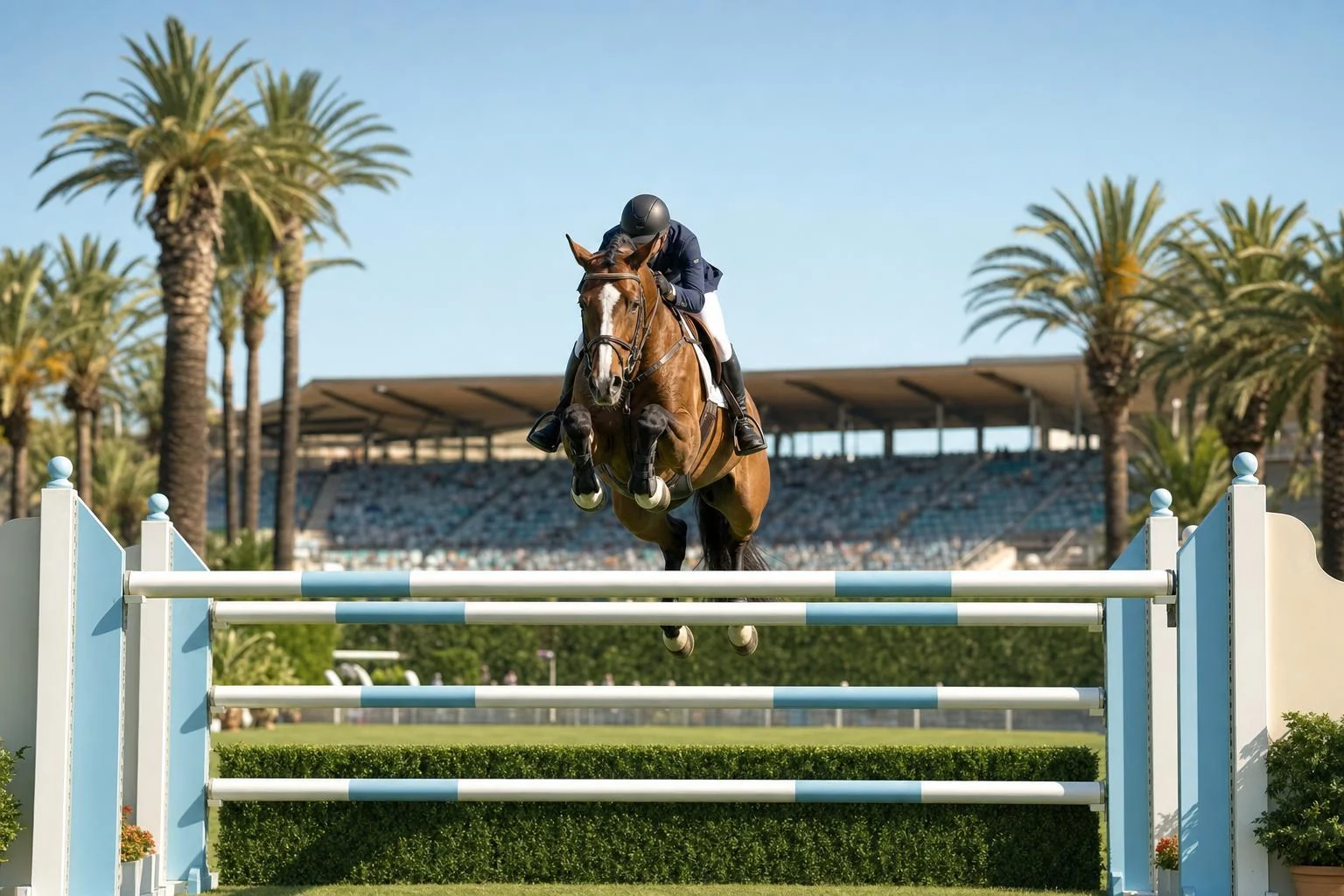

France arrive in Barcelona this Sunday, 4 October, at the top of the Longines League of Nations showjumping standings, with 290 points and two wins from four legs. For the final, those points are worth nothing: all nine teams go back to zero, and the day is decided over two rounds at 1.60m (5ft 3in), the second with no score discarded. In two editions, the League of Nations final has never been won by the French: Germany took it in 2024, Great Britain in 2025, after a jump-off, by 23 hundredths of a second. Here is what awaits Les Bleus and their horses ahead of the noon start.
League of Nations final in Barcelona: why France’s 290 points no longer count
In 2024 the Longines League of Nations replaced the old FEI Nations Cup showjumping circuit. The principle is simple: a regular season of four legs at CSIO 5* level, spread over three continents, which serves only to select the eight best teams, followed by a single final at the Real Club de Polo de Barcelona, closing the Barcelona CSIO (1 to 4 October). Whoever wins the final wins the League, whatever their ranking at the end of the season.
And yet France dominated this 2026 season. They won in Abu Dhabi in February to open the circuit, had less brilliant results in Ocala and Rotterdam, then won at Gassin on 20 September, with just four points. We told the story at the time of how France won the League of Nations at Gassin, on the last Brazilian horse. In the final season standings, Les Bleus finish first with 290 points, ahead of Germany and Great Britain (275), Brazil (270), Ireland (265), Belgium (245), the United States and Italy (230). Switzerland (225) and the Netherlands (195) have not qualified. Spain, as host nation, completes the field: nine teams at the start, all on zero.
On video · 117 seconds
League of Nations Barcelona 2026: France arrive as leaders of a final they have never won
France lead the League of Nations with 290 points, but restart from zero in Barcelona: nine teams, two rounds at 1.60m (5ft 3in), no joker in the second.

Two rounds at 1.60m, no joker: the rules of the Barcelona final
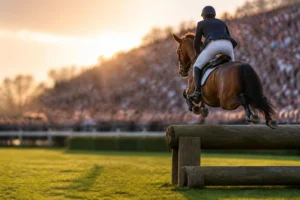
The final is run over a single day, two rounds on 1.60m (5ft 3in) courses. The format, laid out by the specialist press this week, changes the way a showjumping team manages risk:
- First round, at noon: four combinations per nation start, and only the best three scores count. A rail or a refusal can still be wiped out by the other three.
- Second round, at 2.45pm: only three combinations return to the arena, and all three scores count. There is no joker any more: the slightest fault from the first rider weighs on the next two to the very end.
- The total adds the penalties of the best three from the first round and of the three starters in the second.
- In the event of a tie for victory, each team nominates a single combination for a jump-off.
That very jump-off decided the 2025 final. Between the two rounds, the team manager must therefore choose which horses to keep: those that jumped clear at noon are not necessarily those that recover best for a second 1.60m (5ft 3in) round less than three hours later.
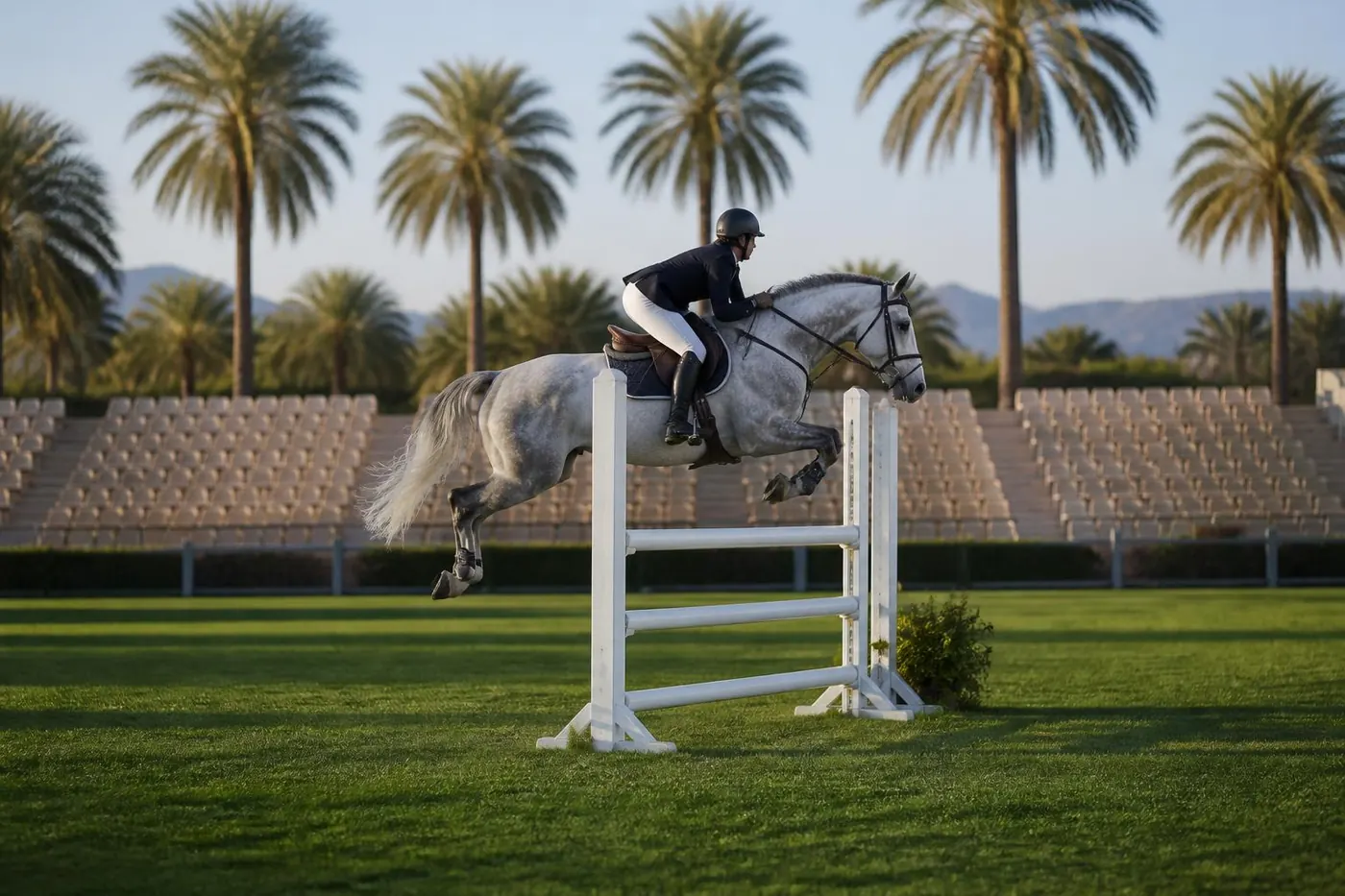
The five French riders in Barcelona, and only one Gassin horse announced
The French Equestrian Federation announced the selection on 29 September. Team manager Édouard Coupérie and the staff have named five combinations for four places at the start:
- Julien Épaillard and Le Coultre de Muze
- Antoine Ermann and Floyd des Prés
- Olivier Perreau and GL Events Dorai d’Aiguilly
- Nicolas Sers and Eleven de Riverland
- Kevin Staut and Exquis RB
The entry list published by So Horse gives each rider a second horse at the show: Donatello d’Auge for Julien Épaillard, Leopard des Joanins Z for Olivier Perreau, Komet des K Z for Nicolas Sers and Visconti du Telman for Kevin Staut. That is standard practice at a five-day CSIO: you arrive with a replacement in case a horse is tired or slightly lame.
The striking detail is the turnover. Of the four horses that won at Gassin two weeks ago, only one is named as a final mount: Floyd des Prés, the only French double clear in the Var. Simon Delestre (Gatsby du Tillard) and Nina Mallevaey (Destine to Be) are not in the selection, and Donatello d’Auge drops to the role of Épaillard’s second horse. Olivier Perreau competed at the World Championships in Aachen in August, while Kevin Staut and Nicolas Sers rode at Calgary in September. For Édouard Coupérie, quoted by Horserizon, the date matters all the more because it is “the last 5-star Cup of the year”.
Germany, Great Britain: the showjumping teams that have already won in Barcelona
The final has only two years of history, and it already has its two winners. On 6 October 2024, Otto Becker’s Germany won the first edition, with a double clear from Richard Vogel and the stallion United Touch S. On 5 October 2025, Great Britain won after a jump-off: Scott Brash and Hello Jefferson finished clear in 38.19 seconds, and Ireland’s Billy Twomey and Jumping Jack van de Kalevallei answered clear in 38.42. Twenty-three hundredths. Ireland finished second, Germany third. France, for their part, have never stood on the top step.
Both holders return with strong squads. Germany field Marcus Ehning, Sophie Hinners, Jörne Sprehe and Richard Vogel, with Kendra Claricia Brinkop in reserve. Di Lampard’s Great Britain come without Ben Maher, who has had shoulder surgery, but with Scott Brash, Tim Gredley, Jessica Mendoza, Jack Whitaker and Jodie Hall McAteer. Those two nations were level, 15 points behind France, in the season standings. To gauge what they are worth in a championship, our article on what awaited Les Bleus at the Aachen World Championships recalls the Olympic stakes of this season.
How much is the League of Nations final in Barcelona worth?
The prize money figures differ from one source to another, and we prefer to say so. French media, Horserizon and So Horse, quote €1.6 million. The German site Equi-Pages details a total of €2,154,300: €490,000 for the winning team, €302,000 for the runners-up and €220,000 for third place, plus three individual bonuses: €40,000 for the rider with the most clear rounds, €15,000 for the best groom and €15,000 for the best team manager. The gap probably comes down to what is counted in the envelope, side classes and bonuses included or not.
The groom’s bonus is no mere anecdote. On a two-round day, the groom cools the horse down, checks the legs, refits the boots and brings the horse back into condition before the second round. The same work is done, on a different scale, at every horse show on the 2026 calendar.
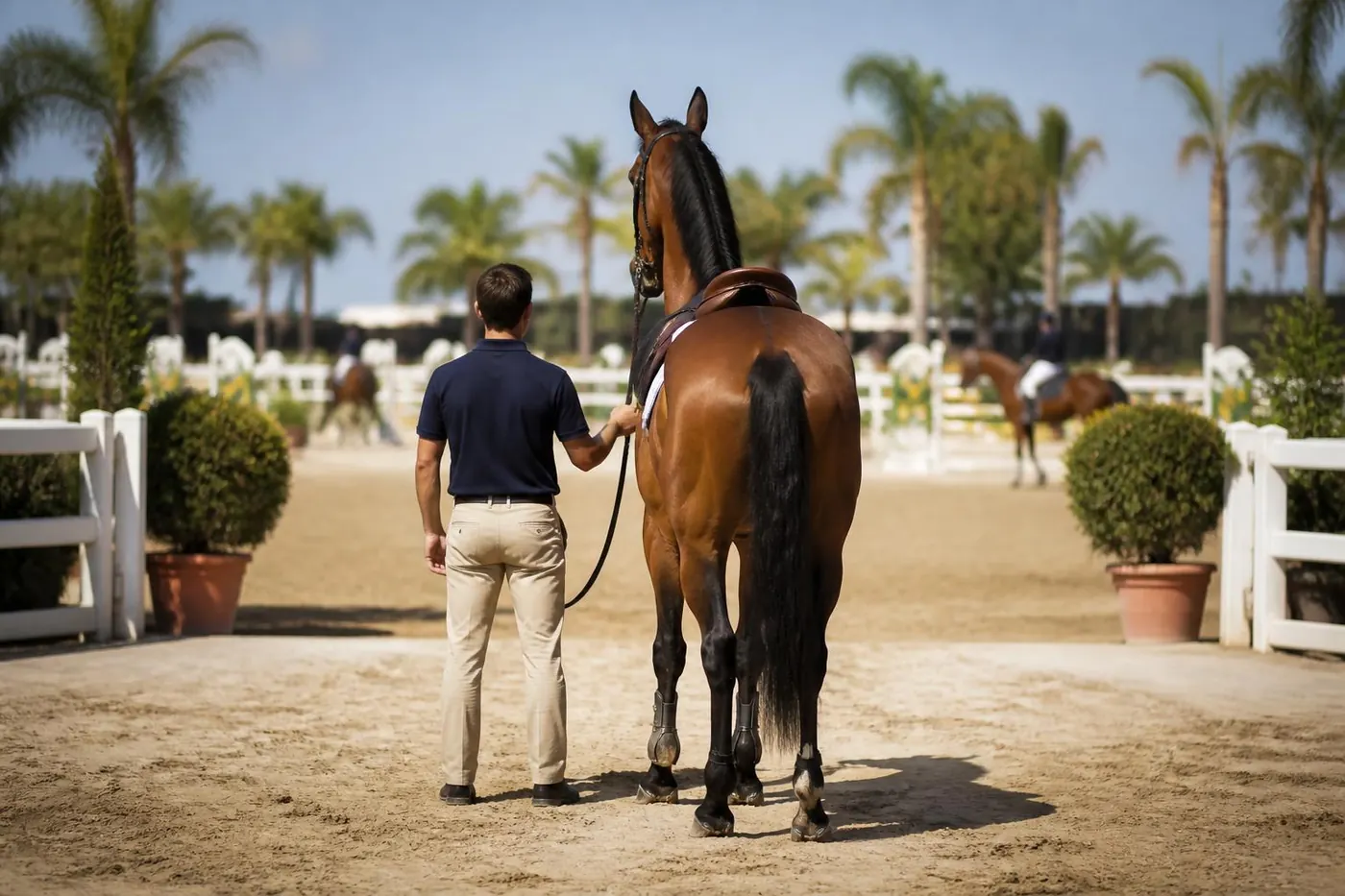
- The first rider of the second round: with no joker, that round sets the pressure on the next two.
- The freshness of the horses: two 1.60m (5ft 3in) rounds on the same day, less than three hours apart.
- The team manager’s choices: who starts fourth at noon, who stays in the stable in the afternoon.
- Consistency rather than heroics: three rounds on four faults beat a clear round followed by two heavy mistakes.
- The time allowed: on a grass arena, a time fault costs as much as a rail.
- The jump-off: one combination per nation, often the fastest, not necessarily the most consistent of the day.
What we do not yet know about the Barcelona final
As we write, on Sunday before dawn, the final has not started. We do not know which of the five French riders will rest at noon, nor which horses Édouard Coupérie will keep for the second round: those choices are only announced with the starting order. Nor do we know the course designer’s track. The result will come in late on Sunday afternoon, Barcelona time, and we will cover it separately. One thing is certain: if France win, it will be a first in the history of the League of Nations.
French Equestrian Federation, selection for the final, relayed by Horserizon and chevaux.info on 29 September 2026; Horserizon, final preview (1 October 2026); So Horse, entries and format (30 September 2026); Equi-Pages, rules and prize money for the 2026 final; Horsesport, final season standings 2026; Horsesport and Equnews, 2025 final (5 October 2025); Horse and Hound, 2024 final (6 October 2024).
Top-level showjumping is easier to follow when you know the rules: rails, refusals, time allowed, jump-off. Our showjumping guide explains it all, from first club competitions to the 5* Grand Prix, and you can test your knowledge with the showjumping rules quiz. And if you jump yourself, the first protection is still your head: our guide to choosing a riding helmet compares standards and models.