
On 26 October 1952, at the old racecourse in Seoul, a lieutenant in the US Marine Corps paid $250 of his own money for a small chestnut mare standing 14 hands (4 ft 8 in, 142 cm) at the withers. Five months later, at Outpost Vegas, that mare carried 386 shells up to the firing positions in 51 trips in a single day, most of them alone, with no one at the end of her lead rope. Her name was Ah-Chim-Hai, “Flame of the Morning”. The Marines renamed her Reckless, treated her for two shrapnel wounds, made her a corporal, then a sergeant in a formal ceremony, and a staff sergeant five years later. Here is what this horse really did in Korea, and why her rank was no barracks joke.
Seoul, October 1952: the Marines buy the mare Reckless for $250
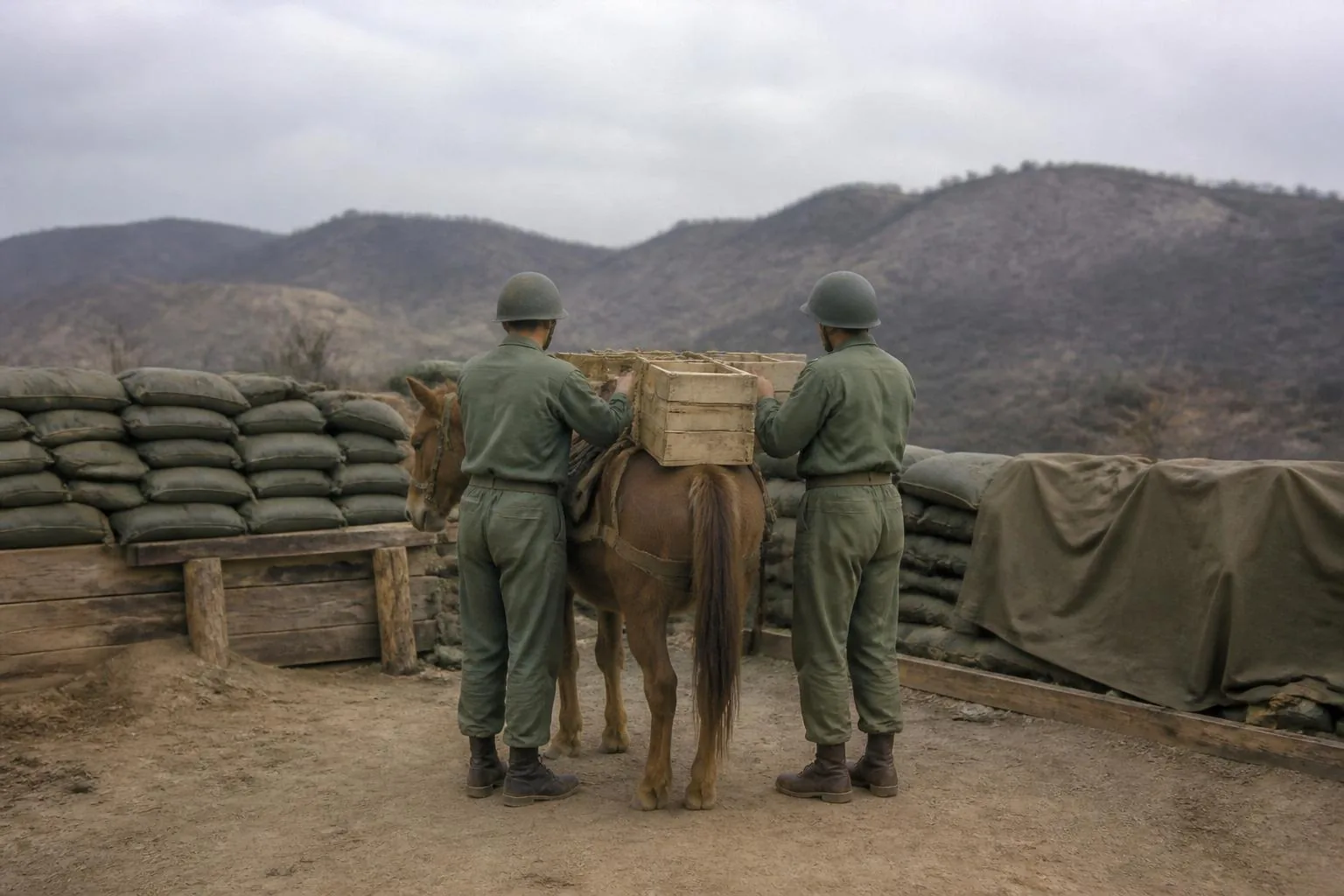
Lieutenant Eric Pedersen commands the recoilless rifle platoon of the anti-tank company, 5th Marine Regiment, 1st Marine Division. His problem is simple and very physical: his crews are hand-carrying 75 mm shells up to ridgelines that no road reaches. He needs a pack animal, and there is none on the table of equipment of a US infantry regiment in 1952.
So he goes down to the old racecourse in Seoul, where what remains of the horses of a country two years into war is being sold. There he finds a small chestnut mare, a former racehorse, and a young stable lad named Kim Huk Moon who agrees to part with her. The price is on record: $250, paid by the officer out of his own pocket. So is the reason for the sale, and it is what makes the scene so hard to bear: the boy’s sister had lost a leg to a landmine, and the family needed the money to pay for a prosthesis.
Two hundred and fifty dollars in 1952 is roughly $3,000 today. The figure is worth keeping in mind: it is the price of a farm horse, at the opposite end of the scale of equine transactions. To measure the gap, our feature on the most expensive horse in the world details what is paid today for a sport horse or a racing stallion, and why those sums have nothing to do with an animal’s working value.
The mare stands 14 hands (4 ft 8 in, 142 cm) at the withers and weighs about 880 lb (400 kg). That is the size of a large pony. Sources describe her as a Mongolian-type horse, and some more precisely as a Jeju pony, a population that does descend from Mongol horses imported in the 13th century. The horse breeds of that region share a small frame, hard feet and a carrying capacity far beyond what their height suggests.
Video · 107 seconds
Sergeant Reckless: 51 trips alone under fire
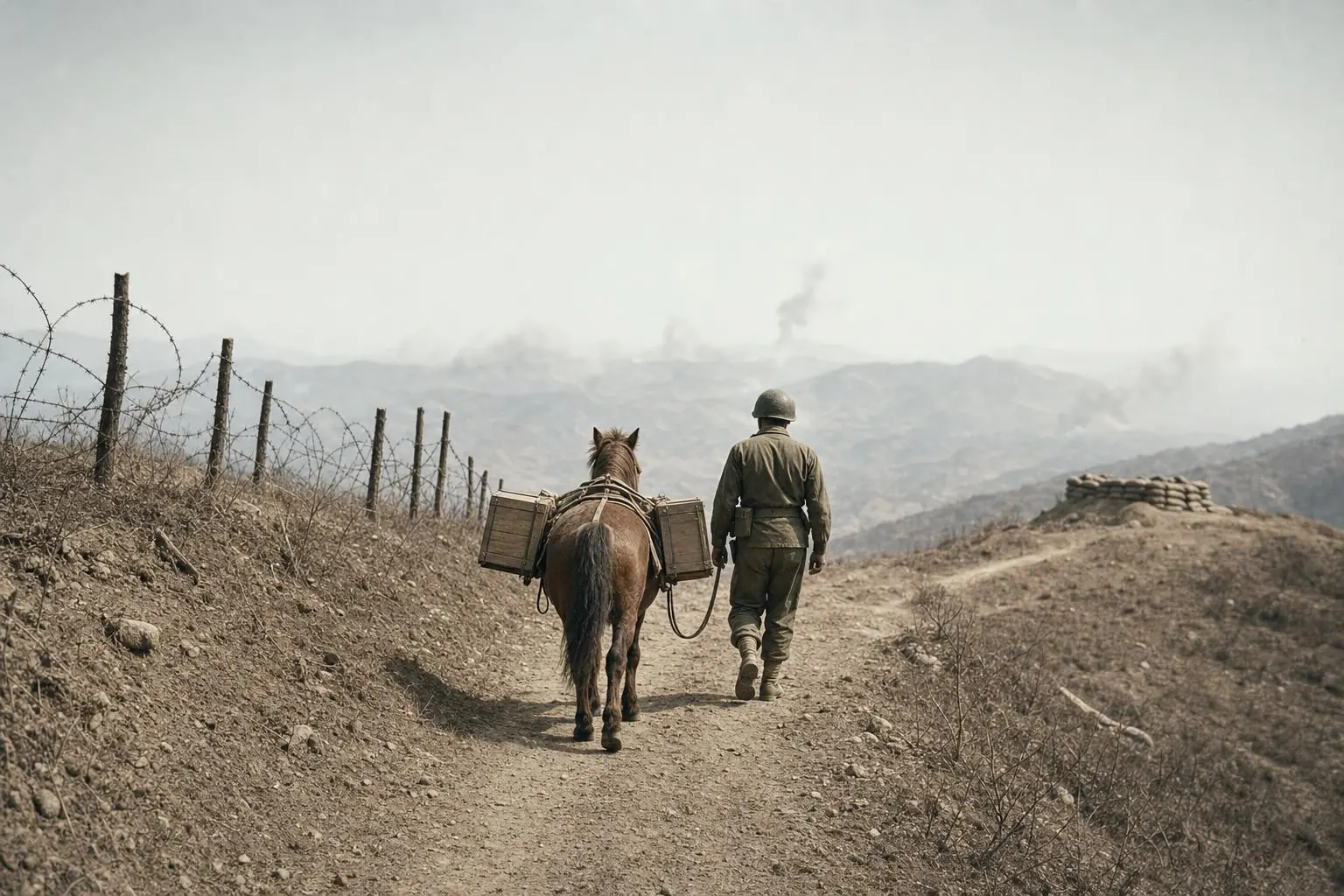
Five months later, at Outpost Vegas, she carries 386 shells up to the firing positions in 51 trips in a single day, mostly alone, with no one at the end of her lead rope. Wounded twice by shrapnel, the mare Ah-Chim-Hai, renamed Reckless, was promoted to sergeant on 10 April 1954 and staff sergeant in 1959, and was buried with full military honours at Camp Pendleton. Here is what this horse really did in Korea.

Why a mare carried the shells for the 75 mm recoilless rifle in Korea
Reckless was not named for her temperament. The 75 mm M20 recoilless rifle was nicknamed the reckless rifle by the Marines, because its back-blast gave away the firing position with every shot. The platoon even called itself the Reckless Platoon. The mare inherited the nickname of the weapon she kept supplied.
A 75 mm shell weighs about 24 lb (nearly 11 kg). The arithmetic of resupply can be read straight from the figures kept by the Marine Corps: 386 shells in 51 trips works out at seven to eight shells a trip, around 175 lb (80 kg) on the pack saddle of a 880 lb (400 kg) horse. The same sources give a total of more than 9,000 lb for the day, over four metric tonnes moved, and about 35 miles covered, a little over 55 km.
A pack horse is not a draught horse. It does not pull, it carries, and the whole craft lies in how the load is distributed: two sides rigorously balanced, a girth that does not injure the withers, and an animal that accepts the permanent imbalance of a slope. This is also why size matters little: on a mountain path, a sure-footed 880 lb (400 kg) horse does better than one of 1,320 lb (600 kg).
What Reckless’s training really demanded
The Marines taught her two things. First, to tolerate noise, the blast of the recoilless rifle and the crash of artillery, which is far from obvious for a species whose natural response to noise is flight. Second, to follow the route between the firing positions. She was led by hand along that route, and then she did it without anyone, which is the decisive point of the whole story: this is not a horse being pushed under fire, it is a horse climbing alone a hill she knows.
Outpost Vegas, 26 to 28 March 1953: 51 trips and 386 shells for a single horse
Outpost Vegas was one of three forward positions the Marines called the Nevada Cities, along with Reno and Carson. The Chinese assault opened on 26 March 1953 and the battle lasted three days. American casualties ran to more than a thousand, and the position changed hands several times. It is within those three days that the day of 51 trips falls.
What the accounts remember is not only the number. It is that the mare went up alone most of the time, in the open, over ground pounded by mortars, and came back down for the next load. The crews no longer needed to accompany her: they loaded her, let go, and off she went. On the return she also helped carry wounded men to the rear.
Two shrapnel wounds, and a horse that never left the hill
She was hit twice during the battle: a fragment above the left eye, another in the left flank. Both wounds were dressed on the spot and she went back to work. These two wounds underpin her two Purple Hearts, the American decoration for those wounded in war, and they are the technical reason her record could never be treated as that of a regimental mascot.
From a veterinary standpoint there is nothing heroic to take away: a shrapnel wound near the eye is an emergency, and a horse that keeps working with a flank wound does so because horses mask pain. Our guide to horse care sets out which signs to look for after an injury, and the point at which a vet’s opinion is no longer up for debate.
From corporal to sergeant: how the Marines gave a mare her rank
The rank was not improvised. Reckless was first carried on the books as a private, then promoted to corporal in 1953, after Outpost Vegas. On 10 April 1954 she was promoted to sergeant in a formal ceremony, in front of the troops, by General Randolph McCall Pate, then commanding the 1st Marine Division. On 31 August 1959, at Camp Pendleton, the same Pate, by then Commandant of the Marine Corps, made her a staff sergeant.
Her list of decorations is that of a combat veteran: two Purple Hearts, the Good Conduct Medal, the Presidential Unit Citation with bronze star, the National Defense Service Medal, the Korean Service Medal, the United Nations Service Medal for Korea, the Navy Unit Commendation and the Republic of Korea Presidential Unit Citation. She is also, to the Marine Corps’ knowledge, the first horse in its history to take part in an amphibious landing. One point of honesty: this list is the one published by the Marine Corps and its museum, and decorations awarded to an animal have no regulatory status in the American system. What can be verified are the ceremonies, the dates and the wounds.
This blend of military gravity and a horse among men is not unique to Korea. It appears just the same in Warrior, the thoroughbred of the 1914 to 1918 front, in the military honours paid to Copenhagen, Wellington’s mount at Waterloo, and in the general order of 1878 that forbade anyone to ride Comanche, the horse found alive after Little Bighorn.
What a route learned by heart says about how horses learn
The most interesting fact in this story is not military, it is ethological. A horse led two or three times along a route can repeat it alone: a horse’s spatial memory is excellent, and its learning rests on the repetition of a stable sequence, not on understanding a goal. Reckless did not know she was resupplying a piece of artillery. She knew that at the top she was unloaded and at the bottom she was fed.
It is exactly the mechanism described in our feature on equine ethology: a horse learns by association and reinforcement, and it reads human body language before it reads intentions. The case of Clever Hans, the horse that could count in front of thirteen experts, served in 1904 to demonstrate the same thing from the other end: what we take for reasoning in a horse is very often a fine reading of signals.
The second lesson, more practical for a rider: desensitisation to noise works. A horse that has learned that a crash is not followed by anything painful stops reacting to it. This is the basis of the work done with police horses and the French Republican Guard, and it is what separates a mare you can use on a shelled ridge from a horse that kills itself bolting.
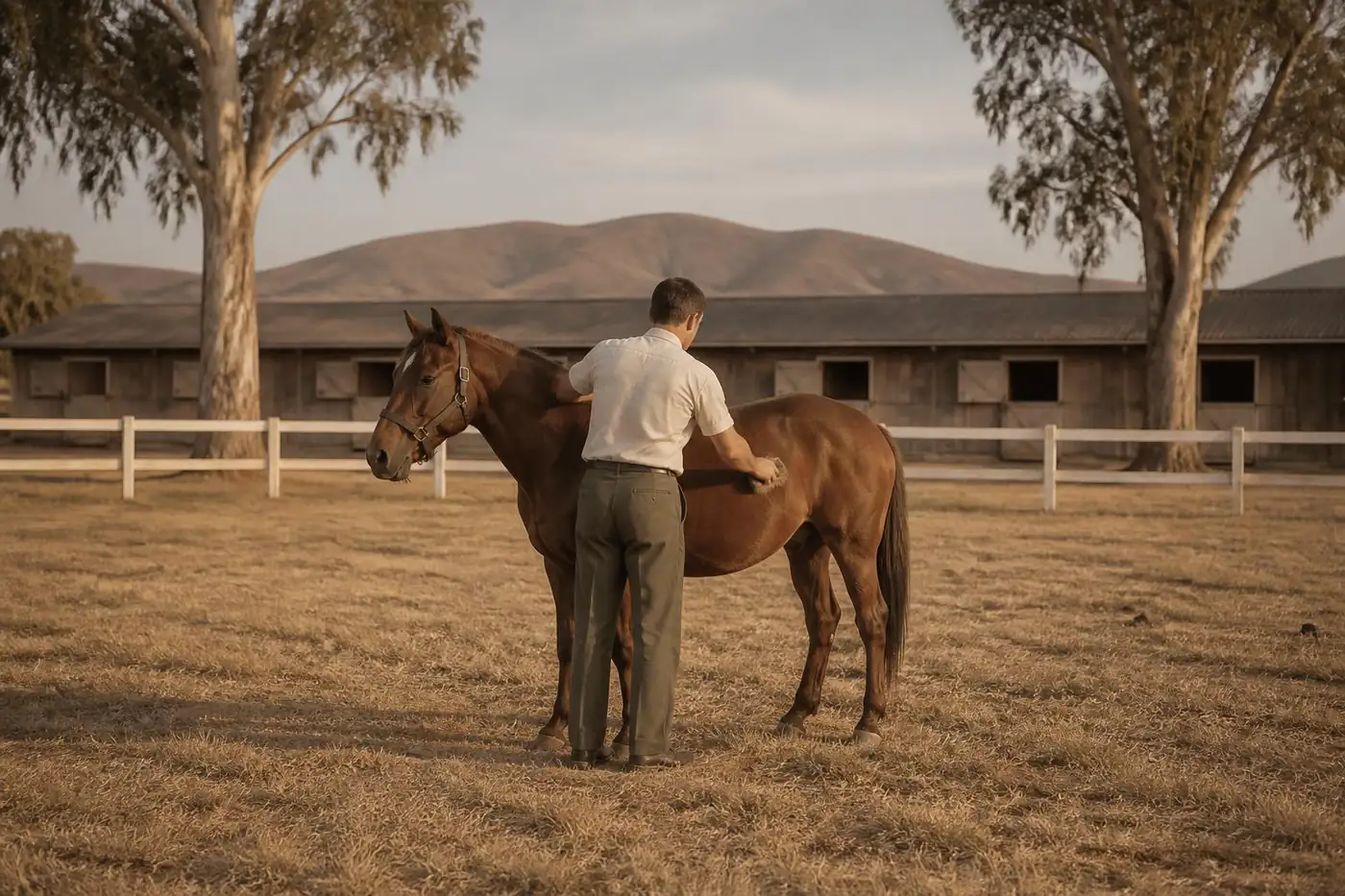
Camp Pendleton, 1954 to 1968: the Californian retirement of the mare Reckless
The question of what came next arose as soon as the armistice of July 1953: the Marines did not want to leave her in Korea. A shipping company, Pacific Transport Lines, offered the passage. Embarked at Yokohama on the SS Pacific Transport on 22 October 1954 and delayed by a typhoon, the mare landed in San Francisco around 10 November 1954, welcomed by a guard of honour. She then joined Camp Pendleton in Southern California.
She lived there for fourteen years. She paraded at Corps ceremonies, was officially retired in 1960 to the base stables, and became a mother there: Fearless was born on 5 April 1957, Dauntless in 1959, Chesty in 1964. Mess-hall anecdotes did the rest of the legend, and they are amusing rather than dubious: she ate scrambled eggs, drank beer and Coca-Cola, once swallowed thirty dollars’ worth of poker chips and, on another occasion, her own blanket.
She died on 13 May 1968, aged nineteen or twenty, after injuring herself on barbed wire on the base; she was put down under sedation during treatment, and buried at Camp Pendleton with full military honours. Two bronze statues by the sculptor Jocelyn Russell were later raised to her, one unveiled on 26 July 2013 at the National Museum of the Marine Corps in Quantico, Virginia, the other on 26 October 2016 at Camp Pendleton. A third followed at the Kentucky Horse Park in 2018. These monuments owe a great deal to the investigative work of the journalist Robin Hutton, author of the standard book published in 2014.
How to judge the story of the mare Reckless
A tale of a heroic horse is fertile ground for exaggeration. Here are the criteria for sorting out, in this story as in others, what is documented from what is barracks embroidery.
How to judge the story of a war horse
- A rank backed by a document, not an anecdote. Reckless’s promotions took place in formal ceremonies, with a named general and a date, on 10 April 1954 and then 31 August 1959. That is what sets her apart from a regimental mascot.
- Decorations tied to a specific event. Her two Purple Hearts correspond to two identified wounds, a fragment above the left eye and one in the left flank. A medal without a documented wound proves nothing.
- Figures that cross-check each other. 386 shells, 51 trips and more than 9,000 lb hold together: the division gives seven to eight shells a trip, which is plausible for a 880 lb (400 kg) horse. A figure that does not divide cleanly is suspect.
- The distinction between packing and pulling. A pack horse carries on its back, a draught horse pulls. Confusing the two is already a mistake about what the animal did.
- A learning process that can be explained. Repeating alone a route shown several times is a matter of the horse’s spatial memory, not devotion. An account that invokes courage where ethology is enough should be read with caution.
- The animal’s original name. Ah-Chim-Hai, Flame of the Morning, existed before the Marines. A story that begins when the West buys the horse forgets half of it.
- What the source does not say. The fate of Kim Huk Moon’s sister, the prosthesis, what became of the boy: none of it is documented. An honest account says so instead of filling the gap.
What we still do not know about the mare Reckless
Three points remain unsettled from one source to the next, and it is better to name them. First, her age when bought: some sources say three years, others five, which explains the estimate of nineteen or twenty at her death. Then her breed: a Mongolian-type horse according to most texts, a Jeju pony according to others, with no breeding document to decide. Finally her usual load: the total for the day at Vegas is consistent, but the number of shells carried on each trip varies from one account to another.
The fate of the Kim family is not documented either. What is known comes down to one sentence reported by the Marines and repeated ever since: the boy was selling his mare to pay for an artificial leg. We will not write more than that, for lack of a source.
Sergeant Reckless: what to remember about the Marines’ mare
A Korean mare of 14 hands (142 cm), bought for $250 at a Seoul racecourse in October 1952, kept a recoilless rifle platoon supplied through the last year of the Korean War. On 26 March 1953 and the days that followed, at Outpost Vegas, she made 51 trips and carried 386 shells, more than four tonnes, mostly with no one leading her, and she was wounded twice. The Marine Corps promoted her to sergeant on 10 April 1954 and staff sergeant on 31 August 1959, and buried her with full military honours at Camp Pendleton on 13 May 1968.
What remains, for a rider, fits in one line: this horse was not brave, she was properly prepared, properly loaded and properly rewarded. The rest, the memory of the path, the tolerance of noise, the stamina of a small frame, belongs to the species. To read further, our stories of Genghis Khan’s Mongol horses and of Elizabeth II’s mare Burmese show the two ends of the same thread, from the horse of conquest to the horse of parade.
A 880 lb (400 kg) horse carrying 175 lb (80 kg) along a ridge, a racehorse sold for millions: a horse’s worth cannot be read from its height. The Equirider feature sets out real market prices, breed by breed and discipline by discipline.
Sources: National Museum of the Marine Corps (reference sheet on Sgt Reckless); Camp Pendleton Historical Society (the 2016 monument and the circumstances of her death); Horse Stars Hall of Fame of the Equus Foundation (dates of purchase, promotion and stay at Camp Pendleton); The War Horse Memorial, entry 22 of the hundred heroic horses; Western Horseman, feature “Reckless, Pride of the Corps”; Robin Hutton, standard book published in 2014 and the work that led to the statues at Quantico and Camp Pendleton. Discrepancies between sources on age, breed and load per trip are flagged in the article. Equirider is not affiliated with the Marine Corps or any of the institutions cited.