
Red Rum was lame the first morning his new trainer took him out. The racehorse, bought for 6,000 guineas on behalf of an old taxi customer, suffered from a bone disease of the foot then considered incurable. Ginger McCain, a second-hand car dealer in Southport, had no gallops to train on: all he had was the beach. So he sent the horse into the sea. Five years later, Red Rum had won the Grand National three times, the toughest steeplechase in the world, and finished second twice. This is how a horse with a diseased foot became the most famous steeplechaser in Britain, what sea water really did for him, and what we still do not know about the story.
Red Rum, lot 43 at Doncaster: a racehorse bought for 6,000 guineas for a taxi customer
Red Rum was born on 3 May 1965 in County Kilkenny, Ireland. His name is a little game with letters: his breeder took the last three letters of his dam’s name, Mared, and those of his sire, Quorum. He was a Thoroughbred built for speed, not for long distances. His very first race, in 1967, was a five-furlong Flat sprint, about 1,000 metres (five-eighths of a mile), which he finished in a dead heat for the win. It was run at Aintree, near Liverpool, on the racecourse that would make him famous six years later.
In the meantime the horse changed hands and trainers several times. Results were patchy, and by 1972 his feet were beginning to cause problems. In August of that year he went through the ring at Doncaster as lot 43. One man bought him for 6,000 guineas: Donald McCain, known to everyone as Ginger.
McCain was not buying for himself. He sold second-hand cars in Southport, trained a few horses in a small yard behind his garage, and topped up his income as a taxi driver. Among his regular fares was an octogenarian businessman, Noel le Mare, whom he drove to his dinner dances on Saturday nights. Le Mare had one obsession: to win the Grand National before he died. He asked his driver to find him the horse. To place the breed among the others, our profile of the English Thoroughbred explains why a Flat sprinter is not, on paper, a candidate for long steeplechases.
On video · 95 seconds
Red Rum: the lame horse who won three Grand Nationals, and why a car dealer treated him in the sea
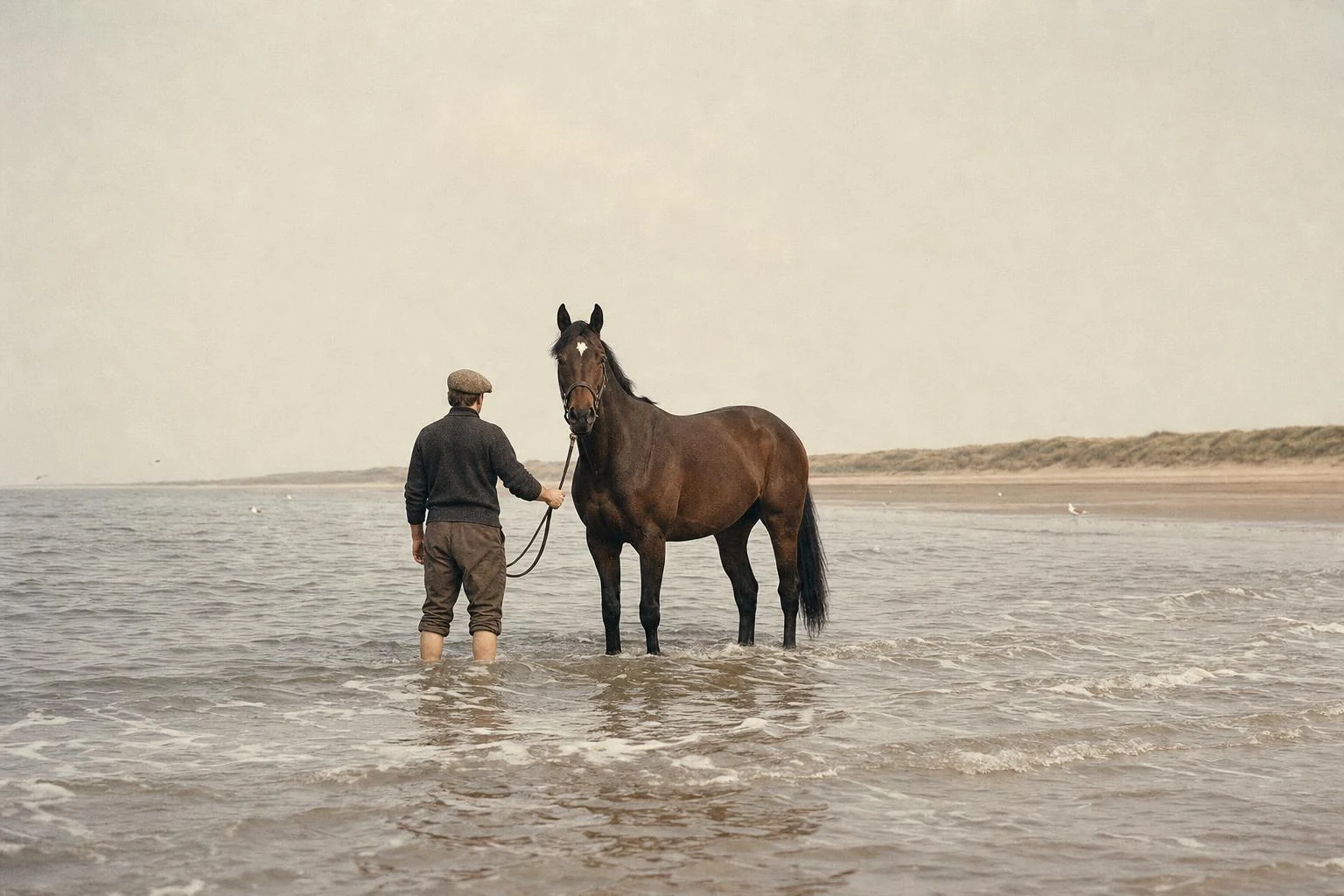
Ginger McCain walked him into the sea at Southport: the horse went on to win the Grand National three times.

On the first morning at Southport, the racehorse was lame
The story is told by every biographer of the horse and by the British racing press: on his first trot out with his new trainer, Red Rum went lame. For a horse just bought for 6,000 guineas with a customer’s money, it was the worst possible start.
The diagnosis that had followed him for several months had a technical name: pedal osteitis. It is an inflammation of the bone inside the foot, the pedal bone (the third phalanx), which is enclosed in the hoof. It shows as an on-and-off lameness that worsens on hard ground and that, at the time, was regarded as incurable. A conventional trainer would have retired the horse or sold him on. McCain had neither the means nor the inclination to do either.
If you are wondering, looking at your own horse, where this kind of lameness comes from, our horse lameness detector helps you locate the limb involved and place it on the grading scale vets use, before the examination.
Why Ginger McCain sent Red Rum into the sea
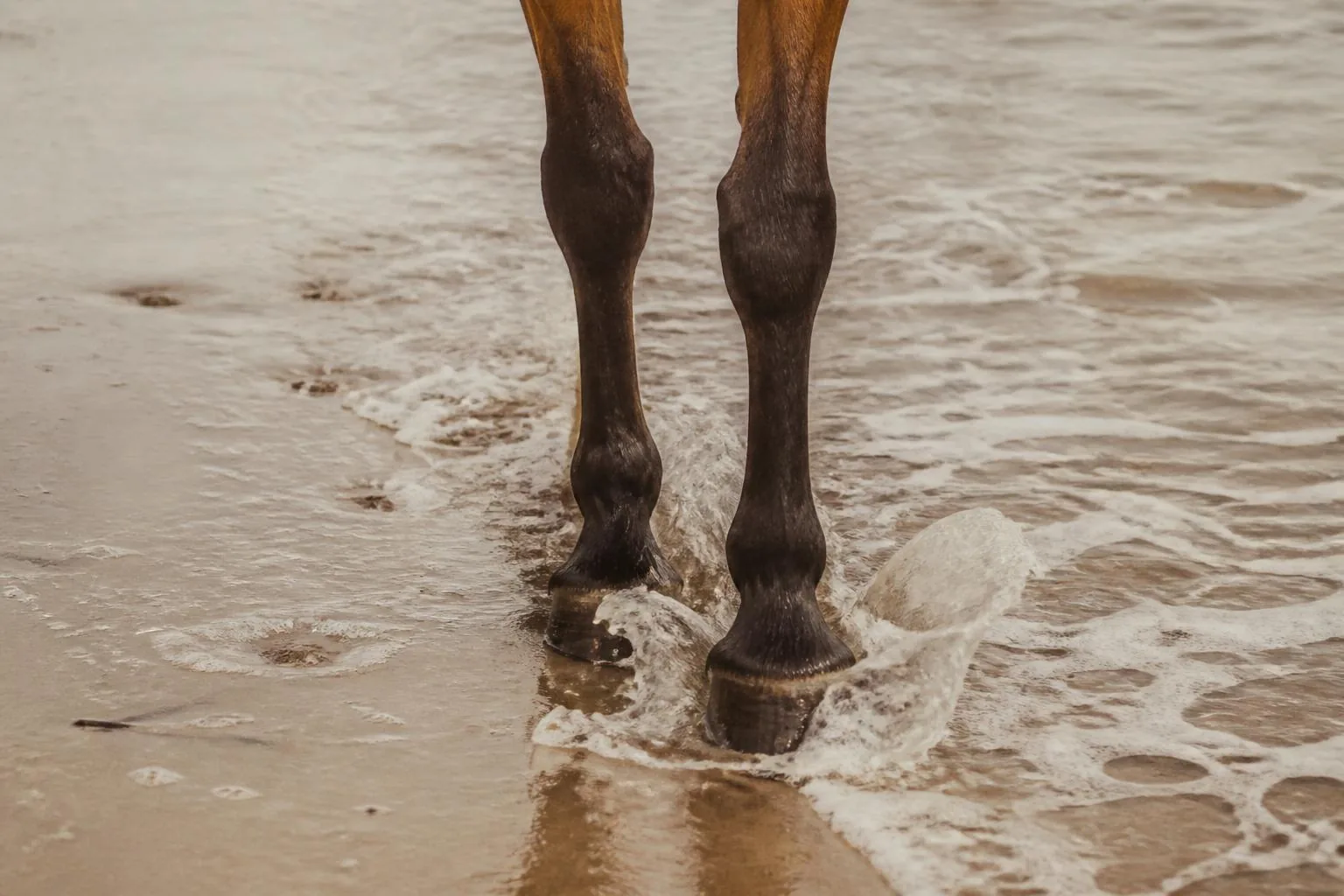
The answer is first of all a matter of geography. McCain had no gallops. His training ground was Southport beach, an immense stretch of flat sand beside the Irish Sea. That day he did the only thing he had to hand: he sent the horse to walk in the sea water. Then he made it a routine. Red Rum cantered on firm, wet sand and spent time in the cold water, up to his knees or higher.
Two effects are put forward. The first is the cold: the Irish Sea is chilly for much of the year, and cold calms inflammation, like the cold hosing we give a horse’s legs after work today. The second is the going: wet, packed sand is both firm and forgiving, and cushions the impact on the foot far better than a baked gallop. For a horse whose pain increases on hard ground, it is the opposite of a punishment.
A former owner of the horse summed up the irony of the story in a much-quoted line: of all the hundreds of people who could have bought him, he ended up with the man who had only the beach to train him on. In other words, what looked like the handicap of a small-time trainer was exactly what this horse needed.
Pedal osteitis in horses: the condition that should have ended Red Rum’s career
We need to be precise about what the sea did, because this is where popular accounts go astray. There is nothing to show that Red Rum was cured. His osteitis did not disappear: it was held in check, enough to let him run and win for years. The proof is the end of his career, which came, precisely, through the foot.
Pedal osteitis is one of the causes of lameness located in the hoof, alongside a foot abscess or navicular syndrome, with which it is sometimes confused by eye. Only a vet, with a lameness examination and imaging, can tell them apart. And modern treatment is not a matter of a single bath: it involves suitable rest, management of the working surface and shoeing planned with the farrier.
The lesson of Southport is therefore not “the sea heals feet”. It is more useful than that: a horse with a fragile foot is managed over the long term, with a chosen surface, cold after work and regular monitoring, instead of being written off at the first diagnosis.
Grand National 1973: Red Rum claws back fifteen lengths on Crisp
On 31 March 1973, Red Rum lined up for the Grand National at Aintree: more than four and a half miles (over seven kilometres) and thirty fences, some of them among the most feared in racing. He carried 10 stone 5 pounds. The public’s great favourite, the Australian-bred Crisp, carried 12 stone, 23 pounds more (a little over ten kilos).
Crisp made the running and opened up a dizzying gap: some twenty lengths at the end of the first circuit, still around fifteen as they passed the last fence. Then, up Aintree’s long run-in, the weight told. Red Rum, ridden by Brian Fletcher, closed stride by stride and passed him in the final strides. He won by three-quarters of a length, in 9 minutes 1.9 seconds, a race record that stood until 1990.
Many English fans remember this race for Crisp’s heroic defeat as much as for Red Rum’s victory. Yet the lame horse from Southport beach had just beaten the best steeplechaser in the field, with the advantage of the weights, admittedly, but over thirty fences. To gauge what this race means in the racing world, our selection of the greatest horse races in the world places it among the legendary events.
Three Grand Nationals and two second places: Red Rum’s record
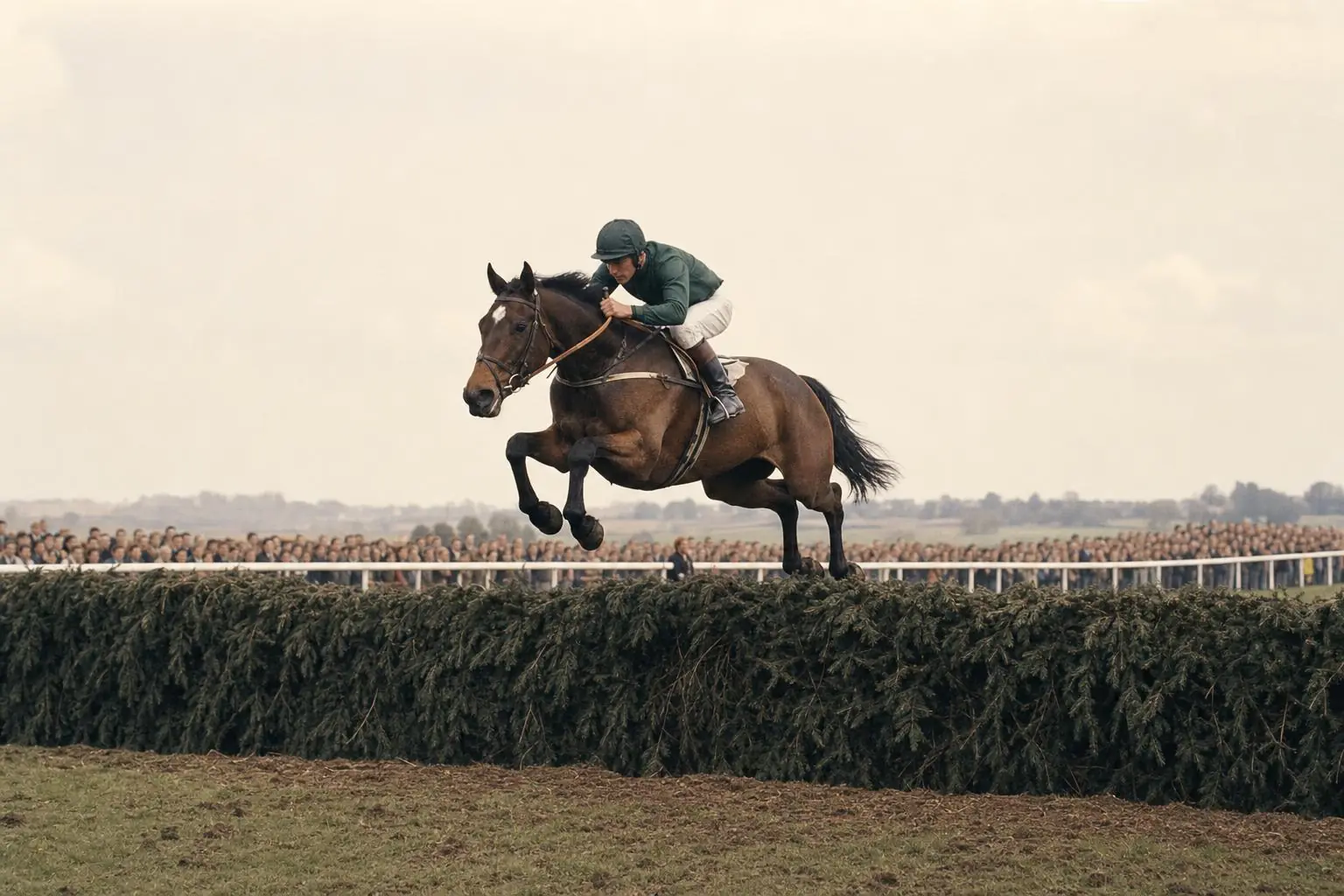
In 1974 Red Rum returned and won again, this time carrying the top weight of 12 stone on his back, about 168 pounds (76 kg). A few weeks later he also won the Scottish Grand National: he remains the only horse to have won both in the same season.
In 1975 and 1976 he finished second, beaten by L’Escargot and then by Rag Trade. Any other horse would have entered the history books on those two places alone. Then, on 2 April 1977, aged twelve, with Tommy Stack in the saddle, he won his third Grand National, by twenty-five lengths. The BBC commentator Peter O’Sullevan described an ovation such as had never been heard in Liverpool.
The record is unique: five runs, three wins, two second places, in a race where so many horses do not get round. Over his whole career, Red Rum took part in around a hundred jump races without ever falling. For a horse whose career might have ended at the Doncaster sale, it is the most telling statistic. To understand why this kind of racing frightens riders so much, read our investigation into the most dangerous equestrian discipline.
Noel le Mare, the taxi customer, saw all three victories. He liked to say that he had had three ambitions in life: to marry a beautiful woman, to become a millionaire and to win the Grand National. He died in June 1977, aged 88, less than three months after the third.
The retirement of Red Rum, announced at the top of the BBC news
In 1978, Red Rum was preparing for a sixth Grand National. The day before the race, after a last gallop at Aintree, his connections gave up: the foot was causing trouble again. The horse was withdrawn. The announcement of his retirement led the BBC’s nine o’clock news, a treatment ordinarily reserved for affairs of state.
His fame did not stop there. He opened shops, betting offices and village fêtes. In 1977 he had already switched on the Blackpool Illuminations and opened a roller coaster named Steeplechase. He is said to have recognised the voice of his jockey Tommy Stack during a television broadcast. He lived in Southport, with McCain, to the end.
It is another point that tends to be forgotten: this horse with the diseased foot lived to thirty, a great age for a racing Thoroughbred. Everyday horse care, feet included, weighs as much on longevity as talent does.
Red Rum buried at the Aintree winning post
Red Rum died on 18 October 1995, aged thirty. He is buried at Aintree, at the foot of the winning post, his head turned towards the line he crossed three times as a winner. Statues of him stand at Aintree, in Southport and at Ayr racecourse in Scotland, where he had won the Scottish Grand National.
For the British it has become a place of pilgrimage on race day. For the French rider it is a reminder that English jump racing has its counterpart on our side of the Channel: Auteuil racecourse, where Hemingway staked his savings in the 1920s, is the other great European stage for steeplechasing. Our wiki entry on Red Rum sums up his record on a single page.
How to judge the story of a lame horse turned champion
Tales of “doomed” horses who became champions are everywhere, and many are embellished. Here are the criteria we apply to this one, and that you can apply to the next.
How we judge the story of a racehorse who beat the odds
- A named diagnosis. Here, pedal osteitis, a specific condition of the third phalanx, not a vague “leg problem”.
- A record you can check. Three wins and two second places in the Grand National, dated 1973 to 1977 and kept in the race’s archives.
- A figure that does not change from one source to the next. The price of 6,000 guineas and lot number 43 are constant. What varies, we flag.
- The difference between curing and managing. The disease did not go away: it is what ended his career in 1978. An honest account says so.
- A plausible mechanism. The cold of the water and firm but forgiving sand are coherent explanations; no study has measured their effect on this horse.
- The other factors. The weight advantage in 1973, the skill of the jockeys, the daily care: the sea does not explain everything.
What we still don’t know about the sea and Red Rum’s feet
Three points remain unclear, and popular retellings almost always smooth them over.
First, the real share of the sea. McCain believed in it, so did those around him, and the photographs of the horse in the surf went round the world. But no measurement was ever made: we do not know what is owed to the cold, the sand, the rest, the shoeing or simply time. The cold salt-water hydrotherapy used in equine rehabilitation today echoes the Southport hunch, without Red Rum’s story being proof of it.
Second, the figures that move. The 1973 time is presented as beating either Golden Miller’s or Reynoldstown’s, two winners from the 1930s; we stick to “race record”. The weight carried in 1977 also varies by source. And McCain’s exact words on that first morning exist only through second-hand accounts.
Finally, the exact nature of the last scare in 1978: sources speak of a foot problem, with no published medical detail. Our method and sources page explains how we handle this kind of discrepancy.
Lameness in horses: what Red Rum teaches today’s rider
What strikes you in this story is less the miracle than the method. A horse goes lame on day one. His trainer does not write him off; he observes: on which surface he hurts, on which he goes better. He adapts the work to the foot, day after day, for years. And when the foot says stop, in 1978, he listens and stops.
It is exactly what we expect of an owner facing chronic lameness: do not stop at the verdict “incurable”, get a precise diagnosis from a vet, note how things evolve, and adapt the surface, the work and the shoeing. Nobody will advise you to take your horse to the beach instead of the vet; on the other hand, cold after work and the choice of a forgiving surface are simple measures your practitioner will often endorse. And if you want to test what you know about feet and limbs, our horse knowledge quiz covers these notions.
Red Rum ran around a hundred jump races without falling, with a foot disease that was said to have no way out. He did not do it alone: he did it because someone looked after his foot every day.
Chronic lameness is managed over time: dates of flare-ups, trimming and shoeing, the vet’s opinion, working surface. The Equirider health record keeps all of it in one place, dated, so that follow-up does not depend on your memory.
Sources: reference entries on Red Rum and on Ginger McCain (born 3 May 1965, origin of the name, first race at Aintree in 1967 finished in a dead heat, pedal osteitis, training on Southport beach, Grand National record from 1973 to 1977, the 1974 double with the Scottish Grand National, death on 18 October 1995 and burial at the Aintree winning post, statues at Aintree, Southport and Ayr); reference entry on the 1973 Grand National (31 March 1973, weights carried by Crisp and Red Rum, margin at the last fence, three-quarters of a length, 9 minutes 1.9 seconds, record until 1990); an article in the British magazine The Field (lame from the first outing, sent into the sea, lot 43 and 6,000 guineas at the August 1972 Doncaster sale, quote from the former owner); an article in the Racing Post (retirement on the eve of the 1978 Grand National announced at the top of the BBC news, Blackpool Illuminations, Peter O’Sullevan’s commentary); an entry on Noel le Mare (taxi journeys, three ambitions, death in 1977 aged 88). Discrepancies between sources on the record beaten in 1973 and the weight carried in 1977 are flagged in the article. Equirider is not affiliated with any of the institutions mentioned.