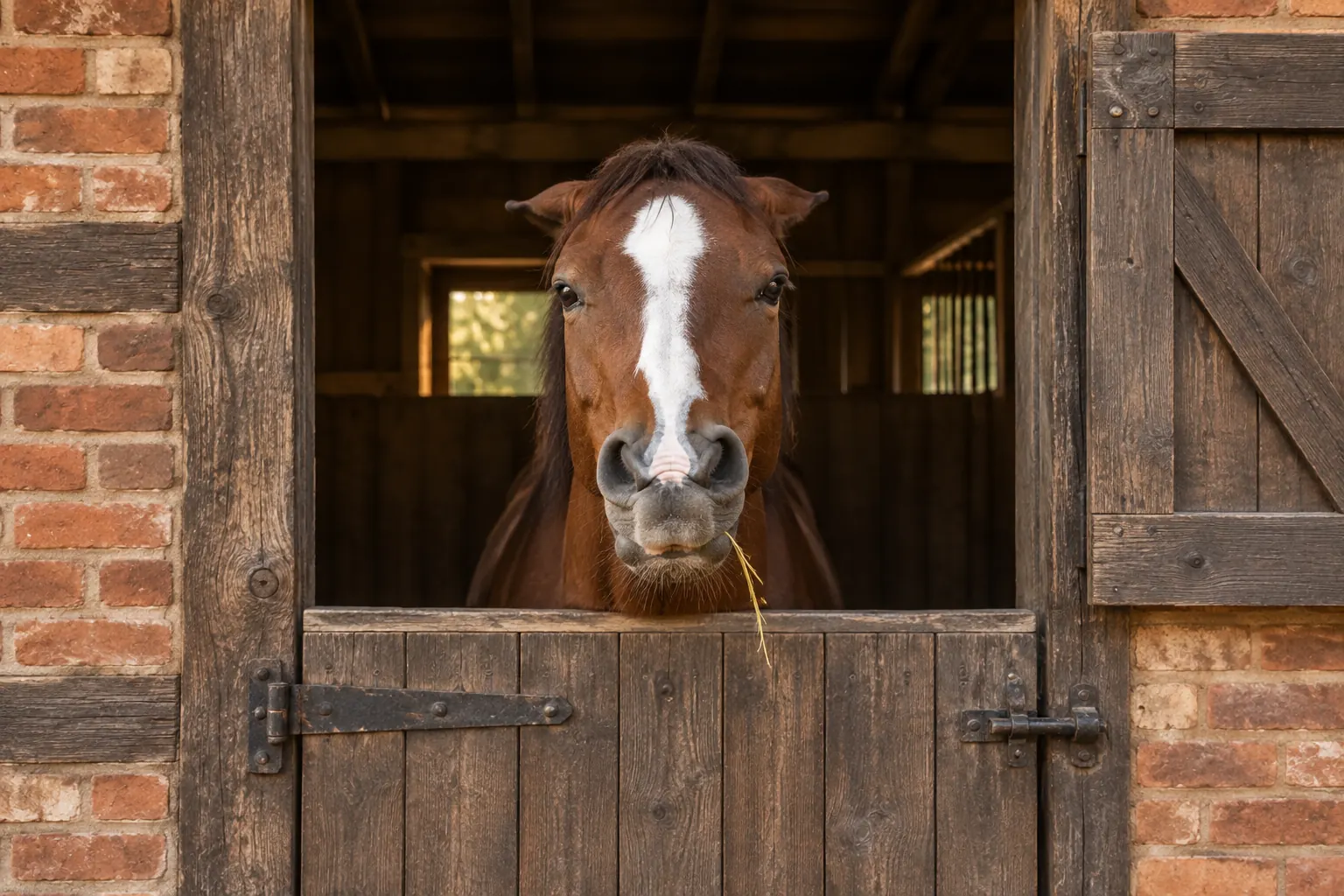

Researchers at the University of Sussex spent fifteen hours reviewing video of 86 horses, movement by movement, to build a complete inventory of the equine face. The result: 17 basic movements. That is more than the chimpanzee (13) and the dog (16), but fewer than humans (27) and cats (21). Within this repertoire sits one combination every rider has had thrown in their face at feeding time: ears pinned, nostrils flared, lips pursed. The grimace that means “leave me alone.” It has a close cousin that looks very similar and means something else entirely: “I am in pain.”
The 17 Facial Expressions of the Horse, Counted One by One at the University of Sussex
The study is called EquiFACS. It was published on 5 August 2015 in the journal PLOS ONE by Jen Wathan and Karen McComb (University of Sussex), Anne Burrows and Bridget Waller. The principle comes from human psychology: FACS, a system that breaks any expression down into “action units,” the elementary movements produced by a single muscle or group of muscles. A human smile, for instance, is described as the sum of several of these units.
The team identified every visible movement on its footage, linking each one to the muscle that produces it. It settled on 17. So these are not 17 moods, but 17 building blocks from which the horse composes every look it has, from the friendliest to the blackest.
The Horse Beats the Chimpanzee and the Dog, but Not the Cat
The authors drew up the ranking themselves. With its 17 action units, the horse comes out ahead of the chimpanzee and the rhesus macaque (13 each), the orangutan (15), and the gibbons and the dog (16). Only humans (27) and cats (21) do better, and the cat owes its score largely to its whiskers and ears. A little cheating, then.
The horse’s ears, as it happens, earn a category of their own: the authors judge their musculature “extremely complex” and describe them with four “descriptors” rather than conventional units. Ears forward, ears together, ears pinned, ears rotated: on their own, they carry half the conversation.
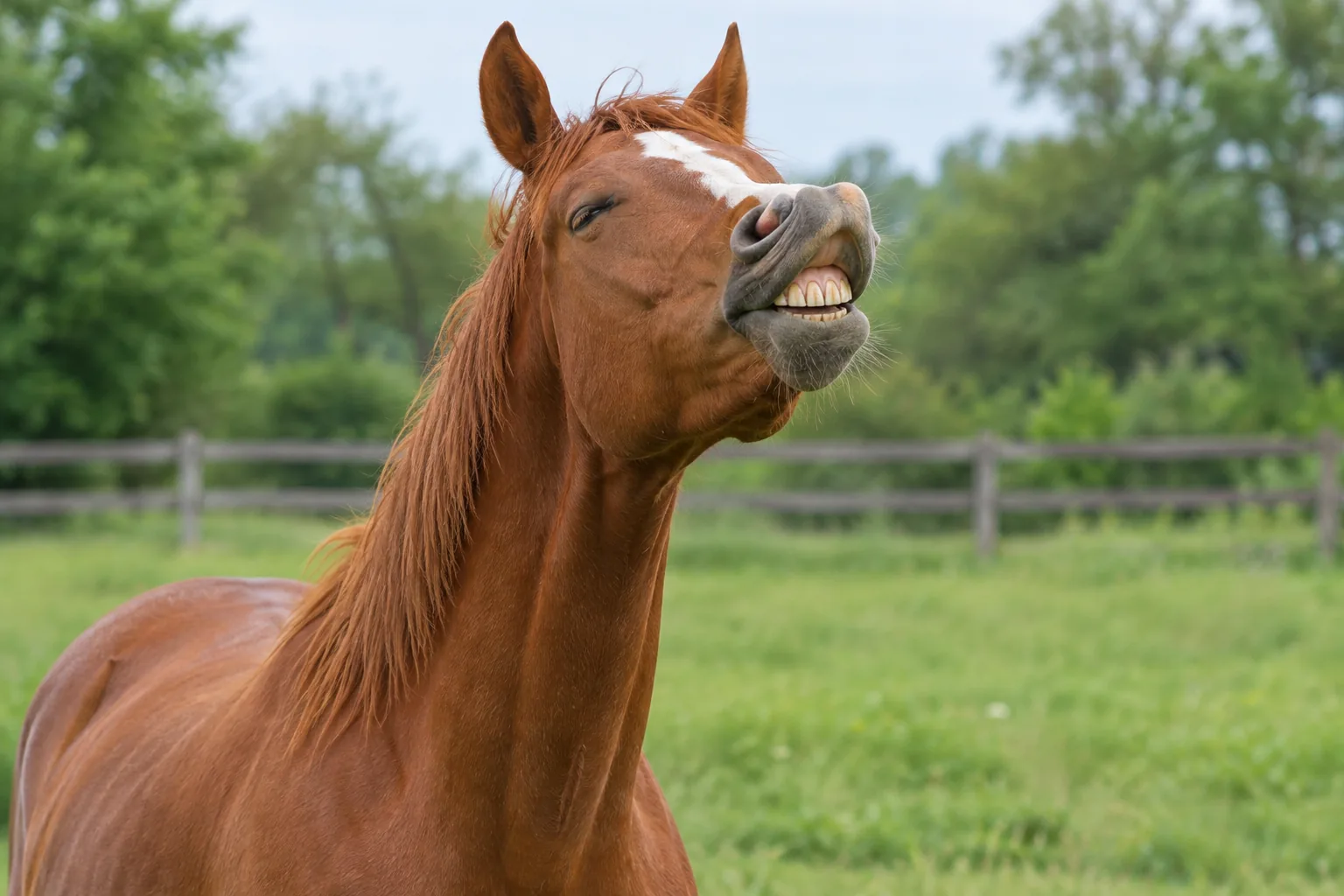
The study also notes a “surprising” number of similarities with humans and other primates. The white of the eye showing, for example, is linked to fear in many animals, ourselves included. And the most photographed expression in the yard, that upper lip curled back over the teeth, head in the air, finally has an official name: AU122. Riders call it the flehmen response, or more simply “the laughing horse.” He is not laughing at all: he is analysing a smell.
The Horse Grimace That Means “Leave Me Alone”
In 2016, the same Sussex team went further in the journal Scientific Reports. It described precisely the face of threat, what ethologists call the agonistic expression, the one used in conflict. The ears are rotated back and pinned flat against the skull. The nostrils are dilated and drawn up and back, which creases the skin along their upper edge. The lips are often pursed. Every muscle is tense. In extreme cases, the mouth opens and the incisors show: this is the threat to bite.
The researchers then showed 48 horses photographs of unfamiliar horses. The verdict: the horses tended to approach relaxed or attentive faces, and avoided this one. A second experiment measured their heart rate: it did not respond in the same way to an enthusiastic face as it did to a threatening one. No subtitles needed, the message gets across between horses the first time. In plain terms: back off.
Your Horse Can Also Read Anger on Your Face
The reverse is true, and it is a little humbling. Also at Sussex, a study published in 2016 in Biology Letters showed 28 horses photographs of two unfamiliar men, sometimes smiling, sometimes angry. Faced with the angry faces, the horses turned their heads to look with the left eye, the one linked to the right hemisphere of the brain, which specialises in threats. Their heart rate climbed faster, and they showed more stress behaviours.
In other words, your horse knows perfectly well when you arrive from work in a foul mood. He is hardly the first to read humans: in the early twentieth century, Clever Hans, the horse who could count in Berlin, answered correctly by reading the involuntary movements of the people questioning him.
Horse Ears Back: Bad Temper or Pain?
Here is the trap. Another grimace also begins with ears pinned back, and it does not mean “go away.” In 2014, Emanuela Dalla Costa and her colleagues published the Horse Grimace Scale in PLOS ONE, a pain scale built by observing 40 stallions before and after castration. It rests on six signs, each scored from 0 to 2: stiffly backward ears, a tightened eye, tension above the eye, prominent chewing muscles, a strained mouth with a pronounced chin, and tense nostrils with a flattened profile.
The difference from a threat shows in the rest of the face. A threat is aimed at someone: ears pinned, nostrils curling up, sometimes teeth. Pain, by contrast, tightens everything where it stands, right up to the eye and the jaw. The authors of the scale admit as much: reliably telling pain from fear or anxiety still needs further work. The grumpy horse is therefore not always a horse with a bad temper. The one that pins his ears as soon as the saddle goes on may have a good reason, and a poorly fitted saddle often makes horses pin their ears long before it leaves marks on the back.
When the grimace returns at fixed times (during grooming, girthing, feeding), noting it with the date gives your vet what they will never see in the consulting room, where the horse, naturally, puts on his best face. It is the simplest use of an online horse health record.
A Horse’s Ears Give Away What It Is Looking At
One last discovery, and not the least: ears are not only for grumbling. In 2014, Jen Wathan and Karen McComb showed in Current Biology that horses use the direction of another horse’s head to find food. Faced with a life-size photograph of a horse looking at one of two buckets, the observers chose the right bucket, but only when they could see both its eyes and its ears. With a mask over the eyes, or over the ears, they chose at random.
A horse’s ears therefore work like two pointers, and they are the best indicators of attention on the whole head, at least as good as the eyes. The day your horse has both ears fixed on the tack room door, there is no point pretending: he knows exactly where the treats are.

What We Know About Horse Expressions, and What It Rests On
What we rely on. The figures and descriptions in this article come from four peer-reviewed scientific publications: EquiFACS (Wathan, Burrows, Waller, McComb, PLOS ONE, 2015), the study of expressions between horses (Wathan, Proops, Grounds, McComb, Scientific Reports, 2016), the Horse Grimace Scale (Dalla Costa et al., PLOS ONE, 2014) and the study of attention (Wathan and McComb, Current Biology, 2014). The study of human faces (Smith et al., Biology Letters, 2016) is cited from the University of Sussex press release. “Leave me alone” is our own translation of the agonistic expression, the one the horses in the study avoided. A pain scale does not replace a vet: it helps you know when to call one.
And if your horse pulls a face at you while you read this article, do not take it personally: he has 17 ways of telling you so.