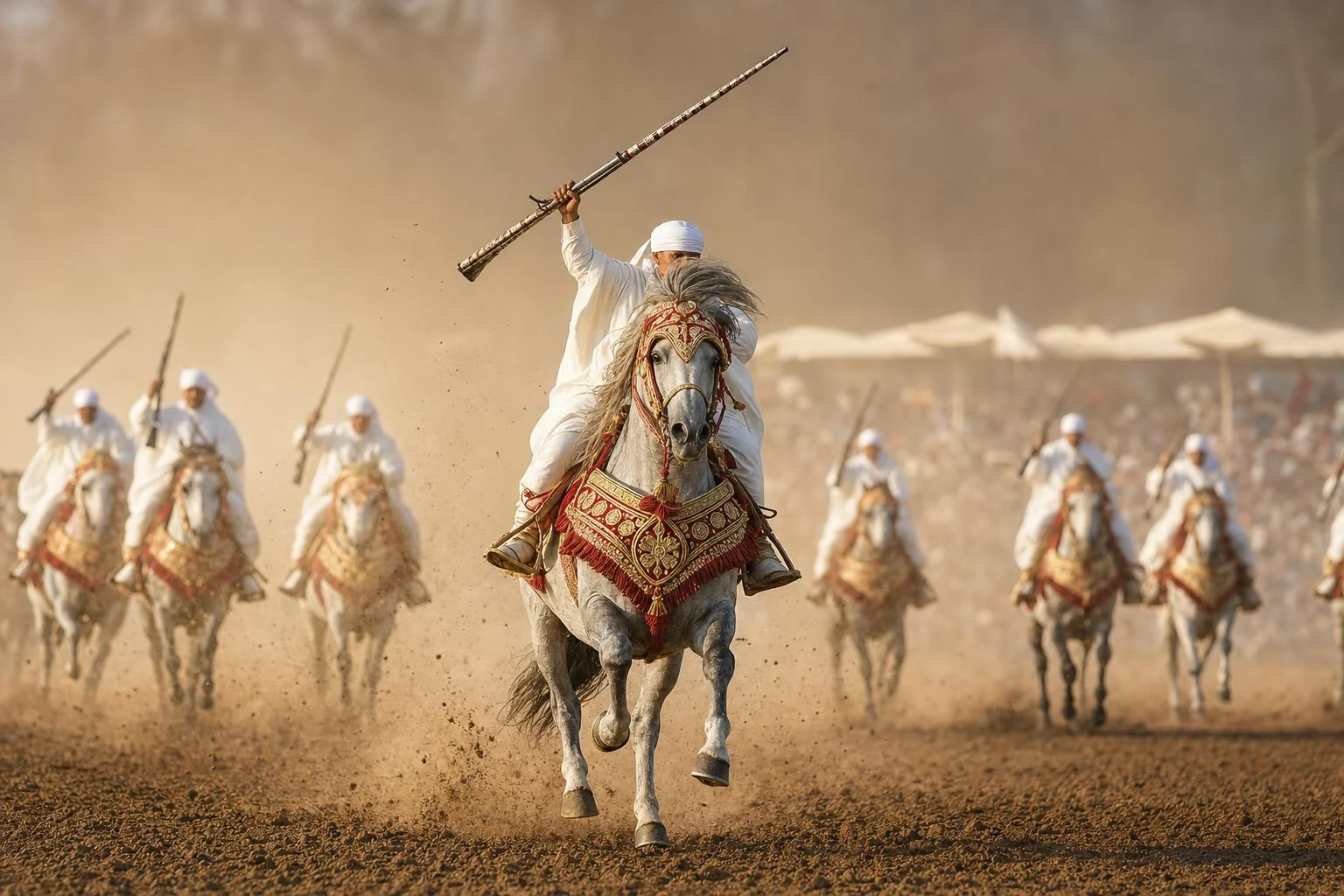

From Tuesday 13 to Sunday 18 October, the Mohammed VI Exhibition Park in El Jadida, on Morocco’s Atlantic coast, hosts the 17th edition of the Horse Show. Every afternoon, from 3pm to 6pm, the tbourida arena stages the Grand Prix of His Majesty King Mohammed VI of Tbourida, the fantasia that UNESCO added to the Intangible Cultural Heritage of Humanity in 2021. A sorba of at least fifteen riders sets off at the gallop, guns raised, and everything is decided in a single second: the shots must ring out together, as one detonation. The jury scores this synchronised volley out of 11 points, on every run.
El Jadida Horse Show 2026: tbourida every afternoon, 13 to 18 October
Founded in 2008 and held under the high patronage of the King, the El Jadida Horse Show is run by the Horse Show Association, chaired by Charif Moulay Abdallah Alaoui. The 2026 theme is “The horse at the service of mankind”, with the organiser stressing “respect, dignity and well-being” for the horse. The official opening takes place on Monday 12 October; the show is open to the public from 13 to 18 October, 9.30am to 6pm.
The official tbourida programme comes down to six appointments in the arena reserved for it, always from 3pm to 6pm:
- Tuesday 13, Wednesday 14, Thursday 15 and Friday 16: the four rounds of the Grand Prix of His Majesty King Mohammed VI of Tbourida.
- Saturday 17: the final.
- Sunday 18: a tbourida exhibition, outside the competition.
On its home page, the organiser describes the troops as “distinguished sorbas, each representing a region of the Kingdom”. At the second edition of this Grand Prix, in October 2022, eighteen sorbas from the twelve regions of Morocco competed, scored by five judges.
On video · 122 seconds
Tbourida at the 2026 El Jadida Horse Show: Fifteen Riders at the Gallop, One Single Shot
At least fifteen riders on Barb horses charge at the gallop, and the synchronised volley is worth 11 points on every run.

Tbourida: what is a sorba of riders and Barb horses?
Tbourida, known in the West as fantasia, stages a cavalry charge. The Moroccan file submitted to UNESCO traces it back to the 16th century and describes it as the simulation of a succession of military parades, following ancestral Arab-Amazigh rituals. The inscription was announced on 15 December 2021, during the online session of the intangible heritage committee.
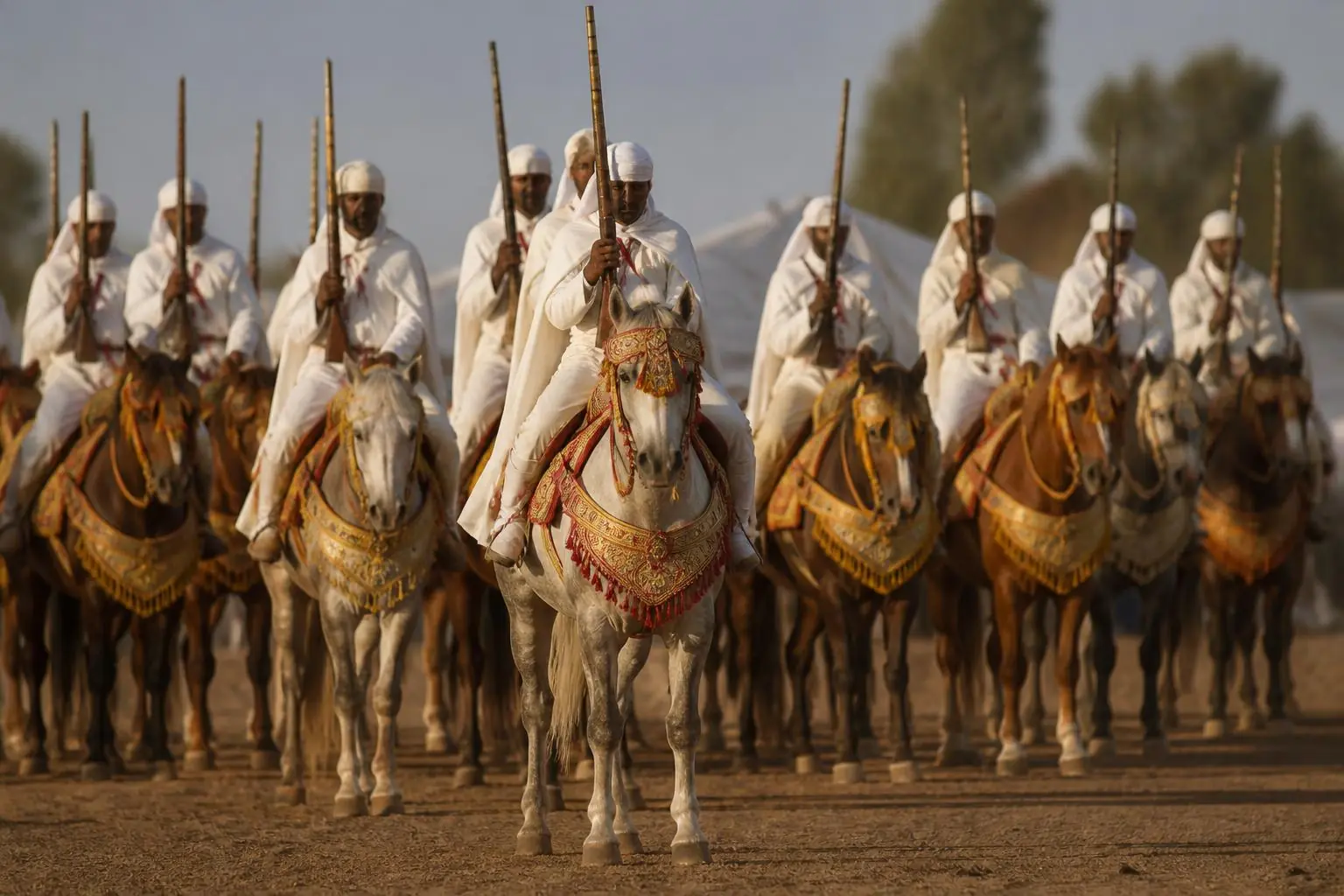
The basic unit is the sorba, a troop of fifteen to twenty-five riders in line, led by a chief positioned in the middle of the line, the mqaddem. The 2022 edition of the tbourida competition rules of the Royal Society for the Encouragement of the Horse (SOREC) sets the minimum at fifteen riders aged 17 and over for a senior troop, and eleven riders aged 12 to 16 for a junior troop. The horse, for its part, is not just any horse: every horse entered in an official competition “must be of Barb and/or Arab-Barb breeding”, with its papers and vaccinated against equine influenza.
The rider wears the dress of his region, the horse a high saddle covered in embroidered cloth, and each man carries a moukahla, the long traditional muzzle-loading rifle. The rules accept “any clothing and tack that is customary in the region of origin” of the sorba: there is no single costume, but as many traditions as there are regions, and that is precisely what the judges check.
How the jury scores a tbourida sorba: 25 points before a single stride at the gallop
The 2022 SOREC rules organise the judging out of 100 points, across two types of test. The first takes place before any run: the hadda (or tahia), the presentation of the troop to the jury. It is worth 25 points, divided as follows:
- The horses, 8 points: 4 for condition, 4 for the state of the feet and the conformation of the legs.
- Traditional dress, 5 points.
- Traditional tack and saddles, 6 points.
- The troop’s performance, 6 points: the alignment of the riders, the handling of guns and reins, the way the mqaddem animates the group, the movement of the horses.
In other words, nearly a third of the presentation mark concerns the horse itself, and half of those points concern its feet and legs. A sorba with splendid costumes but poorly kept horses starts with a handicap before it has covered a yard.
The riders’ shot in tbourida, scored out of 11 points on every run
Then comes the tbourida proper. A senior troop makes three runs, each scored out of 25 points:
- The start, 3 points: respect of the timing and a compulsory alignment.
- The exhibition, or laab, 11 points: the aligned run at the gallop, the handling of the guns and the simultaneous sequence of movements.
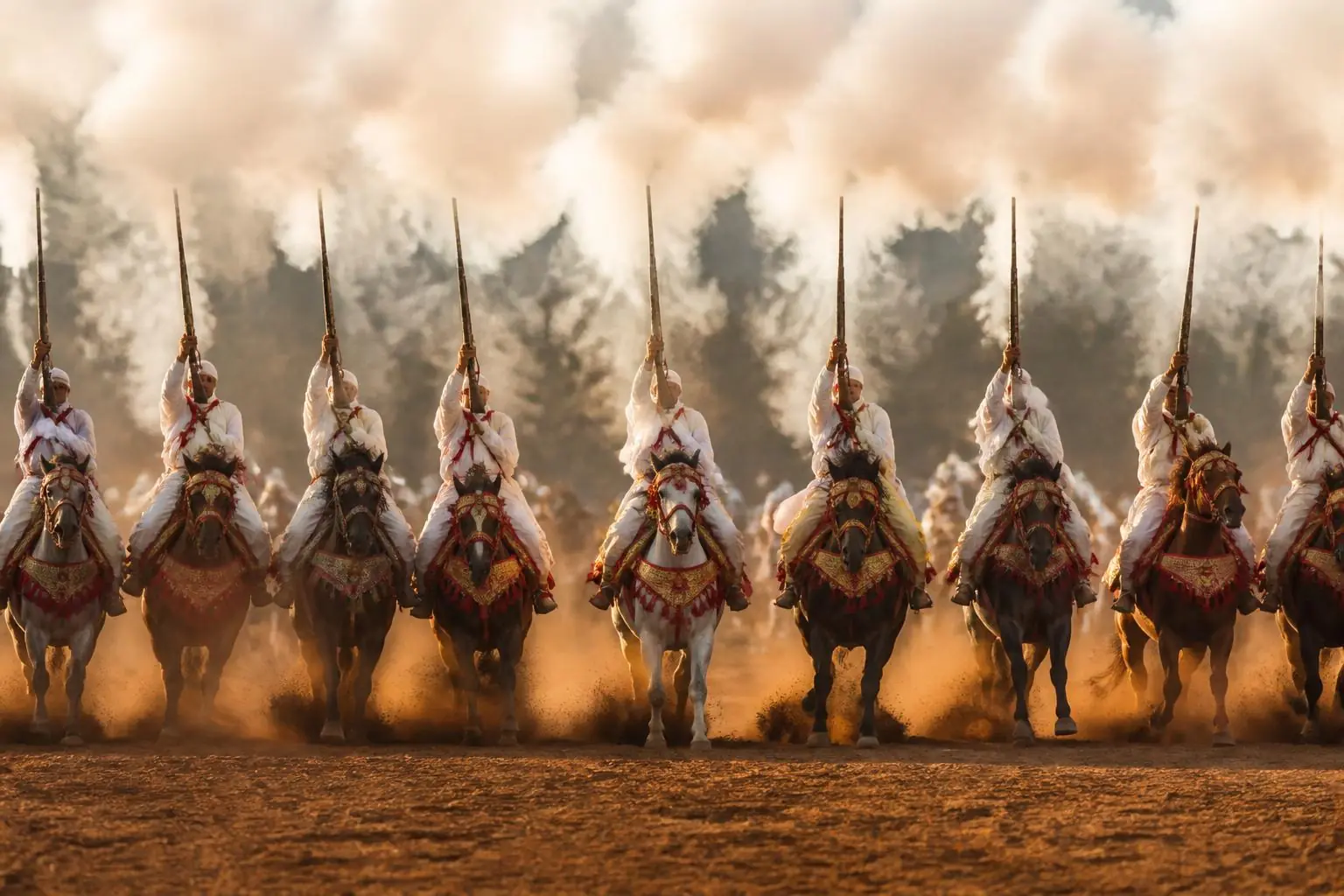
- The synchronised shot at the gallop, 11 points.
This final shot, the talqa, is the moment the whole arena waits for: at the mqaddem’s signal, the riders fire together, and the crowd listens for one single detonation rather than a ragged crackle. The rules provide for deductions at this precise moment: 2 points for every “burst gun” during the shots, and 1 point taken off the overall mark if the troop’s chief does not fire himself. In the event of a tie, it is again the talqa that decides: first place goes to the sorba with the most points on the shots, then to the one that made the best of its last volley.
At the interregional and national stages, each judge scores alone, and a mark that strays by more than 1.5 points from the average of the others is discarded. The rules give a worked example: in a hadda where one judge gave 16 while the average was 17.8, that mark is set aside and the average rises to 18.25.
- The horses: condition, feet and legs, 8 of the 25 presentation points.
- The regional tradition: dress (5 points) and tack with saddles (6 points), in keeping with the troop’s customs of origin.
- The cohesion of the troop: alignment, handling of guns and reins, the role of the mqaddem (6 points).
- The start: on time and aligned, 3 points per run.
- The gallop in line: aligned run and simultaneous movements, 11 points per run.
- The synchronised shot at the gallop: 11 points per run, with a 2-point deduction for each “burst gun” and 1 point if the chief does not fire.
Powder, horses, violence: the rules that protect tbourida and its horses
A charge of fifteen horses launched at the gallop with black-powder guns cannot be improvised. The SOREC rules first regulate the powder: riders must keep to the doses handed out by the organiser, in measured charges, and use its primers; a troop that uses other powder or other primers is disqualified. The moukahla must be in good condition, and riders must be on the course no later than one hour before the start of the competition.
The rules also govern the treatment of the horses. Any lame horse, or one showing signs of illness, is excluded from the competition. Any violence by a rider or an assistant towards a horse costs the sorba 2 points off its overall mark. Vaccination against equine influenza is checked: up to one month late on the annual booster, the owner pays a fine of 500 dirhams and the horse may compete; beyond that, it is withdrawn. These are the rules of a 2022 document; the theme the show has chosen for 2026, the well-being and dignity of the horse, echoes them.
At the El Jadida Horse Show, the showjumping moves up to CSI5*W
Tbourida does not have the bill to itself. El Jadida is the third and final leg of the Morocco Royal Tour, the international showjumping circuit founded in 2010, and its competition goes up a notch this year: it moves from CSI4*W to CSI5*W, the highest level on the international circuit, with a CSI2* run alongside. The organiser presents it as a World Cup qualifier. The CSI2* starts on Thursday 15 at 7pm, the two competitions share Arena A on Friday and Saturday, and the Grand Prix of His Majesty King Mohammed VI of Showjumping is run on Sunday 18 October.
The circuit’s first leg, in Tétouan, was won in early October by Switzerland’s Anthony Bourquard on Fontainebleau Manciais, ahead of 42 starters; he has said he is aiming next at Rabat and then the five-star in El Jadida. The show also hosts the breeding classes for Moroccan breeds: the Arab-Barb Breeders’ Cup on the morning of Friday 16, the Barb Champions’ Cup on the morning of Saturday 17, as well as the Moroccan Purebred Arabian Breeders’ Cup and the international conformation and movement show for purebred Arabians, ranked as a “Title Show”.
Watching tbourida in El Jadida: timings and Horse Show programme
The show is open from 9.30am to 6pm. The organiser announces more than 150,000 visitors, more than 1,100 horses, more than 700 riders, more than 100 exhibitors and more than 50 participating countries. For tbourida, the place to be is the dedicated arena, every day from 3pm to 6pm; Saturday 17 is final day, and Sunday 18 offers an exhibition with no ranking at stake, for those who simply want to watch the sorbas charge.
The official programme also includes tent pegging demonstrations, equestrian displays by the Royal Cavalry School of Témara, the Royal Gendarmerie, the DGSN and SOREC, as well as two Equestrian Nights, on Friday 16 and Saturday 17 October at 9pm, with a show billed as “Pride of Portugal”. We presented the line-up in our feature on the El Jadida Equestrian Nights 2026.
What we still do not know about tbourida 2026 in El Jadida
Five days before the first round, the organiser has not published the number of sorbas entered or their list by region. The scoring described above is that of the SOREC tbourida competition rules, 2022 edition, the latest we have been able to read in full; the El Jadida Grand Prix follows the same logic (hadda, then talqa scored on the start, the run, the handling of the guns and the synchronised shot), but we have not found its 2026 rules. Admission prices were not yet detailed as of 8 October. Finally, no scoring system can say in advance what the crowd will remember: the finest talqa is often the one you hear before you see it.
El Jadida Horse Show: official website (presentation, the 17th edition in figures, the president’s message, what’s new) and official 2026 programme (PDF consulted on 8 October); Royal Society for the Encouragement of the Horse (SOREC): “Programme of tbourida competitions, rules, 2022 edition”; Infomédiaire, “El Jadida Horse Show: 17th edition announced for 13 to 18 October 2026”; Morocco World News (7 October 2026); Labass.net, “Grand Prix of HM King Mohammed VI of Tbourida: 18 sorbas in competition” (19 October 2022); Medias24 and Hespress (inscription of tbourida by UNESCO, December 2021); Morocco Royal Tour, press release of 20 May 2026; Hespress and Le Matin (Tétouan Grand Prix 2026). Equirider is not affiliated with the Horse Show Association, SOREC or the Morocco Royal Tour.
Most tbourida horses are Barbs or Arab-Barbs: our feature on the Barb horse tells the story of this North African breed, one of the oldest in the equestrian world. To ride in Morocco yourself, far from the arenas, our selection offers a trail ride in Morocco, through the Sahara desert and its oases. And to compare with the queen of the conformation classes, read our feature on the Arabian horse.