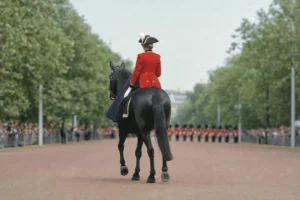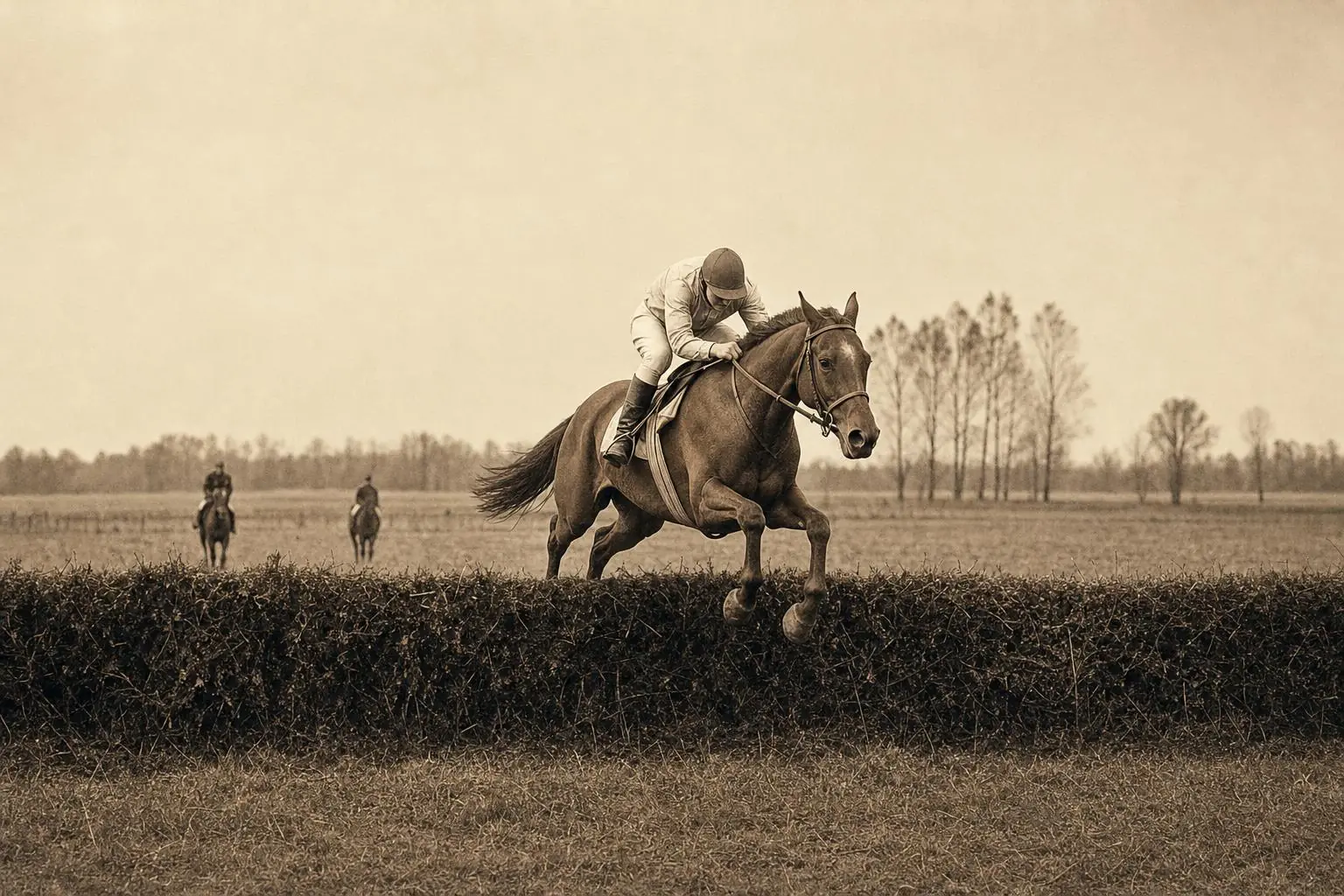

Pardubice, 17 October 1937. More than 40,000 people line the course of the Velká pardubická, the toughest steeplechase in Europe. At the start stand cavalry officers from Nazi Germany, the favourites, and a 42-year-old Czech countess on her chestnut mare, Norma. She wins by seven lengths. Eighty-nine years on, Lata Brandisová remains the only woman ever to have won the race. Two years after her victory, she begins to lose everything: her estate, then her home, then thirty years of her life in a hut deep in the woods.
Velká pardubická 1937: a woman and her mare Norma against the German officers
It helps to picture autumn 1937 in Czechoslovakia. Hitler has been in power for four years, Nazi propaganda is working on the German-speaking minority of the Sudetenland, and the border is never far away. The Velká pardubická is no ordinary race: about 4.3 miles (6,900 metres) today, cross-country, over enormous hedges and the Taxis ditch, which has already killed horses and broken riders. In the 1930s, German army officers turned up as a team, with top-class horses, and they often won. The British journalist Richard Askwith, who devoted a book to Lata Brandisová, writes that they had taken most of the previous editions.
So the crowd has not come simply to watch a horse race. It has come to see whether anyone on home soil can beat the Germans. And that someone is a woman, in a race that was said to be too dangerous for women.
Video · 121 seconds
Velká pardubická 1937: Her Mare Norma Beats the German Officers, Then the Countess Loses Everything
1937: at 42, Lata Brandisová wins the Velká pardubická on her mare Norma, ahead of the German officers. Then everything is taken from her.

Lata Brandisová, a 42-year-old rider in Europe’s toughest horse race
Marie Immaculata Brandisová, known to everyone as Lata, was born on 26 June 1895 at the castle of Úmonín in Bohemia. The family was noble, of Tyrolean origin, and decidedly short of money. Her father, Count Leopold von Brandis, bred horses. One detail matters: her paternal grandmother was the sister of Count Oktavian Kinsky, the founder of the Velká pardubická. Lata grew up in the saddle, in the very family that created the race.
She was no novice. In 1927 she started in the Velká pardubická and finished fifth, having fallen three times and remounted three times. With Norma she was third in 1933, then second in 1934. Every year, part of the press wrote more about her hairstyle than her riding, and on the course and off it she met with hostility from many of her fellow riders.
Three falls in a single race, in headgear that bore no comparison with today’s: that was the norm then. Nowadays a rider heading for a fence starts with certified equipment, and the first purchase remains the riding helmet, which is worth choosing with care.
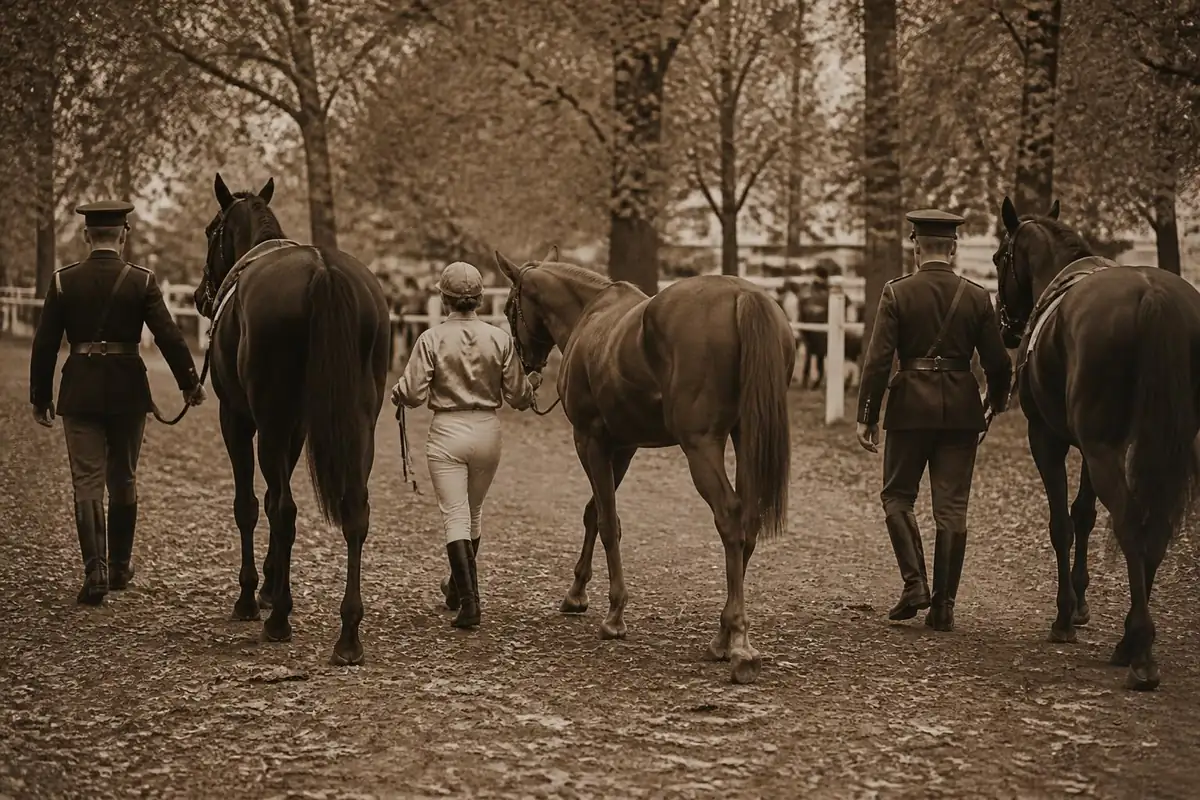
17 October 1937: how the mare Norma won the Velká pardubická
The race is a battle of attrition. At the Taxis ditch, the German Oskar Lengnik, already a two-time winner, takes a heavy fall. He breaks his collarbone, remounts and rides on. Further on, out of sight behind a wood, another German officer, Willibald Schlagbaum, tries several times, according to Askwith’s account, to cut across the mare and force her rider against a wall. Lata does not rise to it. She stays calm, lets Norma jump, and Norma does not put a foot wrong: those who saw her run describe her as an almost infallible jumper.
Behind them, the field empties. According to the same account, five horses fall at the Serpent ditch, and eight of the twelve military riders entered fail to finish. Norma passes the post seven lengths clear. Lengnik, who finished behind with his broken collarbone, comes over to congratulate the winner, then collapses. He is taken to hospital.
What follows looks like a national festival. Some 10,000 people escort the countess and her mare from the racecourse to the town’s main square. In a country that knows it is under threat, a 42-year-old woman has just beaten the Reich’s officers on their favourite ground.
After the Velká pardubická: the rider loses everything, under the Nazis and then the Communists
This is where the story turns. In March 1939, Germany occupies what remains of Czechoslovakia. The Brandis estate is among the first to be confiscated. During the war Lata helps the Czech resistance, and in May 1945, during the liberation of Prague, she brings food and tends the wounded.
Peace gives her nothing back. After the Prague coup of February 1948, the Communists seize power, and a countess is a class enemy. Lata and her sisters end up in a small house deep in the woods, where they live in poverty for more than thirty years. The winner of the Velká pardubická, the heroine of 1937, vanishes from the official story. She dies of pneumonia on 12 May 1981 at Reiteregg, in Austria, aged 85.
What we still do not know about the mare Norma
The mystery is the horse. Norma escaped the wartime requisitions of horses, which was no small thing: the armies took everything with four legs. After that, her trail goes cold. In Czech racing circles, nobody knows for certain what became of her, or where she died. The mare who beat the German officers has no known grave.
We also know little about her origins: the sources we consulted give neither her exact breed, nor her breeding, nor her age in 1937. We would rather say so than invent it.
The only woman to win the Velká pardubická, eighty-nine years on
Since 1937, no woman has done what Lata Brandisová did. Women riders have started, some have finished placed, but victory still eludes them. On Sunday 11 October 2026, Lenka Neprašová, the ninth woman in the history of the race to take the start, finished fourth on Sacamiro. The full story of that edition, lost by half a length to Godfrey, is in our article on the 2026 Velká pardubická and Josef Váňa’s record.
Other women have had to fight to reach the top level, such as Princess Anne, the only competitor at the 1976 Olympic Games exempted from a sex test: her story is told in our account of Princess Anne and the Queen’s horse. To gauge what a race like Pardubice means, our feature on the most dangerous equestrian discipline looks at the risks of jump racing.
Established: the victory of Lata Brandisová and Norma on 17 October 1937, the only female win in the race’s history; her placings in 1927, 1933 and 1934; the confiscation of the estate after 1939; the life in the woods after 1948; her death in Austria on 12 May 1981.
According to one main source (Richard Askwith’s book and the interviews he has given): Willibald Schlagbaum’s manoeuvre against a wall, Oskar Lengnik’s fall and collapse, the five falls at the Serpent ditch, the eight military riders out of twelve who did not finish, the number of German wins before 1937.
Unknown: the breed, age and fate of the mare Norma after the war. The crowd figures (40,000 spectators, 10,000 people in the procession) come from accounts of the time and remain approximate.
Sources for the account of the 1937 Velká pardubická and Lata Brandisová
Richard Askwith, Unbreakable, The Woman Who Defied the Nazis in the World’s Most Dangerous Horse Race (2019); interview with Richard Askwith on Only A Game (WBUR, 2019); Radio Prague International, profile of Lata Brandisová; biographical entry on Lata Brandisová (English Wikipedia); Velká pardubická roll of honour, Pardubice racecourse.