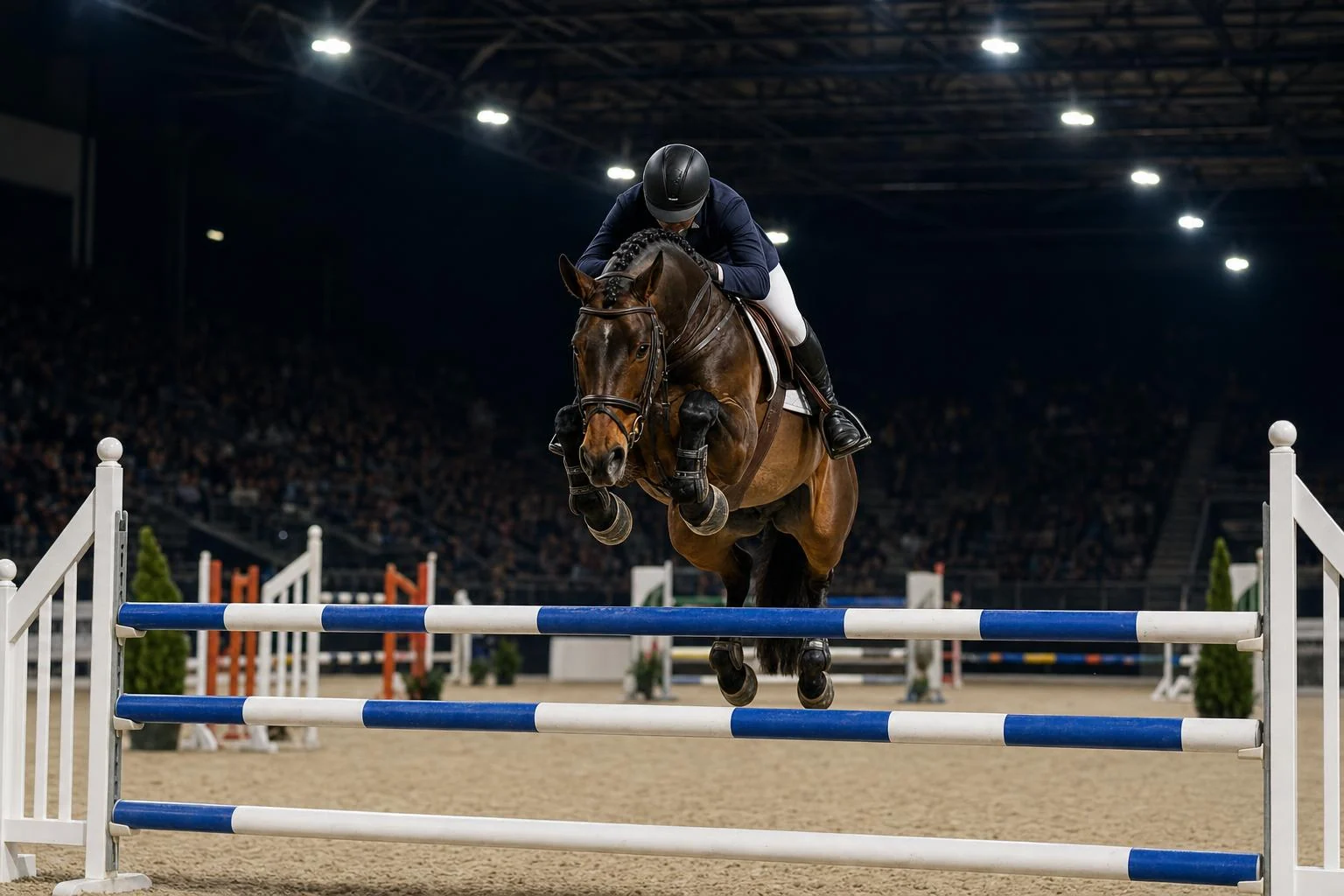

On Wednesday 7 October, the showjumpers move under a roof for five months. Oslo opens the Western European League of the Longines FEI Jumping World Cup, the indoor season that strings together thirteen legs until March, from Norway to Finland. Two of them are held in France, in Lyon at the end of October and in Bordeaux in February. The calendar published by the International Equestrian Federation already gives the start time of every deciding class, and the date of the final: Gothenburg, 24 to 28 March 2027.
Oslo, 7 to 11 October: the opening leg of the Jumping World Cup
The Western European League opens in Norway. The Oslo show runs from Wednesday 7 to Sunday 11 October 2026, and the FEI schedules the World Cup class for Sunday 11 October at 15:30 local time. Norway and France share a time zone, and the clocks do not change until 25 October, so the start is 15:30 for a French spectator and 14:30 in the UK.
Nobody will win the World Cup that Sunday, but everybody will start playing for it. Every leg awards points to the best-placed riders of the day, and it is those points, added up from October to March, that decide who flies to the final. A rider who misses the start of the season spends the winter chasing. In every other respect the format is no different from a Grand Prix: fences, the clock and a jump-off, as our guide to the showjumping competition explains.
Video · 120 seconds
Jumping World Cup 2026/2027: Thirteen Legs, Two in France
Thirteen legs, including Lyon and Bordeaux, ahead of the Gothenburg final in March 2027.

The full 2026/2027 Jumping World Cup calendar
Thirteen legs, nine countries, five months. Here is the Western European League calendar as the FEI publishes it, with the day and local start time of each World Cup class.
| Leg | Dates | World Cup class |
|---|---|---|
| Oslo (Norway) | 7 to 11 October 2026 | Sunday 11 October, 15:30 |
| Lyon (France) | 27 October to 1 November 2026 | Sunday 1 November, 15:30 (15:00 according to the organiser) |
| Verona (Italy) | 5 to 8 November 2026 | Sunday 8 November, 14:30 |
| Stuttgart (Germany) | 11 to 15 November 2026 | Sunday 15 November, 15:10 |
| Madrid (Spain) | 26 to 29 November 2026 | Sunday 29 November, 15:00 |
| A Coruña (Spain) | 3 to 6 December 2026 | Sunday 6 December, 17:00 |
| London, ExCeL (United Kingdom) | 16 to 21 December 2026 | Sunday 20 December, 14:35 |
| Mechelen (Belgium) | 26 to 30 December 2026 | Wednesday 30 December, 15:00 |
| Basel (Switzerland) | 7 to 10 January 2027 | Sunday 10 January, 14:15 |
| Leipzig (Germany) | 13 to 17 January 2027 | Sunday 17 January, 15:45 |
| Amsterdam (Netherlands) | 28 to 31 January 2027 | Sunday 31 January, 15:30 |
| Bordeaux (France) | 4 to 7 February 2027 | Saturday 6 February, 20:00 |
| Helsinki (Finland) | 4 to 7 March 2027 | Sunday 7 March, 14:00 |
One pattern stands out when you read the whole table: eleven of the thirteen legs are decided on a Sunday afternoon, always between 14:00 and 16:00. Two are the exception, and they are the two dates a spectator remembers. Mechelen is run on a Wednesday, 30 December, between Christmas and New Year, when equestrian Belgium settles in for the week. And Bordeaux is the only leg in the whole league held at night, on Saturday 6 February at 20:00, with packed stands and the lights turned down.
Lyon and Bordeaux, the two French legs of the Jumping World Cup
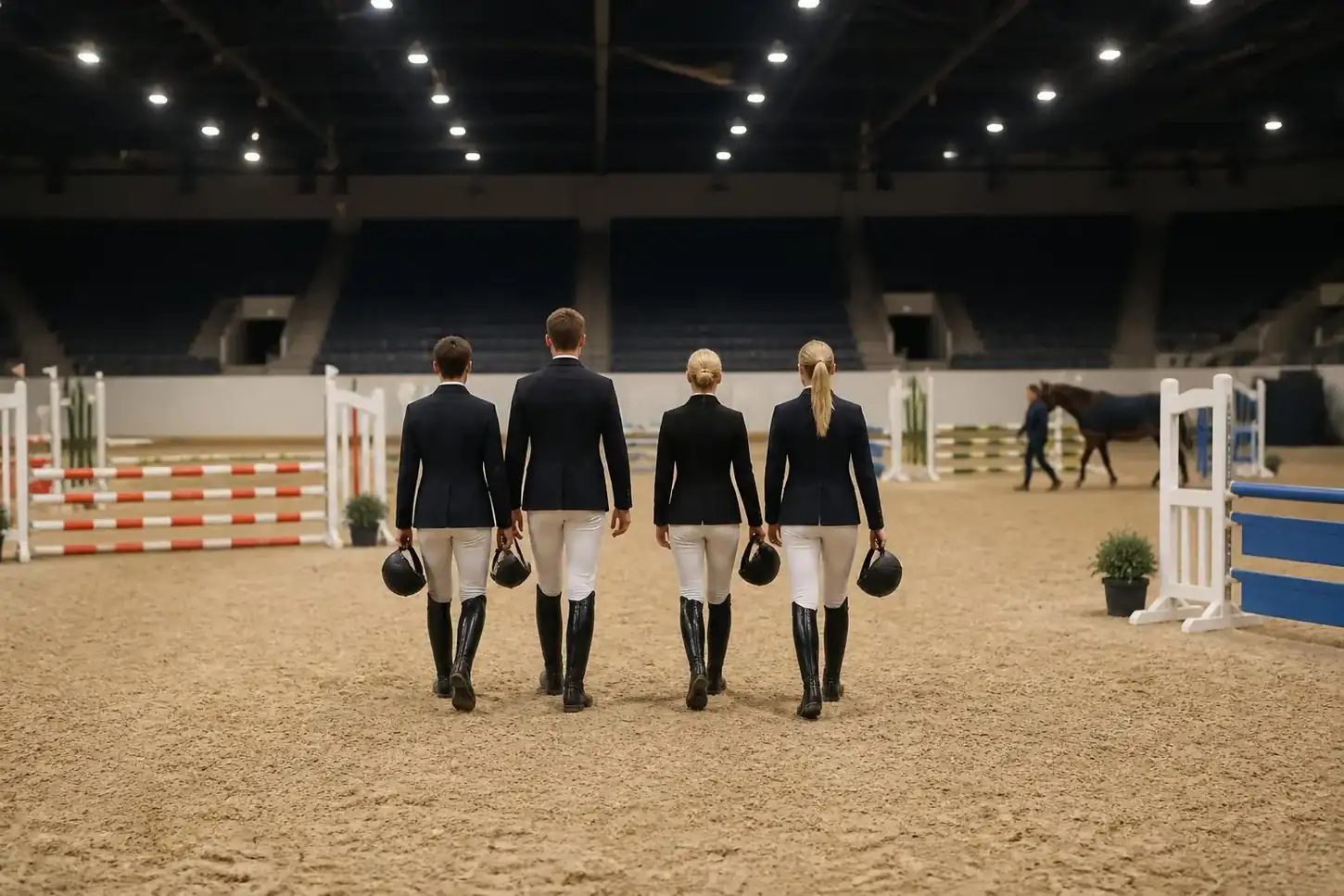
France hosts twice this winter. First at Eurexpo, where Equita Lyon 2026 opens its doors from Wednesday 28 October to Sunday 1 November. Five days of trade fair and competition, with the Longines Grand Prix on Friday evening, the Equita Masters on Saturday evening, and the Jumping World Cup leg to close on Sunday 1 November, which the FEI schedules for 15:30 (the organiser says 15:00). Lyon also stages World Cup legs in dressage and driving, which makes it the most complete fixture of the French autumn.
Then Bordeaux, from 4 to 7 February 2027. The Bordeaux International Jumping has kept its signature: the feature class is not run on Sunday but on Saturday night. Of the thirteen legs in the league, it is the only one scheduled for 20:00. For a rider, that changes the entire day, from the time of the warm-up to the horse’s last meal. For a spectator, it makes for the best atmosphere on the circuit.
These two dates are also the only chances this winter to see the best horses in the world within a day’s drive. If you are planning the trip, our event pages and our tack and equipment comparisons will save you from setting off with the wrong kit in the boot.
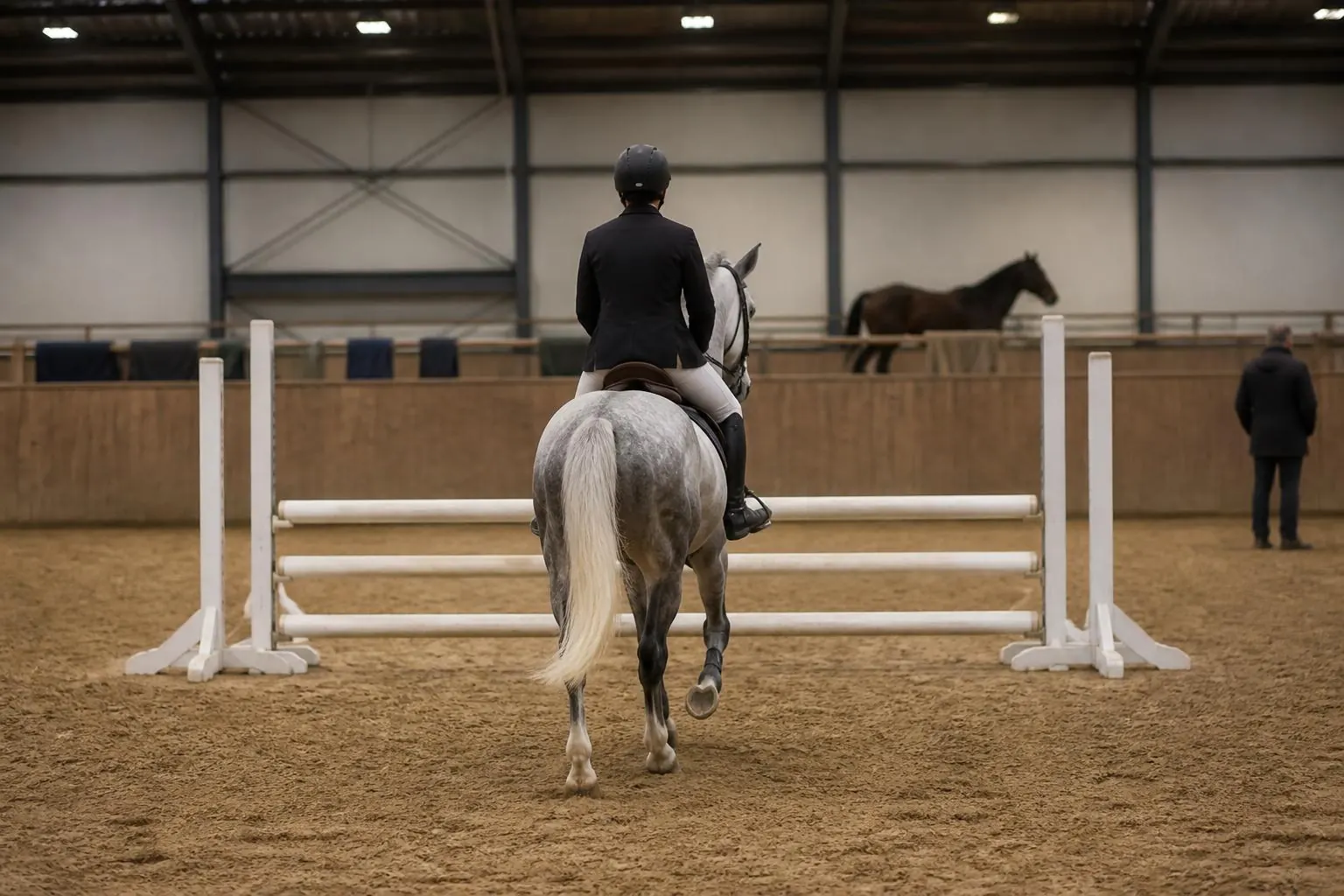
Why showjumpers spend the winter under a roof
The thirteen legs have one thing in common: they are all held in covered halls, from the ice rink in Basel to the exhibition centre in Amsterdam by way of Eurexpo. That is what earns the Western European League its nickname of the indoor season, and why it fills exactly the months when the summer grass arenas are unusable.
An indoor course is not a summer course made smaller. The arena is often less than half the size of an outdoor ring, the turns come up faster, the distances between fences are shorter and the surface is worked sand, watered and harrowed between classes. You need a horse that is quick through the corners, attentive and able to shorten in two strides. Some horses are true indoor specialists and hardly compete at all between October and March.
Artificial light adds its own difficulty. Spotlights flatten the relief and alter how the poles are perceived, a subject we covered in our piece on how horses see colour, and why they do not see orange as we do. Add the noise, the music, the stands close to the rail, and sometimes a crowd six feet (two metres) from the landing.
- Faults first: four points for every fence down, and the clear round remains the only currency that counts.
- The clock second, to separate the clear rounds in the jump-off, never before.
- World Cup points awarded for the day’s result, which accumulate across the whole league.
- Consistency over the season rather than a flash of brilliance: one leg won qualifies nobody on its own.
- The number of legs ridden by the combination, a permanent trade-off between points to be won and freshness to be kept.
- Mastery of the turns, which is worth more seconds indoors than speed in a straight line.
- Recovery between legs, sometimes separated by four days and six hundred miles (a thousand kilometres) by lorry.
- Getting past the officials, the veterinary and equipment checks, which can rule a horse out before it reaches the ring.
Épaillard, then Farrington: the last two Jumping World Cup finals
The season now opening has a fresh French precedent. In April 2025, in Basel, Julien Épaillard won the World Cup final with Donatello d’Auge, a gelding he bred himself. The FEI and the specialist press presented the victory as the first French title in this final for some twenty years.
Twelve months later, the title crossed continents. The 2026 final was run from 8 to 12 April at the Dickies Arena in Fort Worth, Texas, and went to American Kent Farrington with Toulayna Greya, his first World Cup title, ahead of Germany’s Daniel Deusser and America’s Katherine Dinan. Épaillard, the defending champion, had not made the trip.
That to-and-fro says a lot about this circuit: a whole season of travel for a handful of tickets. The French team arrive in good heart in any case, after winning the League of Nations in Gassin on 20 September, and this winter we will meet the same names as on the big summer circuits, from the Rolex Grand Slam to the world championships.
Gothenburg, 24 to 28 March 2027: the Jumping World Cup final
The finishing line is fixed. The FEI has announced the Longines Jumping World Cup final in Gothenburg, Sweden, from 24 to 28 March 2027. The venue is no accident: the very first Jumping World Cup final was held in this city in 1979, and Sweden has since become the most regular host of the event.
To get there, you have to finish near the top of your league. Last season the FEI qualified the top eighteen of the Western European League, joined at the final by the best of the other leagues around the world, and awarded points to the top sixteen of each leg. The 2026/2027 rules can be read on the federation’s website, but the order of magnitude hardly changes from one season to the next.
The Western European League is not the only one in the running, either: the Central European League stages its own final in Kraków, Poland, from 18 to 21 February 2027, and also sends its best riders to Sweden. Between now and then lie five months of indoor shows, and a first answer on Sunday 11 October in Oslo.
- The Western European League opens in Oslo from 7 to 11 October, with the World Cup class on Sunday 11 October at 15:30.
- Thirteen legs until March, in nine countries, all held indoors.
- Two French legs: Lyon from 28 October to 1 November, Bordeaux from 4 to 7 February 2027.
- Eleven of the thirteen legs are decided on a Sunday afternoon; Mechelen is run on a Wednesday and Bordeaux is the only night leg, Saturday 6 February at 20:00.
- The final is held in Gothenburg from 24 to 28 March 2027, in the city of the very first final, in 1979.
- Latest winners: Julien Épaillard and Donatello d’Auge in 2025 in Basel, Kent Farrington and Toulayna Greya in 2026 in Fort Worth.
To follow the winter in the best conditions, our equestrian sports section keeps track of the big fixtures, and our guide from the pony club to the Olympic podium explains how the classes work for anyone new to the discipline. And if you feel like taking on the fences yourself this winter, start with the one piece of kit nobody argues about: a riding hat that fits you and meets the current standard.