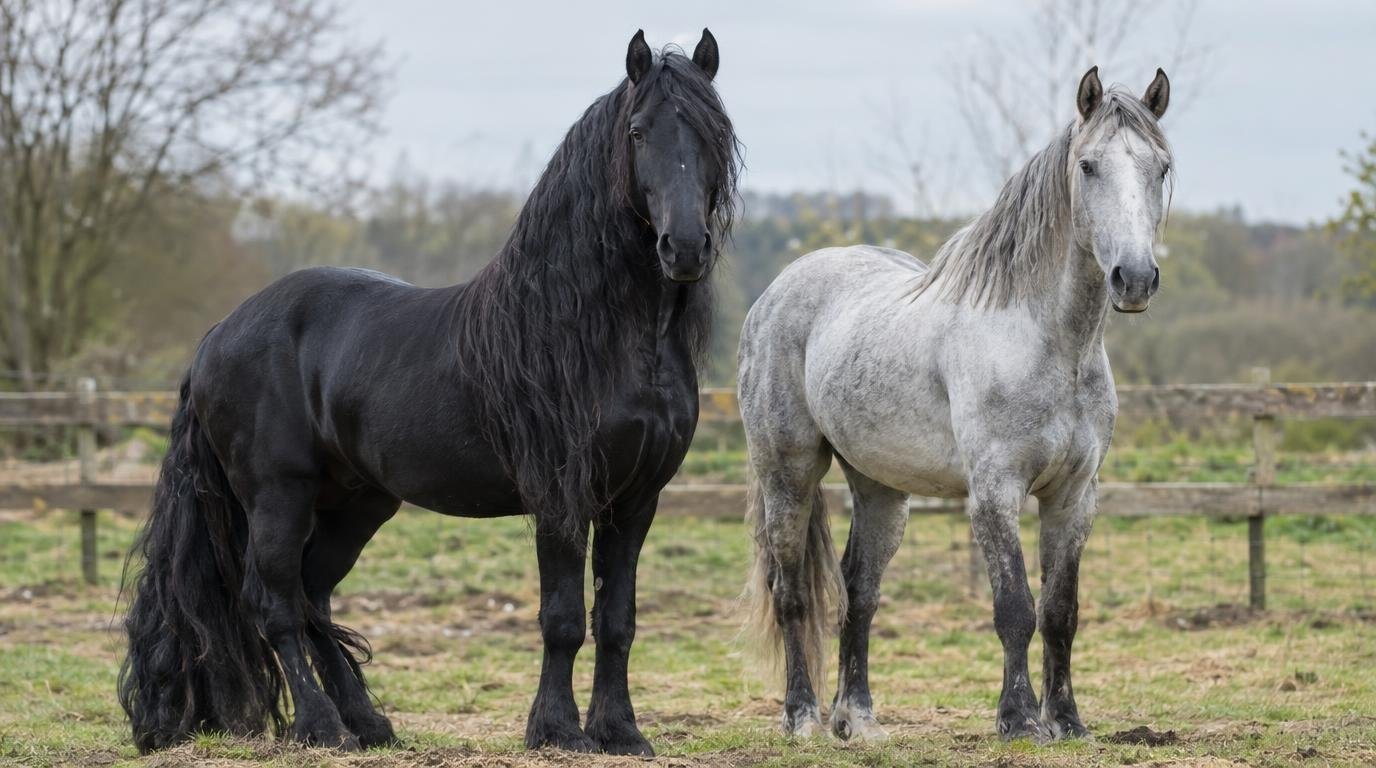

The Friesian is known around the world for one thing first: its deep black coat. So photos of a pure white Friesian, shared thousands of times on social media, raise a fair question. Does the white Friesian horse exist, or is it a myth? This article looks at the genetics of the breed, at the rules of its studbook, and at what the horses sold as “white Friesians” are.
The Friesian: a black heritage
Friesians come from Friesland, in the north of the Netherlands, and they are famous for their glossy black coat. That color is the result of strict selection over more than a century. The Dutch studbook, the KFPS, registers black horses only: a small star on the forehead is tolerated on mares and geldings, and approved stallions must be solid black. A purebred, registered Friesian of any other color does not exist in the studbook.

The genetics behind coat color
A horse’s coat color is set by its genes. Many genes play a part, but two decide most of it. The Extension (E) gene controls whether the horse makes black pigment, and the Agouti (A) gene decides whether that black covers the whole body or only the points (mane, tail, legs). Friesians carry no Agouti that restricts the black, and they carry no cream gene, the dilution that lightens a coat. The result is a solid black horse.
One exception exists: some Friesians carry a hidden copy of the chestnut (red) gene. Two carriers bred together can produce a chestnut foal. The KFPS tests breeding stallions for this gene and works to remove it, so chestnut Friesians are rare and cannot be entered in the main studbook. A chestnut Friesian is still brown or red, never white.
Myths and facts: the white Friesian
To be clear about the white Friesian, separate the photos from the genetics. The genes that produce a white coat in other breeds, the dominant white (W) family, cause complete depigmentation in some horses. They have not been found in Friesians. A purebred Friesian does not turn white. Other causes, covered below, explain most of the “white Friesians” you see online.
Genetic mutations
Spontaneous mutations occur in every species, horses included. A new white mutation appearing in a Friesian is possible in theory. No case has been documented in the scientific literature or recognized by the studbook.
Health conditions and aging
Some conditions, such as vitiligo, cause depigmentation of the skin and hair in patches, mostly around the eyes and muzzle. With age, some black horses also grow a few white hairs. Neither turns a black Friesian into a white horse.
The gray gene
In the horse world, the gray gene is the one that turns a coat silvery white over the years. A gray foal is born dark and lightens with each coat change. Purebred Friesians do not carry the gray gene. A “Friesian” that turns gray or white is a crossbred, usually a Friesian crossed with an Andalusian, a Lipizzaner or an Arabian. These crosses are often sold as “Friesian Sport Horses” or “Friesian crosses”, and they make most of the white Friesian photos online.

Albinism and leucism
Albinism and leucism are two different conditions that give some animals a white or nearly white coat. True albinism, a total absence of pigment with pink eyes, has never been documented in horses. White horses with dark eyes carry dominant white or similar genes, which come close to leucism. No case of either has been confirmed in purebred Friesians.
Bottom line: if a seller offers you a white Friesian, ask for the papers. A KFPS-registered Friesian is black. A white horse with a Friesian mane and feathering is a cross, and its price should reflect that. To learn more about the breed itself, read our full Friesian horse guide.