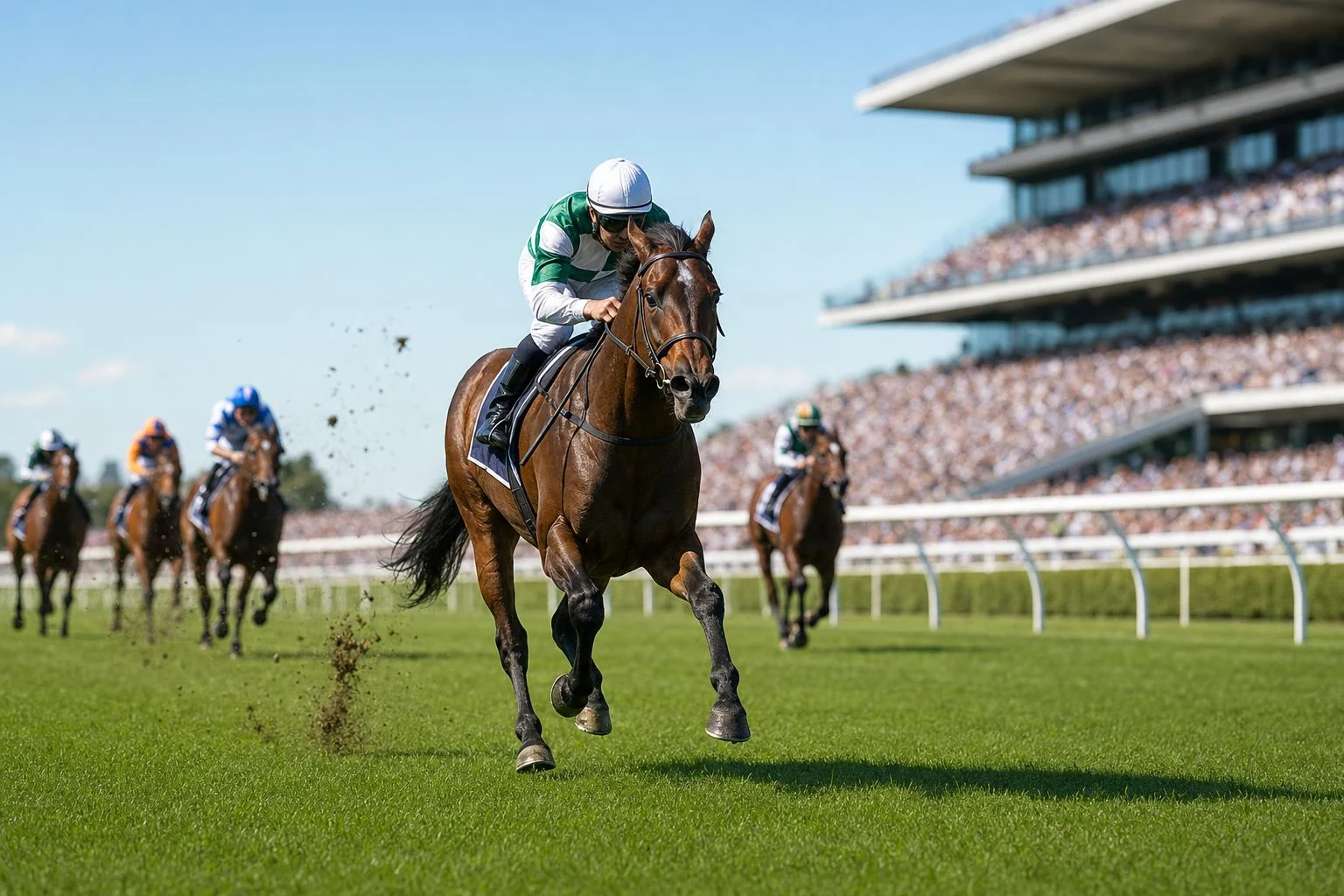

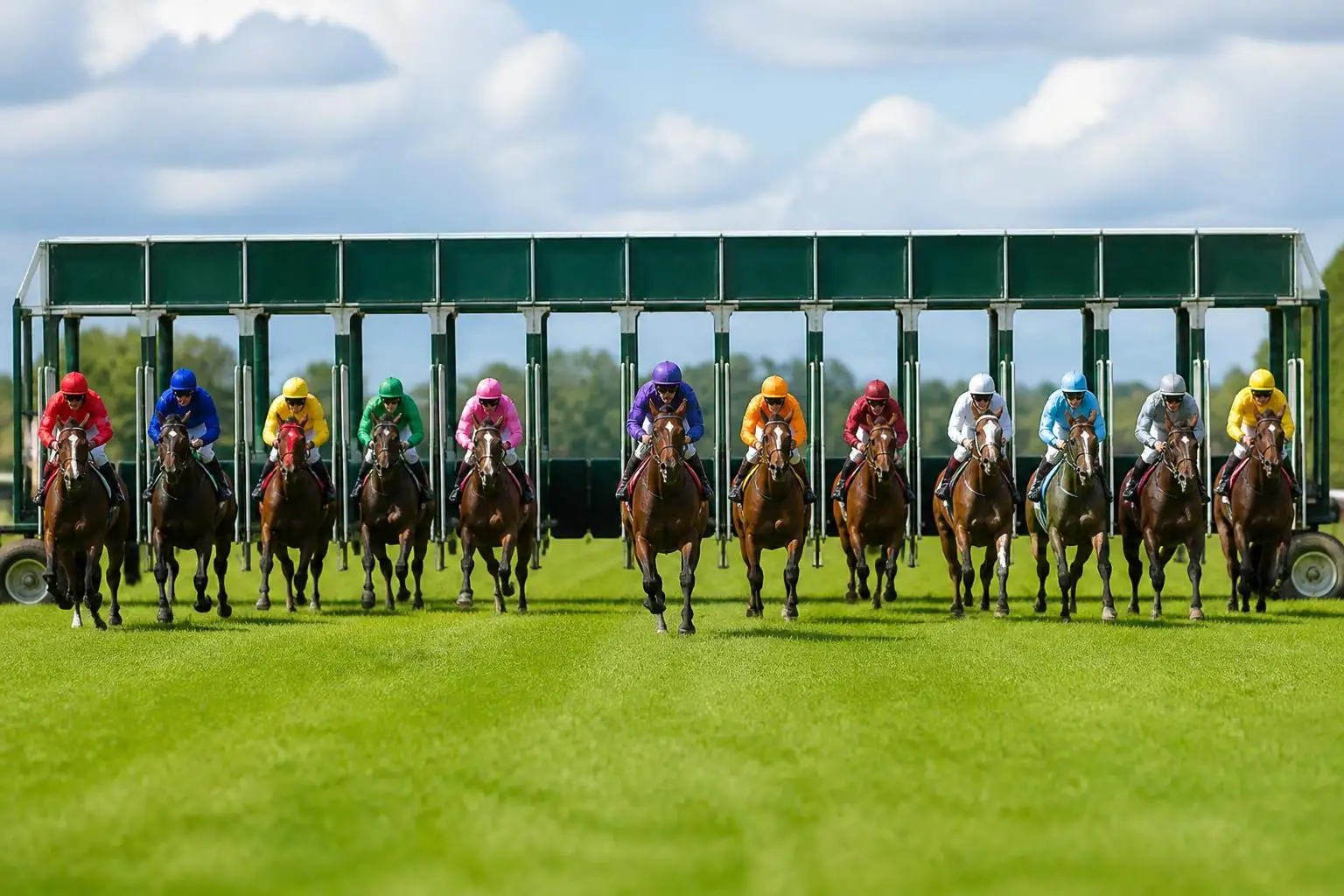
On Saturday 17 October, at Royal Randwick in Sydney, twelve horses will line up for The Everest: 1,200 metres (about six furlongs) on turf, A$20 million in prize money, the richest turf race in the world. Yet not one of those horses qualified. Every place was bought for A$700,000 (excluding tax) by a “slot holder”, a stable, a club or an institutional punter, who then chooses the horse to run. And the 2026 conditions contain one detail that says everything about this race: the horse that finishes twelfth, last of all, earns A$700,000, exactly the price of the slot.
The Everest 2026 at Randwick: A$20 million for a 1,200-metre race
The official 2026 conditions, published by Racing NSW and the Australian Turf Club, fit into a few lines. The Everest is run on Saturday 17 October 2026 at Royal Randwick over 1,200 metres (6 furlongs), for horses aged three and over. It is a sprint with a single turn, over in a little more than a minute and eight seconds: the 2025 winner clocked 1:08.13. The race takes place in the afternoon in Sydney, which puts the start early on Saturday morning in France, nine hours behind.
The field is limited to twelve runners, plus a maximum of six emergencies. Weights are set by age, with no apprentice allowance: 129 lb (58.5 kg) for males aged four and over, 125 lb (56.5 kg) for mares of the same age, 117 lb (53 kg) for three-year-old colts and geldings and 112.5 lb (51 kg) for fillies. The conditions provide a separate scale for horses born in the Northern Hemisphere, who are a few months younger at the same official age.
The A$20 million is divided as follows:
- 1st: A$7,000,000, plus trophies valued at A$730,000 (A$625,000 for the owner, A$52,500 for the trainer, A$52,500 for the jockey).
- 2nd: A$2,900,000; 3rd: A$2,000,000; 4th: A$1,500,000; 5th: A$1,200,000; 6th: A$950,000.
- 7th to 12th: A$700,000 each.
- A$250,000 paid into a fund dedicated to horse welfare.
For a sense of scale, the Prix de l’Arc de Triomphe, run on 4 October at ParisLongchamp, carried €5 million. The Everest distributes more than double that, over a distance half as long.
On video · 119 seconds
The Everest 2026: a slot costs A$700,000, and the horse that finishes last earns the same
The 12 slots sell for A$700,000 each, and the horse that finishes last earns exactly that sum.

The right to run is bought before the horse: how the 12 slots in The Everest work
In a major conventional race, a horse earns its place through results, and its owner then pays the entry fee. The Everest reverses the order. The twelve places, known as “slots”, are licences sold by the organisers, generally for several seasons. For 2026, the licence costs A$700,000 plus tax a year, paid in two non-refundable instalments of A$350,000, the first due before 1 February. At that point the slot holder has no horse at all: they have bought a right, which they must fill with the best sprinter they can persuade to run.
The twelve 2026 holders listed by the Australian racing press are a very mixed group: the Hong Kong Jockey Club in partnership with the Australian Turf Club, the betting operator TAB, the powerhouse stables Coolmore and Godolphin, the sales company Inglis, trainer Chris Waller, Yulong Investments, Mulberry Racing, Fairway Thoroughbreds, Newgate with GPI Racing, James Harron, and a syndicate of investors built around the Whitby, Madden, McCain and Werret families.
Between the slot holder and the horse’s owner, everything is negotiated privately: share of winnings, who bears the costs, the colours the jockey wears. It is a market in its own right, and it comes alive from the end of the Australian winter. In early September, for instance, Fairway Thoroughbreds, the vehicle of John Camilleri, announced that its slot would go to Ninja, a four-year-old trained by Michael Freedman, who had just won the Missile Stakes, a Group 2 over 1,200 metres, by 1.2 lengths. The deadline to name the twelve runners is set for Tuesday 13 October at 10am, Sydney time.
The last-placed horse pays back its slot: what each runner in The Everest earns
The most revealing figure in the conditions is not the winner’s. From 7th to 12th, each horse earns A$700,000, which is exactly the pre-tax cost of the licence. In plain terms, a holder who manages to field a runner recovers at least their stake, whatever the result. The loss comes elsewhere: from the tax, from the share negotiated with the horse’s owner, and from an empty slot if no horse turns up.
The conditions are harsh on absentees. If the nominated horse is withdrawn before 7.30am on the morning of the race, the holder may replace it with one of the emergencies, drawn from the runners in the Sydney Stakes, a A$2 million race over the same distance, run on the same day as a consolation prize. After 7.30am, no replacement is possible and the slot stays empty. The holder then receives the last-place sum if the horse was withdrawn by the official veterinarian, and nothing at all in any other case.
The emergency runner is the only case in which the conditions themselves set the split of the winnings. If a reserve wins The Everest, the A$7 million is shared as follows: A$3,010,000 for the slot holder, A$2,800,000 for the horse’s owner, A$700,000 for the trainer, A$350,000 for the jockey, and A$140,000 for the strapper, the groom who looks after the horse day to day. In last place, that same strapper still receives A$14,000.
- Pure speed over 1,200 metres (6 furlongs): a sprint of barely more than a minute leaves no second chance after a poor start.
- Weight for age: 129 lb (58.5 kg) for an adult male, about 4 lb (2 kg) less for a mare, and a clear weight advantage for three-year-olds.
- The stall draw: over such a short trip, starting wide costs ground at the only turn.
- The state of the Randwick turf: a heavy track after spring rain reshuffles the hierarchy of sprinters.
- Travel and quarantine: a horse arriving from Hong Kong or Europe must be acclimatised, after weeks of health restrictions.
- The jockey and current form: recent runs over the distance count for more than the career record.
Ka Ying Rising, the Hong Kong gelding defending his title in The Everest
The horse everyone is waiting for at Randwick does not come from Australia. Ka Ying Rising, a gelding foaled in New Zealand on 3 September 2020, trained in Hong Kong by David Hayes and ridden by Zac Purton, won The Everest in 2025 in the colours of the Hong Kong Jockey Club slot. He became the first horse trained outside Australia to win the race. His trainer remembers it with a certain irony: “Visually, it was his worst run of the season, but he still won by a length and a half.”
Since then, Ka Ying Rising has not been beaten. Opening the Hong Kong season on 6 September 2026 in the Chief Executive’s Cup, a Group 3 over 1,200 metres at Sha Tin, he extended his streak to twenty consecutive victories, nineteen of them at that track. He shares the top of the world rankings with Ombudsman, and his earnings exceed HK$140 million. In early September, Australian bookmakers made him the strong favourite for the 2026 edition.
If he wins, he will join just one other horse in the race’s history: Redzel, winner in 2017 and 2018, the only back-to-back victory ever recorded in The Everest.
Nine runnings of The Everest: seven geldings among the winners, one mare and a row over the Sydney Opera House
Created in 2017 with A$10 million in prize money, raised to A$15 million as early as 2018 and then to A$20 million, The Everest has built its reputation in under ten years. Its roll of honour says something about Australian sprinting: of nine runnings, seven were won by geldings, castrated males.
- 2017 and 2018: Redzel, gelding, trained by Peter and Paul Snowden.
- 2019: Yes Yes Yes, three-year-old colt, trained by Chris Waller, ridden by Glen Boss.
- 2020: Classique Legend, gelding, trained by Les Bridge, ridden by Kerrin McEvoy.
- 2021: Nature Strip, seven-year-old gelding, trained by Chris Waller, ridden by James McDonald.
- 2022: Giga Kick, three-year-old gelding, trained by Clayton Douglas, ridden by Craig Williams.
- 2023: Think About It, gelding, trained by Joseph Pride, ridden by Sam Clipperton.
- 2024: Bella Nipotina, seven-year-old mare, trained by Ciaron Maher, ridden by Craig Williams.
- 2025: Ka Ying Rising, gelding, trained by David Hayes, ridden by Zac Purton.
The race has also weathered its storm. In October 2018, the organisers won permission to project the race’s promotion, and the barrier draw, onto the sails of the Sydney Opera House. A petition against the commercial use of the landmark passed 300,000 signatures in under a week. The projection went ahead regardless, in a reduced form.
What we still do not know about the runners in The Everest 2026
Eight days before the race, the field is not complete. The holders have until Tuesday 13 October, 10am in Sydney, to name their horse, and the barrier draw follows that declaration. Ka Ying Rising’s presence has been announced by his connections and the horse has been placed in quarantine for the journey, but only the final declaration will count as confirmation. The state of the track will depend on the week’s weather. Finally, the conditions provide that if the race could not be run within eight days of the scheduled date, the licence would be refunded and no prize money paid: a clause that has never yet been used.
Racing NSW and the Australian Turf Club: “The TAB Everest, 17th October 2026”, 2026 race conditions (prize money, weight scale, licences, declarations, emergencies, split of winnings); RSN and SEN (5 September 2026, Fairway Thoroughbreds slot given to Ninja); Bettingpro (list of 2026 holders); Thoroughbred Daily News (Hong Kong Jockey Club slot for Ka Ying Rising); Sportsnaut and TrueNicks (Ka Ying Rising’s streak, Chief Executive’s Cup of 6 September 2026); horseracing.com.au (roll of honour 2018-2024); English Wikipedia, “The Everest” (successive prize money levels, 2018 Sydney Opera House controversy). Equirider is not affiliated with Racing NSW, the Australian Turf Club or any slot holder.
A slot at A$700,000 is a long way from the price of the horses themselves: our investigation into the most expensive horse in the world tells the story of auction records that top €70 million. The Everest sprinters are almost all Thoroughbreds, the queen breed of flat racing. To follow French meetings, see our horse racing programme. And to stay in Australia, read the story of Phar Lap, the horse poisoned with arsenic, or our selection of the 10 greatest horse races in the world.