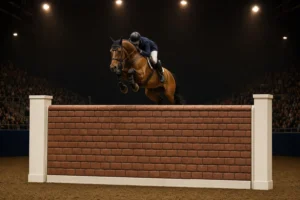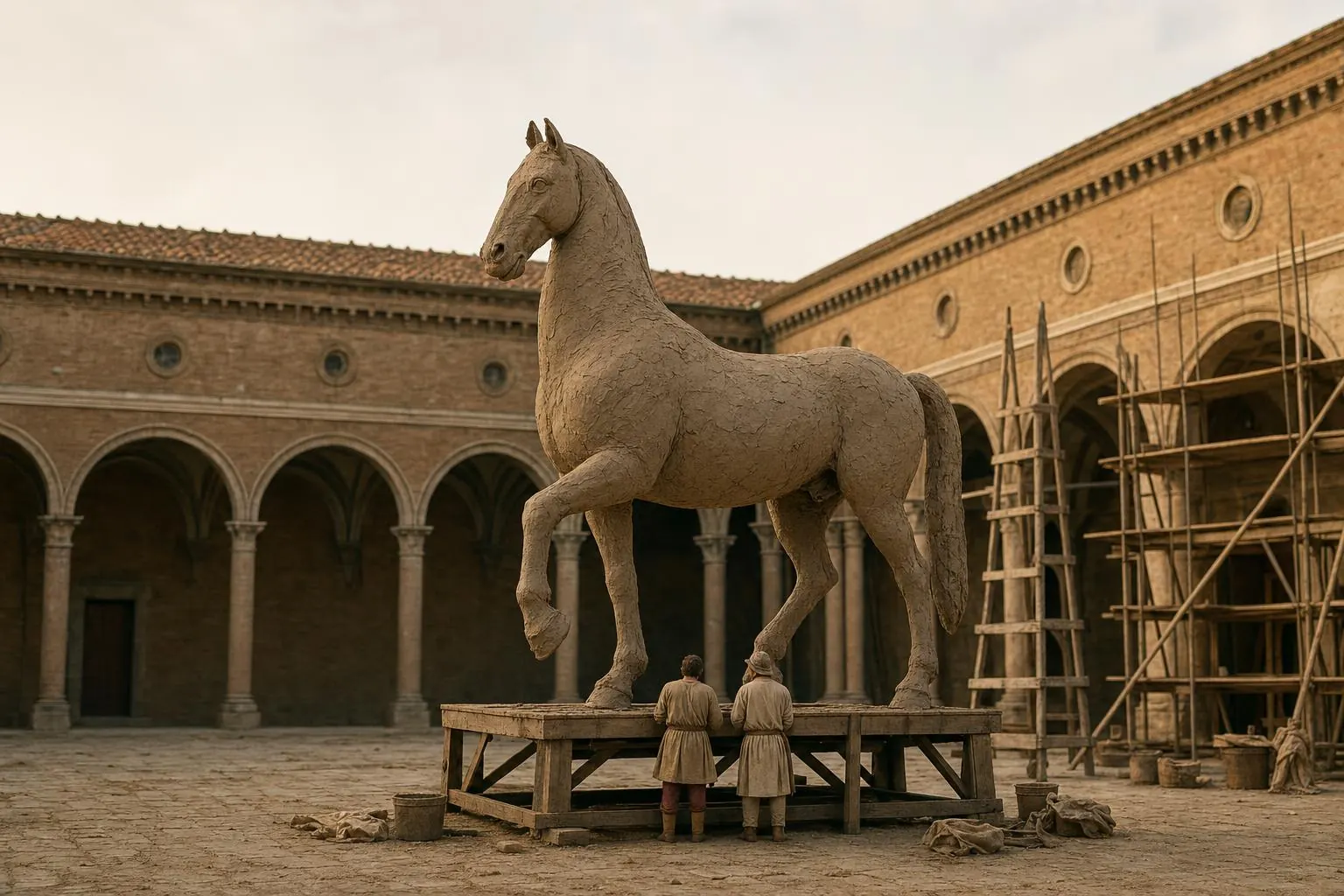

In 1482, a thirty-year-old engineer arrives in Milan with a promise at the foot of his job application: to cast the largest bronze horse ever seen. Twelve years later, a clay colossus of more than 23 feet (7 m) stands in the ducal courtyard and the whole city files past to see it. It will never be cast: the seventy tonnes of bronze set aside for it go to cannon, and the French soldiers who enter Milan in 1499 use it for target practice. Leonardo da Vinci’s horse waited five centuries to see metal.
What Leonardo da Vinci promised Milan in 1482: the largest bronze horse in the world
When Leonardo leaves Florence for Milan, he does not go as a painter. The draft letter he addresses to Ludovico Sforza, known as Ludovico il Moro, reads like the catalogue of a military engineer: portable bridges, mining tunnels, bombards, covered chariots. Painting comes only at the end, followed by a line that will occupy him for twelve years: he says he is able to undertake the bronze horse, to the immortal glory of the prince’s father.
That father is Francesco Sforza, a condottiere who became Duke of Milan in 1450. A dynasty born of a mercenary captain needs a statue to look like a dynasty, and the equestrian statue is then the most expensive political object in existence: it says that the man holds his power through the horse, and that he can afford bronze.
Leonardo knows what he is up against. Rome keeps the equestrian statue of Marcus Aurelius, cast around AD 175, the only ancient bronze equestrian statue to have reached us intact. Padua has Donatello’s Gattamelata, and Venice awaits the Colleoni by Verrocchio, who had been Leonardo’s master in Florence: these two horsemen stand at around 11.5 to 13 feet (3.5 to 4 m). Leonardo announces more than 23 feet (7 m), without a rider. Double the size, and a mass that no founder in Europe had ever cast in a single pour.
On video · 106 seconds
Leonardo da Vinci’s horse
He spends twelve years measuring the horses in Milan’s stables, then in 1493 raises a clay colossus that the whole city comes to see. The bronze, meanwhile, goes to cannon. And when French troops enter Milan in 1499, crossbowmen use the clay horse as a target. Here is why Leonardo da Vinci’s horse was never cast in his lifetime, what his treatise on equine anatomy took with it, and how an American pilot had it cast in Milan in 1999.

Twelve years measuring the Sforza stable horses, the head divided into sixteen
The work begins with living horses. Leonardo spends months in the ducal stables, notebook in hand. His surviving sheets at Windsor are not artist’s sketches but workshop surveys: a profile, then measurements taken along the neck, shoulder, cannon bone and pastern.
His unit of measurement is the horse itself: he takes the animal’s head, divides it into sixteen, and expresses everything else as a fraction of it, height at the withers, length of the back, distance from elbow to ground. A method of proportions, not of inches.
One annotation even names the model: a Sicilian horse belonging to Galeazzo Sanseverino, captain general of the Milanese armies and the duke’s son-in-law. The Sicilian of the day is a parade horse with a thick neck and lofty paces, and that is the type Leonardo wants to give the monument. Five centuries later, a rider comparing two horses does the same thing: proportions before coat colour, as our overview of horse breeds and their conformation explains.
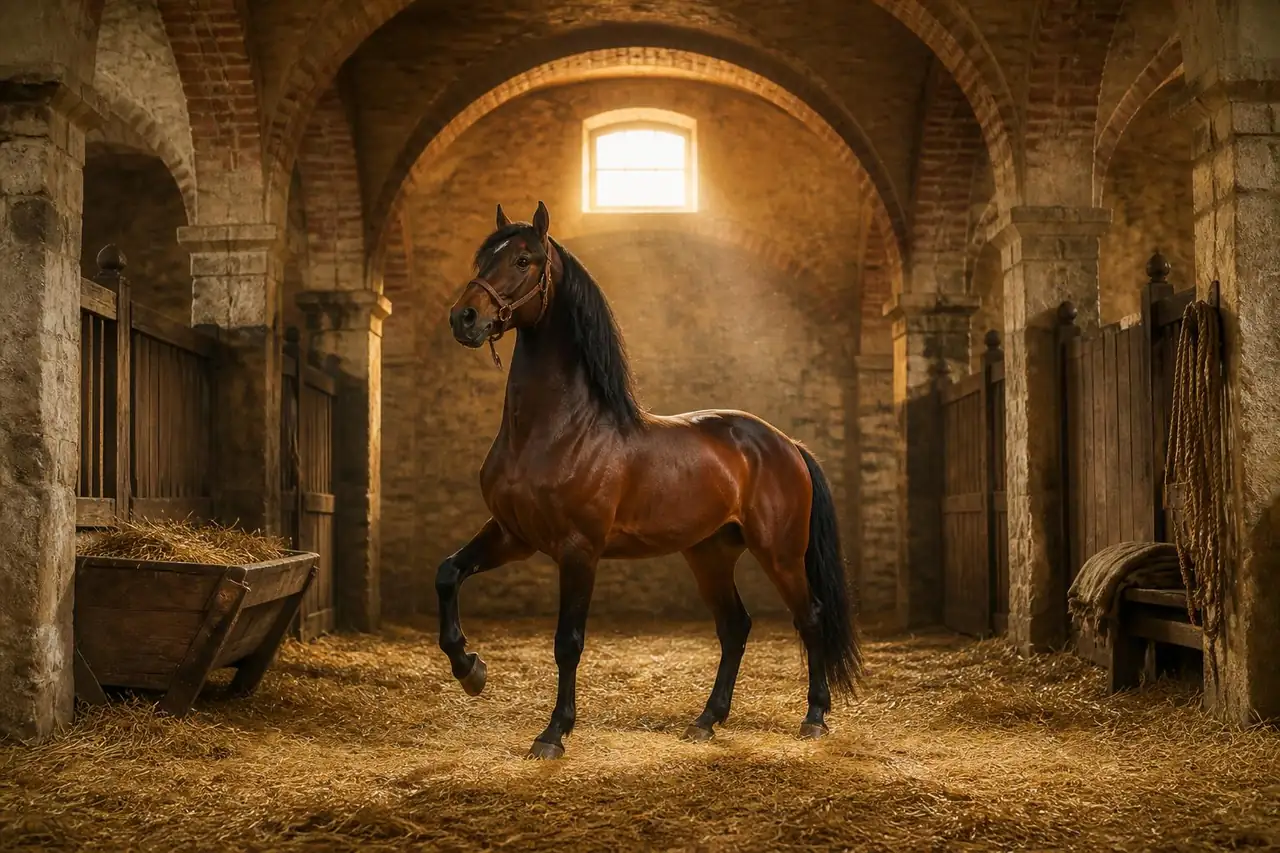
The drawings also tell of a renunciation. The first project showed a rearing horse above a fallen enemy. Leonardo abandons it: a rearing horse stands on only two points of support, the whole mass of the bronze bears on the hindquarters, and at that scale the sums do not work. He returns to the horse at the walk, left foreleg raised, three points on the ground, the figure that a dressage rider recognises when a horse carries itself tall.
30 November 1493: a 23-foot clay horse before the whole court of Milan
On 30 November 1493, Milan celebrates the marriage of Bianca Maria Sforza, Ludovico’s niece, to the Emperor Maximilian. The wedding is held by proxy, the city is in festive mood, and the centrepiece of the decor is the horse: the full-size clay model, without a rider, raised beneath a triumphal arch before the court and the ambassadors.
The effect is immediate. Court poets write about it, and Leonardo ceases to be a promising painter and becomes the man of colossal undertakings. On 20 December 1493, he notes that he is ready for the casting.
The scale is worth picturing. A riding horse stands 15.1 to 17.1 hands (1.55 to 1.75 m) at the withers and weighs 990 to 1,430 lb (450 to 650 kg), which you can estimate yourself with the method for calculating a horse’s weight. The colossus stood more than four times the height of its living model, and the planned bronze weighed about as much as one hundred and twenty adult horses.
- Scale relative to the living horse. Twenty-three feet is four times a riding horse: the whole problem flows from that ratio.
- The number of points of support. Four give a stable statue, three give the walk, two give an overhang that bronze does not forgive.
- Measured anatomical accuracy. Measurements taken from a named horse are worth more than an idealised one: the Windsor sheets carry figures.
- The feasibility of the casting. Wall thickness, internal armature, mould position, pouring points: a monumental project is judged on these before its beauty.
- The provenance of the metal. Seventy tonnes of bronze is not a workshop purchase but an expense of state, and therefore cancellable.
The horse’s 70 tonnes of bronze go to cannon
In 1494, Charles VIII crosses the Alps to press his claim to Naples, and northern Italy becomes a corridor for armies. In November, Ludovico Sforza takes the decision that kills the project: he sends the bronze gathered for the horse to his father-in-law Ercole d’Este, in Ferrara, to be made into cannon.
The duke’s reasoning is cold and sensible: a monument does not defend a duchy. Leonardo writes to his patron in a sentence that has come down the centuries: “Of the horse I will say nothing, for I know the times.”
The clay model, for its part, remains standing in the courtyard with no metal to wait for, the largest horse sculpture ever modelled in Europe.
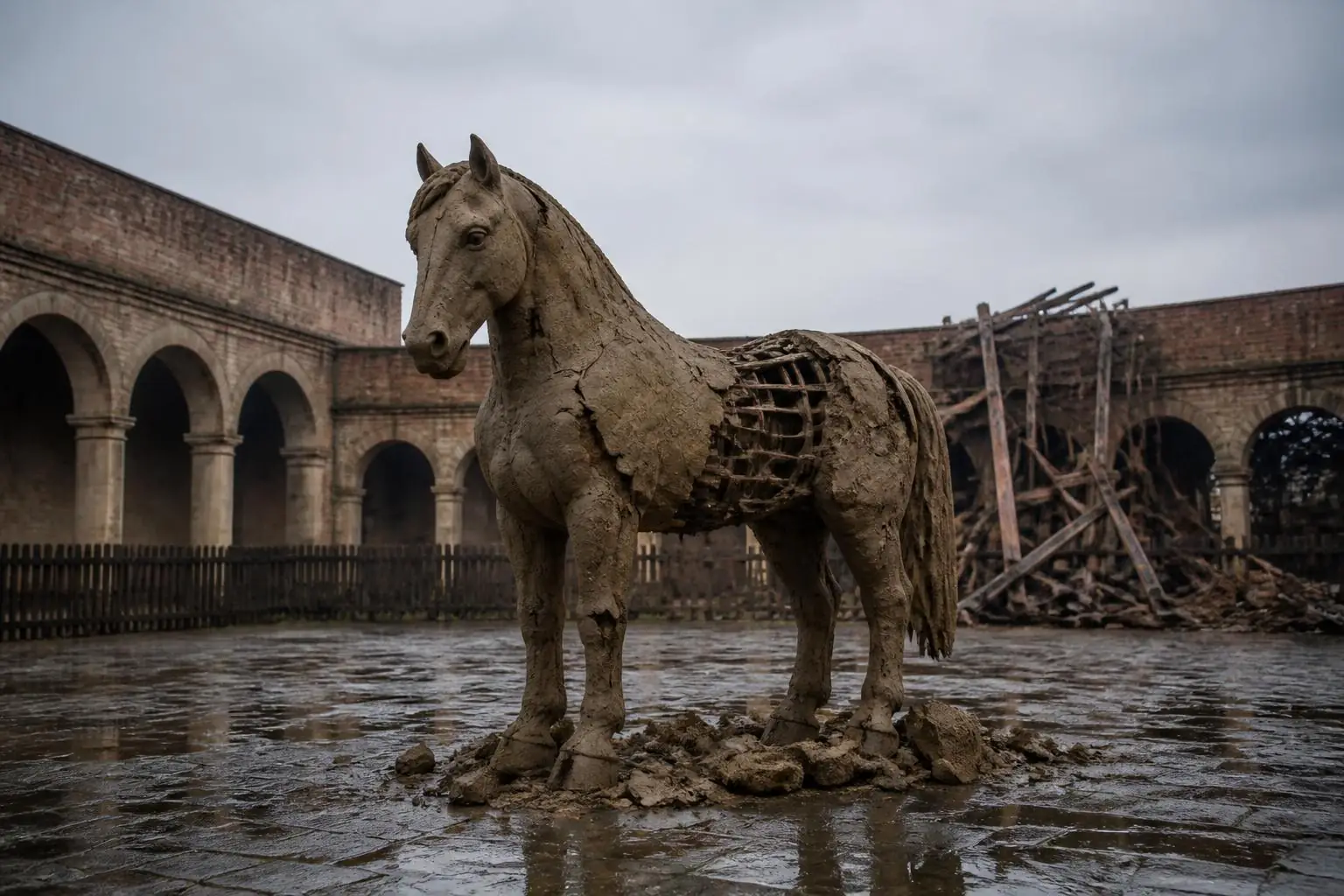
1499: French soldiers use the clay horse for target practice
Five years later, the duchy falls. Louis XII’s troops enter Milan in early September 1499, Ludovico Sforza flees and ends up a prisoner in France, and Leonardo leaves the city.
What happens next is told by Milanese tradition rather than by any official record: Gascon crossbowmen are said to have used the colossus for target practice. The tale is plausible. A mass of clay 23 feet high, in a courtyard occupied by idle soldiers, does not last long.
The rest is a matter of weather. Raw clay is not fired, it drinks water, and the frosts of Lombardy finish the job. The greatest horse of the Renaissance disappears without any witness dating its end: not a fragment, not a cast, not an engraving made from life.
The treatise on horse anatomy that Leonardo da Vinci never published
The loss does not end with the model. Vasari and then Lomazzo claimed in the following century that Leonardo had written a treatise on the anatomy of the horse, drawn from his dissections in Milan. That book has never been found.
It takes until 1766 and the Englishman George Stubbs for an artist finally to publish a worthy anatomy of the horse, drawn from his own dissections. Two hundred and fifty years, during which painters of horses worked by guesswork: limbs too long, impossible gallops, necks with no proper attachment.
This struggle for the anatomical truth of the horse runs through the whole of Western art: it begins at Lascaux, where the horse is the most frequently depicted animal, passes through the horses of Géricault, and ends in the twentieth century when the avant-garde breaks the horse apart instead of copying it. For the living side of that anatomy, our reference points are gathered in the horse care and maintenance guide.
1965: the casting plans for the Sforza horse resurface in Madrid
The story resumes in a library. In 1965, the American scholar Jules Piccus is working at the National Library of Spain in Madrid on medieval songbooks. He comes across two manuscripts by Leonardo da Vinci that a cataloguing error had made impossible to find for about a hundred and fifty years. Their existence is announced in February 1967.
These two volumes, the Madrid Codices, change the status of the Sforza horse. The second contains some twenty pages on the casting of the monument, begun in May 1491: the casting pit, the furnaces, the mould dismantled in sections, the iron armature, and the idea of casting the piece in a single pour, head down.
We no longer know merely that Leonardo wanted a great horse: we know how he intended to make it. The engineers who have examined these pages judge the method viable. The horse did not fail technically, it failed politically.
10 September 1999: Leonardo da Vinci’s horse is finally cast, in Milan
In September 1977, an American airline pilot turned amateur sculptor, Charles Dent, reads a magazine article about the horse that never was. He lives in Allentown, Pennsylvania, and resolves that the horse will be cast and given to Italy by Americans. He devotes seventeen years to it.
He dies of amyotrophic lateral sclerosis on 25 December 1994, without having seen the bronze. The sculptor Nina Akamu takes up Leonardo’s studies and redesigns the whole, and the Tallix foundry in Beacon, New York, casts a horse of 24 feet (7.3 m).
On 10 September 1999, the horse is unveiled in Milan, at the San Siro racecourse, almost exactly five hundred years after the French entered the city. A second cast is inaugurated on 7 October in Grand Rapids, Michigan, and a 12-foot (3.7 m) version in Allentown, in memory of Charles Dent.
The San Siro bronze is not Leonardo’s statue: it is a work of 1999 after his drawings, without a rider. But it finally gives the scale, and standing beneath it you understand what the court of Milan saw in 1493. The worth of a horse has never rested on the animal alone: our record prices paid for a horse tell the same story.
What we still do not know about Leonardo da Vinci’s horse
Four areas remain unclear, and it is better to name them than to smooth them over.
First, the exact height of the model: sources say more than 23 feet (7 m), sometimes 26 feet (8 m) with the plinth. The figure of 24 feet (7.3 m) that circulates today is that of the 1999 bronze, not a measurement taken from the clay of 1493.
Second, its location: accounts place the colossus sometimes in the Corte Vecchia, the old ducal courtyard, sometimes in the Castle square, always beneath a triumphal arch. Both versions coexist.
Above all, the end of the model: no witness describes its destruction at the time, and the Gascon crossbowmen belong to a tradition reported later, coherent but unproven.
Finally, the fate of the bronze. We know it went to Ferrara to become artillery. We know neither how many cannon came out of it, nor what became of them.
- 1482: Leonardo promises Ludovico Sforza the largest bronze horse in the world.
- Twelve years of study of the ducal stable horses, with the head divided into sixteen as the unit.
- 30 November 1493: the clay model, more than 23 feet high, is shown in Milan.
- November 1494: the seventy tonnes of bronze leave for Ferrara to be melted into cannon.
- 1499: Louis XII’s army occupies Milan, the model is used as a target, and frost finishes off the clay.
- 1965: the Madrid Codices, mislaid through a cataloguing error, give back the casting plans.
- 10 September 1999: a 24-foot (7.3 m) bronze after his drawings is unveiled in Milan.
One practical lesson remains. Leonardo did not begin by drawing a horse, he began by measuring one, a named one, in a stable, with a unit borrowed from the animal. Our stories on the horses of Lascaux and on reading horse coat colours start from the same gesture.
Seventy tonnes of bronze for a single parade horse: the price of a horse has never measured the animal, it has always measured what is projected onto it. The Equirider guide sets out real market figures, breed by breed and discipline by discipline.
Sources: Royal Collection Trust, Leonardo’s equestrian studies held at Windsor, including the annotated sheet of Galeazzo Sanseverino’s Sicilian horse; National Library of Spain, Madrid Codices I and II; City of Milan and the San Siro racecourse for the bronze of 10 September 1999; Frederik Meijer Gardens and Sculpture Park; Vasari and Lomazzo for the lost treatise on horse anatomy; George Stubbs, The Anatomy of the Horse, 1766. Discrepancies between sources are flagged in the article. Equirider is not affiliated with any institution cited.