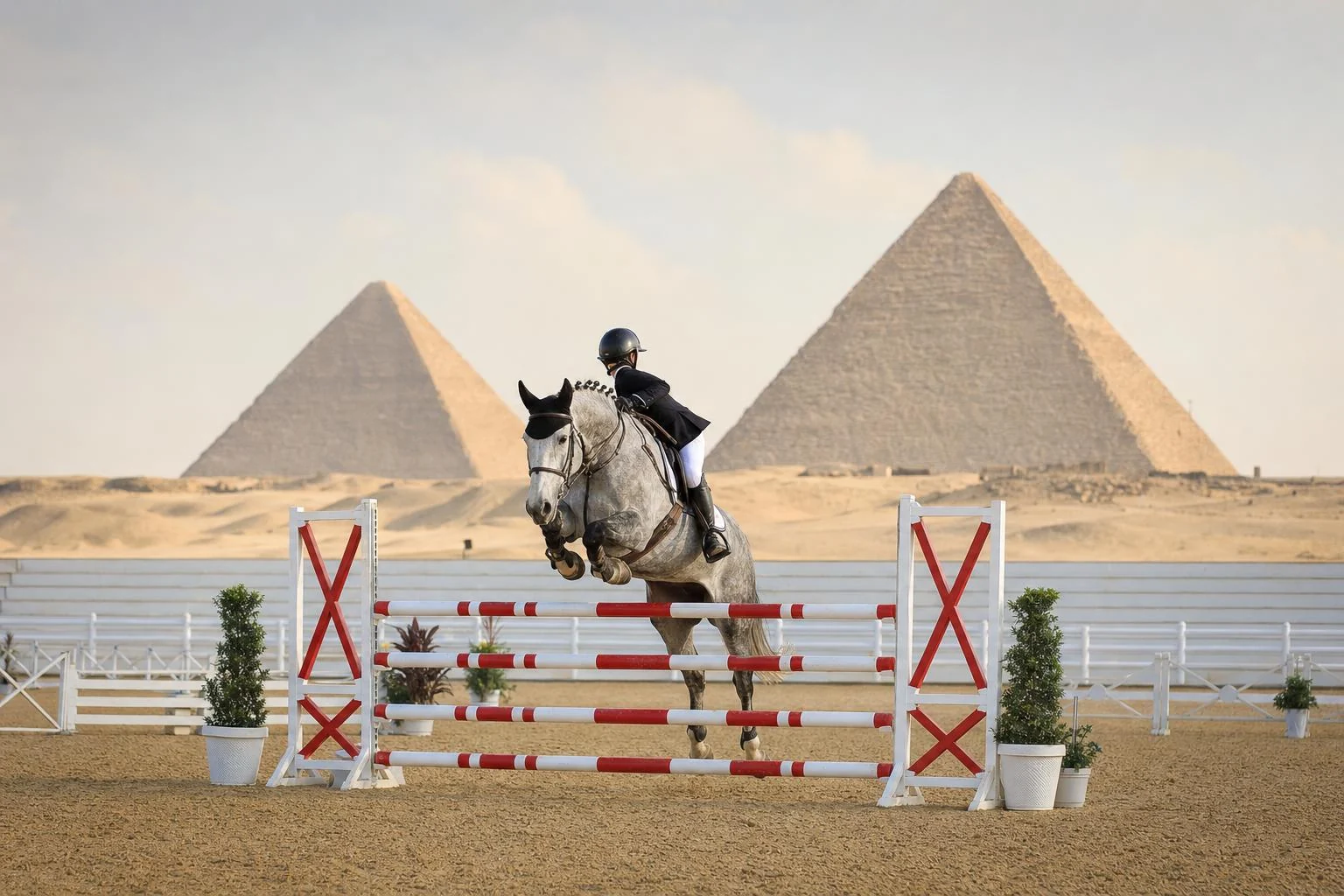

Top-level show jumping arrives at the foot of the Giza pyramids this Thursday, 22 October. For the first time, the Global Champions Tour stops in Egypt: three days of five-star jumping, €1.75 million in prize money and a €1 million Grand Prix on Saturday. But before the first horse entered the ring, another story occupied the equestrian press: the working horses that carry tourists around the plateau. Within a few weeks they have been counted and microchipped, and a free vaccination campaign has been launched. Here is what is at stake in the ring, what has been announced for the horses of Giza, and what to watch once the show has moved on.
Global Champions Tour in Cairo: three days of show jumping at the foot of the Giza pyramids
The circuit founded by Dutch rider Jan Tops turns twenty this year, and its team league, the Global Champions League, turns ten. Its recipe has not changed: take show jumping out of the usual showgrounds and set it in backdrops everyone recognises, from the beach at Miami Beach to the Champ-de-Mars in Paris, by way of the harbour at Monaco. The 2026 calendar has seventeen legs across four continents, and Egypt joins it for the first time.
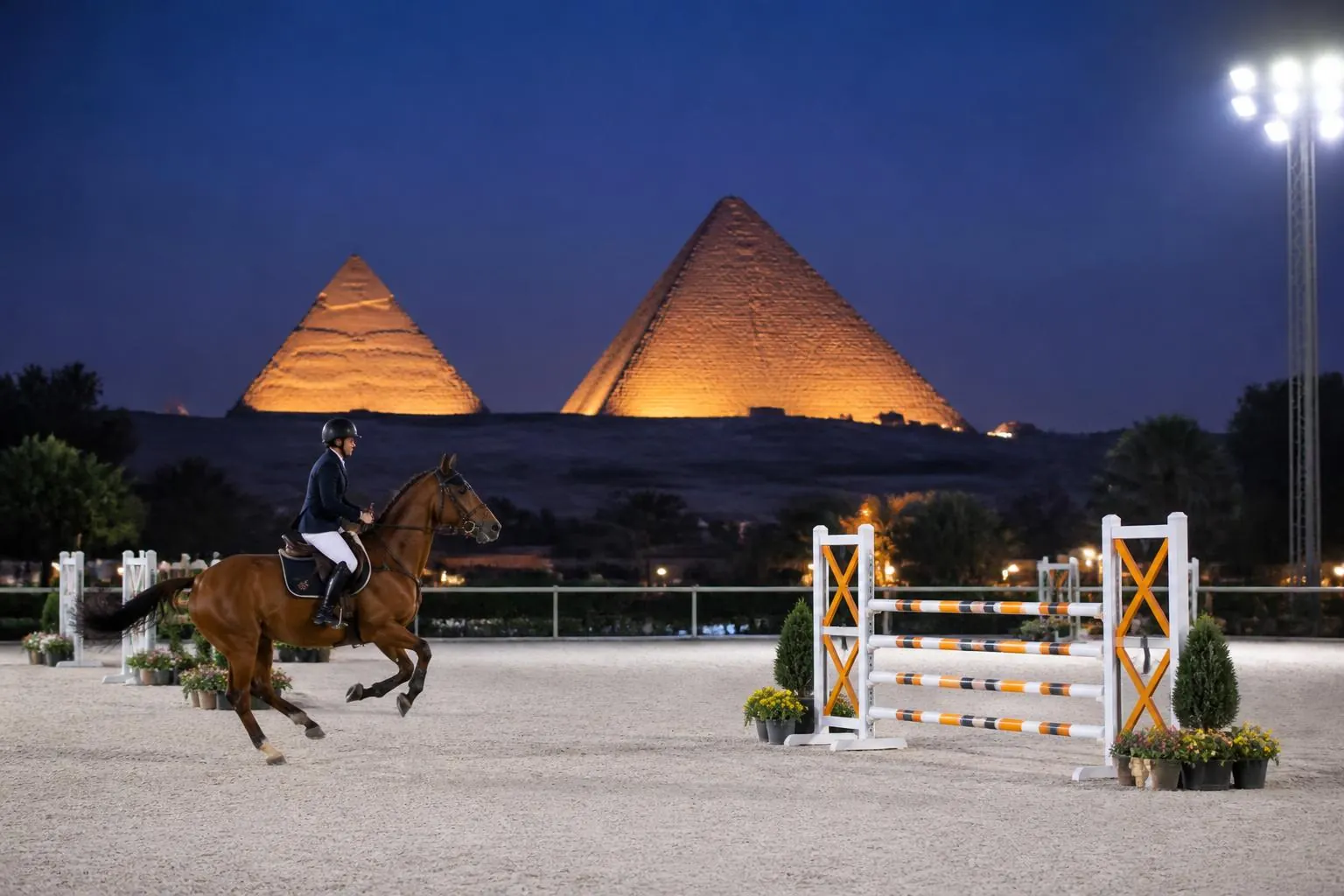
The Cairo leg was unveiled in January at a press conference attended by Egyptian Prime Minister Mostafa Madbouly, the Egyptian equestrian federation and the Egyptian Military Academy. The arena is set up on the site known as Panorama 2 on the Giza plateau, facing the Pyramid of Khufu. The opening hours published by the organiser say a great deal about the rhythm imposed on the horses: Thursday and Friday from 5 pm to 10 pm, so evening classes under floodlights once the heat has eased; Saturday from noon to 5 pm for the Grand Prix.
According to the Egyptian website CairoScene, the agreement between the circuit and the Egyptian federation runs for five years. Cairo is therefore not a one-off, and that is what gives weight to the question of the working horses, which we come back to below.
Video · 113 seconds
Global Champions Tour in Cairo: Before the Pyramids Show Jumping, Giza’s Horses Are Vaccinated and Microchipped
Before the competition, the plateau’s working horses were microchipped and vaccinated free of charge. What has been announced, and what remains to be checked.

The Cairo Grand Prix: €1 million and fences at 5ft 3in (1.60 m)
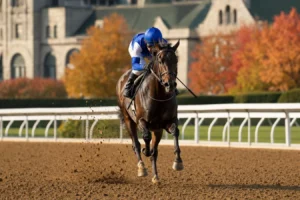
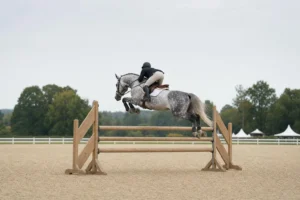
Of the €1.75 million total prize fund, Saturday 24 October’s Grand Prix accounts for a million on its own. It is a CSI 5* class, on a par with the biggest shows in the world, with fences at 5ft 3in (1.60 m), the height of Olympic Grands Prix. To understand what those fences ask of a horse, and how a jump-off works, our complete guide to show jumping covers the rules from the beginning.
The stakes go beyond the cheque. Cairo is the penultimate leg before the Rabat final in Morocco, from 30 October to 1 November, and then the GC Playoffs in Riyadh from 18 to 21 November. In the overall standings there are hardly any points left to play for, and one fence down in Cairo could cost the season title. The specialist site HorseShowJumping names three main contenders: Abdel Said, Edwina Tops-Alexander and Christian Ahlmann.
Who is riding in Cairo: Olympic champions and Egyptian riders on home ground
The leader of the standings is a symbol in himself. Abdel Said rides for Belgium but is of Egyptian origin, and he arrives in Cairo having won the Rome Grand Prix in early October. Around him, the entry list reads like an Olympic podium: Germany’s Christian Kukuk, individual Olympic champion in Paris in 2024; Britain’s Ben Maher, a two-time winner of the circuit and Olympic gold medallist; his compatriot Scott Brash, who has two Olympic team titles; as well as Marcus Ehning, Daniel Deusser, Max Kühner and Ireland’s Cian O’Connor.
On the French side, Simon Delestre, who won team bronze at the Paris Games alongside Julien Épaillard and Olivier Perreau, is among the starters. France comes off a solid Nations Cup season, as we reported at the Nations League final in Barcelona.
And then there are the home riders. Nayel Nassar, an Egyptian based in the United States, represented Egypt at the London Games in 2012 and in Tokyo in 2021. Sameh El Dahan, who rode for Great Britain for five years, has returned this year under the Egyptian flag. Mouda Zeyada and Ismael Osama El Borai complete the delegation, and the Cairo Pharaohs team contests the team competition in front of its own crowd. Nassar told the Belgian press plainly that he would never have imagined seeing a five-star show staged on Egyptian soil.
The working horses of the Giza pyramids: free microchip, vaccination and veterinary check
Anyone who has visited Giza has seen them: carriage horses and riding horses hired out to tourists, decked in pompoms, plodding back and forth between the pyramids and the Sphinx under the sun. As soon as the Cairo leg was announced, riders and charities began asking what would become of them. The charity Egypt Equine Aid, quoted by the British weekly Horse and Hound on 20 October, spoke of “grave concern”: animals denied essential care, rest, proper feed and clean water.
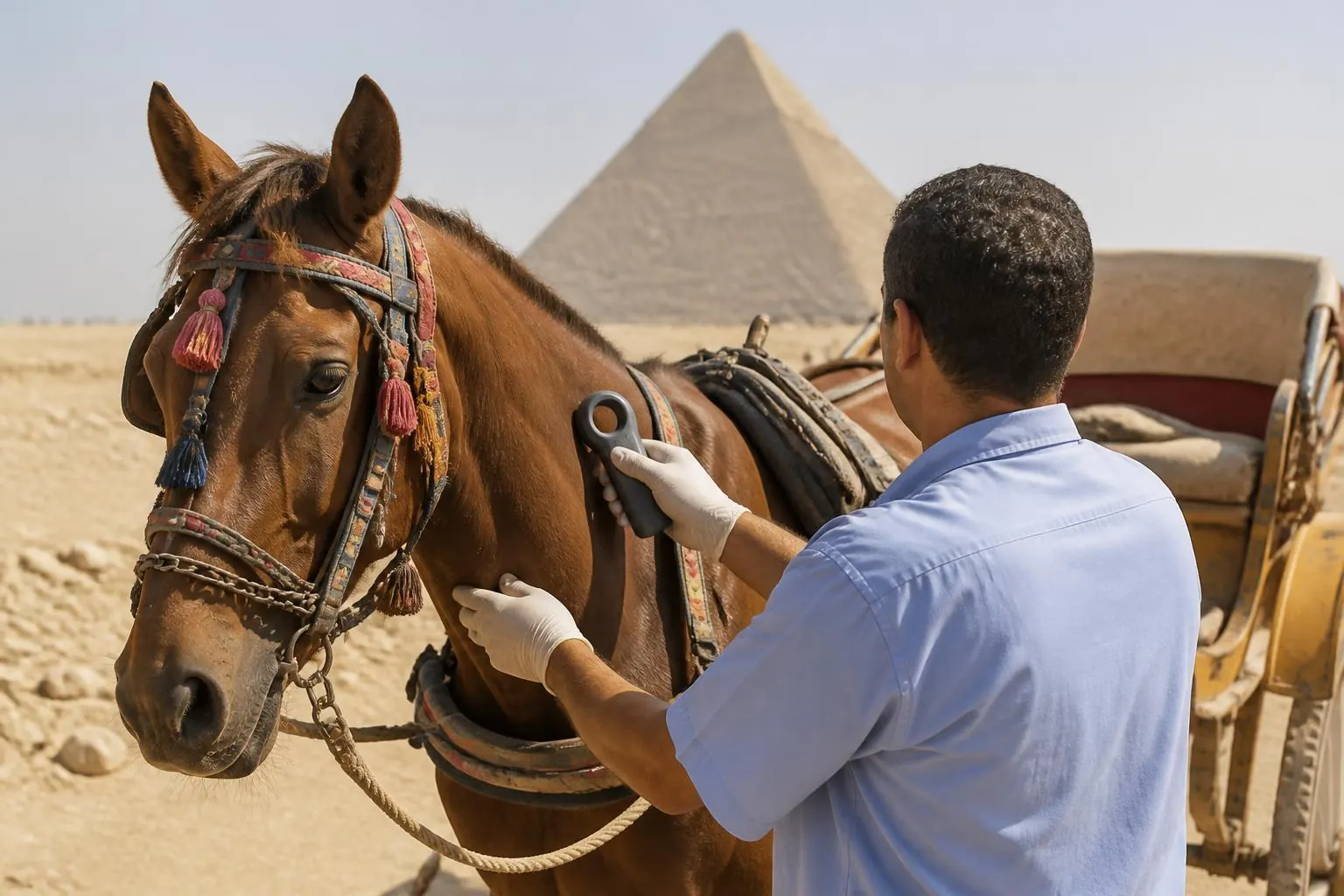
The answer came from the Egyptian equestrian federation, which set up a programme with the British charity Brooke, the General Organisation for Veterinary Services, the Giza governorate and Orascom Pyramids, the site operator. What has been announced:
- A census and microchipping of all the plateau’s working horses, begun several weeks before the show;
- a vaccination campaign for all registered horses, launched this week and said to be completed within a few days;
- a full veterinary examination for every horse;
- all of it free for owners and hirers;
- periodic check-ups, also free, presented as a lasting system rather than a one-off operation.
The federation’s spokesperson puts it this way: the legacy of a major sporting event must “go well beyond the days of competition”. The programme also acknowledges an economic reality: these horses provide a living for their owners and are part of the tourist experience. The aim is not to remove them from the plateau but to monitor them.
Why the welfare of Giza’s horses has become part of a show jumping event
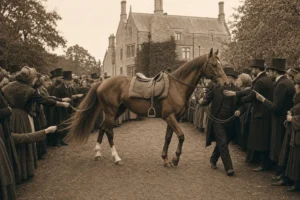
The link is not artificial. Brooke, the charity involved in the programme, was born in Cairo. In 1930, Englishwoman Dorothy Brooke discovered there hundreds of former British cavalry horses from the First World War, sold locally after 1918 and worn out by labour in the city’s streets. She bought them back one by one and in 1934 founded a hospital for these war horses. Today the charity treats working horses, donkeys and mules in many countries. Almost a century later it is back at the foot of the pyramids for a show where every Grand Prix horse is veterinary-monitored, microchipped, vaccinated and passported.
That is the whole contrast of these three days: on the same plateau, sport horses that only travel with their health papers up to date, and carriage horses that have only just been identified. Sameh El Dahan summed it up to Horse and Hound: some will say all this is only happening because the circuit is coming to Egypt, but if so, “so much the better”, provided it is not done once and then abandoned. The rider points out that the circuit is due to return to Cairo for several years, so the effort will have to last.
Egypt and the horse: from the pharaohs’ chariots to the Global Champions Tour
The setting is more than a postcard. The horse reached Egypt late, during the Second Intermediate Period, and very quickly became a royal attribute: in the New Kingdom, pharaohs had themselves depicted standing on their war chariots or out hunting. The Arabian horse, which Egypt has bred for centuries with its own bloodlines, remains at the heart of its equestrian identity. Our profile of the Arabian horse traces that history.
For anyone who would like to see the plateau from somewhere other than a grandstand, there are also horse treks in Egypt, from the pyramids to the Red Sea. It is, incidentally, a good moment to find out how an operator chooses and treats its horses before you book.
An announcement is not a result. Here are the six points that will tell us, a year from now, whether the plateau’s horses have really gained anything from the Global Champions Tour’s visit:
- A published figure: how many horses have been counted and microchipped. To date, no total has been released.
- Vaccination coverage: the share of registered horses actually vaccinated, and against which diseases.
- Follow-up after the show: do the free periodic check-ups still take place in 2027, once the cameras have gone?
- An independent view: an assessment signed by Brooke or by the veterinary services, not only by the organiser.
- Working conditions: access to water, shade and rest on the plateau, the length of the working day, the weight of the carriages.
- Horses taken out of work: what happens to a horse judged unfit for work at an examination, and who pays for its care.
What we still do not know about the horses of the Giza plateau
Several questions remain open on the morning of the first day of competition. The organisers have not given the number of horses working on the plateau. The vaccines administered are not specified in the statements we have read. And the schedule for follow-up checks has yet to be published. We will update this article after Saturday’s Grand Prix, with the sporting result and any new information on the veterinary programme.
For your own horse, the lesson from Giza is simple: up-to-date identification and vaccinations are the foundation of any monitoring. If you want to see its vaccinations, worming and vet visits at a glance, Equirider’s digital horse health record keeps them all in one place, and our article on the horse passport explains the page nobody ever opens, yet which decides everything at an inspection.
Global Champions Tour, event guide “LGCT of Cairo 22-24 October 2026” (dates, venue, opening hours) and presentation of the 2026 calendar (Cairo press conference, January 2026, reported by Horse Sport on 18/01/2026); Eleanor Jones, “A positive step: top rider welcomes measures to protect Pyramids working horses”, Horse and Hound, 20/10/2026; HorseShowJumping, “Longines Global Champions Tour heads to the Pyramids with 1.75 million euros prize fund in Cairo”, 14/10/2026; Equnews, “Strong field of horses and riders for LGCT Cairo”, 19/10/2026; CairoScene, “Longines Global Champions Tour enters Pyramids’ equestrian legacy”, October 2026. History of Brooke: the charity’s public archives.