
From Thursday 24 to Sunday 27 September 2026, the French Majors show jumping championship takes place on the grounds of Équivallée in Cluny, Saône-et-Loire, and entry is free. What sets it apart comes down to a single line in the rulebook: to ride in this national championship, you must be 40 or older. Every other age category of the French Equestrian Federation (FFE) sets a ceiling; this one sets a floor. Here is what is at stake in Cluny this week, how riders sometimes thirty years apart in age are separated on the scoreboard, and what we still do not know about this edition.
French Majors Show Jumping Championship: Four Days of Jumping at Cluny
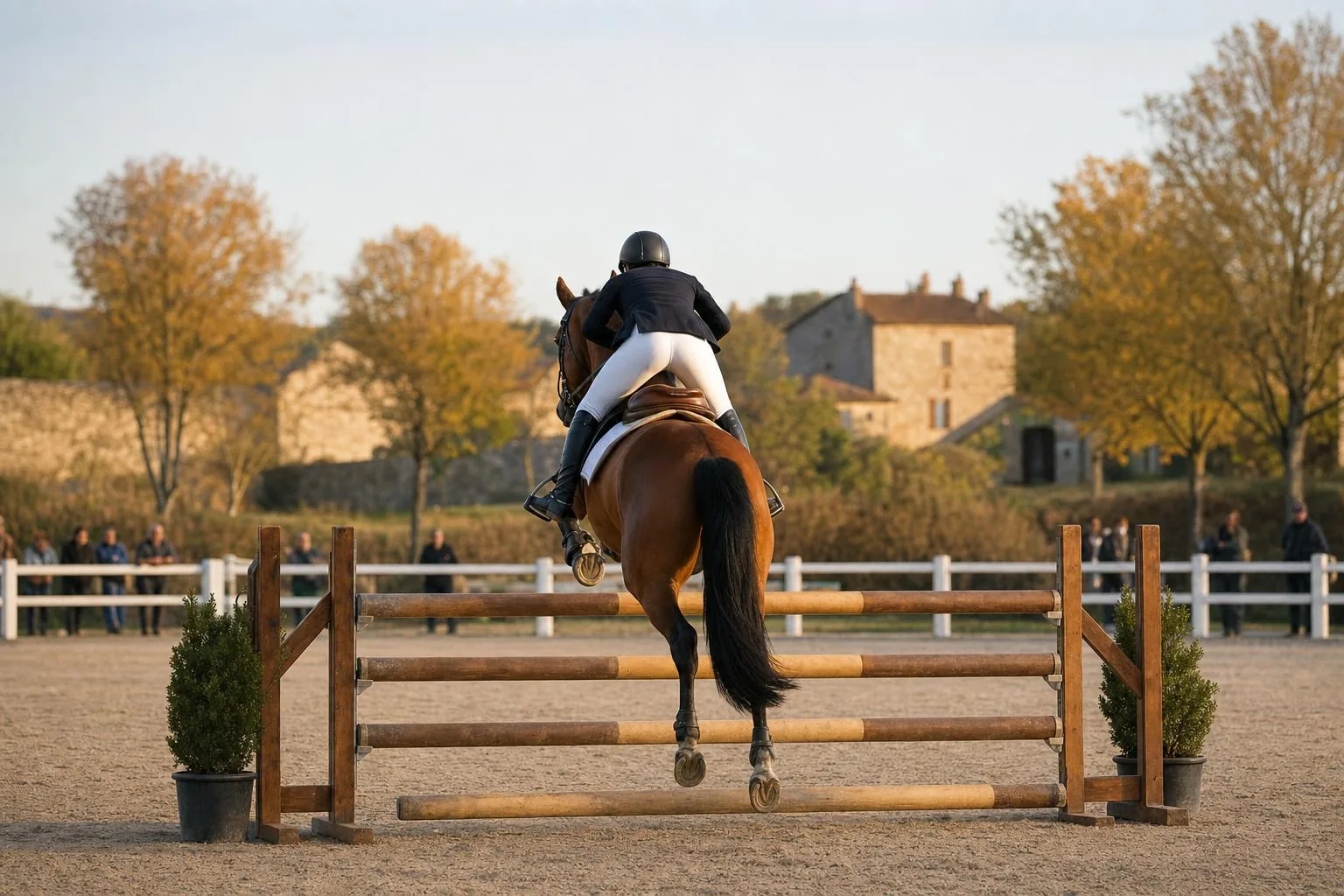
The event runs from 24 to 27 September 2026 on the Équivallée grounds, chemin de Rochefort, Cluny (71250). Both the Burgundy tourist board and the Cluny Sud Bourgogne tourist office announce free entry, all day long, across the four days. The stables sit right beside the arenas, and a camping area is open to riders and their support teams, next to the lorries.
In practical terms, a spectator with no horse entered can walk in, take a seat at the edge of the arena and watch an entire national championship without buying a ticket. That is rare, and it is one of the reasons this championship deserves better than the single line in the diary it is often reduced to. If you are new to the sport and want to understand what you are watching, our complete guide to show jumping competition explains how a course works, the scoring tables and the levels before you settle in by the ringside.
One useful caveat before going further: the organiser has not published, on any freely accessible source, the list of classes by name, the fence heights set for each level or the number of entries for this 2026 edition. The provisional timetable is referred to the Facebook page and website of Équivallée. Everything below therefore rests on the rules of the category and on earlier editions documented by the French Equestrian Federation, never on a 2026 figure we have not seen.
Video · 113 seconds
French Majors Show Jumping Championship 2026 at Cluny (24 to 27 Sept.): The Event Where No Rider Is Under 40
Entry is free on all four days. What sets it apart comes down to a single line in the rulebook: you must be 40 or older to ride, whereas every other FFE age category sets a ceiling. Here is what is at stake, what a Majors rider is judged on, and the four pieces of information nobody has yet published about this edition.

Majors: The FFE Category Reserved for Riders Aged 40 and Over
The definition is short and leaves no room for interpretation. In its report on the June 2025 Majors dressage championship, the French Equestrian Federation writes that “the Majors category is open to riders aged 40 and over”. That is all. No selection based on national rankings, no regional quotas: an age, a competition licence, a horse, and the regulatory qualifications for the level entered.
The category has its own national championships, held discipline by discipline and on different dates. In 2025, the Majors dressage championship was held at the Haras de Jardy, in the Hauts-de-Seine, over two stages from 13 to 15 June, with close to 180 starts recorded. In 2020, the Federation awarded ten French Majors champion titles across the year: four in dressage, at Le Mans, and six in show jumping, at Deauville, where nearly 400 entries were counted in the jumping alone.
Those two figures, 180 starts in dressage and nearly 400 entries in show jumping, say most of what the Majors circuit is: not an anecdotal category for a handful of diehards, but a full national championship, with start lists, crowded warm-up rings and fiercely contested podiums.
Why Rider Age Shapes the Majors Championship, and Not Just Who Can Enter
Age does not only filter entries, it also divides the classes. In 2020 at Deauville, the Amateur 2 level was split into two separate titles: one for riders aged 52 and under, one for those aged 53 and over. Two French champions over the same fence heights in the same year, separated by an age boundary. It is a practical answer to a problem only this championship faces: a rider of 41 and a rider of 68 do not have the same relationship to effort, recovery time and risk, even when they jump the same fence.
The rest of the 2020 field was spread across Amateur Elite, Amateur 1, Amateur 2 in its two age bands, Amateur 3 and Amateur 4. The top five in the premier category, Amateur Elite, received a two-day training course from the Federation at the national equestrian park in Lamotte-Beuvron. Again, nothing guarantees that this split and this prize will be repeated as they were at Cluny in 2026: it is the documented 2020 format, not an announcement for this week.
What a Rider Is Judged On at the French Majors Show Jumping Championship
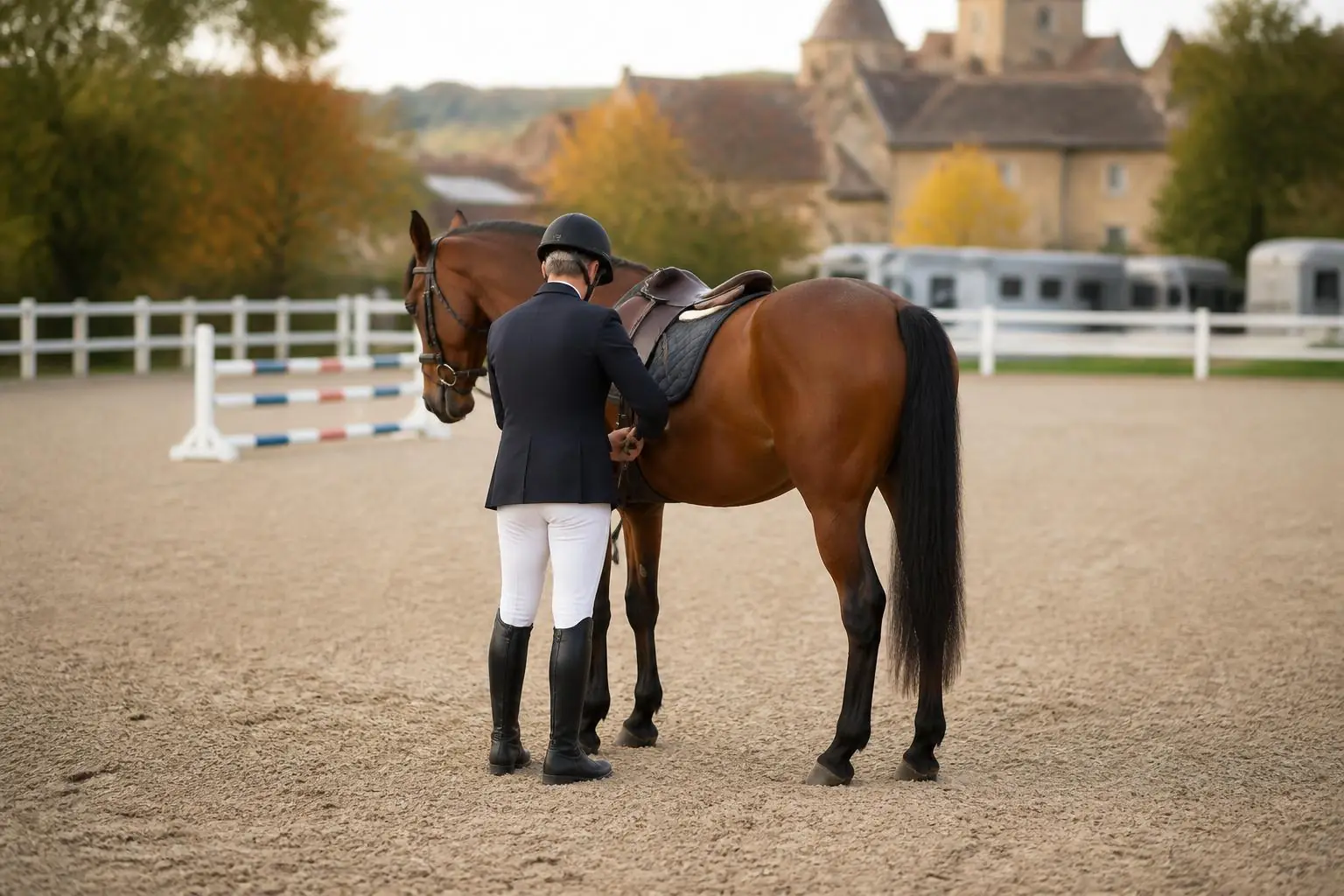
A show jumping championship does not reward the prettiest movement, it rewards the fewest mistakes. The basic rule is that of Table A against the clock, used in almost every show jumping class in France: each fence knocked down costs four penalty points, each refusal also costs four, a second refusal means elimination, and exceeding the time allowed adds time penalties. The ranking therefore reads the opposite way to the usual instinct: the best rider is the one with the lowest total.
What a Majors rider is judged on
- The poles, first. Four points for every fence down, whatever the style of the jump. A clear round without elegance beats a brilliant round with a pole on the ground.
- The clock, second. Under Table A against the clock, time only separates riders level on faults, unless the time allowed is exceeded, which is paid for in points.
- Consistency over several days. A championship is not won in a single round. In 2020, the Majors jumping title was decided over two stages and then a two-round final: four rounds to hold together, not one.
- The horse’s freshness on the last day. Over four days of competition, the question is not who jumps best on Thursday, but which partnership is still intact on Sunday.
- The level, which fixes the comparison. An Amateur 4 is never compared with an Amateur Elite: each level has its own title and its own fence heights.
From Amateur 4 to Amateur Elite: The Levels That Rank Riders at the Majors Championship
The word Amateur, in equestrian competition, is not a value judgement: it is an official status, that of a rider who competes without earning an income from it, as opposed to a professional. Within that status, the Federation stacks numbered levels, from Amateur 4, the most accessible, to Amateur Elite, the most demanding. Each level has its own technical standard and fence heights, and each awards its own French championship title. To place these steps precisely, and the step between the club circuit and the national circuit, our article on Amateur CR status and the levels of regional competition unpacks the vocabulary of the acronyms, which are often misunderstood.
This is what makes the Majors championship easy to follow for a spectator: on a single day, the arena can host a modest-level class and a considerably higher one, without one repeating the other. These are two parallel championships, two titles, two populations of riders. A rider returning to competition at 45 and a former professional who has reverted to amateur status do not meet in the same class.
One regulatory detail is worth recalling, because it conditions everything else: the federal competition licence is compulsory to take part in any official FFE competition. It is not merely an administrative pass; it also carries insurance cover whose real content surprises many riders on the day they fall, as we set out in our article on what the FFE licence actually pays out on the day of a fall.
What Riders Over 40 Change in Their Show Jumping Preparation
To our knowledge, there is no public study devoted specifically to the preparation of Majors riders, and we will not invent one. What can be said rests on what riders themselves and their instructors describe, and it boils down to three trade-offs.
The first is time. A 50-year-old rider with a full-time job often rides fewer times a week than a young professional, and makes up for frequency with preparation: a longer warm-up, a more gradual loosening-up, fewer jumps in training and more work on the flat. The second trade-off concerns the horse. Many partnerships entered in the Majors rely on an experienced horse, often older too, chosen for reliability around a course rather than for potential to progress. The third is accepted risk: at this age, a fall costs more in weeks off, and that shows in the choice of level, often one step below what the rider could technically jump.
None of this is medical advice, and persistent pain, a fall on the back or a loss of strength should be discussed with a doctor, not an article. What this championship demonstrates, however, speaks for itself: a competition rider’s career does not end at 35.
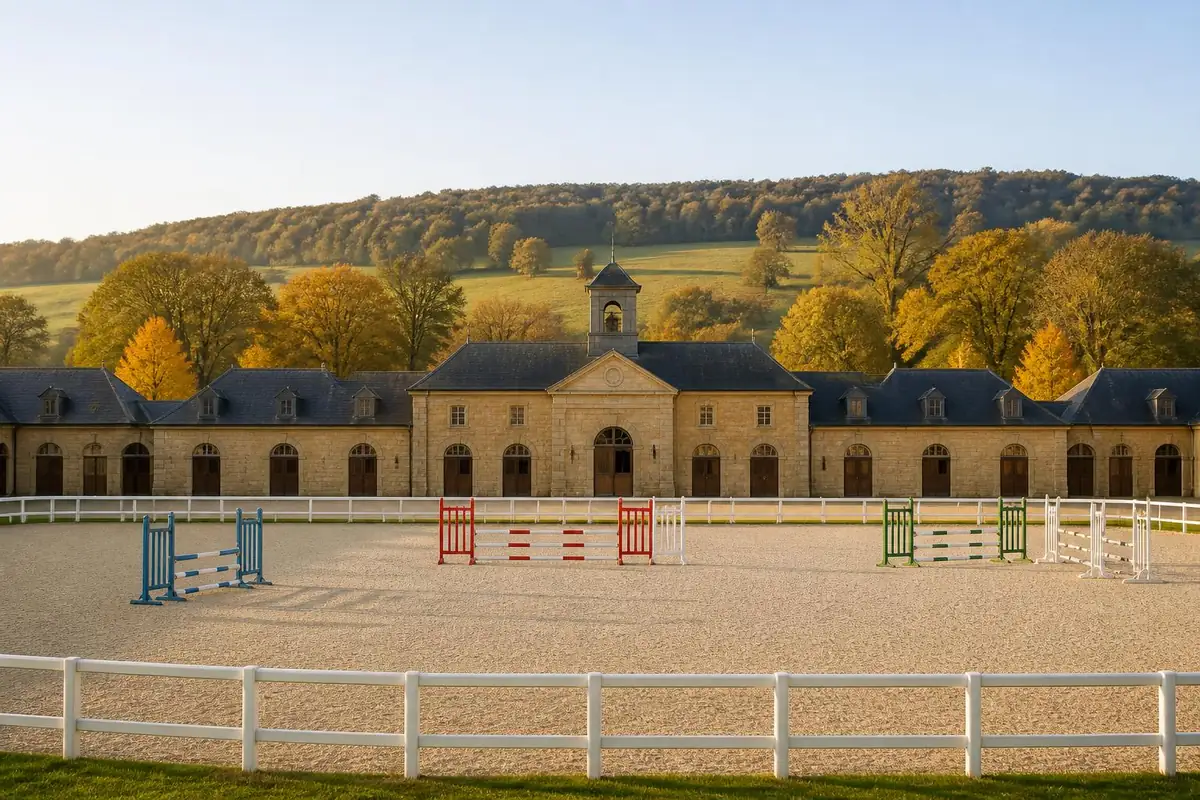
The Cluny National Stud: The Setting for This French Show Jumping Championship
Cluny does not host this championship by chance. The Saône-et-Loire town is home to one of the sites of the French national stud network, now attached to the French Institute for Horses and Riding (IFCE). The stud, the sports centre and the riding centre are united there under one banner, Équivallée, which is precisely the name of the grounds where the Majors championship is held this week. We have devoted an entry to this place and its history in our encyclopedia: the Cluny stud, between a Benedictine abbey and Burgundian horse breeding.
The site was not idle before the Majors arrived. A few days earlier it hosted the dressage leg of the FFE Grand National, for which the Federation published its report on 22 September: the Antarès Tempo team continued its winning streak there. Two national events in two weeks on the same facilities, for two audiences with nothing in common, is a good measure of what an equestrian centre of this size can absorb at the end of the season.
For visitors, the layout has a practical advantage: the arenas, the stables and the camping area are grouped together, which makes the championship easy to follow without a car once you are there. Timetable information goes through the organiser, who can be reached on +33 3 85 32 09 73 according to the Burgundy tourist office listing.
What We Do Not Yet Know About the 2026 Majors Championship in Cluny
We would rather say so plainly than fill the gaps. At the time of publication, four pieces of information are missing, and we have not found them on any freely accessible source.
- The number of 2026 entries. The 400 entries cited above are from the 2020 edition at Deauville. No official figure has been published for Cluny.
- The fence heights for each level. The technical programme for this edition refers to the organiser’s own materials, which we were unable to consult directly.
- The exact format of the championship. Two stages followed by a two-round final was the 2020 format. Nothing says it is the same this year.
- The results of the first days. The timing provider that publishes the rankings cannot be reached from our tools. We will therefore give no winner’s name until we have read it on an official source.
The titles are decided at the end of the week: it is on Sunday, the last of the four days, that we will need to look to learn the 2026 French Majors show jumping champions.
After Cluny: The Next Show Jumping Fixtures for Amateur Riders
The end of September opens the busiest stretch of the autumn for amateur riders and for those who enjoy watching them. The FFE Grand National moves on to Deauville from 1 to 4 October, Mâcon Chaintré from 2 to 4 October, Saint-Lô from 15 to 18 October, then Lyon on 28 and 29 October, within Equita Lyon, which occupies Eurexpo from 28 October to 1 November, according to the calendar published by the French Equestrian Federation.
On the championship side, the next fixture is the French Amateur Show Jumping Championship, from 15 to 18 October at the Haras de Bel Air in Pernay, in Indre-et-Loire: four days of show jumping, this time with no age condition. To place these events in the history of the discipline, from the first pole at a riding club to the Olympic course, our feature from the pony club to the Olympic podium: understanding show jumping is a good starting point.
And for those who come away from this championship wanting to get back in the saddle rather than just watch, the simplest step is to find a yard near home: our directory of riding centres, département by département, lists the clubs that coach adult competitors. Being over 40 is, quite officially, no obstacle there.
French Majors Show Jumping Championship at Cluny: Key Facts
- When. Thursday 24 to Sunday 27 September 2026, four full days.
- Where. Équivallée grounds, chemin de Rochefort, 71250 Cluny, Saône-et-Loire.
- Who. Riders aged 40 and over, with a valid federal competition licence.
- How much. Free entry for the public, all day long.
- What is at stake. One French championship title per level, from Amateur 4 to Amateur Elite.
Sources: French Equestrian Federation, reports on the Majors championships published on 14 September 2020 and 25 June 2025, and the national circuits calendar; event listings from Bourgogne Tourisme and the Cluny Sud Bourgogne tourist office for dates, venue and access conditions; French Institute for Horses and Riding for the attachment of the Cluny national stud.