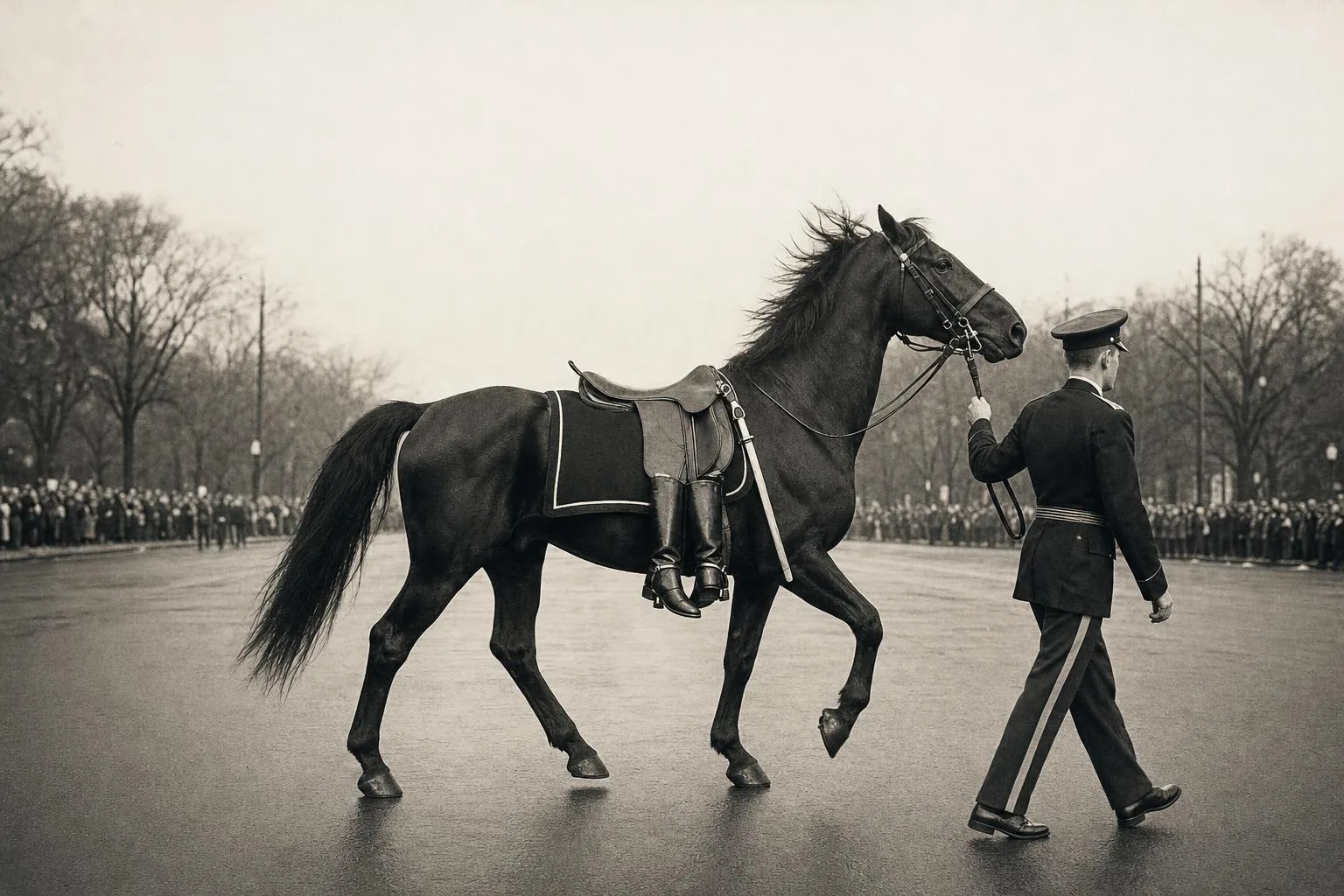

Washington, 25 November 1963. Behind the coffin of John F. Kennedy walks a black horse with no rider. In the empty saddle hangs a sheathed sabre, and in the stirrups sits a pair of boots turned backwards, toes to the rear. Millions of viewers are watching, and what they see looks nothing like a calm ceremonial horse: he tosses his head, prances, pulls on the lead and treads on the foot of the 19-year-old soldier holding him. His name is Black Jack. The reversed boots have a precise meaning, and so does the horse’s restlessness: the army knew about it long before Dallas.
Black Jack, the riderless horse of Kennedy’s funeral
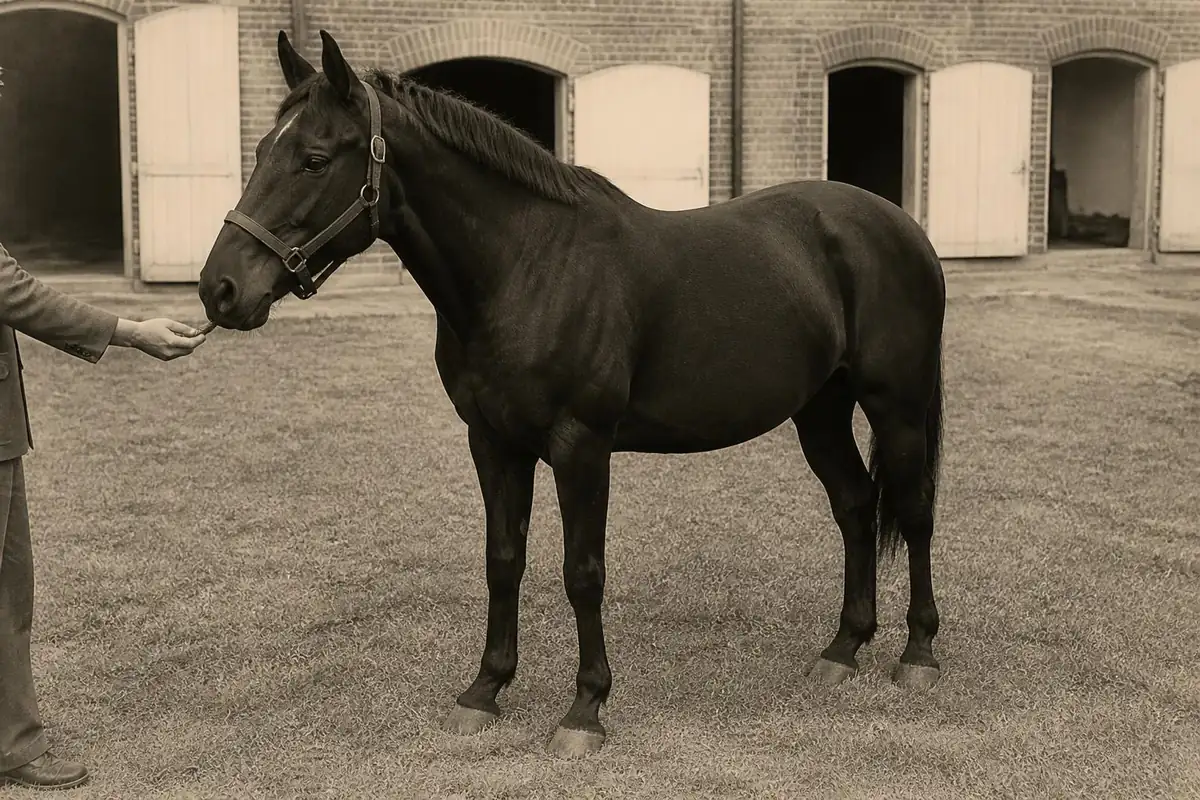
Black Jack was born on 19 January 1947. A cross between a Morgan and a Quarter Horse, he was entirely black apart from a small white star on his forehead, and stood 15.1 hands (1.55 m) at the withers, weighing close to 1,190 lb (540 kg). He was named after General John Pershing, whom the American army nicknamed “Black Jack”.
He arrived at Fort Myer, Virginia, on 22 November 1952. The date is uncanny: exactly eleven years to the day before Kennedy’s assassination in Dallas. Fort Myer is home to the 3rd Infantry Regiment, the “Old Guard”, which supplies the horses and soldiers for military funerals at Arlington National Cemetery, next door.
Black Jack held another distinction, more administrative but unique: he was the last horse issued by the army’s Quartermaster Corps to carry the “U.S.” brand on his left shoulder, along with his registration number, 2V56, on the left side of his neck. After him, the US Army never branded its horses this way again.
On video · 127 seconds
Black Jack, the horse of Kennedy’s funeral: why the horse with the reversed boots danced behind the coffin
25 November 1963: behind Kennedy’s coffin, Black Jack, a black riderless horse with reversed boots, prances and treads on his handler’s foot. Here is why.

Why Kennedy’s horse wore reversed boots
The riderless horse (also known as the “caparisoned horse”) is an ancient military tradition: the mount a leader will ride no more is led behind his coffin. The boots placed backwards in the stirrups signify that the fallen commander looks back one last time at the troops he leaves behind. The sabre hung from the saddle recalls his command.
As president, Kennedy was commander in chief of the armed forces, so the riderless horse was his due. And his widow insisted on it. In the hours after the assassination, Jacqueline Kennedy asked that the funeral draw on that of Abraham Lincoln in 1865. Lincoln’s procession at Springfield had already included his horse, Old Bob, draped in black and led by hand behind the hearse. What was needed, then, was a black horse, saddled, with no one on his back. The Old Guard chose Black Jack.
A horse nobody could keep in the saddle: Black Jack’s temperament
The choice was not an obvious one. Black Jack had a fiery temperament, and that is no legend invented after the fact. At Fort Reno, Oklahoma, where he was trained before arriving in Virginia, he sent rider after rider to the ground in the training ring, according to the American equestrian magazine The Chronicle of the Horse. He never really settled: the soldiers who knew him describe him as always sharp, and no wiser with age.
Hence a paradox that tradition makes almost logical: the horse that was hard to ride became the horse that is not ridden. A riderless horse needs only a man on foot at his head. That man still has to hold on.
24 and 25 November 1963: the horse that danced behind Kennedy’s coffin
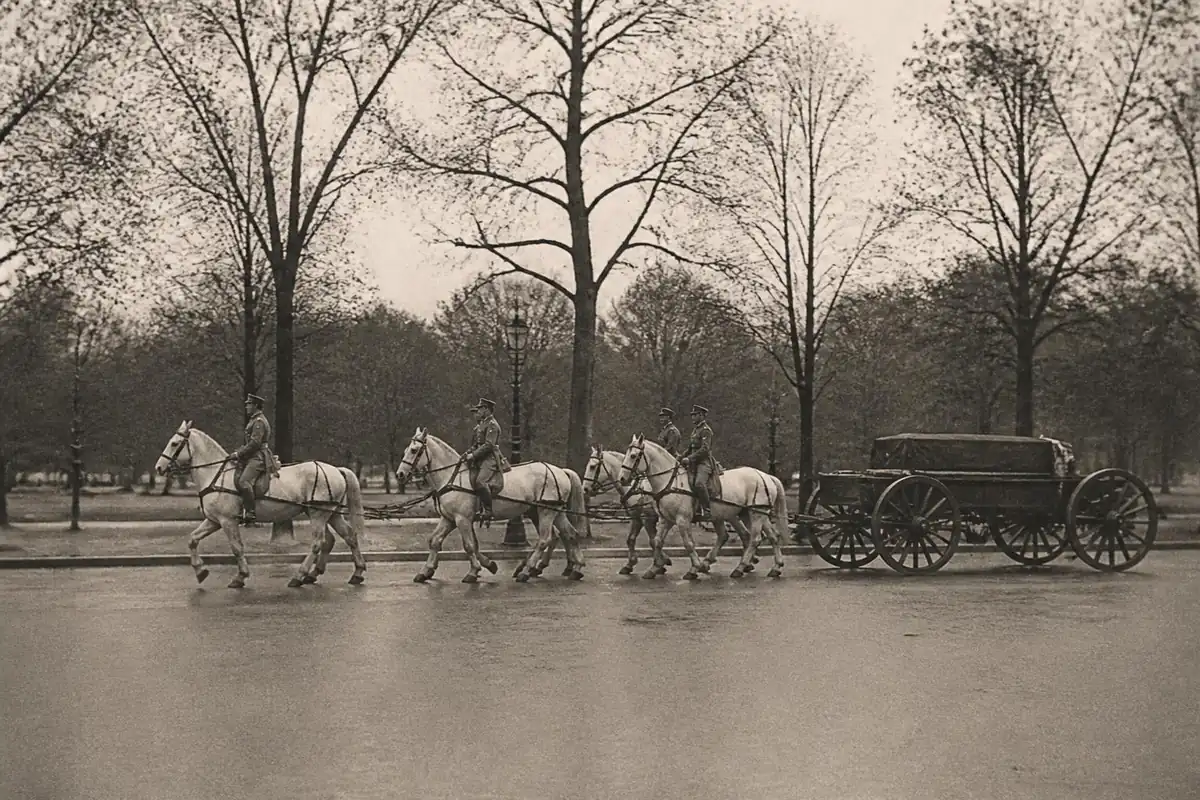
The man that day was Arthur Carlson, a private first class in the Old Guard, aged 19. On Sunday 24 November, the coffin left the White House for the Capitol on a gun carriage drawn by grey horses. On Monday 25, the day of the funeral, the procession set off again from the Capitol to the White House, then to St Matthew’s Cathedral, then to Arlington. Black Jack followed the caisson on both days.
He did not walk at a steady pace like the others. According to accounts gathered by The Chronicle of the Horse, he danced and pranced the whole way to the Capitol, to the point that the procession had to pause so he could catch up. At one moment a wheel of the caisson jammed, which unsettled all the horses, him included. On the return to the White House he was positively wild: he brought a hoof down on Carlson’s foot so hard that the young soldier thought his toes were broken. They were not.
Carlson did not let go of the lead. He would later say he was convinced that, if the horse got away, he would end up posted to Greenland. The horse prancing behind the coffin, head high, mane flying, became one of the most powerful images of the funeral. Many saw in him the anger or the grief of an entire nation, in a procession where everything else was regulated to the millimetre.
What Jackie Kennedy asked for Black Jack
Jacqueline Kennedy did not forget the horse. According to The Chronicle of the Horse, she let the Secretary of the Army know that she wished to buy Black Jack when he retired. She did, at any rate, receive his full ceremonial tack: the saddle, bridle, saddle blanket, sabre, boots and spurs. Black Jack’s saddle and boots are today in the collections of the John F. Kennedy Presidential Library in Boston.
Accounts disagree on what followed. Some write that she did buy him, others that she did not. One thing is certain: the horse never left Fort Myer. It was there that he spent his retirement, and there that he died.
More than 1,000 funerals, then military honours for a horse
Kennedy is only one name on a long list. In twenty-one years of service with the Old Guard, Black Jack served as the riderless horse at more than 1,000 military funerals with full honours, most of them at Arlington. He also followed the coffins of two other presidents, Herbert Hoover in 1964 and Lyndon B. Johnson in 1973, and that of General Douglas MacArthur in 1964.
He retired on 1 June 1973. The soldiers who cared for him knew his weakness: cake, and butter pecan above all other flavours. He died on 6 February 1976, aged 29. His body was cremated, and his ashes were buried on Summerall Field at Fort Myer with full military honours. He is often described as the second horse in United States history to receive them. Another story of an American military horse honoured after death is that of Comanche, the survivor of Little Bighorn.
This ceremonial horse’s fate recalls that of Burmese, Elizabeth II’s mare, who stayed calm under six gunshots in 1981, or that of Copenhagen, Wellington’s horse, who was also buried with honours. Black Jack did the opposite of Burmese: he never stayed calm, and that is precisely why he is remembered.
Established: Black Jack’s birth on 19 January 1947, his arrival at Fort Myer on 22 November 1952, the “U.S.” brand and the number 2V56, his role as riderless horse at the funerals of Kennedy, Hoover, MacArthur and Johnson, his retirement on 1 June 1973, his death on 6 February 1976 and his burial at Fort Myer with military honours; the meaning of the reversed boots; Jacqueline Kennedy’s request that the funeral follow Lincoln’s.
According to witnesses (reported by The Chronicle of the Horse and the local Arlington press): the riders thrown at Fort Reno, the jammed wheel, Arthur Carlson’s crushed foot, his fear of Greenland, the horse’s taste for butter pecan cake.
Uncertain: whether Jacqueline Kennedy actually bought Black Jack (sources differ), and the exact rank of “second horse” so honoured, which depends on what one counts.
Sources for the story of Black Jack, the horse of Kennedy’s funeral
The Chronicle of the Horse, “Remembering Black Jack”; John F. Kennedy Presidential Library and Museum, exhibition “A Nation Remembers” and object records (Black Jack’s saddle and boots); InsideNova, “Uniquely Arlington: Black Jack”; biographical entry on Black Jack (English-language Wikipedia); 3rd US Infantry Regiment (The Old Guard), Fort Myer.