
From Wednesday 23 to Sunday 27 September 2026, in Centelles, Catalonia, eight French horseback archers contest the European mounted archery championships with a double title to defend: the French team has been world champions since September 2025 and has held European team gold for three editions running. The squad, announced by the French Equestrian Federation (FFE) on 7 September, fields three seniors, three young riders and two individual competitors aged 15 and 17, with one curious detail: a single horse, Jive La Beige, runs in two categories under two different riders. Here is the discipline, the rules that decide the standings, the pairs competing and what France has come to Spain to win.
Mounted archery: galloping without reins and hitting a target, what the discipline demands of horse and rider
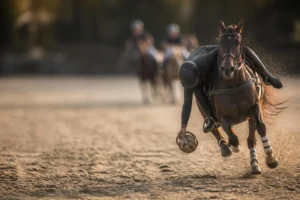
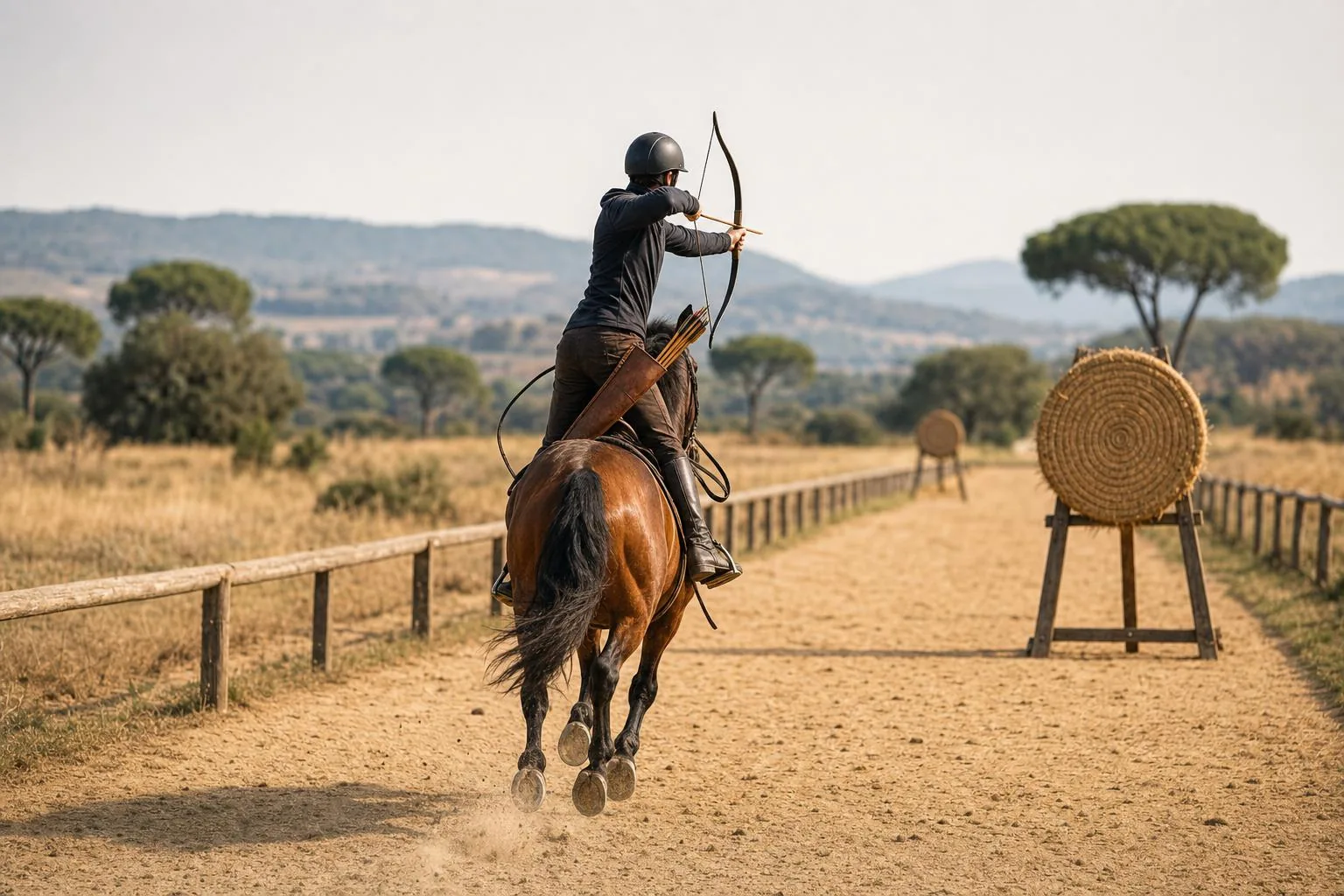
The principle fits in a sentence: the rider sends their horse galloping down a sand lane edged with a rail, drops the reins, takes up the bow, nocks an arrow and shoots at targets set along the lane, all before the end of the straight. Both hands are busy with bow and string; the horse is steered by body weight, legs and voice, and it must stay straight, even and calm while its rider turns to aim. That is what makes this a true equestrian discipline before it is a shooting event: a horse that slows, drifts or panics ruins the run of arrows, however skilled the archer.
The discipline descends from the mounted archers of the steppes and the horseback warriors of Asia and central Europe; our guide to mounted archery traces its martial origins, the traditional kit and the French clubs where you can learn it. In modern competition, the international framework is the International Horseback Archery Alliance (IHAA), which publishes the rulebook and the grid of levels, and runs the world championships every two years and the continental championships in the years between. In France, the FFE recognises and oversees the discipline, selects the national teams and includes it in its federal circuits.
In video · 120 seconds
Mounted Archery: World Champions France Defend Their European Gold in Spain from Wednesday
From 23 to 27 September 2026 in Centelles, Catalonia, eight French horseback archers contest the European mounted archery championships: France are reigning world champions and have held European team gold for three editions. The discipline, the three events, the pairs competing.

European Championships in Centelles 2026: three events to rank the horseback archers
The IHAA championships, European and world alike, are held in the discipline known as Horseback Archery Eventing, a combination of three events each worth a third of the final result, according to the international alliance’s own description. The first is the Tower: a short lane, 295 feet (90 metres) at the 2024 European Championships in Hungary and 360 feet (110 metres) at the 2025 World Championships in the United States, with a single target at which the archer shoots on the approach, as they come level with it, then as they ride away. The second is the Raid: a long lane, roughly 770 feet (234 to 235 metres) depending on the edition, dotted with several targets to be hit in succession at the gallop. The third is the Chase, a course over varied ground that breaks with the straight line: 0.9 mile (1.4 kilometres) and 24 targets in Hungary in 2024, and just over a mile (1,700 metres) at the 2025 Worlds in Tennessee.
The team standings add up the scores of three pairs, and the FFE pointed out after the 2025 Worlds that there is no “drop score”: no result is discarded, and every arrow from each of the three riders counts. That is the major difference from a showjumping Nations Cup, where the worst round of the first leg is wiped. In mounted archery, a single ruined run weighs directly on the team medal.
What a horseback archer and their horse are judged on at a championship
- Accuracy. Each target scores points according to the zone hit; an arrow not shot, or one that misses the target, earns nothing. On the Tower, the archer shoots forward, to the side, then backward at the same target: three very different angles.
- The number of arrows. On the Raid’s long lane, the faster the rider nocks and shoots, the more arrows they get away before the end of the line: rate of fire is part of the score, not just accuracy.
- The clock. The run down the lane is timed and the time counts towards the result: a horse that dawdles to give the archer more time pays for it on the score sheet.
- The horse’s gallop. Even, straight, without reins: the horse must hold its speed down the lane without being checked, something that takes months of schooling.
- The sum of all three events. Tower, Raid and Chase carry equal weight in the final standings. A straight-line specialist who fumbles the Chase loses the podium.
- A team with no joker. Three pairs, no score dropped: the team medal is won on the consistency of all three, not on one rider’s performance.
The eight French horseback archers selected for Centelles, and their horses
The list released by the FFE on 7 September 2026, settled by national team coach Alan Le Gall and the federation’s staff, comprises eight riders and seven horses. The senior French team brings together Aymeric Baudry (Ferme équestre Hantayo, Lot-et-Garonne) with Jaiko de Nogal, owned by Renate Deutsch; Raphaël Malet (Centre équestre du Pays Beaumontois, Dordogne) with Jive La Beige, owned by the Domaine de Gauchoux; and Chloé Simons (Ferme équestre Hantayo) with Eden de Kerbotin, her own horse, already her mount in the 2022 European selection.
The young riders’ team fields Ilan Borruel (Écuries d’Arion, Seine-et-Marne) with the same Jive La Beige, Enzo Coli Jun Ong (Domaine de Gauchoux, Haute-Vienne) with Raiduk Ar C’hoat, and Titouan Coucoulis (SAS Le Capimont, Tarn) with Toto, his own horse. Two girls compete in the individual events only: Émilie Chaigneau, in the U15 category, with Tango La Beige, and Eva Coli Jun Ong, in the U17 category, with Féline d’OK, both horses from the Domaine de Gauchoux. This yard in Peyrat-de-Bellac, in Haute-Vienne, thus supplies four of the delegation’s seven horses; three of the five clubs represented are in Nouvelle-Aquitaine, a region covered by our Nouvelle-Aquitaine equestrian directory.
Jive La Beige, the horse running two European championships in one week
The detail that stands out in this selection is the name Jive La Beige, entered twice: under Raphaël Malet in the seniors and under Ilan Borruel in the young riders. One horse for two standings, so three events twice over, with two riders of different weight, seat and shooting rhythm. The FFE does not spell out how the runs will be organised; what we can say is that the format of mounted archery, with its short lanes and chase courses, lends itself to this kind of sharing far better than a three-day event or an endurance ride, and that the federation’s stated policy, voiced in 2024 by national technical adviser Jaouad Boustani, is to “select pairs, not just riders”. Raiduk Ar C’hoat has also changed hands: it was on this horse that Chloé Simons became junior European champion in 2024, and this year it carries Enzo Coli Jun Ong in the young riders’ team.
World champions and three-time European champions: the record of France’s horseback archers
France does not arrive in Centelles as an outsider. At the 2024 European Championships in Pomáz, Hungary, on 12 to 14 July, the French team took team gold ahead of Hungary and Poland, its third consecutive team gold at a major championship after the 2022 European title and the 2023 world title in Mongolia; it was also its third European title after 2019 and 2022. Raphaël Malet became senior European champion there with Ritano, ahead of his team-mate Gaëtan Blot; Chloé Simons took junior gold, César Vassallucci silver, and Jules Boisson silver among the young riders: six French medals, three of them gold, among 65 competitors from 14 countries according to the IHAA.
A year later, from 19 to 21 September 2025 in Lewisburg, Tennessee, France retained its world team title with 293.532 points, some fifty points clear of Indonesia (254.193) and Poland (242.093), among 56 competitors. A particular feature of that American edition, as recounted by the FFE: the French rode horses hired locally and tried only a few days before the competition, Chloé Simons on DHMA Prince and Raphaël Malet on DHMA Lady Georgia Lynx. Malet finished third in the overall standings across all categories, and Simons was junior world champion ahead of Vassallucci. FFE president Frédéric Bouix saw in it proof that the federation was right to back “these lesser-known activities such as mounted archery, TREC and working equitation”, so-called development disciplines in which “France wins medals against countries that have practised this kind of riding for far longer than we have”.
In Centelles, the two headline names step up a level. Raphaël Malet, 19 at the 2025 Worlds, defends his senior European title on a different horse from Ritano; Chloé Simons, 17 a year ago, leaves the juniors for the senior team, this time with her own horse rather than a hired one. Gaëtan Blot, 2024 European runner-up and a member of both world-champion teams, is not in the 2026 selection.
The mounted archery horse: what type, what schooling, what protection for the rider
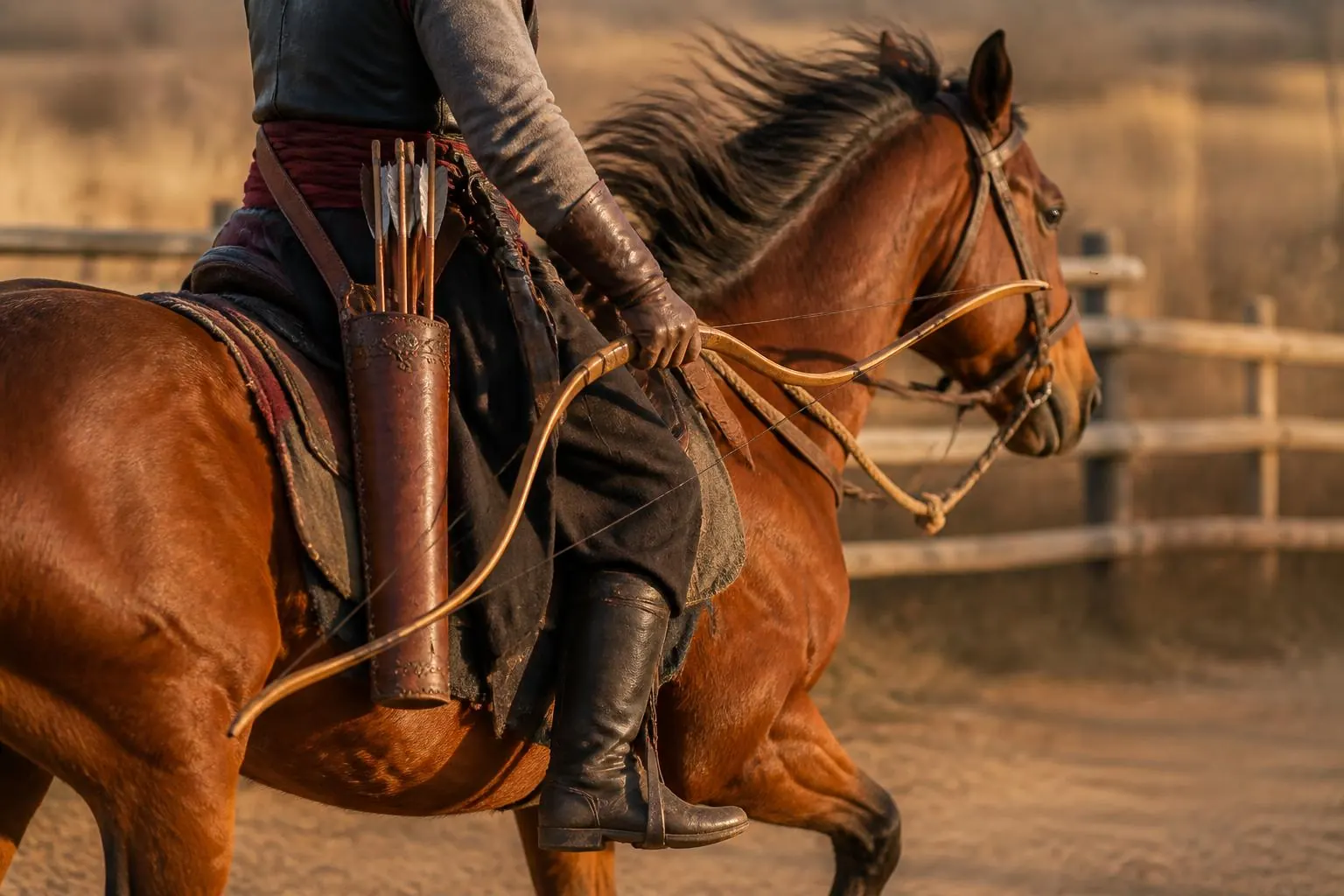
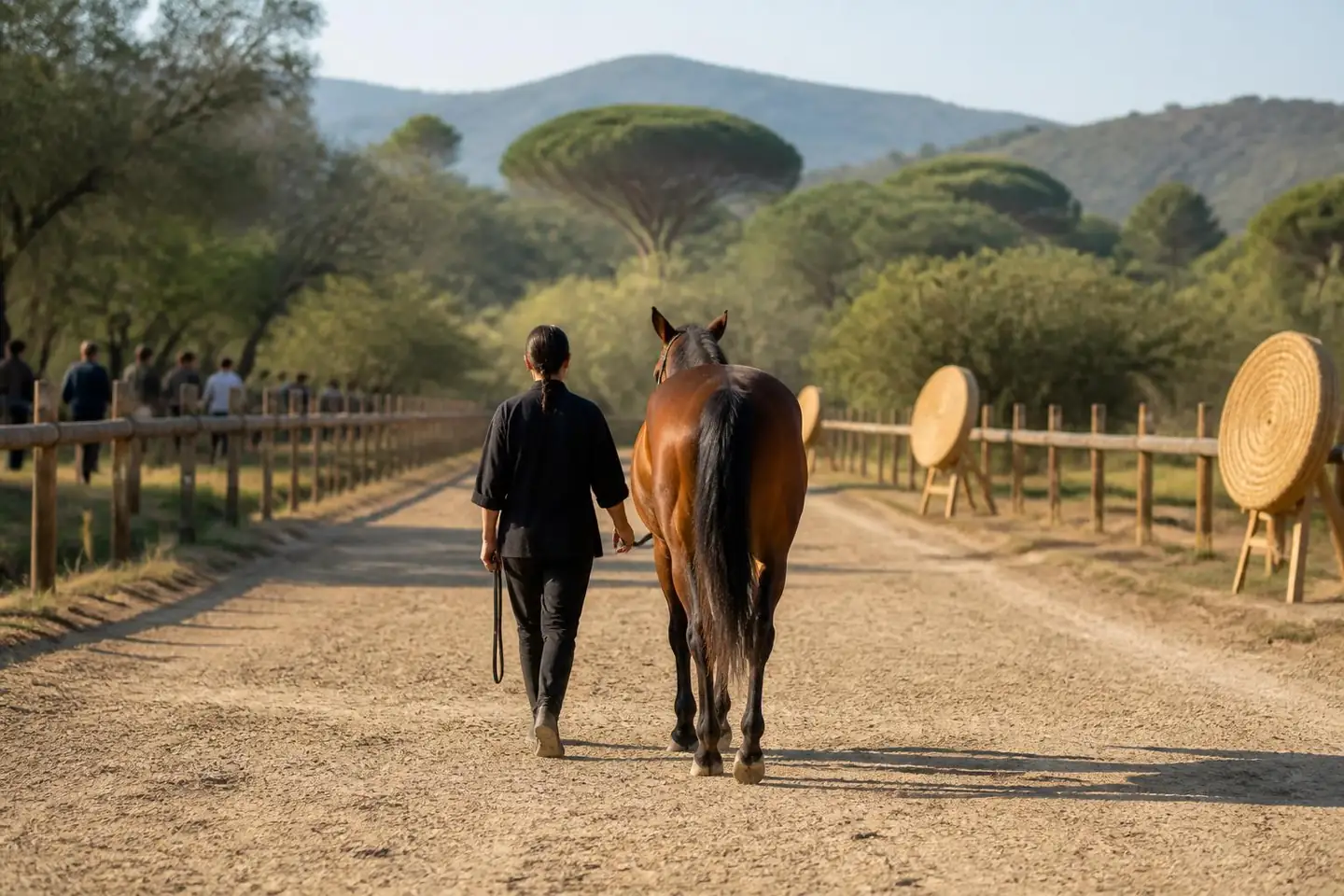
The names in the selection say it all: Ar C’hoat, La Beige, Kerbotin, Nogal. These are horses and ponies from French clubs and breeders, not racing Thoroughbreds or six-figure sport horses. The discipline asks for a compact horse, straightforward at the gallop, able to hold a steady rhythm over 295 to 770 feet (90 to 235 metres) without being held, and above all unbothered by the snap of the string and the whistle of an arrow loosed a few inches from its ears. This schooling, which begins at walk and trot with a bow but no arrows before moving up to the gallop, is the invisible part of the sport; it is what makes the spectacular backward shot possible. The mounted archers of history, the steppe riders we mentioned in connection with Genghis Khan and his Mongol horses, rode with short stirrups to free the upper body; modern competition has largely kept that raised seat, the rider standing in the stirrups down the lane.
As for the rider, a riding hat is compulsory in federal competition, mounted archery included, and our riding hat guide explains what the standards demand of a helmet that has to protect a head turned backward at the gallop. To compete in France, an FFE competition licence is required, as for showjumping; the clubs that teach the discipline remain few, and the five yards in the selection, from Lot-et-Garonne to the Tarn by way of Seine-et-Marne, map it out.
Centelles, the calendar and what follows in the horseback archers’ season
The European Championships run from Wednesday 23 to Sunday 27 September 2026 in Centelles, a town in the province of Barcelona, Catalonia. It is the fifth edition of a championship that the IHAA has moved around between France in 2017, Poland in 2019, France again in 2022, at the Domaine de Gauchoux, and Hungary in 2024. Results will be published by the federation and by the international alliance as the three events unfold; two team standings matter to the French, the seniors’ and the young riders’, in a discipline where France has made a habit of doubling up on individual podiums.
For those intrigued by the discipline, the season does not end in Spain: the Australian national mounted archery championships take place from 8 to 11 October, and the 2026 horse show calendar lists the autumn fixtures across all disciplines. The other equestrian sports that Equirider follows, from eventing to polo, have their own end-of-summer championships too.
Mounted archery in Centelles: key points
- The dates: IHAA European mounted archery championships, 23 to 27 September 2026 in Centelles, province of Barcelona (Spain).
- The stakes: France are world team champions (2023 in Mongolia, 2025 in Tennessee) and reigning European team champions (2019, 2022, 2024).
- The seniors: Aymeric Baudry and Jaiko de Nogal, Raphaël Malet and Jive La Beige, Chloé Simons and Eden de Kerbotin.
- The young riders: Ilan Borruel and Jive La Beige, Enzo Coli Jun Ong and Raiduk Ar C’hoat, Titouan Coucoulis and Toto; individually, Émilie Chaigneau (U15) and Tango La Beige, Eva Coli Jun Ong (U17) and Féline d’OK.
- The format: three events of equal weight, Tower, Raid and Chase; teams of three pairs, no score dropped.
- The horse: an even gallop without reins down a lane of 295 to 770 feet (90 to 235 metres), indifference to shooting, a raised seat on short stirrups.
Sources: Fédération française d’équitation press release of 7 September 2026 on the French selection for Centelles (relayed by GRANDPRIX on 9 September), FFE reports on the 2025 World Championships and the 2024 European Championships, and International Horseback Archery Alliance pages on the European Championships and the World Championships. Participation figures for 2025 differ from one source to another (56 competitors from 19 countries according to the IHAA, 23 nations according to the FFE); we have used those of the organiser. Equirider is not affiliated with the FFE or the IHAA.