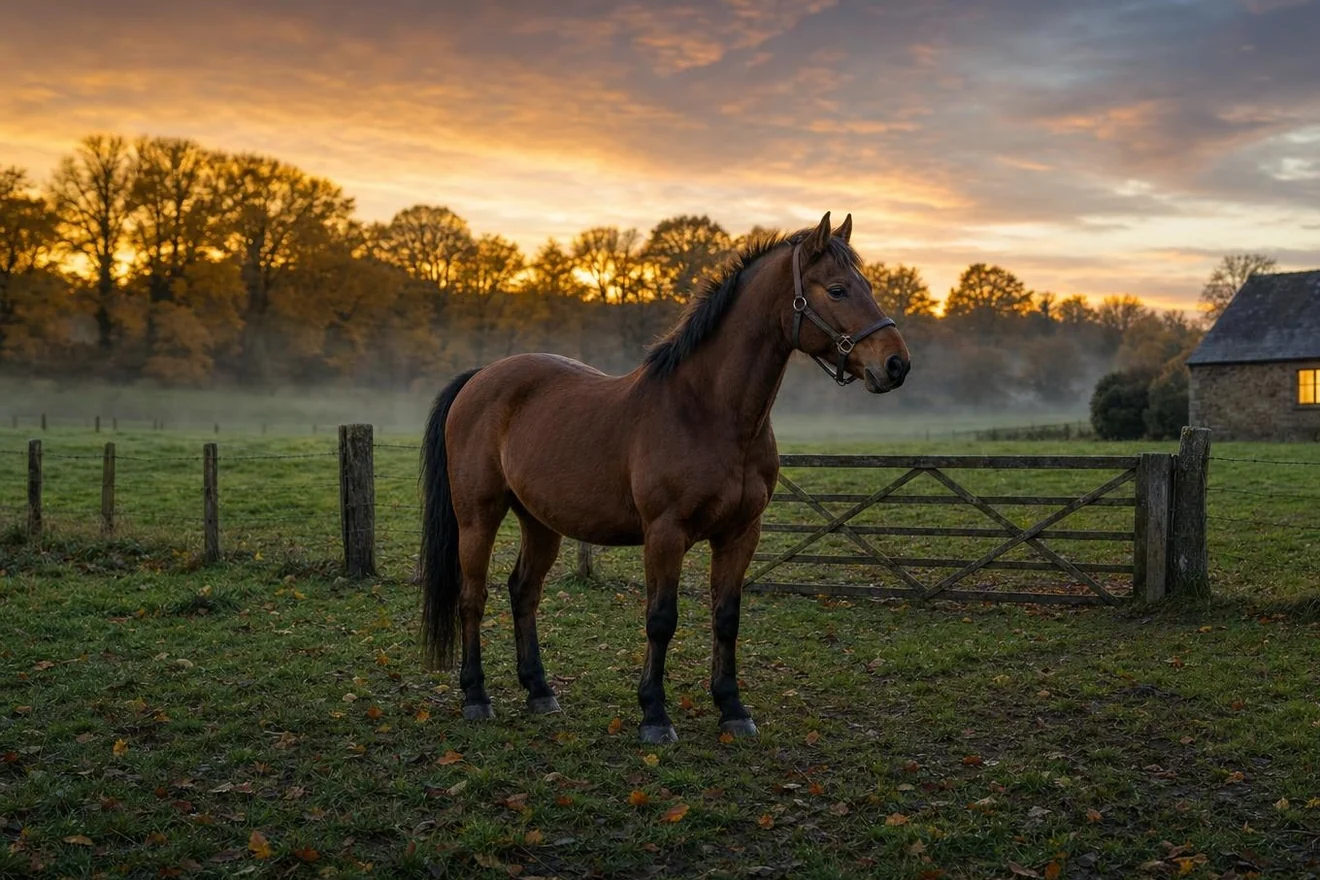

In the night of Saturday 24 to Sunday 25 October 2026, France moves to winter time: at 3 a.m. it will be 2 a.m. For us, an extra hour of sleep. For the horse, nothing changes in the sky, but everything changes in the yard: the hay arrives an hour later than his stomach expects, turnout shifts, and the evening ride ends in the dark. Here is what the clock change really does to a horse, what it does not do, and how to prepare him in a week.
The clocks change on 25 October: what shifts for the horse, and what does not
The switch to winter time is a human convention. It changes neither the length of the day nor the temperature. On Sunday 25 October, the sun will set in Paris at around 5.45 p.m. by the clock, whereas the day before it set at around 6.45 p.m. The light itself has lost only two or three minutes from one day to the next, as on every day of autumn.
The horse cannot read the time. He sets his body by two things: sunlight, which drives his underlying rhythms, and the routine we impose on him, which drives his expectations of the day. The clock change does not touch the first. It upsets the second, all at once, in a single night.
That is why the question is often wrongly framed. We wonder whether the horse “suffers” from the clock change like a human woken at the wrong hour. That is not the right question. The right question is: what happens when feed, stable and work all arrive an hour later than usual, for an animal that lives by routine?
Video · 121 seconds
Clock change and your horse: winter time on 25 October
The sky does not change for the horse, but his meals, his turnout and his evening ride all shift at once. How to prepare him in seven days.

Why the horse asks for his hay an hour early
A horse fed at fixed times learns those times. Ethologists call this food anticipatory behaviour: in the hour before feed is served, the horse becomes restless, whinnies, scratches at the stable door, circles or paws. A study published in 2024 in the journal Animals filmed stabled horses for five days around mealtimes. Horses on restricted rations showed more stereotypic behaviour and signs of excitement than those fed ad libitum, and that agitation built as mealtime approached.
Earlier work on stabled horses by Jonathan Cooper’s team in the United Kingdom describes the same pattern: weaving and head-nodding appear mostly before feeding, once the horse knows it is coming. If on Sunday 25 October you serve hay at 8 a.m. by your watch, your horse’s stomach is still running on yesterday’s 9 a.m. He has been waiting for an hour.
For a horse living at grass with forage always available, the effect is slight. For a stabled horse fed two or three times a day, it is real for the first few days: impatience, kicking at the door, and sometimes a horse that bolts his ration.
The horse’s stomach never takes a break: the real risk of the shift
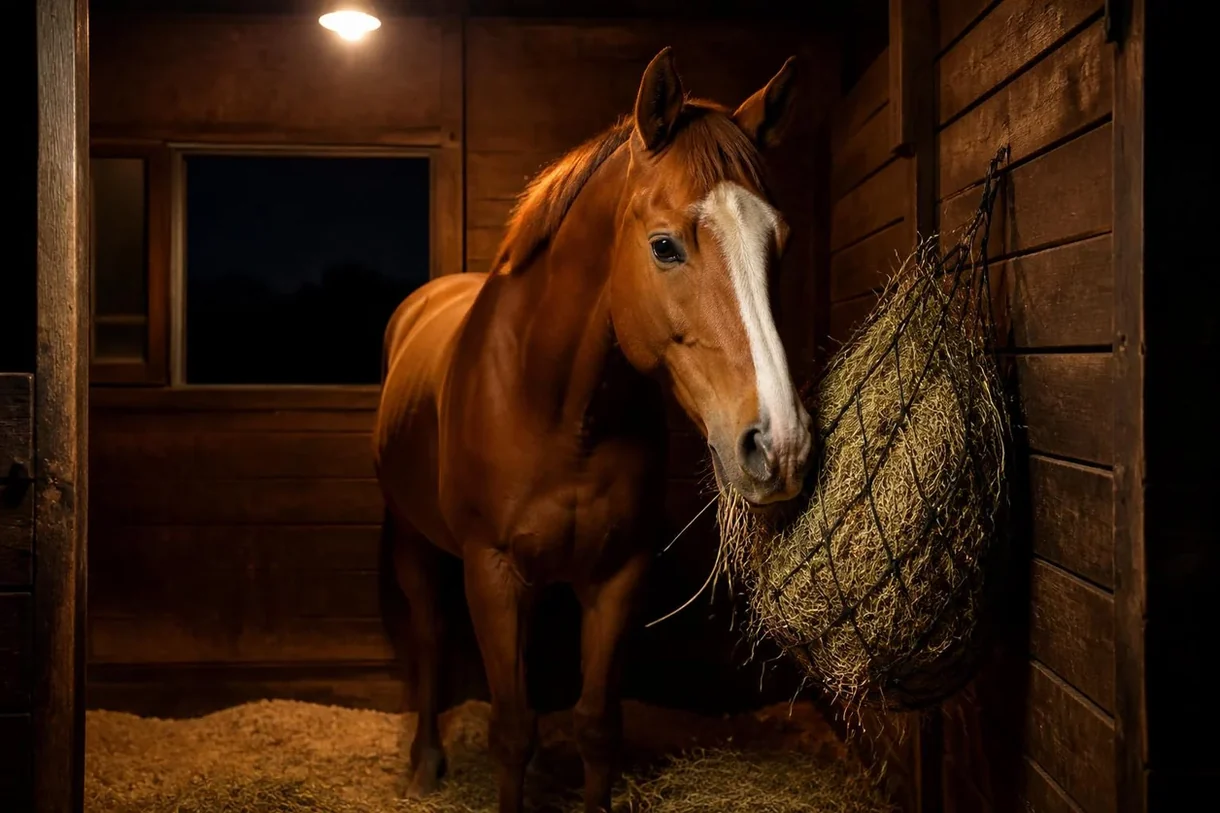
The horse’s stomach secretes acid continuously, whether or not he is eating. In a horse chewing forage, saliva buffers part of that acidity. In a horse waiting for his meal with an empty stomach, the acid is no longer neutralised. This is one of the well-described mechanisms behind gastric ulcers in horses.
One extra hour, just once, does not make a horse ill. The risk comes from accumulation: a horse already managed with long gaps without forage overnight, to whom you add another hour of waiting, followed by a hard feed bolted down because he is hungry. Sudden changes in feeding management are also a recognised risk factor for colic in horses. The clock change is not dangerous in itself: it is a sudden change of routine, and for that reason it deserves a week of preparation.
We found no published study that directly measures the effect of the clock change on equine health. What precedes rests on what is known about meal anticipation and digestive physiology, not on a survey devoted to 25 October.
Preparing your horse for the clock change in seven days
The simplest method is not to shift by a full hour at once, but in small steps. From Sunday 18 October, delay each feed by 10 minutes a day. By Saturday 24 October in the evening you will already have slid by about an hour, and on Sunday, by your watch, you will serve at the usual winter time without the horse having noticed anything.
- Shift all feeds together, hay and hard feed alike, so the gaps between them stay the same.
- Keep forage available overnight if you can, in a small-mesh haynet for example: mealtime matters far less to a horse who always has something to chew.
- Tell everyone at the yard. At livery, the timetable belongs to the yard manager: if the change is made all at once, at least ask that a little hay be given first, before the hard feed.
- Watch horses with stereotypies (crib-biting, weaving): they are the ones who anticipate meals most, and so the ones who will feel the shift most.
- Do not compensate with a bigger ration on the day itself: the quantity stays the same, only the time moves.
If your horse lives at grass, the main change concerns the time at which you bring him in or give him hay. The same logic applies: a few days of transition, and a ration calculated on his real needs. Our horse ration calculator lets you check the amount of forage before winter.
Your horse’s winter coat did not wait for 25 October
What many riders put down to the clock change was in fact decided well before. Winter coat growth is governed by day length, not by the clock. As nights lengthen, the horse’s pineal gland secretes melatonin for longer, prolactin falls, and the winter coat starts to come through. This mechanism begins at the end of summer, around the September equinox.
Researchers at University College Dublin published in 2020 in PLOS One four trials on ponies and horses fitted with masks delivering low-intensity blue light to one eye until 11 p.m., to extend the day to around fifteen hours. Begun a month after the summer solstice, this artificial long day kept the summer coat in stabled horses. Begun at the autumn equinox, it did not reverse winter coat growth: by then the process was already under way. The authors also note that temperature strongly modulates coat growth in the pony. In other words, it is light, then cold, that is in charge, not the date on the calendar.
In practical terms, 25 October changes nothing about your horse’s coat. It is, however, often the time when the coat is thick enough to raise the question of clipping and rugging. If your horse sweats in work and dries badly in the evening, clipping your horse is worth considering. A clipped horse, for his part, needs to be rugged: the weight depends on the clip, his way of living and the weather, and our guide to horse rugs will help you choose the right one for this winter.
The clock change and the mare’s cycle: light decides, not the clock
The mare is a long-day breeder. As day length falls, she gradually enters ovarian inactivity, and resumes cycling in spring. Here again, it is the photoperiod that decides. On 25 October, day length in Paris is around ten and a quarter hours; at the December solstice it will fall to a little over eight hours. The clock change does not remove a single minute of light.
Breeders who want foals early in the year use artificial lighting programmes in winter to bring forward the return of cycling. Work by Inrae on mare seasonality places maximum stimulation at around 14.5 hours of light a day; below 13 hours or beyond 16 hours, the effect disappears. Such a programme runs on the yard clock: if your timer is set to local time, remember to reset it on 25 October. To understand the mare’s cycle, our feature on mares in season details the signs and the calendar.
- Behaviour before feeds: no more restlessness than usual in the hour before feed is served.
- Speed of eating: the horse eats his ration at his own pace, without bolting it.
- Droppings: the same quantity and consistency as before the clock change.
- Appetite for hay: it stays in the net, and he does not neglect his forage.
- Stereotypies: in a horse that crib-bites or weaves, no visible increase over the week.
- State in work: a relaxed horse at the evening ride, even when it finishes at nightfall.
- Drying after work: a horse put away dry in his stable, not damp with sweat as the cold sets in.
Riders: the evening ride now ends in the dark
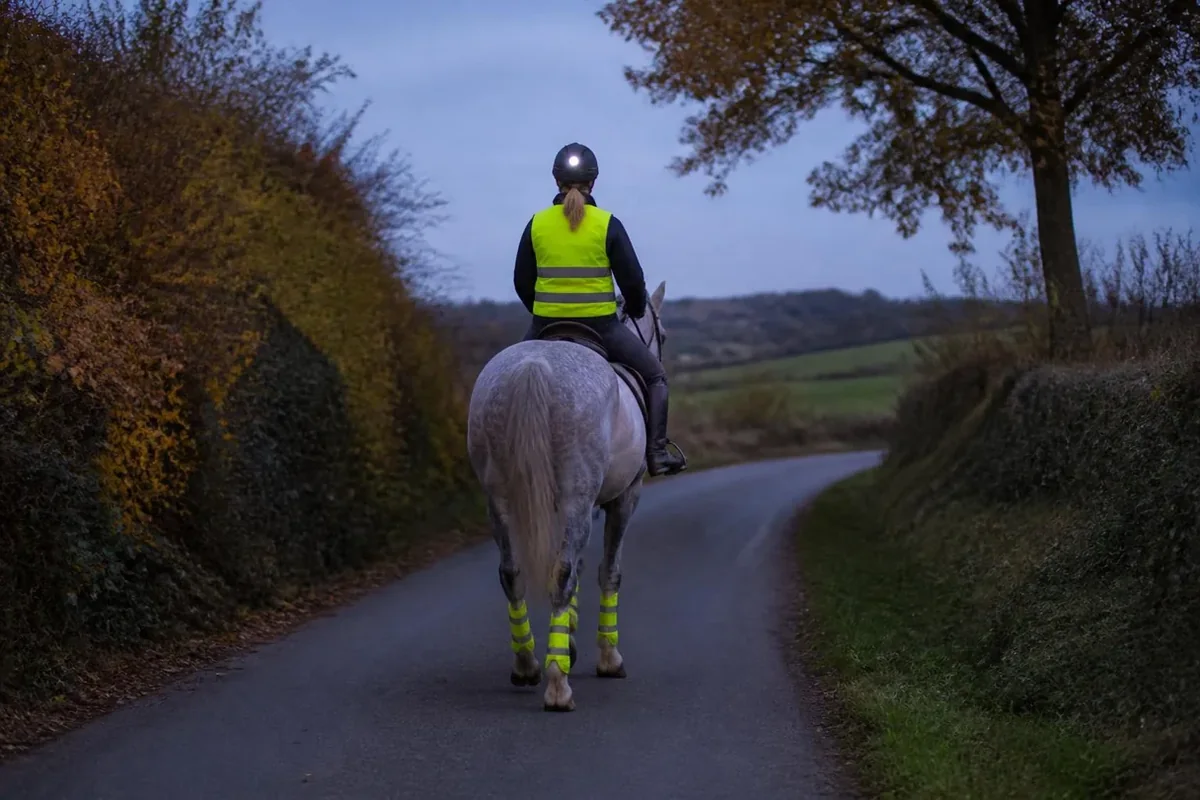
For the rider, this is the real change. On Monday 26 October, anyone who rides after work at 6 p.m. will be finishing in the dark. In a floodlit arena, it is merely a matter of habit. Outdoors, it is a matter of safety.
- On the road, be visible: a high-visibility jacket for the rider, reflective leg bands or a reflective exercise sheet for the horse, and a white light at the front if you come home after sunset.
- Shorten your hacks: set off earlier, or keep outdoor rides for the weekend, in daylight.
- Protect your head: at night, a horse startled by headlights or a noise may shy. The riding hat remains the rider’s first piece of equipment, by day and by night.
- Let him dry before rugging: night falls earlier, and so does the temperature. A damp horse put away in the cold chills quickly.
What we still do not know about horses and the clock change
The European Union voted in 2019 in favour of ending the seasonal clock change, but the measure was never implemented for lack of agreement between member states. France therefore still changes its clocks twice a year, and the next switch to summer time will take place on Sunday 28 March 2027.
On the horse side, no published study that we know of has measured how many days a horse takes to readjust to a meal shifted by an hour. Observations from breeders and livery yard managers speak of a few days. That is plausible given what we know about meal anticipation, but it has not been measured. If your horse stays restless or eats less beyond a week, the cause is probably elsewhere, and your vet’s opinion is called for.
For a broader look at winter, see our advice on horse care through the seasons.
Study on food anticipatory behaviour in horses on restricted or ad libitum rations, journal Animals, December 2024; work by J. J. Cooper and colleagues on feeding frequency and stereotypies in stabled horses (Applied Animal Behaviour Science, 2005); O’Brien, Darcy-Dunne and Murphy, effects of extended photoperiod on coat growth in ponies and horses (PLOS One, 2020); Inrae reviews on seasonality of reproduction in the mare (INRAE Productions animales); sunrise and sunset times calculated for Paris. This article does not replace the advice of your vet. Equirider is not affiliated with any of the institutions cited.