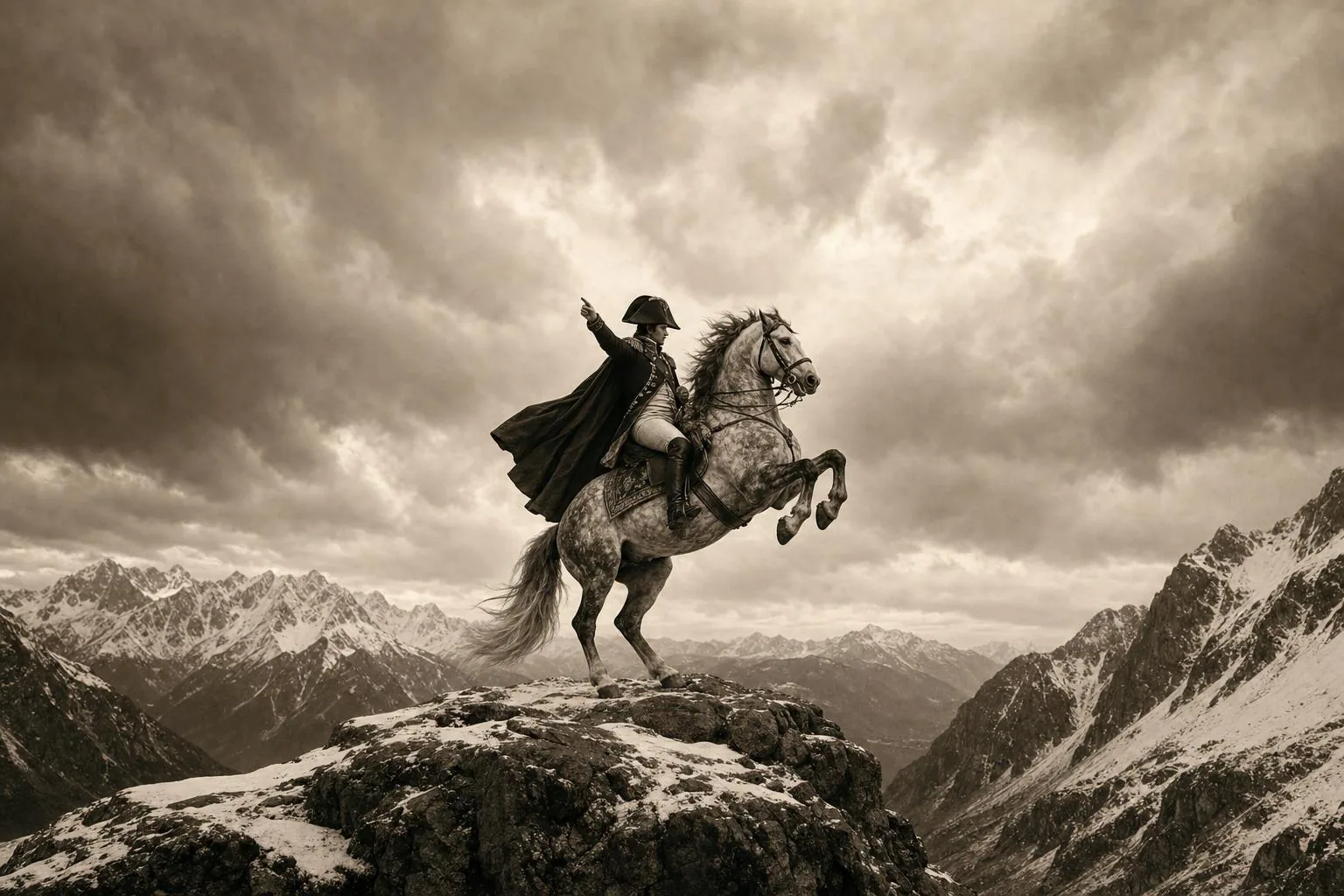

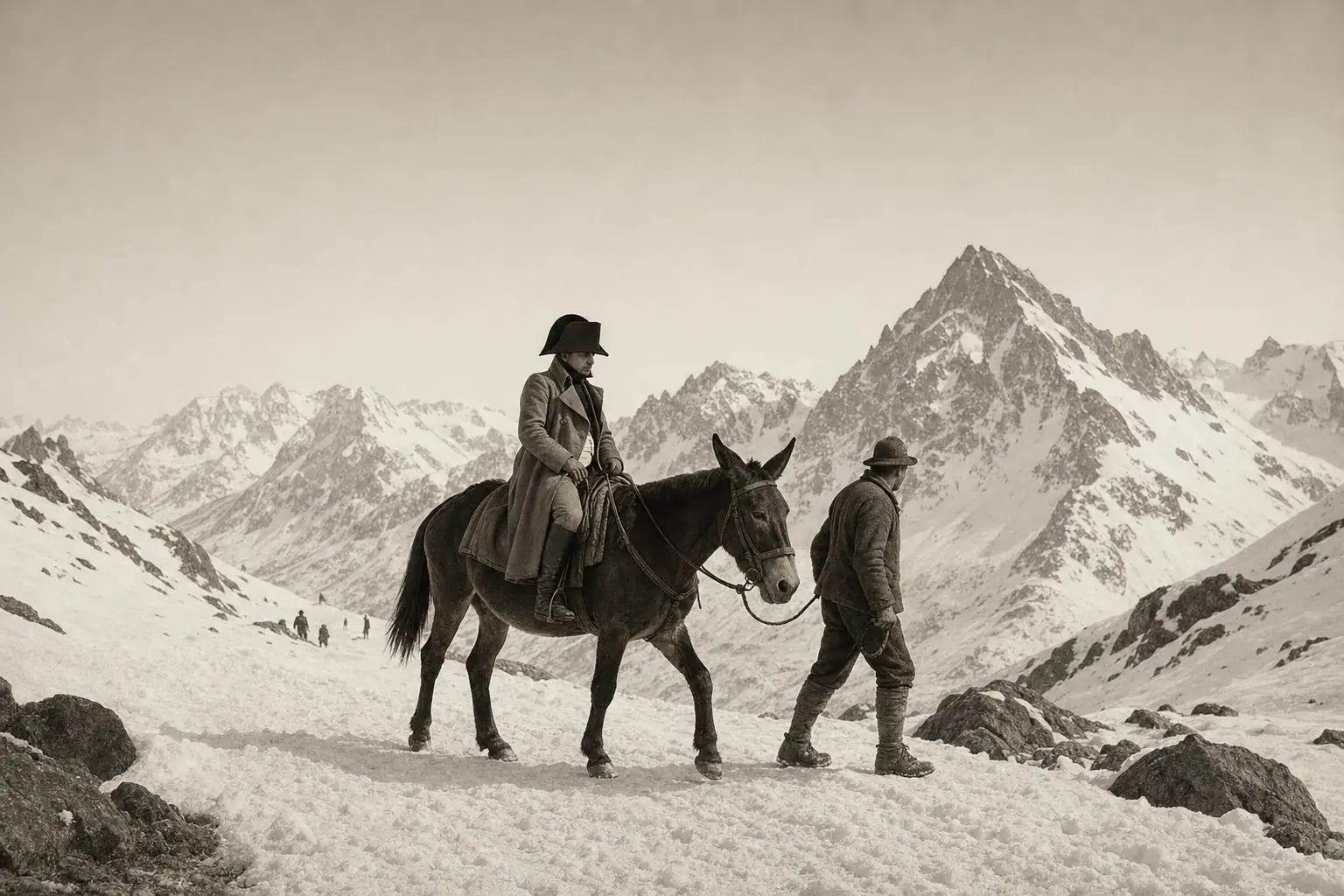
On 20 May 1800, Bonaparte crossed the Great St Bernard Pass, at 8,100 feet (2,469 metres), seated on a mule led by the bridle by a guide from the neighbouring village. A few months later, Jacques-Louis David painted him on a rearing horse, cloak streaming in the wind, on the edge of a precipice. This was no painter’s mistake: it was a commission. Bonaparte himself asked to be shown “calm on a fiery horse”, and he refused to sit. Here is what really happened on the pass, why the painting of Napoleon crossing the Alps shows a horse and not a mule, which real horses served as models, and what history remembered of the guide.
Napoleon in the Alps, May 1800: 40,000 soldiers and not one horse on the path
In the spring of 1800, Bonaparte is not yet emperor. First Consul for six months, he wants to surprise the Austrian army besieging Genoa. Rather than go by the coast, he sends the Reserve Army across the Alps by the Great St Bernard Pass, between the Swiss Valais and the Aosta valley. Some 40,000 men set out along the path from 15 May, with the artillery dismantled. The guns are hoisted into hollowed-out tree trunks and dragged through the snow by hand.
The First Consul crosses himself on 20 May, behind part of his troops. On the narrow path, icy in places, he does not ride a war horse. He rides a mule. There was nothing humiliating in the choice at the time: it is what any sensible traveller did in high mountains. Five weeks later, on 14 June 1800, the Battle of Marengo, on the Piedmont plain, gave him the victory that justified the gamble.
Video · 121 seconds
Napoleon crossing the Alps: why David painted him on a rearing horse
On 20 May 1800, Bonaparte crossed the Great St Bernard Pass on a mule, held back from the ravine by his guide. David painted him on a rearing horse: those were his instructions.

Why a mule rather than a horse on the paths of the Great St Bernard
The mule is the offspring of a donkey and a mare. From its dam it inherits size and strength, and from its sire a small, hard, very sure foot, along with a caution that muleteers know well: on a doubtful stretch, it stops and looks where it is putting its hoof. A horse, a flight animal, is more inclined to react fast, and on a path of rock and ice above a ravine, speed is the last reflex you want. Our guide to the donkey, its breeds and its uses explains where this reputation for sure-footedness comes from.
In the Alps, mules had carried mail, salt, wine and travellers for centuries. The monks of the Great St Bernard Hospice, who welcome passers-by at the summit of the pass, know something about that. According to an English-language note on Delaroche’s painting, the First Consul’s mule was obtained at Martigny, below the pass; other accounts simply say it was supplied on the spot. The detail varies, the fact does not: Bonaparte crossed the pass on a mule.
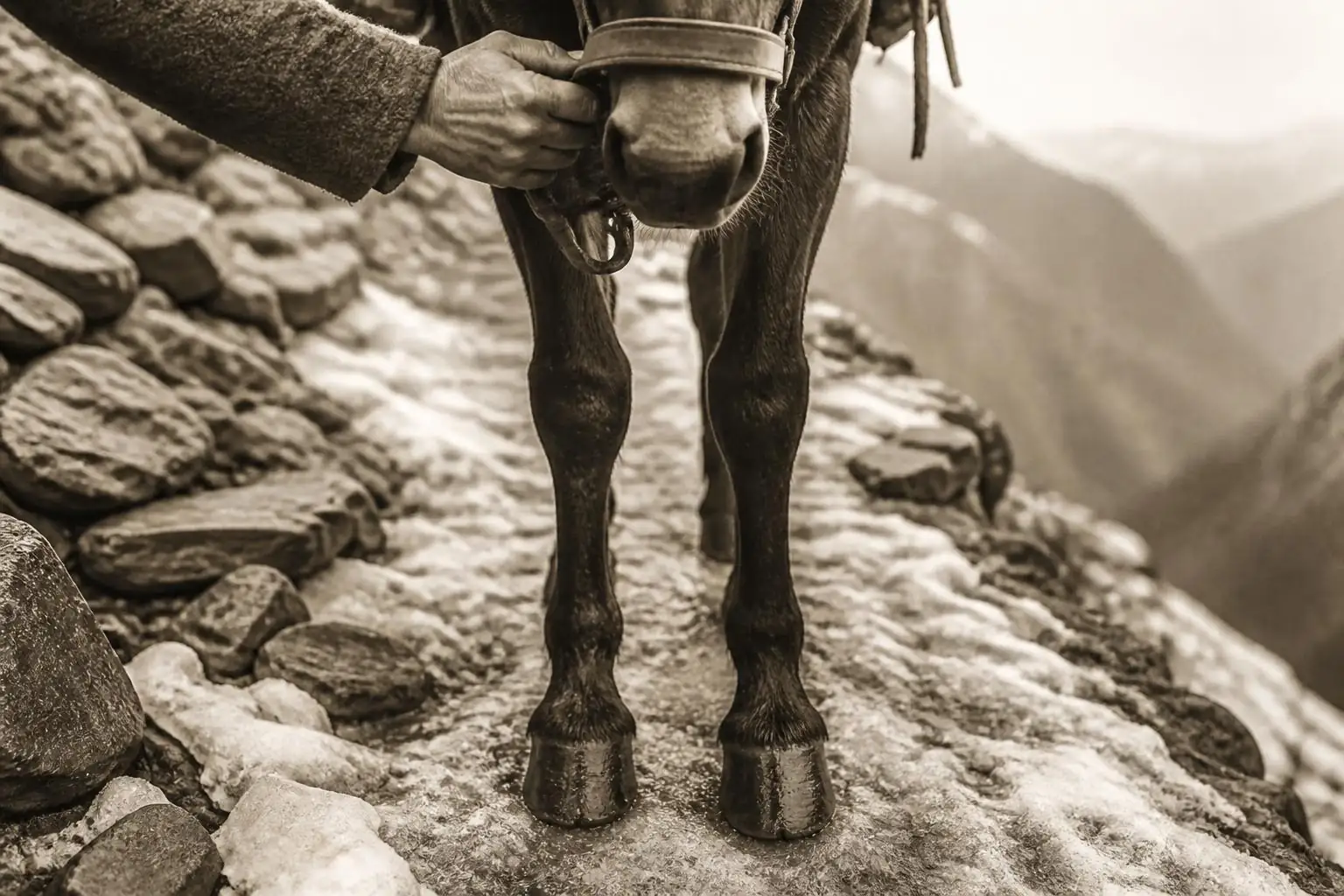
Pierre-Nicolas Dorsaz, the guide who held Bonaparte’s mule back from the ravine
The man holding the bridle is called Pierre-Nicolas Dorsaz. Born in 1773, he lives in Bourg-Saint-Pierre, the last village on the Swiss side before the pass. The Fondation Napoléon sums up the episode in one sentence: “Bonaparte made the journey on a mule accompanied by a guide, Pierre-Nicolas Dorsaz.” On the Sarreire stretch, the mule slips on a stone. It would have fallen had the guide not held it firmly. Swiss accounts place the scene shortly before the hamlet of Proz, above a ravine.
What follows is the stuff of a good story, though its conclusion is documented. According to the account passed down by the guide’s biographers, during the climb he talks about his life, the young woman he hopes to marry, the house he cannot afford to buy. At the summit, his passenger introduces himself: he is the First Consul, and he promises to send him the means to marry and settle down. A decree of 21 October 1801 grants “Pierre-Nicolas Dorsaz, inhabitant of Bourg-Saint-Pierre”, guide to the First Consul on the crossing of the Great St Bernard, the sum of 1,200 francs “in recognition of his zeal and devotion”. Dorsaz marries Éléonore Genoud, buys a house in his village, and both his children are born there.
“Calm on a fiery horse”: Napoleon’s instruction to the painter David
In August 1800, King Charles IV of Spain commissions a portrait of the First Consul from Jacques-Louis David. It is a diplomatic gesture, a pledge of understanding between the Spanish monarchy and the French Republic. David, the most celebrated painter of his day, delivers the canvas in January 1801, after about four months of work.
Bonaparte does not simply leave things to chance. He sets the brief in a phrase that has become famous: he wants to be painted “calm on a fiery horse”. And he refuses to sit. The reply attributed to him has entered every textbook: “Sit? What for? Do you think the great men of Antiquity, whose likenesses we have, ever sat?” For him, an official portrait should show not features but character.
The rearing horse answers that idea. In the tradition of equestrian portraiture, from the statues of Roman emperors to portraits of kings, the horse rising on its hind legs is the image of a force that only the leader can master. Art historians read the painting’s message this way: the surge, the violence, the danger belong to the animal and the mountain; the composure belongs to the man. A mule picking its way carefully through the snow would have told a different story, that of a sensible traveller, not of a conqueror.
David’s son on a ladder: how the painting of the rearing horse was made
With no sitter, David improvises. He obtains the uniform Bonaparte wore at Marengo and sets it on a wooden mannequin. For the rider’s posture, he has his own son climb a ladder, in the pose of an arm stretched towards the summit. His pupils, among them Jérôme-Martin Langlois and Georges Rouget, help him with the later versions.
The setting is built with the same freedom. The sky is heavy, the wind snaps the cloak, whereas the crossing of 20 May took place, by most accounts, in fine weather. In the foreground, on the rocks, David carves three names: BONAPARTE, ANNIBAL and KAROLVS MAGNVS, Charlemagne. Before the First Consul, Hannibal and Charlemagne had also crossed the Alps with an army. The painting does not show a mountain crossing, it places a man of 30 in the line of the great conquerors.
La Belle and Marengo: the two real horses behind David’s rearing horse
If the rider did not sit, the horses did serve as models. The notes on the painting name two of the First Consul’s mounts: a mare called La Belle, found in the Charlottenburg version, and Marengo, the grey stallion who appears in the Versailles and Vienna versions. It is a delicious irony: the rearing horse of Versailles and Vienna probably owes its looks to a battle horse, whereas on the pass that day it was a mule that carried the First Consul.
Marengo, a small Arabian horse brought back from Egypt according to tradition, has his own legend. We told it in why Napoleon swore by his horse Marengo, and his profile is in the Equirider wiki entry on Marengo. For the breed itself, our page on the Arabian horse sets out what gives it its stamina and its gait.
Five paintings, three coat colours: the versions of Napoleon crossing the Alps
The success is immediate. Bonaparte orders three more versions for his propaganda, paid at 15,000 francs each after negotiation (David was asking 20,000). David paints a fifth for himself. Between 1801 and 1805, five canvases leave the studio, and the horse is not always the same colour.
- Madrid, then Malmaison. Charles IV’s version shows a pied horse and an orange-yellow cloak. It has hung in the Château de Malmaison museum since 1949.
- Saint-Cloud, then Berlin. Vermilion red cloak, a bay horse according to the French note, chestnut according to the English one. The Prussians carried it off in 1814; it is in Charlottenburg Palace.
- Les Invalides, then Versailles. A dapple-grey horse. The canvas entered Versailles in 1837.
- Milan, then Vienna. A version close to the previous one, sent to Austria in 1834, now in the Belvedere.
- David’s studio. Kept by the painter until his death, it entered Versailles in 1979 and has been shown at the Louvre Abu Dhabi since 2017.
Pied, bay or chestnut, dapple grey: if these words seem close to one another, our guide to horse coat colours explains how to tell them apart, and the page on pied coat patterns details the case of the Malmaison horse.
Delaroche, 1850: the painter who put Napoleon back on his mule
Half a century later, the painter Paul Delaroche takes the opposite view. A first version dates from 1848 and is held in the Louvre. The second, completed in 1850, was commissioned by an English collector, the third Earl of Onslow, who thought David’s painting unrealistic after seeing it in the Louvre. It stands nearly 10 feet (3 metres) high and hangs in the Walker Art Gallery in Liverpool.
It shows a tired man wrapped in a grey greatcoat, hunched on a mule plodding through the snow, led by an old peasant. No cloak in the wind, no outstretched arm, no rearing horse. The Fondation Napoléon notes that Delaroche wanted to show the crossing “in all its reality”. The two paintings say the same thing in two ways: one shows what Bonaparte wanted remembered, the other what actually happened.
How we judge a story about Napoleon and his horse
Stories about Napoleon and his horses circulate by the hundred, and many mix legend with archive. Here are the criteria we applied to this one.
How we judge the story of the rearing horse and the mule
- A precise date and place. 20 May 1800, the Great St Bernard Pass, 8,100 feet (2,469 metres): the sources agree.
- A named witness. The guide Pierre-Nicolas Dorsaz is known by name and village, and his reward appears in a decree dated 21 October 1801.
- An identified patron. The painting was commissioned by Charles IV of Spain, then by the First Consul: it is an official image, not a news report.
- A written instruction. “Calm on a fiery horse” explains the choice of the rearing horse better than any hypothesis.
- Discrepancies flagged. The coat colour of the Berlin horse, the exact origin of the mule: where the notes diverge, we say so.
- A counter-painting. Delaroche supplies the realistic version; comparing it with David shows what was added.
What we still do not know about Napoleon’s mule and horse in the Alps
Three points remain unclear. First, the origin of the mule: obtained at Martigny according to one source, supplied on the spot according to others, and we know neither its name nor who owned it. Second, how much of the route was covered on foot: on some stretches, going up as well as down, travellers walked beside their mounts, and the accounts do not always say when. Finally, the exact model for each painted horse: the notes attribute La Belle and Marengo to certain versions, but nothing proves that David did not blend several horses, or recompose a coat colour from memory.
What is not unclear is the gap between the scene and the image. It was deliberate, owned, and it worked: two centuries later, the rearing horse is the one everybody has in mind, and almost nobody knows the name of Dorsaz.
Horse or mule in the mountains: what Bonaparte’s pass teaches the trail rider
The episode holds a very concrete lesson for anyone riding in the mountains. On a narrow path, what matters is not the horse’s pace but the sureness of its footing, its calm in front of a drop, and the presence of someone who knows the way. Before committing to an Alpine route, check that your horse has already worked on varied terrain: mountain trail exercises prepare precisely for these passages, and our guide to the price of a horse trek helps you choose an outing led by a guide who knows the terrain.
And if you want to ride in the Emperor’s footsteps, the route he followed on his return from Elba in 1815 can be ridden on horseback: our itinerary for the Route Napoléon on horseback, from Corps to La Mure, covers one stage. More stories of horses and artists await you too: Copenhagen, Wellington’s horse at Waterloo, Géricault and his falls from horses, or Leonardo da Vinci’s giant horse.
Want to ride in the mountains? Waymarked routes, stages, required levels and stabling for horses: our riding-holiday guides help you prepare the trip before you saddle up.
Sources: reference notes in French and English on Jacques-Louis David’s painting “Bonaparte Crossing the Great St Bernard Pass” (commission by Charles IV in August 1800, delivery in January 1801, prices of the versions, the instruction “calm on a fiery horse”, the refusal to sit, the painter’s son on a ladder, the Marengo uniform and mannequin, the models La Belle and Marengo, the inscriptions on the rocks, location and coat colours of the five versions); Fondation Napoléon, napoleon.org (crossing by mule with the guide Pierre-Nicolas Dorsaz, the mule slipping at the Sarreire, Delaroche’s 1848 painting in the Louvre); biographical notes on Pierre-Nicolas Dorsaz (Bourg-Saint-Pierre, the First Consul’s promise, the decree of 21 October 1801 and 1,200 francs, marriage to Éléonore Genoud); reference note on “Bonaparte Crossing the Alps” by Paul Delaroche (commission by the Earl of Onslow, 1850 version at the Walker Art Gallery in Liverpool, mule obtained at Martigny, about 40,000 men from 15 May 1800). Discrepancies between the notes on the Berlin horse’s coat colour and the origin of the mule are flagged in the article. Equirider is not affiliated with any of the institutions mentioned.