
Every autumn, horses that were perfectly healthy the night before are found the next morning unable to stand, passing dark brown urine. The cause is a winged sycamore maple seed lying in the pasture grass: atypical myopathy. On 29 September, as the high-risk season began, the RESPE, France’s equine disease surveillance network, republished its prevention guidelines. Around seven in ten affected horses do not survive. The good news is that the guilty tree is easy to recognise, by a detail any rider can check just by bending down: the angle formed by its two seed wings.
Atypical myopathy: why autumn is sycamore maple season
Atypical myopathy is a poisoning. It is caused by hypoglycin A, a toxin found in the samaras, those winged seeds that spin like helicopters as they fall, and in the young seedlings of two maples: the sycamore maple (Acer pseudoplatanus), responsible for the vast majority of cases in Europe, and the box elder (Acer negundo), which is implicated more rarely.
The calendar follows the life of the tree. In autumn the samaras fall in great numbers; in spring they germinate and the seedlings push up through the grass. These are the two risk seasons the RESPE points to. Wind makes everything worse: according to Horsia’s toxicology sheet, it can carry samaras up to 200 metres (about 650 ft) from the tree, which means a paddock with not a single maple in it is not necessarily safe if a sycamore is growing in the neighbour’s hedge.
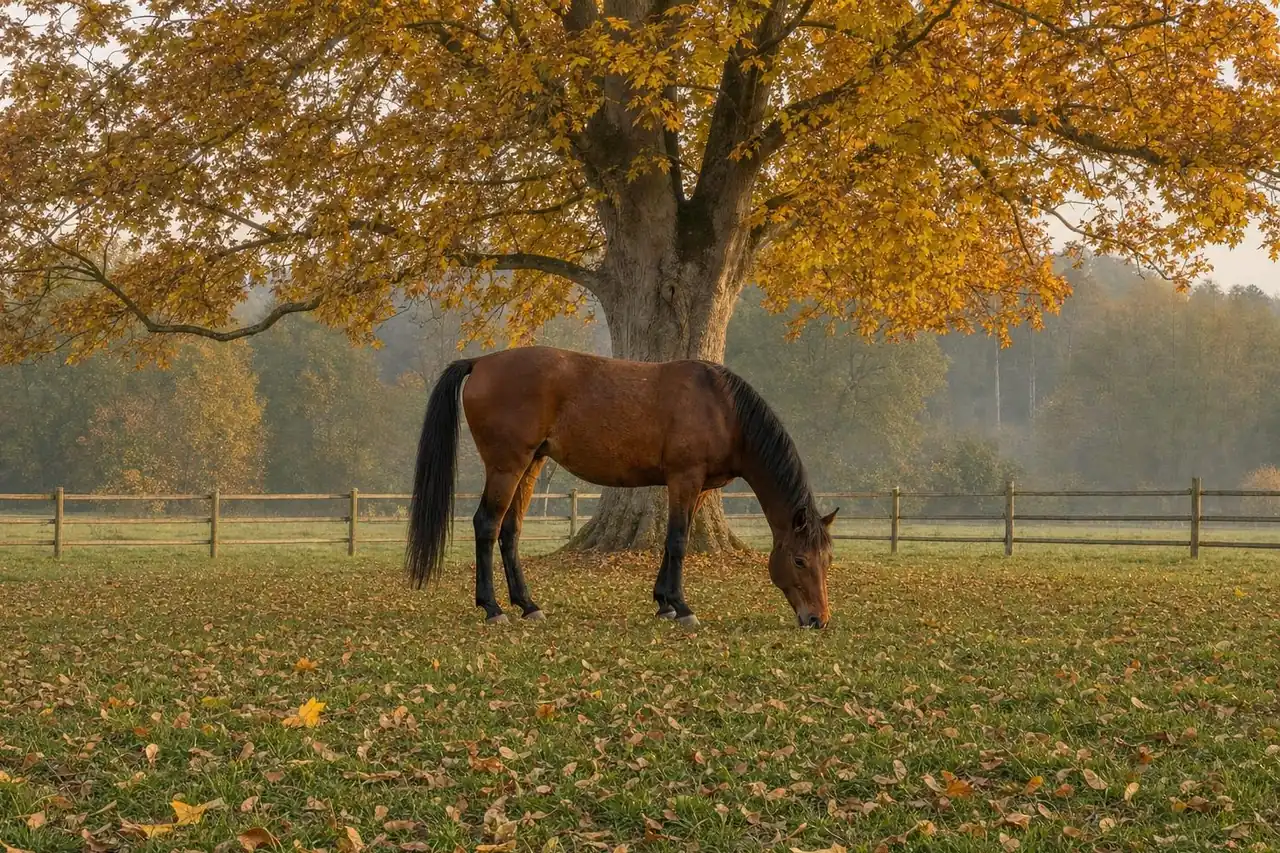
The horses most at risk are those living out at grass around the clock, on pasture close to maples, especially when the grass runs short and the horse starts grazing what it would normally leave alone. The RESPE also lists windy spells and dry periods among the risk factors. Several field sources report that young horses, under five years old, are the most often affected.
On video · 106 seconds
Atypical myopathy: the autumn maple that poisons horses gives itself away by its V-shaped seeds
The RESPE republished its guidelines on 29 September: in autumn, sycamore maple seeds fall into the pasture, and atypical myopathy kills around seven in ten affected horses. The tree can be recognised by the angle of its samaras.

Recognising the sycamore maple in the paddock: the angle of its seeds
Not every maple is dangerous, which is exactly why identification matters. In 2016, a study by Utrecht University and the RIKILT institute in Wageningen analysed 278 maple samples: it found hypoglycin A in the sycamore maple, but not in the field maple (Acer campestre) or the Norway maple (Acer platanoides), two species very common in hedgerows and parks.
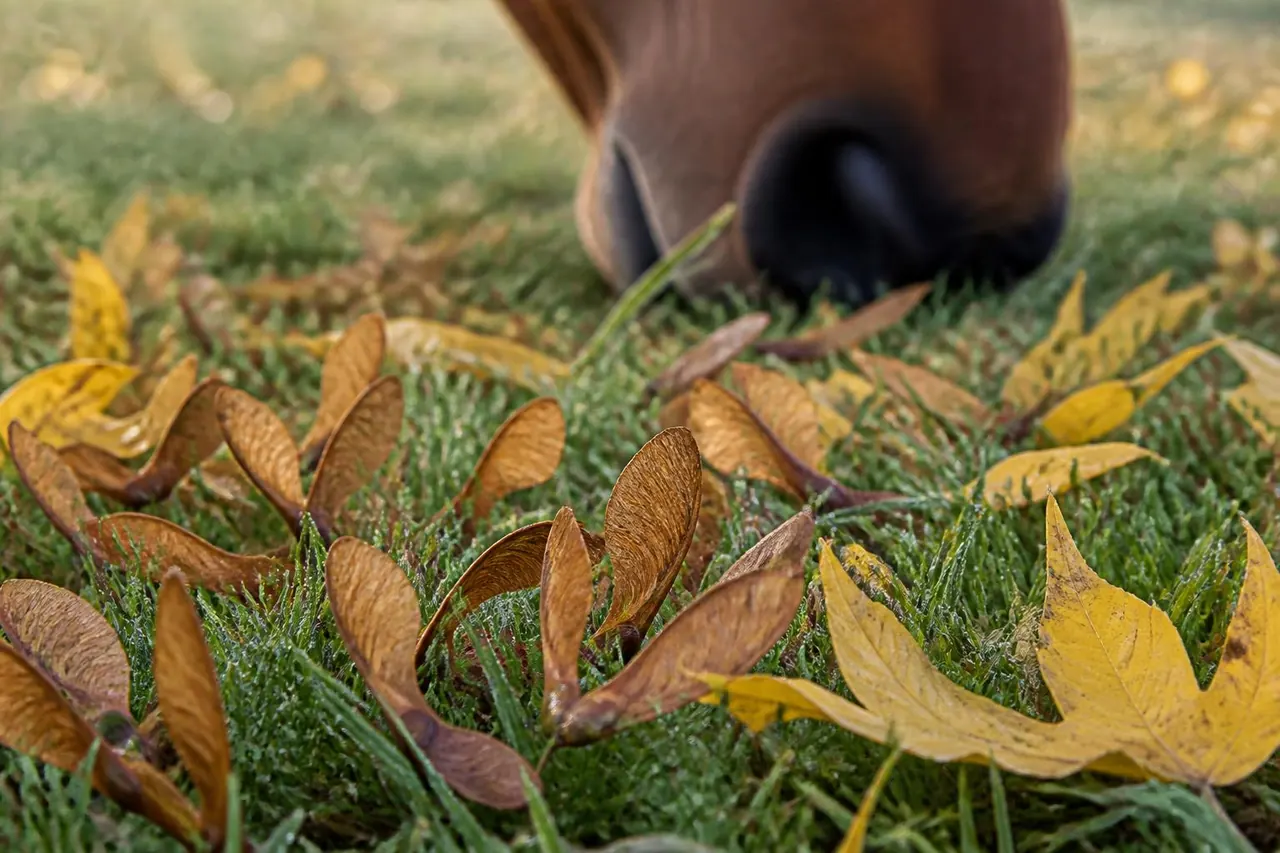
The simplest way to tell them apart in October is to pick up a pair of samaras and look at the angle between the two wings:
- Sycamore maple: the two wings form a tight V, at 90 degrees or less.
- Norway maple: the wings open wide, at more than 90 degrees, almost horizontal.
- Field maple: the wings lie flat and aligned, at 180 degrees.
The leaves confirm it: sycamore leaves have five rounded lobes separated by narrow notches; Norway maple leaves end in fine, drawn-out points; field maple leaves are small, with blunt lobes. On an old tree, the sycamore’s bark, smooth and grey when young, flakes off in irregular plates. If in doubt, a vet, a farm adviser from the local chambre d’agriculture or an arborist will be able to settle it.
Atypical myopathy in horses: the symptoms, and the appetite trap
The toxin destroys muscle fibres on a massive scale, including those of the postural and respiratory muscles and the heart, which is why the disease is so severe. The signs described by the RESPE and in veterinary guidance are as follows:
- sudden weakness, a stiff horse that moves with difficulty or stays lying down;
- muscle trembling and patches of localised sweating;
- very dark, reddish-brown urine, a sign that pigment from damaged muscle is passing into the urine;
- congested mucous membranes, and laboured breathing in severe forms;
- sometimes signs that look like colic.
The trap lies elsewhere: a sick horse often keeps its appetite. A horse that is still eating is therefore no cause for reassurance if it shows the other signs. Confusion is also common with tying-up, exertional rhabdomyolysis, which produces similarly dark urine; the difference lies in the context, a horse at grass that has not been worked, versus a horse that seizes up when work resumes, as we explained in our piece on tying-up in horses. Only a vet can tell the two apart, with a blood test and a urine examination.
- A sycamore maple nearby, in the paddock, the hedge or next door: samaras in a tight V, leaves with rounded lobes.
- Samaras on the ground after a gust of wind in autumn, or maple seedlings in the grass in spring.
- Short grass or an overgrazed pasture, which pushes the horse to eat what it would normally sort out and leave.
- A horse at grass full time, nights included, without enough hay.
- A young horse, with those under five years old most often cited among cases.
A horse suspected of atypical myopathy: what to do while waiting for the vet
There is no specific antidote, the RESPE points out. Survival depends on how quickly the diagnosis is made and on intensive care, notably intravenous fluids: the Royal Veterinary College in London puts survival at around 30 to 40% in horses treated quickly. Horses that survive generally recover without lasting effects.
The first-hour reflexes, while waiting for the vet’s advice and never replacing it:
- Call the vet immediately, saying that the horse lives at grass near maples and describing the colour of the urine.
- Do not walk the horse to “loosen it up”, and do not transport it without the vet’s say-so: its muscles are breaking down.
- Keep it sheltered from the cold and leave water within reach.
- Bring in the other horses from the same pasture: this is the RESPE’s instruction in case of suspicion, since they have had access to the same seeds.
Cases are tracked in France by the RESPE, in liaison with the Atypical Myopathy Alert Group (AMAG) at the University of Liège, which centralises European surveillance. Your vet can report the case there.
Hypoglycin A: the sycamore maple’s toxin is also found in ackee and lychee
The disease was a mystery for a long time. It was not until 2013 that American researchers linked seasonal pasture myopathy in horses in the United States to hypoglycin A in box elder seeds, and 2014 before the Liège team confirmed the same toxin in sycamore samaras in Europe. Once ingested, hypoglycin A is converted by the body into a compound, MCPA, which blocks the way muscles burn fat to produce energy.
The most surprising detail is that this toxin is not unique to maples. It belongs to the soapberry family (Sapindaceae), which includes ackee, the national fruit of Jamaica, responsible in humans for “Jamaican vomiting sickness” when eaten before it is ripe, and lychee, linked to outbreaks of acute encephalopathy in undernourished children in India. The same molecules, hypoglycin A and its cousin MCPG, act in horses and in humans alike.
Protecting your horse from the sycamore maple this autumn
The measures recommended by the RESPE come down to a handful of habits, to be started now, while the samaras are falling:
- Locate and map the maples around your pastures, including in hedgerows and on neighbouring land.
- Take horses off contaminated pastures during the risk period, or keep them out of the seed-fall zone with an electric fence.
- Pick up samaras where possible, and inspect the paddock after every gust of wind.
- Provide plenty of hay so that a well-fed horse does not go looking for seeds; our horse ration calculator helps estimate the amount.
- Cut down turnout time in autumn and spring, and bring horses in on very windy nights.
The sycamore maple is only one of the plants that threaten a horse at grass. Yew, ragwort and meadow saffron also claim victims every year: our guide to plants poisonous to horses covers 19 of them, with their symptoms and the right responses. And if your horse shows digestive rather than muscular signs, see our first steps to take when facing colic.
What we still do not know about atypical myopathy in horses
Not every horse grazing under a sycamore falls ill. The Utrecht researchers stressed this themselves: the presence of hypoglycin A in a tree does not necessarily make it dangerous, as the content varies greatly from one tree to another and from one year to the next. Nor is it possible to set a quantity of seeds beyond which a horse is at risk, or to explain fully why some horses resist better than others.
As of the date of this article, we have not found a published tally of French cases for autumn 2026. Without a reliable threshold, caution remains the rule: a sycamore maple near a paddock in October should be treated as a risk.
RESPE, “Toxic maple in horses: how to prevent atypical myopathy?” (29 September 2026) and “Atypical myopathy in horses: a serious poisoning linked to certain maples” (5 March 2026), both in French; Utrecht University and RIKILT Wageningen, study of 278 maple samples (press release of 12 April 2016); Royal Veterinary College, “Atypical Myopathy” fact sheet (updated 2022); Horsia, toxicology sheet “Maples and atypical myopathy”; Premier Galop, samara identification criteria based on the RESPE and AMAG; Valberg et al. (2013) and Votion et al. (2014), Equine Veterinary Journal, for the identification of the toxin. This article is for information and does not replace the advice of your vet.