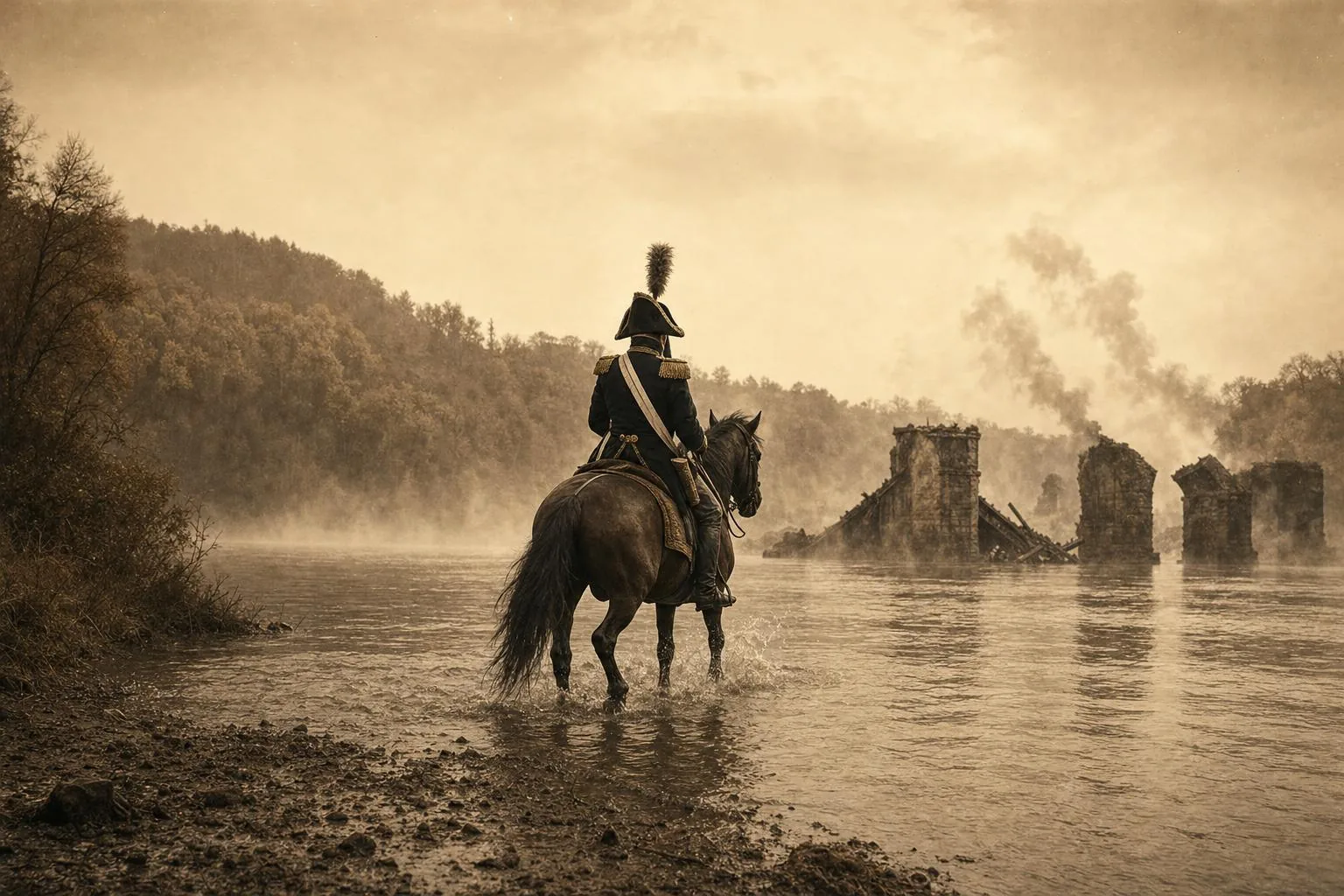

Leipzig, 16 October 1813. In the thick of the Battle of the Nations, Napoleon hands the baton of a Marshal of the Empire to Prince Józef Poniatowski, a Pole and the only foreigner ever to receive that honour. Three days later, on 19 October, the same man drives his horse into the Elster, a river swollen by autumn rain, and vanishes in the current. Parisians know his name without knowing it: it is the one on the Boulevard Poniatowski, in the 12th arrondissement. What is told less often is why a rider of his calibre, wounded and surrounded, chose the water over surrender, and what his bronze horse went through afterwards in Warsaw.
Poniatowski on horseback: a Polish prince trained in the Austrian cavalry
Józef Antoni Poniatowski was born in Vienna on 7 May 1763. He was the nephew of Stanisław August Poniatowski, the last king of Poland. Like many young aristocrats of his day, he learned the soldier’s trade in the saddle: in February 1780 he joined the 2nd Carabiniers as a second lieutenant, an Austrian cavalry unit stationed in Bohemia. He rose quickly, becoming a colonel and aide-de-camp to Emperor Joseph II, and was wounded in the assault on the fortress of Šabac, in Serbia, on 24 April 1788.
He then entered Polish service, fought the Russians in 1792, and went on to become Minister of War and commander-in-chief of the army of the Duchy of Warsaw, the state created by Napoleon. In 1809, at Raszyn, he led a counter-attack himself. Poland has a long cavalry tradition, that of the winged hussars who charged at Vienna in 1683; Poniatowski was its heir, a leader who commanded from the saddle and from the front rank.
Video · 107 seconds
Poniatowski: why he rode his horse into the Elster
Made a marshal by Napoleon on 16 October 1813 at Leipzig, the Polish prince Józef Poniatowski drowned three days later when he drove his horse into the Elster. His bronze horse, in Warsaw, never knew peace.

Leipzig, 16 October 1813: Napoleon makes Poniatowski his only foreign marshal
In October 1813, after the catastrophe in Russia, Napoleon was fighting for survival in Germany. Around Leipzig, in Saxony, more than half a million soldiers clashed between 16 and 19 October: the Battle of the Nations, the largest in Europe before the First World War. Poniatowski’s Polish corps held the southern sector of the city.
On 16 October, the first day of fighting, the Emperor made him a Marshal of the Empire. The Fondation Napoléon notes that he is the only foreigner ever to hold the title. The reward came at the worst possible moment. The battle was turning, the Coalition armies (Russians, Prussians, Austrians, Swedes) were tightening their grip, and Napoleon ordered a retreat to the west. Poniatowski was given, together with Marshal Macdonald, the most thankless task of all: covering the withdrawal and holding Leipzig while the army got away.
19 October 1813: the Elster bridge is blown, and Poniatowski’s horsemen are trapped
The whole French army had to cross the Elster by a single stone bridge, west of the city. The bridge was mined, with orders to blow it once the troops had passed, to block the pursuers. On the morning of 19 October, the charge went off too soon. According to the army’s official bulletin, the blame lay with a corporal of engineers, left alone by the mines, who lost his nerve when he saw the enemy approaching. Thousands of men were stranded on the wrong bank, between the city and the river.
Poniatowski was among them. He had already been hit twice during the fighting, in the arm and in the side, according to biographical accounts. His aides-de-camp urged him to surrender. He refused. He is credited with a line that remains famous in Poland, “God entrusted the honour of the Poles to me, and I will return it only to God”, but Polish historians themselves admit that no one knows exactly what he said. The Fondation Napoléon records a plainer phrase: “We must die like brave men.”
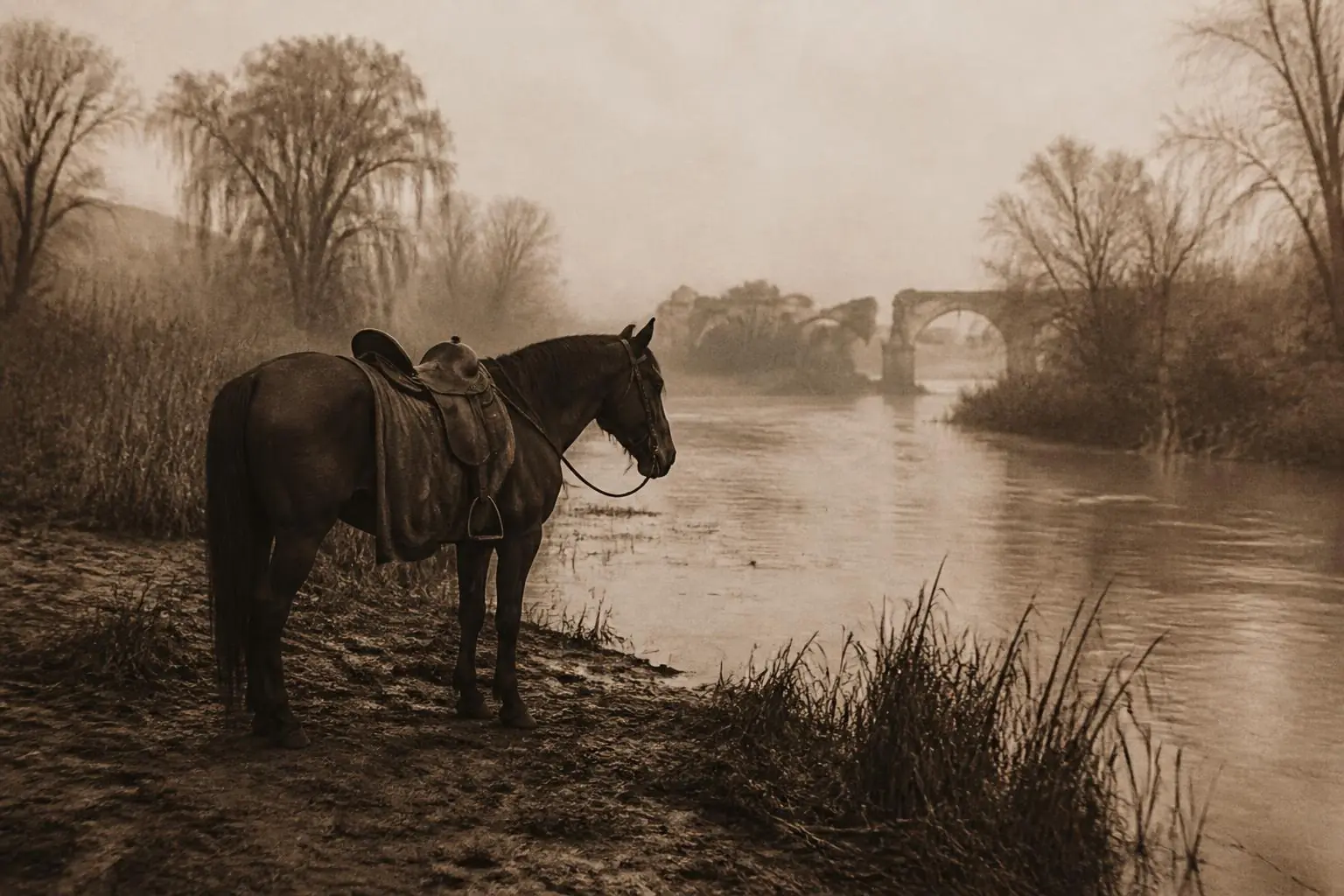
Why Poniatowski rode his horse into the Elster
The most detailed account comes from the memoirs of Bourrienne, Napoleon’s former secretary. Poniatowski first met the Pleisse, a smaller arm of the river. He plunged in, and his officers helped him reach the far side; his horse stayed in the water (Polish sources say it was killed under him). On another mount, he then reached the Elster. At that point the opposite bank is steep. He drove his horse into the current anyway.
The horse could not find footing on the steep bank. A last bullet struck Poniatowski in the chest, according to the Fondation Napoléon. Man and horse were swept away, and several officers who had followed him drowned with them. Marshal Macdonald, caught in the same trap, managed to swim across and survived. Poniatowski’s body was not recovered until five days later, on 24 October.
Why water rather than surrender? No document gives his reason, and what follows is our own reading, to be taken as such. Surrendering that day meant falling into the hands of the Russians, whom he had fought since 1792 for Poland’s independence, and handing the tsar the commander-in-chief of the Polish army. For a rider who had been jumping obstacles on horseback since the age of 17, a river in flood looked like a chance, not a death sentence. He bet on his horse, and the bank won.
Poniatowski’s bronze horse: exiled, dynamited, recast
His funeral in Leipzig brought together victors and vanquished. His remains travelled back to Poland in 1814, then were laid to rest on 22 and 23 July 1817 in Wawel Cathedral in Kraków, beside King John III Sobieski and Tadeusz Kościuszko. On Saint Helena, according to Las Cases’s Mémorial, Napoleon said of him that “the true king of Poland was Poniatowski”. Horace Vernet painted his death in the waters of the Elster and showed the canvas at the 1817 Salon.
Warsaw wanted its statue too. In 1818 it was commissioned from the Danish sculptor Bertel Thorvaldsen, who chose an ancient model: the equestrian statue of Marcus Aurelius on the Capitoline Hill. Poniatowski appears in Roman dress, sword extended, on a horse at the walk. The public had expected a warrior in Polish costume and complained; Thorvaldsen would not yield. The bronze was cast in Warsaw between 1830 and 1832.
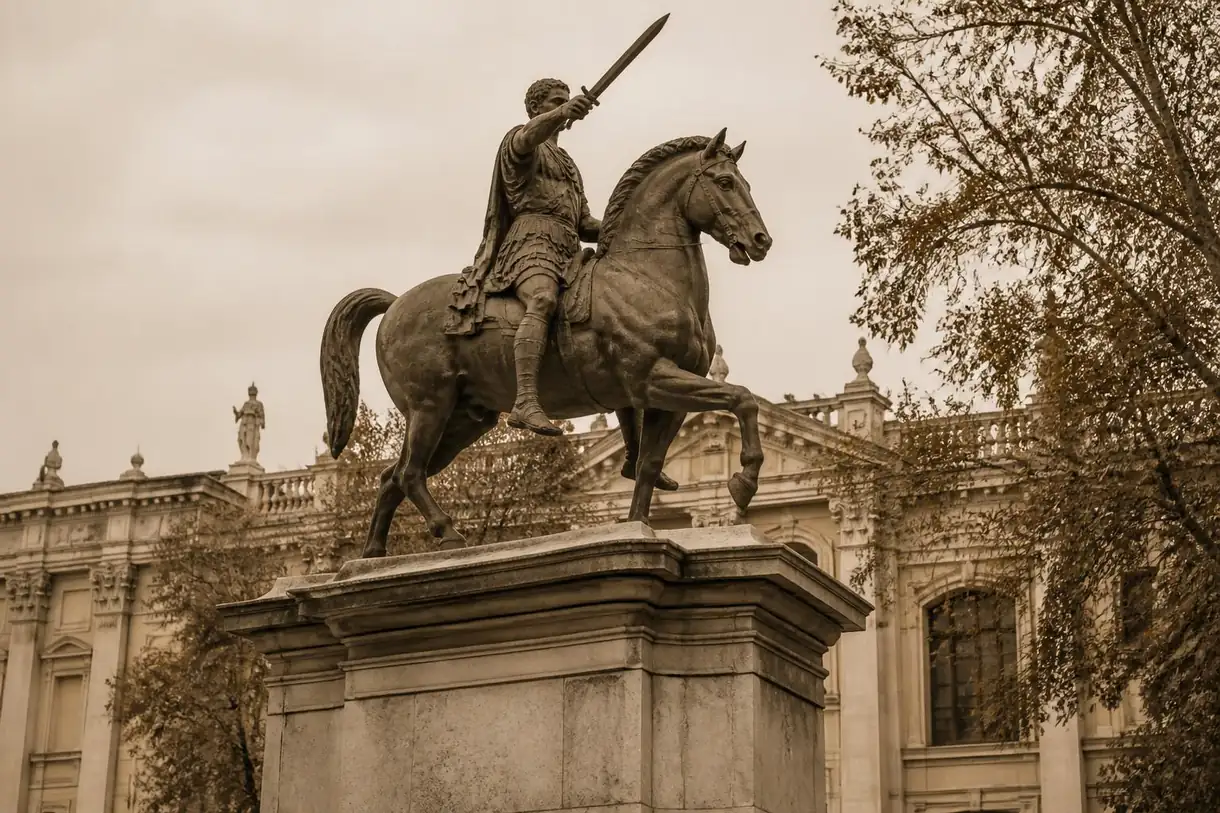
The bronze horse was never to know peace. After the Polish uprising of 1830, the Russian authorities banished it to the fortress of Modlin in 1836, and then Marshal Paskevich carried it off in 1842 to his palace at Gomel, in what is now Belarus. It returned only in 1922, under the Treaty of Riga, and was unveiled in Saski Square on 3 May 1923. On 16 December 1944, after the Warsaw Uprising, the Germans blew it up. Denmark offered a new casting, made in Copenhagen between 1948 and 1951 from the model kept at the Thorvaldsen Museum. It was installed in front of the Presidential Palace, on Krakowskie Przedmieście, on 19 October 1965: exactly 152 years to the day after the drowning in the Elster.
Napoleon, his marshals and their horses: what the Elster says about 1813
The 1813 campaign was also shaped by the horses that were missing: the Grande Armée had left most of its cavalry in Russia the previous winter, and Napoleon never managed to rebuild it. At Leipzig he had to hold on without the cavalry that had won his victories, the horsemen he had led himself on mounts such as Marengo, his favourite horse. Two years later, at Waterloo, it would be Copenhagen, Wellington’s horse, that carried the victor.
Poland, for its part, never ceased to be a land of horses. In 1817, the very year Poniatowski entered Wawel, the Janów Podlaski State Stud was founded to rebuild the herds decimated by the Napoleonic wars. It would make the country one of the great breeding grounds of the Arabian horse, the breed of endurance and blood, still prized today by riders around the world.
Established: Józef Poniatowski’s birth in Vienna on 7 May 1763, his entry into the Austrian cavalry in 1780, his appointment as Marshal of the Empire on 16 October 1813 (the only foreigner), the premature destruction of the Elster bridge on 19 October, his death by drowning the same day while trying to cross the river on horseback, the recovery of his body on 24 October, his burial at Wawel in July 1817. For the statue: Thorvaldsen, the Marcus Aurelius model, Modlin, Gomel, the destruction of 16 December 1944, the Danish copy installed on 19 October 1965.
Varying by source: the details of his wounds (arm and side, then the chest), the first horse lost in the Pleisse (left in the water in Bourrienne, killed under him according to Polish historians), the corporal of engineers blamed by the official bulletin. One isolated source dates the appointment to 15 October; the standard reference works give 16 October.
Uncertain or interpreted: his last words (the line about the honour of the Poles is not reliably attested), the exact origin of the last bullet, and the reasons for his choice, which reflect our reading of the context and not any testimony.
Sources for the story of Poniatowski, the marshal who drowned on horseback
Fondation Napoléon, entry “Poniatowski, prince Joseph (1763-1813), maréchal”; Louis Antoine Fauvelet de Bourrienne, Mémoires sur Napoléon, chapter on Leipzig; biographical entries on Józef Poniatowski (Wikipedia in French, English and Polish); entry on the Józef Poniatowski monument in Warsaw (Polish Wikipedia); entry on Horace Vernet’s painting, La Mort du prince Poniatowski (1816); Emmanuel de Las Cases, Mémorial de Sainte-Hélène.