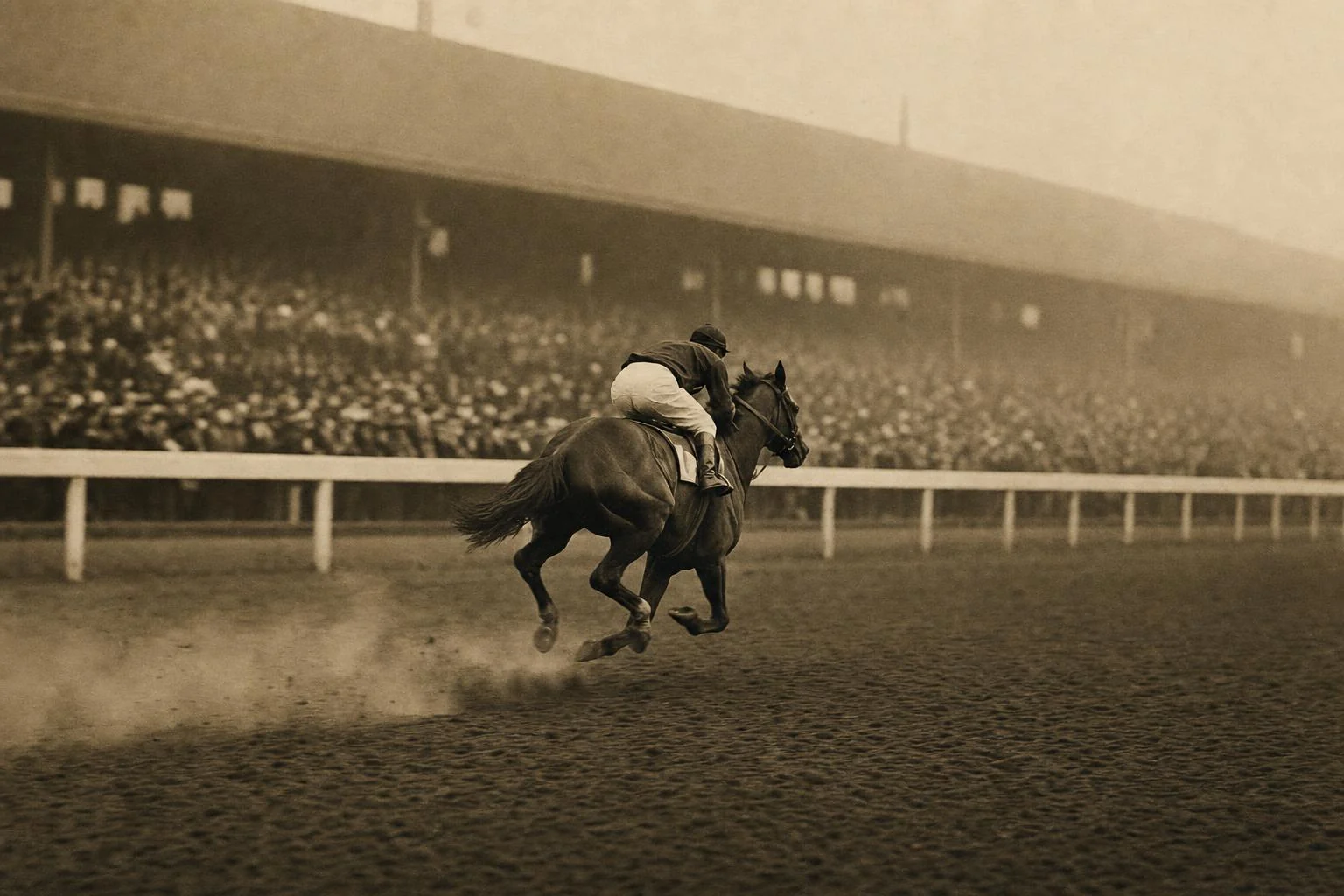

In 1938, the figure who filled the most column inches in the American press was neither Franklin Roosevelt nor any politician in Europe. It was a racehorse standing 15.2 hands (1.57 m) at the withers, bought for $8,000 two years earlier. His name was Seabiscuit. And the jockey who brought him back to the top had been riding for years with a completely blind right eye, without anyone on any racing commission suspecting a thing.
The story is true, documented by the National Museum of Racing and Hall of Fame, by the PBS archives and by journalist Laura Hillenbrand’s research, which became a worldwide best-seller and then a 2003 film nominated for seven Academy Awards. It rests on three pieces: a horse the racing world had written off as a failure, a silent trainer, and a rider who lied about his eyesight so he could keep working.
Seabiscuit in 1938: A Racehorse Mentioned More Than the President of the United States
The raw figure first, since it is what makes the whole story. Over the course of 1938, Seabiscuit generated more newsprint in the United States than Franklin Delano Roosevelt, then president and still emerging from the Great Depression, and more than the European leaders who were crowding the front pages that autumn. That is the claim made in PBS’s American Experience feature on the phenomenon, which speaks frankly of a national “Seabiscuit-itis”: hats, toys, board games, wastepaper baskets and even a train named after the horse.
The country lived alongside him. Manufacturers stuck his name on everything that could be sold, newspapers sent reporters to his morning workouts, and a two-minute race on 1 November 1938 was heard by some forty million Americans, roughly one in four of the population. No horse, before or since, has had such a presence in the daily life of a nation.
What that figure hides is the starting point. Two years earlier, this same horse was merchandise his owner wanted to be rid of.
Video · 104 seconds
Seabiscuit: His Jockey Hid That He Was Blind in One Eye
Two years later, Seabiscuit fills more column inches in the American press than Franklin Roosevelt, and 40,000 people crowd into Pimlico to watch him take on the Triple Crown winner. The jockey who rode him to victory was doing so with a completely blind right eye, a secret he kept all his life. The story of a racehorse, a torn ligament and a comeback nobody expected.

An Undersized Thoroughbred, Sold for $8,000 After 43 Races
Seabiscuit was born in 1933 at Wheatley Stable. His sire, Hard Tack, was a son of Man o’ War, the greatest name in American racing in the 1920s. The breeding was there. The physique was not: 15.2 hands (1.57 m) at the withers, a thick body, short limbs, a scraggly tail and an uneven stride in the left foreleg that observers of the day compared to the motion of an egg beater.
In the barn of trainer James “Sunny Jim” Fitzsimmons, he was used the way a cheap tool is used: 35 starts in his two-year-old season alone, for five wins, and 43 races before he had even turned three. Horses of that value spend their lives in claiming races, where anyone can buy a runner at the posted price. A Thoroughbred of that calibre does not make headlines, he fills race cards.
In August 1936, at Saratoga, a Californian businessman who had made his fortune in automobiles, Charles S. Howard, bought him for $8,000. A middling sum, at the time, for a horse in work. It was not Howard who spotted the horse: it was his trainer.
Tom Smith, the Trainer Who Saw Something Else in This Horse
Tom Smith was a former plainsman, a breaker of wild horses turned racehorse trainer, known for speaking very little and never explaining his methods. He watched Seabiscuit win two races in a row at Saratoga and persuaded Howard to buy. His conviction was not statistical, it was behavioural: the horse was not used up, he was misunderstood.
Smith removed the pressure, let the horse sleep and eat, gave him a stable companion, and rebuilt his work instead of grinding him through it. It is a story found elsewhere in horse racing: the career of Ourasi, the “lazy king” of four Prix d’Amérique wins, also rests on training that accepted the horse’s temperament instead of correcting it.
All that remained was to find him a rider. It would be the most unlikely of all.
Red Pollard, the Jockey Who Hid His Blind Right Eye
John Pollard, known as “Red”, was born in 1909 in Edmonton, Canada, the second of seven children of a brickmaker of Irish descent. He started young, at the minor tracks, those small ovals where supervision is lax and spills are frequent. It was there that his life turned: during a morning gallop on a crowded track, he took a violent blow to the head. The injury hit the area of the brain that governs vision. He permanently lost the use of his right eye.
For a jockey, it was an immediate professional death sentence. Not only because you can no longer see half the field, but because depth perception disappears: judging the gap between two horses travelling at over 37 mph (60 km/h), to within a couple of inches, becomes a gamble. No steward would have allowed a man in that condition to ride.
So he kept quiet. According to PBS’s biographical file, Pollard kept the secret all his life, and the only person he is believed to have told was his wife. The public only learned of it long after his death in 1981 at the age of 72, when Laura Hillenbrand’s research pieced the story together from archives and family accounts.
That hidden handicap had a measurable cost on the track. In February 1937, in the Santa Anita Handicap, the richest race of the day, Seabiscuit was beaten by a nose by Rosemont. Pollard, blind on his right side, did not see his rival coming until it was too late. The following year it happened again: beaten in a photo finish by Stagehand, who carried 30 pounds (about 14 kg) less than he did.
Two Accidents in 1938: The Broken Jockey, Then Seabiscuit’s Match Without Him
1938 broke Pollard. In February he was caught in a multi-horse fall in the San Carlos Handicap and nearly lost his life. A few months later, an inexperienced horse crushed him against the wall of a stable building: his leg was almost severed below the knee. Surgeons saved it, but he would not ride again that season.
He was therefore not in the saddle on the most famous day of his horse’s career. Like the jockey Chris Antley, who leapt to the ground to hold his horse’s injured limb, Pollard belongs to that category of riders whose story is written as much in hospitals as on racetracks.
1 November 1938 at Pimlico: Seabiscuit’s Race Against War Admiral
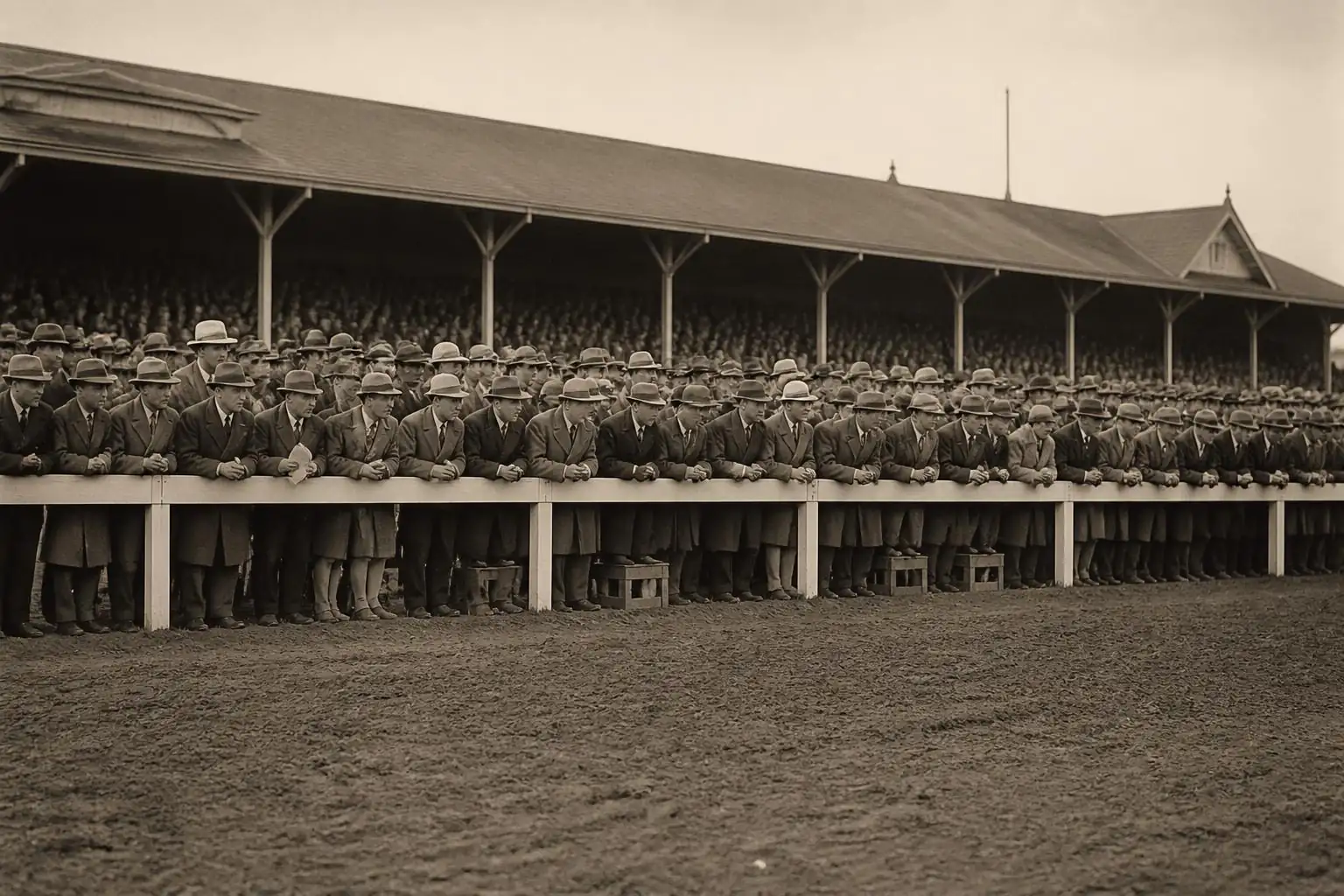
The duel all America had been demanding for a year was finally arranged: a two-horse match race at Pimlico in Baltimore, over 1 3/16 miles (about 1,900 m). Opposite him stood War Admiral, the 1937 Triple Crown winner, unbeaten that season, owned by Samuel Riddle.
The two rivals were of the same family. War Admiral was a son of Man o’ War; Seabiscuit was his grandson, through Hard Tack. The match of the century pitted an uncle against his nephew, something the 1938 press made much of.
The bookmakers had no doubts: War Admiral went off at 1-4, a heavy favourite. On paper everything went his way, the start included, since Riddle had insisted the race begin without a starting gate, from a walking start, a format in which his horse excelled.
Tom Smith’s Bell, Secretly Prepared in Training
This is where the silent trainer played his hand. Howard accepted the walking start, but set one condition: the signal would be given by a bell, and not by the starter’s flag alone. The request seemed harmless. It was not. For weeks, Tom Smith had been conditioning Seabiscuit to break at full speed at the sound of a bell, away from prying eyes.
On the day, Pimlico discovered it had no portable bell. Smith offered one, of his own making. At the signal, Seabiscuit took the lead immediately, when every forecast had predicted the opposite. George Woolf, who replaced Pollard, then let War Admiral draw level down the back stretch before asking his mount again in the home straight.
Seabiscuit won by four lengths, in just under 1 minute 57 seconds, a new track record. Commentator Clem McCarthy shouted over the radio: “Seabiscuit by three! Seabiscuit is the winner by four lengths!” The race was worth $15,000 to the winner.
Forty Thousand Spectators at Pimlico, Forty Million on the Radio
Forty thousand people came through the gates, and others clung to fences, rafters and trees. Outside, the country stopped: according to Laura Hillenbrand, one American in four listened to the race. At the White House, Franklin Roosevelt suspended his cabinet meeting to switch on the radio.
The race has featured ever since in every anthology of world racing, alongside the contests we detail in our round-up of the greatest horse races in the world.
Why This Horse Made More Headlines Than Politics in 1938
Seabiscuit’s popularity was not only a matter of times and records. 1938 was the end of a decade of hardship in the United States. The country was barely out of the Great Depression, a third of households had known unemployment, and Europe was heading towards war. Against that backdrop, a horse that was too small, discarded by the powers of the turf, bought by a self-made man and ridden by a chronically injured jockey, made a perfect allegory.
Charles Howard, who had sold automobiles, knew how to sell something else: he fed the press without pause. PBS stresses that the horse’s fame owed as much to this permanent promotion as to his performances. Seabiscuit was named American Horse of the Year for 1938.
The contrast with today’s racing economy is stark: $8,000 for a future record-breaker, when the market now soars to levels we have set out in our feature on the most expensive horse in the world. Racing has known other bargain purchases that became legend, such as Snowman, the plough horse bought for $80, who ended up a champion show jumper in New York.
Ruptured Suspensory Ligament: The Injury That Should Have Ended Seabiscuit
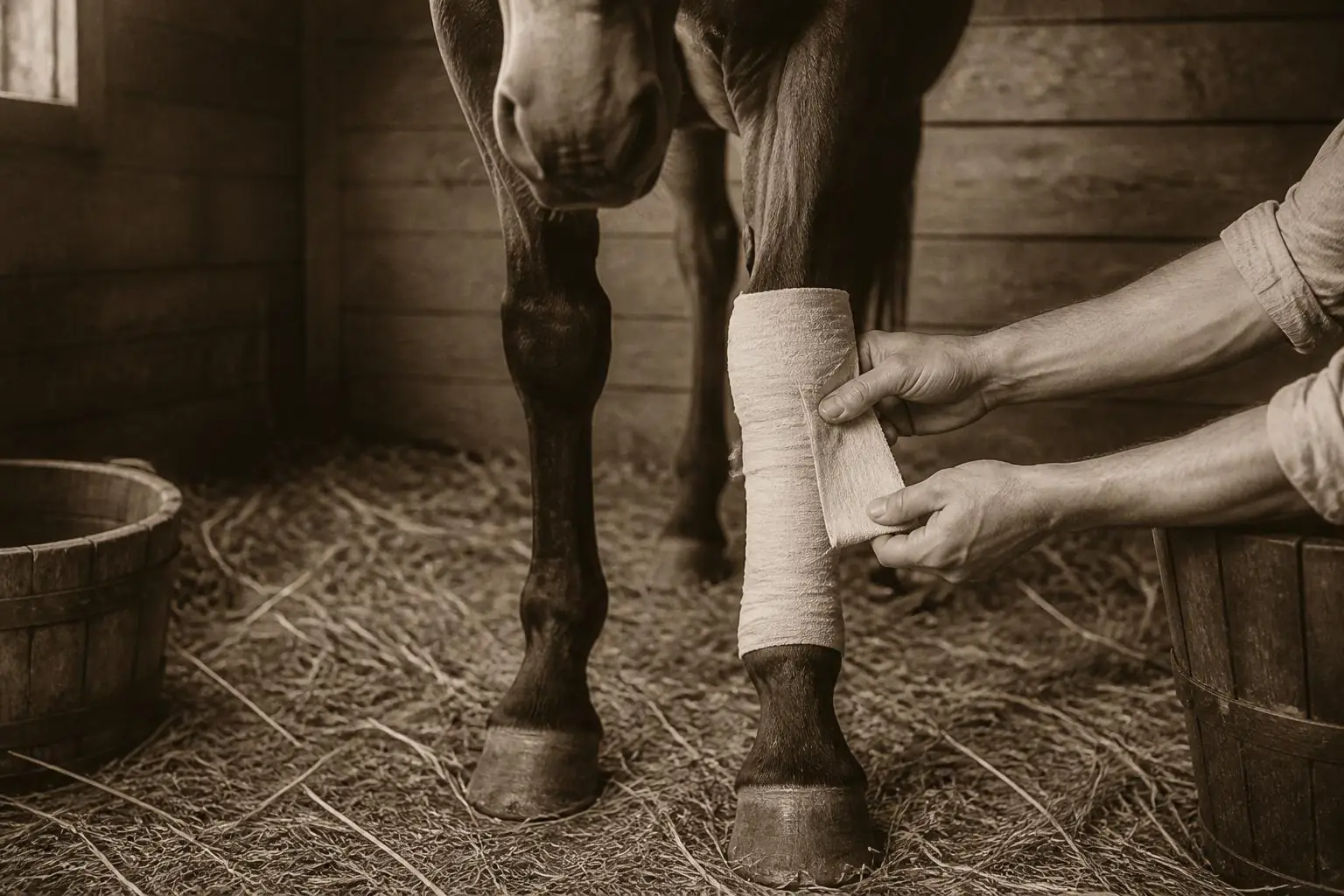
In February 1939, a few months after Pimlico, the horse was injured in a race: a rupture of the suspensory ligament in the left foreleg. This fibrous band supports the fetlock and, with every stride at the gallop, absorbs several times the horse’s body weight. A rupture, in those days, meant immediate retirement, if not worse.
Howard sent Seabiscuit back to the family’s Ridgewood ranch in Willits, in northern California. Pollard, whose own leg had not healed either, moved there too. The two convalescents began walking again together, first at a walk, on dirt tracks, far from the racecourses.
Tendon and ligament injuries remain, almost a century later, the nightmare of equine athletes. Healing times are counted in months, relapses are frequent, and the management of each episode determines the return to work. Our guide to tendinitis in horses describes timescales and precautions that have not fundamentally changed since 1939, and it is exactly the kind of history that a rider records today in the horse’s health record, to avoid repeating the mistake of coming back too soon.
2 March 1940, Santa Anita: The Horse and His Jockey Return
Nobody believed in it. On 2 March 1940, Seabiscuit, aged seven, reappeared in the Santa Anita Handicap, the one great race that had always eluded him, twice beaten by a whisker. On his back was Red Pollard, with a rebuilt leg and a right eye still blind.
78,000 people filled the stands. Seabiscuit won by a length and a half from Kayak II, his own stablemate, in 2 minutes 1 1/5 seconds over 1 1/4 miles (about 2,000 m). It was his final race. He retired on 10 April 1940 with $437,730 in earnings, an absolute world record for a racehorse, which stood until Citation in 1951.
His career record is that of an iron horse: 89 starts, 33 wins, 15 seconds and 13 thirds, from 1935 to 1940. He entered the National Museum of Racing and Hall of Fame in 1958. Pollard said after the finish: “I had a great ride. The greatest I ever had, on the greatest horse that ever lived.”
Seabiscuit died of a heart attack on 17 May 1947, aged fourteen, at Willits. Compared with the other giants of racing, he died young: Secretariat, whose autopsy revealed a heart of nearly 22 pounds (10 kg), lived to nineteen.
What We Still Do Not Know About Seabiscuit, and What Remains Debated
A story told this often ends up carrying a few approximations. Three points deserve to be set out honestly.
The 1938 press ranking. The idea that Seabiscuit outstripped Roosevelt and the European leaders in volume of coverage comes from Laura Hillenbrand’s research, repeated by PBS. No public line-by-line count has ever been published to back it up. The order of magnitude is solid and nobody has seriously challenged it, but it is a journalist’s estimate, not a certified statistical tally.
The radio audience. The forty million listeners are a period estimate, made before modern audience measurement. The most cautious formulation remains Hillenbrand’s: one American in four. The exact figure is beyond reach.
The horse’s grave. Charles Howard had Seabiscuit buried at the Ridgewood ranch, beneath an oak planted for the occasion, without ever saying which one. The foundation that looks after the site confirms that the exact location remained a family secret. Visitors can see a memorial, not a grave.
Finally, a note on the record: the 2003 film popularised a much condensed version of the story. The central facts, the $8,000 purchase, Pollard’s hidden blindness, the Pimlico match, the ligament rupture and the 1940 comeback, are all attested by the independent sources cited below.
What Seabiscuit’s Story Still Tells Riders Today
Three lessons still hold up in 2026. First, a horse judged on his conformation and his two-year-old record can be judged too soon: 43 races before the age of three should have finished him, and a change of method revived him. Second, training bends to the horse’s temperament and not the other way round, which Tom Smith practised long before the idea was fashionable. Third, a ligament injury is only the end of a career if its management is botched: fourteen months separate the rupture of February 1939 from the earnings record of March 1940.
Then there is the blind spot, in the literal sense. A jockey rode for years with half his field of vision gone, in the most dangerous sport of his day, because admitting it meant never working again. That silence says as much about the era as the stopwatch does.
Sources on Seabiscuit and the Pimlico Match
- National Museum of Racing and Hall of Fame, Seabiscuit profile: record, 89 starts, 33 wins, earnings, 1940 Santa Anita Handicap, death on 17 May 1947.
- National Museum of Racing and Hall of Fame, War Admiral profile: 1937 Triple Crown, Man o’ War lineage, Pimlico match.
- PBS, American Experience, biography of Red Pollard: blindness in the right eye, the secret he kept, the 1938 accidents, Santa Anita 1940, death in 1981.
- PBS, American Experience, “Seabiscuit-itis”: 1938 press coverage and merchandise.
- Baltimore Magazine, looking back at the Pimlico match: 40,000 spectators, one American in four on the radio, time, purse, Clem McCarthy’s commentary.
- Seabiscuit Heritage Foundation, page on the gravesite: burial at Ridgewood ranch and the location kept secret.