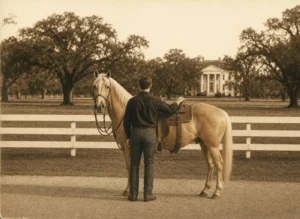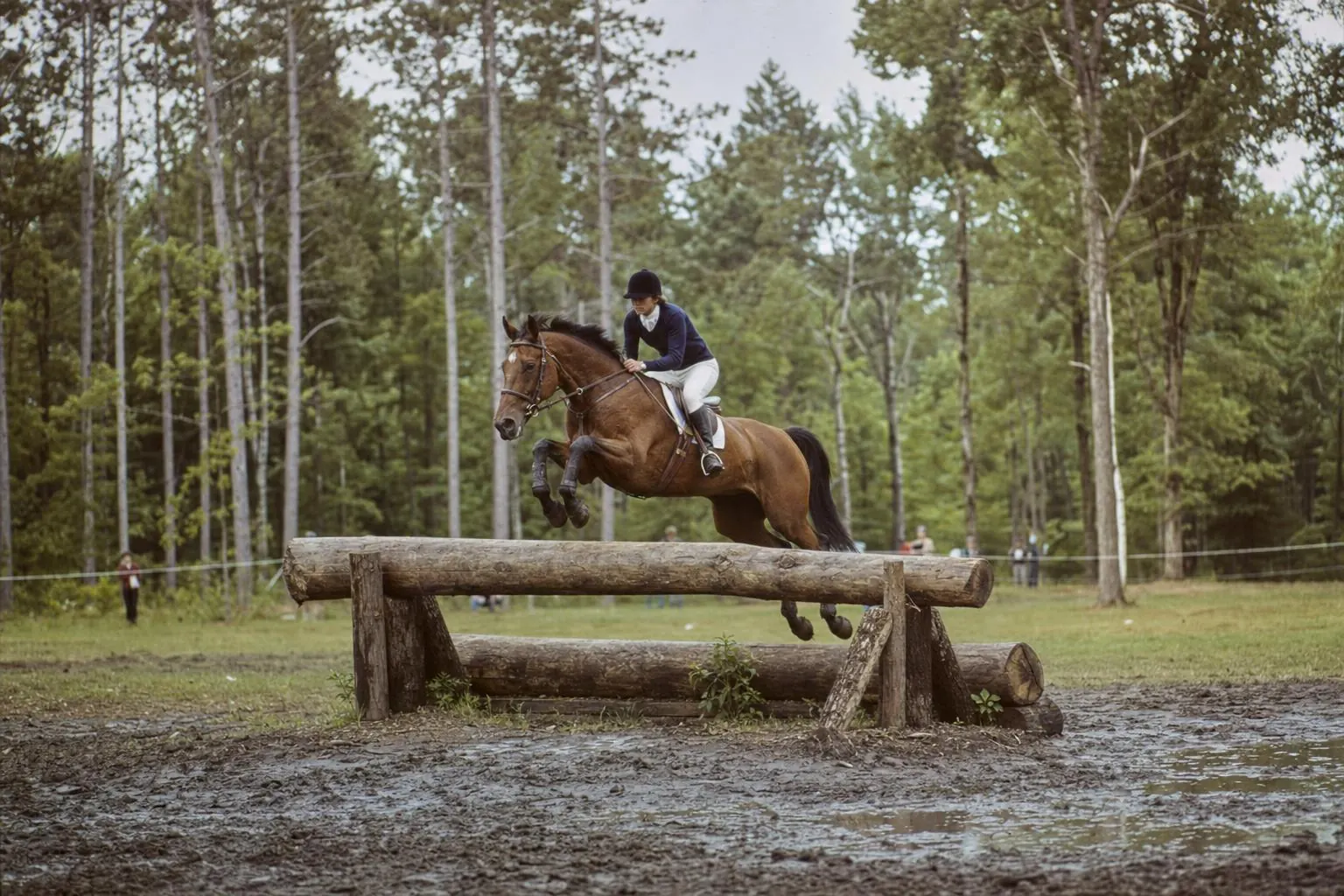

At the Montreal Olympics in July 1976, every female competitor had to pass a sex test. Every one but a single rider: Princess Anne, daughter of Elizabeth II, a three-day eventer on the British team, mounted on Goodwill, a horse owned by her mother. Olympedia, the reference database for Games historians, lists her as the only exception. The reason was never written into any regulation: it was simply judged improper to put the Queen’s daughter through the check. Two days later, at the 19th fence of the Bromont cross-country, she fell in the mud, got back on and finished the course with a concussion she has no memory of.
Montreal 1976: Princess Anne, the only rider excused from the sex test
Princess Anne is 25 when she arrives in Canada with the British three-day eventing team. It is the first time a member of the British royal family has taken part in the Olympic Games as an athlete. The equestrian events are not run in Montreal itself but at Bromont, in the Eastern Townships, about 50 miles (80 km) away: dressage on 23 July, cross-country on the 24th, show jumping on the 25th. Forty-nine horse-and-rider combinations from thirteen nations start.
Like every female athlete at these Games, she should have gone through the laboratory at the Olympic Village and come away with a certificate, without which no woman could compete. She never went. Olympedia, the database that documents every Olympic participant since 1896, says so in its entry on gender verification: the tests applied to all women, “with one exception, Princess Anne of Great Britain, who competed in the equestrian events in 1976.”
Video · 118 seconds
Princess Anne, 1976 Olympics
Two days later, on Goodwill, the Queen’s horse, she fell on the Bromont cross-country.

The Olympic sex test, from Mexico City 1968 to Princess Anne
The check was a recent invention. It first appeared at the 1966 European Athletics Championships, then at the Olympic Games in Mexico City in 1968. The method was simple: a few cells were scraped from the inside of the cheek and examined under a microscope for the Barr body, a small mass found almost exclusively in female cells. An athlete whose sample raised questions went on to further examinations.
By 1976, equestrian sport was already a special case: it is one of the few Olympic sports in which men and women compete together, over the same course, under the same scoring. The test was nonetheless applied to riders just as it was to swimmers and sprinters. The International Olympic Committee eventually dropped it: its Athletes’ Commission recommended abolition in January 1999, and the decision was ratified in June of that year.
Why the rider Princess Anne was not tested: what the sources say
No IOC text published at the time explains the exemption. The accounts that mention it, from the specialist site Inside the Games to chroniclers of the monarchy, all give the same reason: the rider was the Queen’s daughter, and making her give a sample to prove she was a woman was judged unseemly. To our knowledge, nobody has found a written exchange between Buckingham Palace and the organisers.
The situation had something singular about it. Elizabeth II had opened the Games as Queen of Canada on 17 July 1976. She was in the stands at Bromont to watch her daughter, alongside Prince Philip, Prince Charles, Princes Andrew and Edward, and Mark Phillips, Anne’s husband and himself a three-day event rider. Putting the daughter of the host country’s sovereign through the same check as the other competitors, under the eyes of the world’s press, was something nobody wanted to take responsibility for.
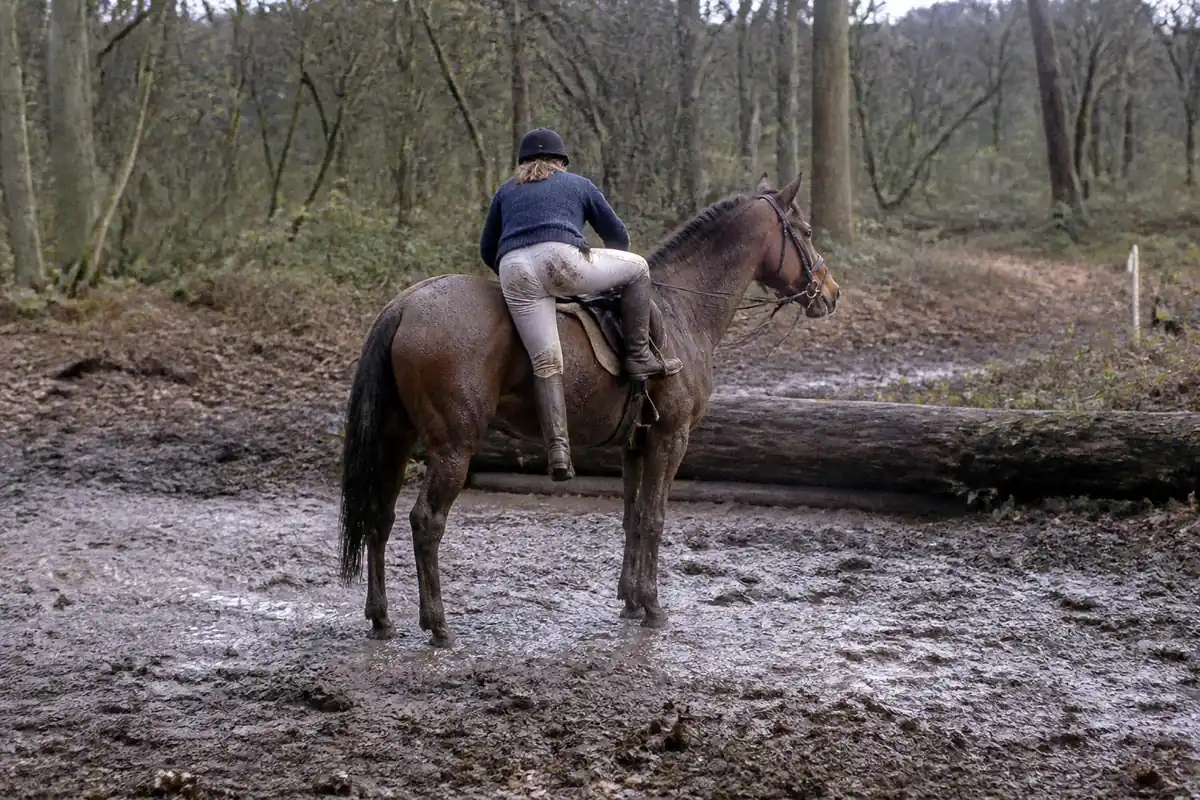
Goodwill, the Queen’s horse, in the mud of the Bromont cross-country
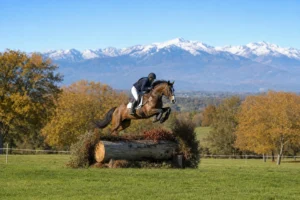
On 24 July comes the speed and endurance day, the most dreaded of three-day eventing: roads and tracks, steeplechase, then the cross-country, a series of fixed fences over varied terrain. The going is heavy in places. At the 19th fence, Goodwill gets stuck in the mud as he takes off. Princess Anne goes over his head and falls.
She gets up, remounts and completes the course. It would emerge afterwards that she was suffering from concussion. She finishes 25th in the individual standings. The British team does not finish: two horses in the group were injured and Great Britain withdraws from the team event. The individual gold medal goes to the American Edmund “Tad” Coffin, on Bally-Cor.
The Bromont cross-country, wiped from Princess Anne’s memory
Years later, asked about her Games, Princess Anne summed up what was missing with a line since repeated by Team GB: “I had a bit of a problem: the part I would like to remember, the cross-country, I don’t remember.” She jumped the last fences of the Olympic course without keeping a single image of them.
Getting back on after a blow to the head is now forbidden on a three-day event cross-country: a rider who falls is stopped, and a medical examination decides what happens next. The Bromont scene, as it unfolded in 1976, would no longer be possible. It is one of the reasons why the riding helmet and the airbag vest have become the norm on cross-country courses, including for amateur riders tackling the fixed fences over varied terrain in federation exams.
- The sex-test exemption: it is recorded by Olympedia, the reference for Olympic statisticians. The fact is solid.
- The reason for the exemption: it comes from the press and from chroniclers, not from an official document. It is coherent, but it is not proven in writing.
- The fall at the 19th fence: the fence number and the mud are reported by the press; the concussion and the remounting are reported by every source, Team GB included.
- The result: 25th of 49 according to the results tables; some entries round off or give a different placing, which is why it pays to cite the score sheet.
- The British team’s withdrawal: attributed to two injured horses, though the sources do not agree on their names.
Before Montreal: Doublet, the horse that made Princess Anne a European champion
Princess Anne was no ceremonial guest on the team. In 1971, aged 21, she won the European three-day eventing title at Burghley on Doublet, a chestnut bred in the royal stables. The same year, BBC viewers voted her Sports Personality of the Year. In 1975, at the European Championships at Luhmühlen in Germany, she brought home two silver medals, individual and team.
It was this record that earned her Olympic selection, not her title alone. Three-day eventing, which strings together dressage, cross-country and show jumping with the same horse, was already the most demanding equestrian discipline at the Games, and the British counted among its best nations.
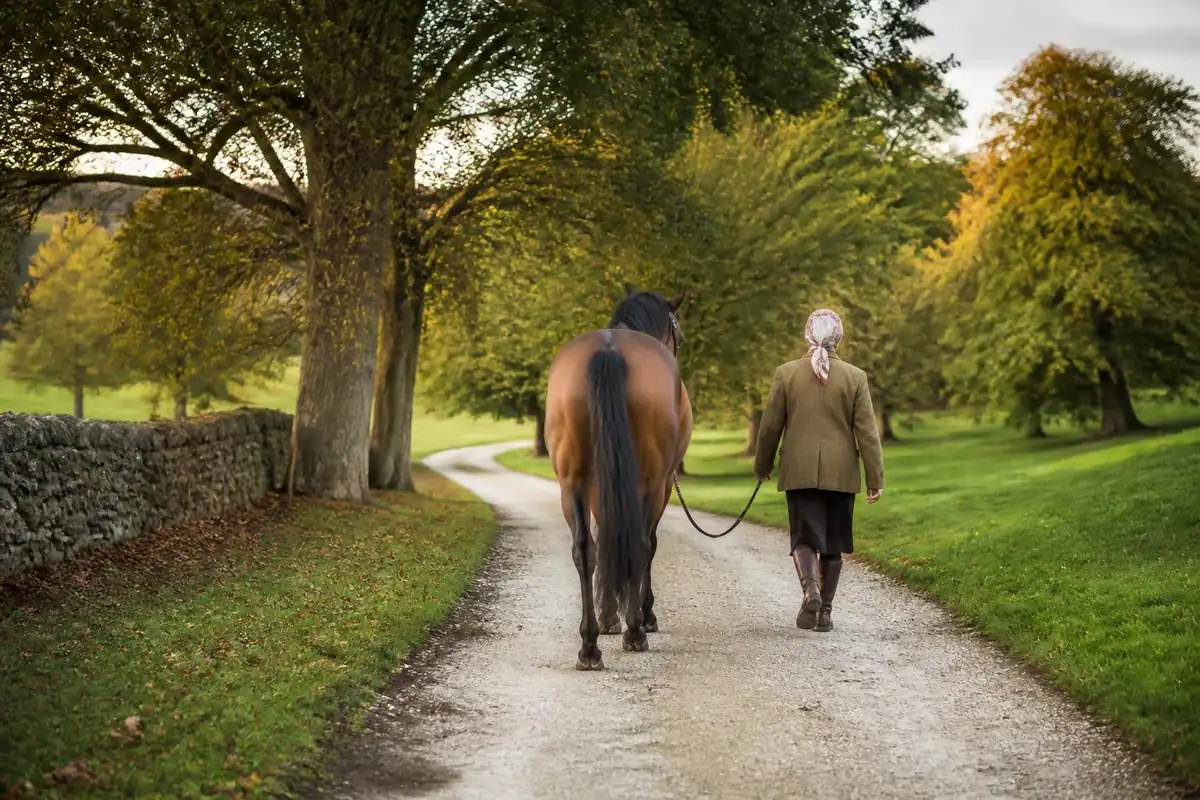
Gatcombe, June 2024: a horse, another concussion, 48 years after Bromont
Princess Anne has never left horses behind. She lives at Gatcombe Park in Gloucestershire, an estate that hosts major three-day events every year. On Sunday 23 June 2024, aged 73, she was walking there when she suffered a head injury near horses on the estate. Buckingham Palace spoke of minor injuries and a concussion, “consistent with an impact from a horse’s head or legs.”
She spent five nights at Southmead Hospital in Bristol. The palace explained that, because of the concussion, the exact circumstances of the accident could not be established. Forty-eight years after the Bromont cross-country, the same rider found herself with no memory of the moment a horse had put her on the ground.
Zara Tindall, the rider daughter: the Olympic medal presented by Princess Anne
Princess Anne never won an Olympic medal. Her daughter did. Zara Phillips, now Zara Tindall, also rides in three-day eventing, was crowned world champion in 2006 at Aachen and competed at the London Games in 2012 on High Kingdom. The British team took silver, and it was her mother, a member of the International Olympic Committee since 1988, who presented the medals on the podium at Greenwich.
The rider excused from the test in 1976 had thus become, twelve years later, one of the people who decide the rules of the Games. Great stories of royal riders and horses are not in short supply: that of Burmese, Elizabeth II’s mare, under the gunshots of 1981, is one; the story of the equestrian events at the Olympic Games tells many others.
What we still do not know about Princess Anne’s sex test at the 1976 Olympics
Several points remain open. We do not know who took the decision to exempt her, or when: the Montreal organising committee, the IOC medical commission or an informal arrangement with the British delegation. Nor do we know whether Princess Anne was consulted. The number of the fence where she fell comes from the press and has not been cross-checked against the official Bromont cross-country plan. Finally, the names of the two injured British horses, which led to the team’s withdrawal, vary from one account to another.
What is established fits in three lines: a 25-year-old rider, the only one exempted from a check imposed on everyone else, the Queen’s horse stuck in the mud, and an Olympic course completed without a memory of it.
Olympedia, entry “Gender Verification” (introduction in 1968, Barr body method, Princess Anne’s exception in 1976, abandonment by the IOC in 1999); Inside the Games, “The only female competitor not to have to submit to a sex test at the 1976 Summer Olympics in Montreal was Princess Anne”; Team GB, “When Princess Anne made history in Montreal 50 years ago” (Goodwill, mud, concussion, quotation on the cross-country); CBC Archives, “A family affair: the royal visit that wound up at the 1976 Olympics” (Bromont, royal family present); Hola, June 2026 (19th fence); Wikipedia entry “Equestrian at the 1976 Summer Olympics, Individual eventing” (dates, 49 starters, 25th place, Edmund Coffin); Wikipedia entry “Anne, Princess Royal” (Burghley 1971, BBC 1971, Luhmühlen 1975, team withdrawal, IOC 1988); Buckingham Palace statements relayed by CBC and LBC, June 2024 (Gatcombe, Southmead).