
Théodore Géricault, the painter of The Raft of the Medusa, died on 26 January 1824, at six in the morning, at 23 rue des Martyrs in Paris. He was 32. His biographers agree on the cause: tuberculosis of the spine, known as Pott’s disease, whose abscess opened and never closed again after a series of falls from his horse in 1822, on Montmartre and at the Champ-de-Mars. Operated on several times by Dupuytren and confined to his bed from the middle of 1823, he died with his hands held by two friends. The horse, which he had learned to paint in the stables of Versailles, had been the passion of his whole life, and it hastened his end.
France knows the painting. It knows the man less well: an obsessive horseman who, at 21, had exhibited an officer on a rearing horse, served in the King’s Musketeers, painted the Epsom Derby thoroughbreds at full gallop, and who, even when ill, kept getting back in the saddle.
Géricault, schooled in horses before painting: Carle Vernet and the Versailles stables
Born in Rouen on 26 September 1791, Théodore Géricault grew up in Paris in a comfortable family, with a twin passion for drawing and horses. Around 1808 he entered the studio of Carle Vernet, the painter of horses and riders, then, in 1810-1811, that of Pierre-Narcisse Guérin, where history painters were trained. Guérin taught him the human figure; Vernet had given him the horse.
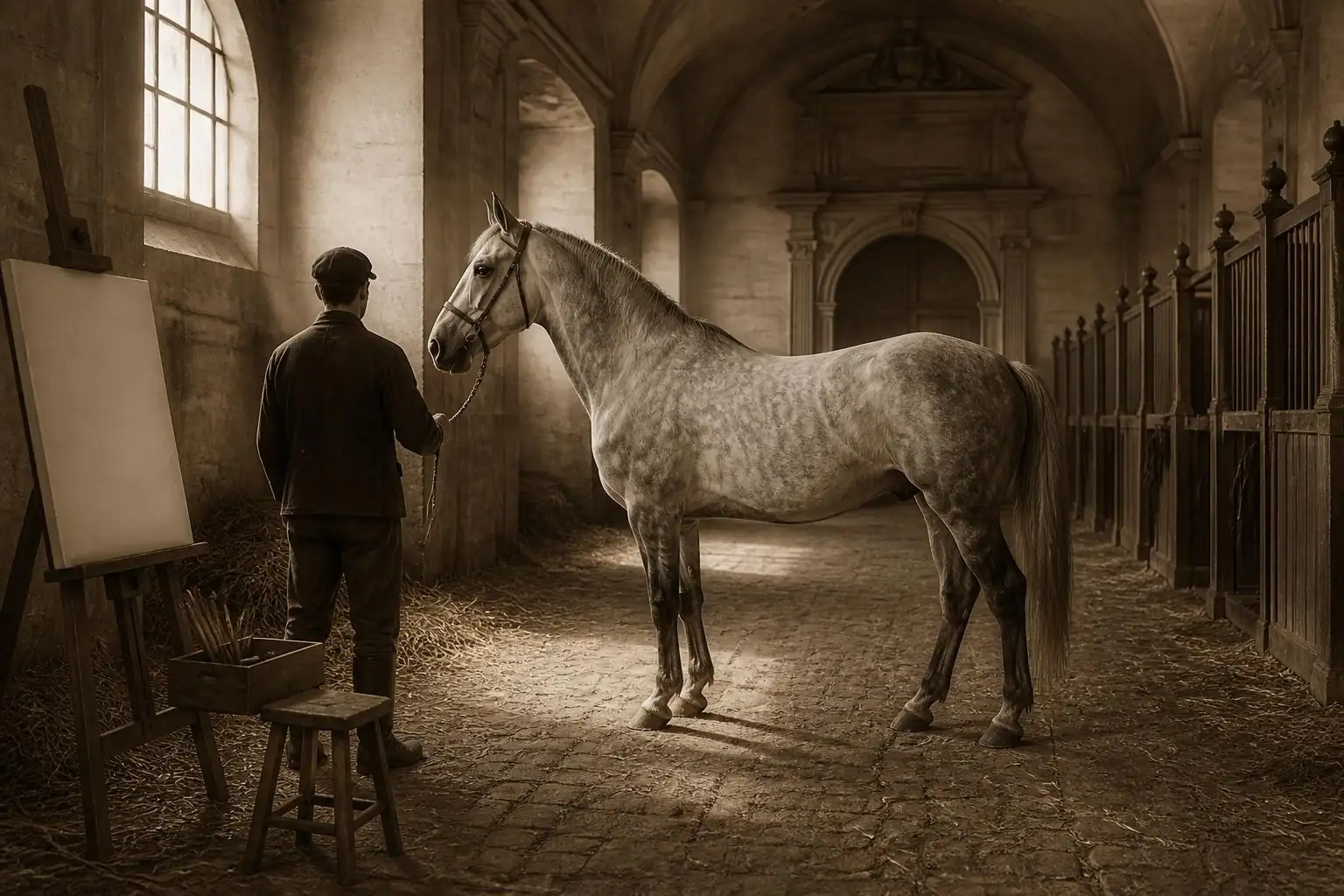
The rest he sought out in the stables of Versailles, where he obtained permission to work from life and where, it is said, he learned the anatomy and movement of the horse that would give his canvases their precision. Even in those years he rode a great deal himself. For him the horse was never a motif but a daily practice, just as, later, it would be for Rosa Bonheur, with the horse market she went to draw dressed as a man.
On video · 124 seconds
Géricault
Falls from his horse in 1822, an abscess that would not close, and death at 32 on 26 January 1824: the painter of The Raft of the Medusa lived and died by horses.

The Salon of 1812: at 21, Géricault exhibits a rearing horse painted in five weeks
In 1812, aged 21, he showed at the Salon his Officer of the Imperial Guard Chasseurs on Horseback Charging: a lieutenant on a dapple-grey horse rearing on the battlefield, sabre raised, the animal almost larger than the man. The canvas, executed in five weeks, won a gold medal. At the Salon of 1814 he followed it with the Wounded Cuirassier Leaving the Field, a rider leading his horse down a slope by the bridle, the reverse side of the charge.
On 6 July 1814, after the fall of Napoleon, he enlisted in the King’s Musketeers, Louis XVIII’s cavalry corps, and followed the king towards the frontier during the Hundred Days. In Rome in 1817 he watched the race of the barberi, riderless horses let loose along the Corso, and drew from it dozens of studies of men straining against horses that shy away, for a Race of the Riderless Horses that he would never paint. He did not paint the schooled horse; he painted the strength needed to restrain it.
The Raft of the Medusa, 1819: the horse painter shaves his head and paints a shipwreck
Back in Paris, he seized on a state scandal. In July 1816 the frigate Méduse had run aground off what is now Mauritania; one hundred and forty-seven people were abandoned on a raft and fifteen survived. Géricault rented a studio in the Faubourg du Roule, had his head shaved so as not to be tempted to go out, met survivors, and drew limbs in the morgue.
The painting, measuring 16 ft 1 in by 23 ft 6 in (491 by 716 cm), was shown at the Salon on 25 August 1819 under the neutral title Scene of Shipwreck. The jury awarded it a medal; the State did not buy it. In 1820 Géricault took it to London, to the Egyptian Hall in Piccadilly, where forty thousand paying visitors came to see it. It was this English stay that would bring him back to horses.
The Epsom Derby, 1821: Géricault’s horses fly, and no horse gallops like that
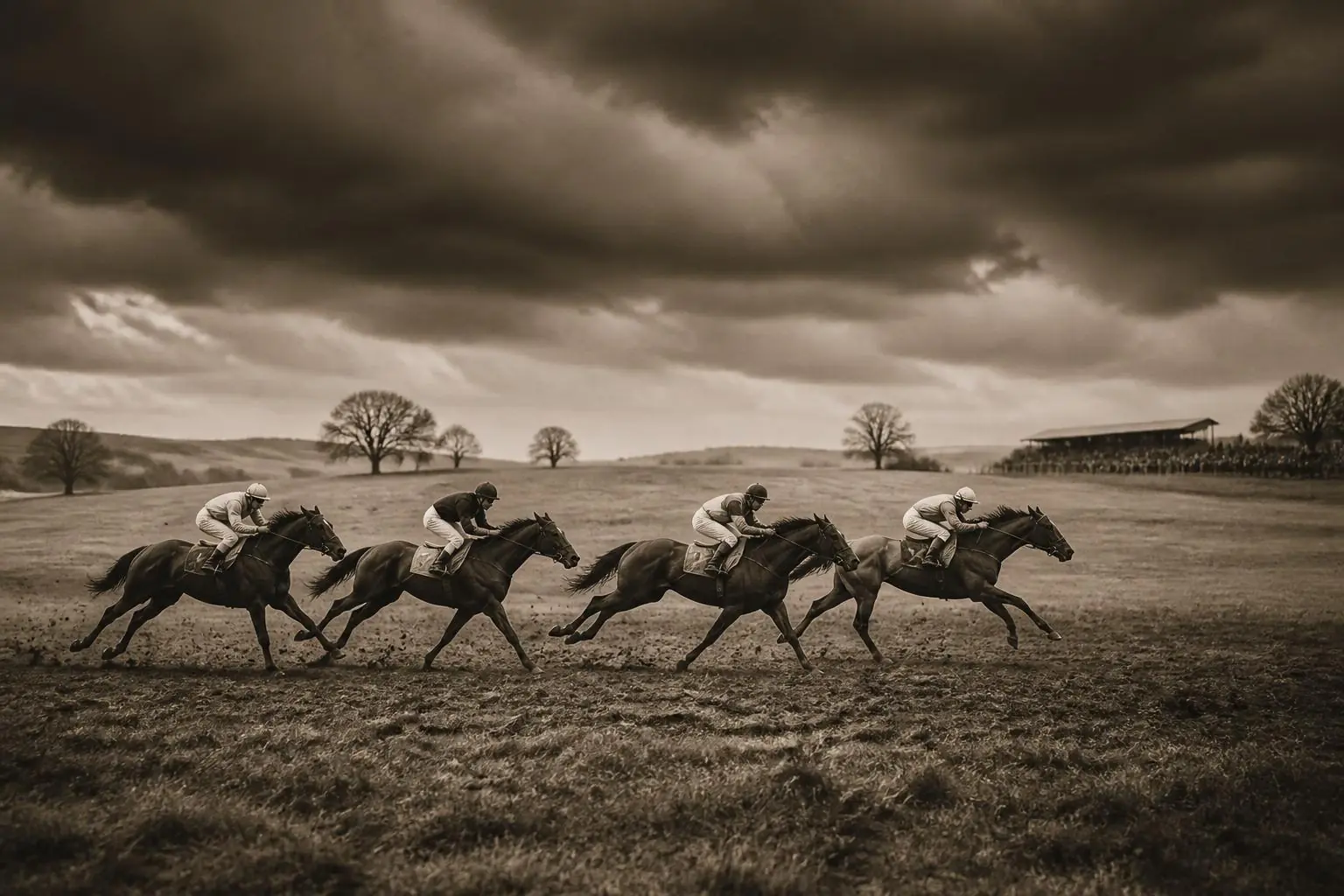
From April 1820 to November 1821 he lived in England, between London and the racecourses, drawing everything: thoroughbreds, coal-merchants’ horses, cab horses, blacksmiths. For Adam Elmore, a horse dealer who put him up in London, he painted a canvas of 36 by 48 in (92 by 123 cm), Horse Race, known as The 1821 Derby at Epsom, which entered the Louvre in 1866. Four horses and their jockeys race beneath a stormy sky, skimming a heath with no crowd in sight.
They gallop in the “flying gallop”, forelegs stretched forward, hindlegs stretched back, every hoof off the ground at once, like an animal gliding through the air. No horse moves like that. It would take until 1878 and Eadweard Muybridge’s cameras at Palo Alto to photograph the true gallop, legs gathered beneath the belly at the moment of suspension: we have told the story of how twelve cameras settled the question of the gallop in 1878. Géricault, who knew horses better than almost anyone, chose the flying gallop because it conveys the sensation of speed, which the accurate gallop does not.
Montmartre and the Champ-de-Mars, 1822: Géricault’s falls from his horse
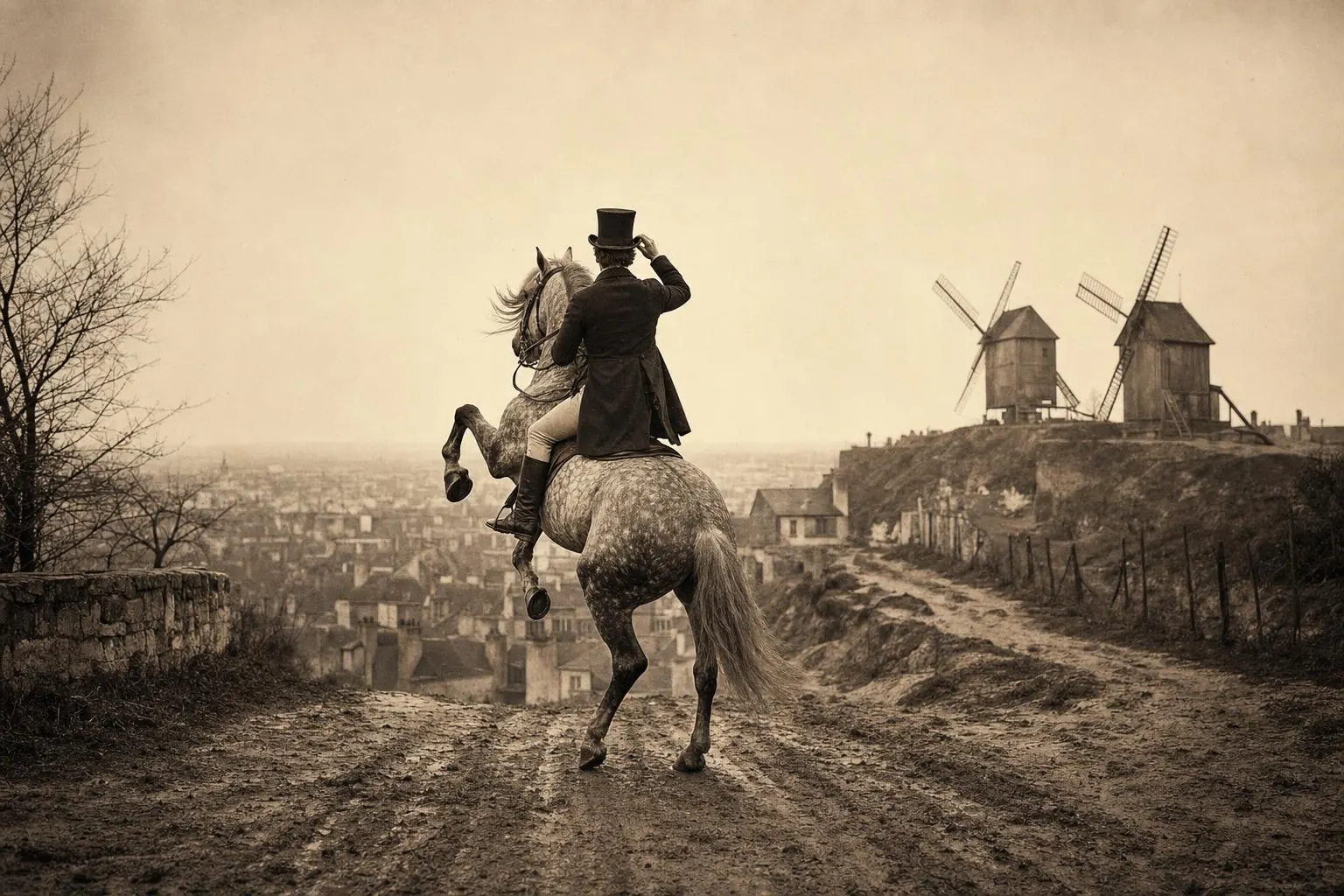
Already in London he was suffering: in February 1821 he wrote that he was “extremely ill” and he was dragging a sciatica around with him. Back in Paris at the end of December 1821, he had money, bought horses, and rode. In the spring of 1822, in March or April, he fell: two or three falls according to the biographers, on the Butte Montmartre, at the Champ-de-Mars, perhaps at Fontainebleau. One of them, at the Champ-de-Mars, is said to have been a collision with another rider. One of his pupils, Montfort, reported a detail that every biographer has repeated since: hampered in the saddle by his waistcoat, Géricault had tied it behind his back with a large knot; in the fall, the knot and the buckle were driven deep into his loins. For Montfort, that was the origin of his death.
After these accidents an abscess formed in the left lumbar region, then in the thigh. He took refuge with his friend the painter Pierre-Joseph Dedreux-Dorcy from April to December 1822, and seemed to recover. But in February 1823 came a brutal relapse; from then on he scarcely left his bed. Some accounts place a last fall in August 1823, in the rue des Martyrs; the exact chronology of the accidents has never been fixed with certainty.
Why falls from his horse killed the painter of the Raft: Pott’s disease
This is the gap the title opens, and the answer comes in two parts. Géricault did not die of a fracture or of a direct injury: he died of vertebral tuberculosis, Pott’s disease, an infection of the vertebrae that produces cold abscesses along the spine and the muscles of the back. He had probably been carrying it since England, hence the sciatica and fatigue of 1821. What the falls did was open up what might have stayed closed: after the shock at the Champ-de-Mars, the lumbar abscess formed a fistula through the skin. There was then no remedy for tuberculosis of the bone; an open abscess does not close, it becomes infected and drains the body. The surgeon Guillaume Dupuytren, the most famous in Paris, performed several drainings, without curing anything. The doctors gave up at the end of 1823.
The second part of the answer is that he never stopped riding. Between the first fall and the last there were months, and a man who had known since London that he was ill. He rode because he painted what he rode: it was the life he had chosen at Versailles fifteen years earlier, and he did not change it when it became dangerous.
On 30 December 1823, Delacroix, visiting him, noted a “dreadful” thinness: thighs “as thick as my arms”, the head of an old man. The day before his death Géricault is said to have murmured: “Is it not sad to die at thirty-three, regretting that one has done nothing yet of all that one has felt!” He died on 26 January 1824, at six in the morning, watched over by Dedreux-Dorcy and by Colonel Louis Bro, who held his hands. He would have turned 33 in September.
Géricault’s death and his falls from his horse: what we can and cannot say
Attested by dated and concordant documents: his birth in Rouen on 26 September 1791; the Officer of Chasseurs at the Salon of 1812; the King’s Musketeers (6 July 1814); the Raft at the Salon on 25 August 1819, then in London in 1820; the English stay (April 1820 to November 1821) and the Epsom Derby painted for Adam Elmore, in the Louvre since 1866; the letter of February 1821; the falls of spring 1822 and the lumbar abscess; the convalescence at Dedreux-Dorcy’s, the relapse of February 1823, confinement to bed from mid-1823; Dupuytren’s drainings; Delacroix’s note of 30 December 1823; his death on 26 January 1824, at 23 rue des Martyrs, aged 32.
Reported, but not documented to the same degree: the exact number of falls (two or three), their places and their order; the fall of August 1823 in the rue des Martyrs, cited by some accounts and absent from others; the knotted waistcoat, the testimony of a single pupil, Montfort; the words attributed to Géricault on his deathbed, quoted with variants; the diagnosis of Pott’s disease, made retrospectively by physicians from the testimonies, consistent with the symptoms but with no known autopsy.
What we do not claim: nothing about the precise circumstances of each fall beyond the testimonies cited, nothing about the price paid for the Raft at the studio sale, which varies according to the sources.
Père-Lachaise: the Raft of the Medusa in bronze on the horse painter’s tomb
On 2 and 3 November 1824 the studio was auctioned: hundreds of horse studies, sketches for the Roman race, English lithographs. The Raft was bought by Dedreux-Dorcy, the friend who had watched over him, and passed to the Louvre thanks to the Comte de Forbin; it is still there, beside the Officer of Chasseurs and his rearing horse. The Epsom Derby would join it in 1866.
In Père-Lachaise cemetery, in the 12th division, Antoine Étex’s monument (1839-1841) shows Géricault in bronze, lying on his side, palette and brush in hand, above a bas-relief of The Raft of the Medusa; the other faces recall his great canvases, including the Officer of Chasseurs. Those who followed him, from Delacroix to Rosa Bonheur, kept learning the horse from the living animal; a century later, we saw how the horse entered the avant-garde without ever leaving Géricault behind. To understand what he was looking for in a thoroughbred launched across the Downs, it is still enough to watch a horse race from the rail, or to reread what makes an English thoroughbred, the breed he painted at Epsom. As for the rider who gets back on after a fall, each will judge for themselves; today’s riders, at least, have a riding helmet that Géricault, in a top hat on the Butte Montmartre, did not.
Géricault and his horses: key takeaways
- The painter: Théodore Géricault, born in Rouen on 26 September 1791, trained in horses with Carle Vernet and in the Versailles stables before turning to history painting under Guérin.
- Horses in his work: the Officer of Chasseurs on Horseback (Salon of 1812, gold medal, at 21), the Wounded Cuirassier (1814), the Race of the Riderless Horses (1817, never finished), the Epsom Derby (1821, Louvre).
- The falls: two or three, in the spring of 1822, on Montmartre and at the Champ-de-Mars; a waistcoat knot driven into his back according to his pupil Montfort; a lumbar abscess that would not close.
- The cause of death: vertebral tuberculosis, Pott’s disease, opened and aggravated by the falls; Dupuytren’s drainings; bedridden from mid-1823.
- The end: 26 January 1824, at six in the morning, 23 rue des Martyrs, aged 32; Antoine Étex’s tomb at Père-Lachaise, with the Raft in bronze bas-relief.