
On 10 July 2025, at Sotheby’s in Paris, a black leather handbag sold for €8.58 million. It was the very first Birkin, made for Jane Birkin in 1984, and it is the most expensive fashion object ever sold at auction in Europe. That bag descends in a direct line from a leather satchel designed to carry a saddle and a rider’s boots. And the house that made it began, in 1837, by selling harness to Parisian cab horses.
Hermès is not a couture house that bolted on an equestrian line to lend itself an air of pedigree. It is the other way round: a nineteenth-century saddlery and harness maker that outlived the disappearance of its market, the driven horse, and turned that survival into the first great fortune of French luxury. The horse is not a decorative reference at Hermès. It is the starting point, and it has stayed in the logo, in the name of the trade and in the workshops.
1837, rue Basse-du-Rempart: Hermès opens a harness workshop for the horses of Paris
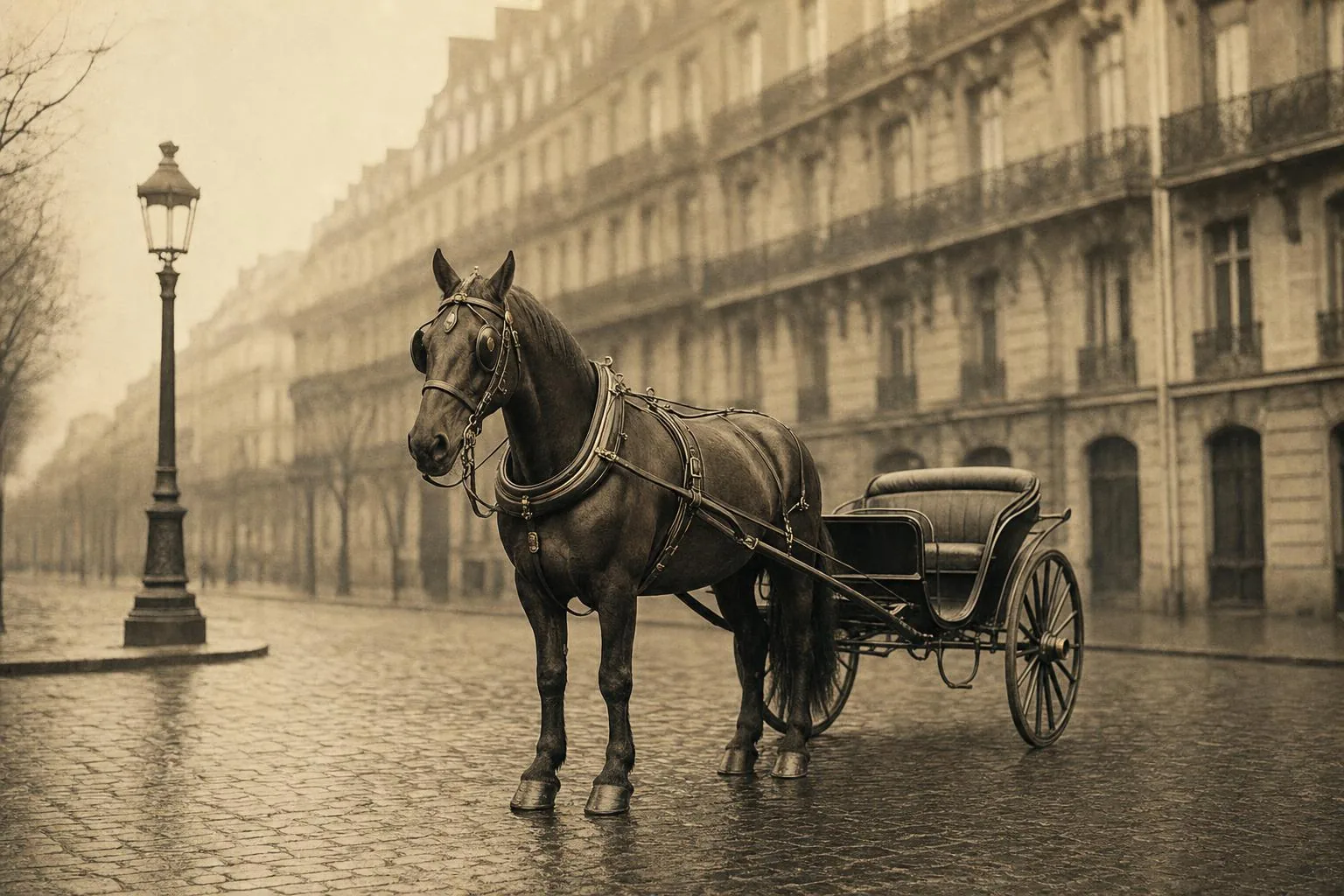
Thierry Hermès was born on 10 January 1801 in Krefeld, in the Rhineland, into a family of French origin that later returned to France. In 1837 he opened a workshop at 56 rue Basse-du-Rempart, a street that has since vanished, swallowed up by the building of the boulevard de la Madeleine. His trade had a precise name: sellier-harnacheur, saddler and harness maker. He sold no bags and no clothes. He made harness, collars, bridles, traces and reins, in other words the leather equipment that links a horse to a carriage.
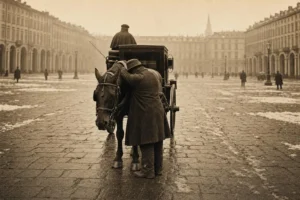
The context explains everything. Paris in the mid-nineteenth century ran on horses. Everything that moved through the city, people, coal, bread, furniture, the post, travelled behind a horse in harness. A harness workshop was therefore not a luxury business but an infrastructure supplier, on a par with a blacksmith or a wheelwright.
Thierry Hermès died in 1878 at Neuilly-sur-Seine. His son, Charles-Émile Hermès, took over the business and made the decision that would change everything: in 1880 he moved the workshop and the shop to 24 rue du Faubourg-Saint-Honoré, an address that has never changed since. Crucially, he added a second product to the harness, one that demanded a different skill: the saddle.
On video · 107 seconds
Hermès the saddler: the bag that sold for €8.6 million began as a satchel built to carry a saddle
That bag descends from a leather satchel designed around 1892 to carry a saddle and a rider’s boots. The house that made it began in 1837 by selling harness to Parisian cab horses, and it survived the end of the driven horse in 1913. The story of a saddlery and harness maker that became the first great fortune of French luxury, from the saddle stitch to the logo with its empty carriage.

The saddle stitch: the seam invented for horse harness, and never replaced
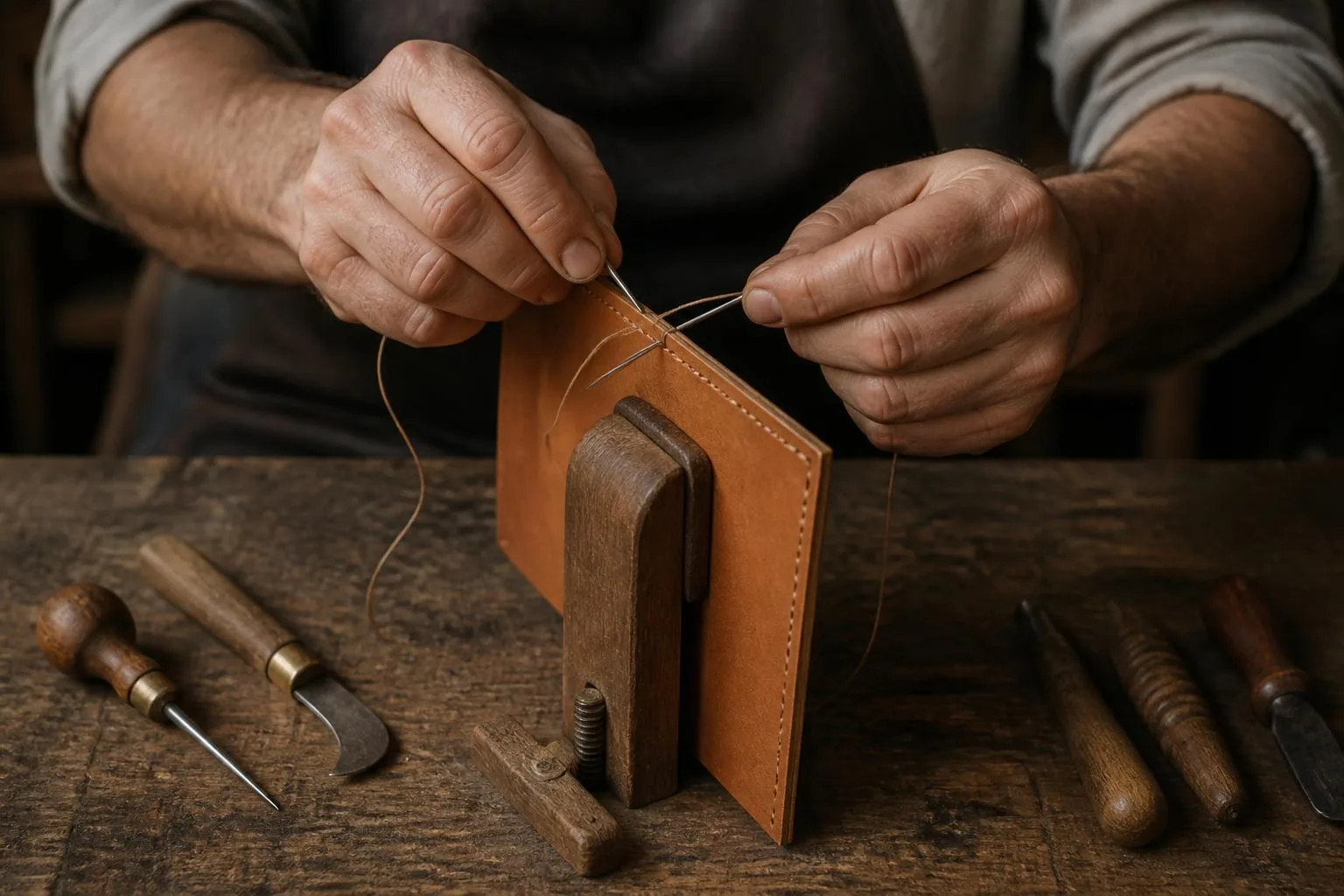
What made the workshop’s reputation from the 1860s was not a design but a seam. The saddle stitch is done by hand, with two needles on a single length of waxed linen thread, crossing each other in the same hole pierced with an awl. Every stitch is therefore locked independently of the others.
The consequence is purely mechanical, and it is the one that matters to a rider: if one stitch breaks, the seam does not unravel. A machine seam, by contrast, runs along its whole length as soon as one thread gives way. On a harness taking the pull of a 1,320 lb (600 kg) horse, or on the stirrup leathers and girth straps that keep a rider in place over a fence, the difference is not aesthetic. It is vital.
That is why the saddle stitch, conceived for nineteenth-century carriage driving, has never been abandoned. It is still found today on top-end saddles and on luxury small leather goods, exactly as it was. The full story of that object, from the steppe blanket to the composite tree, is set out in our feature on the history of the saddle.
1867: the medal that made Hermès saddler to the stables of Europe
Recognition came at the Paris Universal Exposition of 1867, where the jury awarded Hermès a first-class medal for its harness. In a trade where orders travelled by word of mouth between stables, such an award was as good as a hallmark. The house became a supplier of high-end carriage equipment, and its order book soon spilled well beyond Paris.
It is worth gauging the size of that market. The Compagnie générale des omnibus, which ran Paris’s horse-drawn public transport, owned 6,580 horses in 1860, 10,947 in 1877 and 17,323 in 1899. It replaced 3,000 to 4,000 of them every year. On top of these came the cabs, the private carriages, the delivery vans and the omnibuses of the department stores.
80,000 horses every morning: the harness market when Paris ran on horsepower
Studies of Parisian transport history give the order of magnitude: around 80,000 horses were on the streets of Paris each morning around 1900. In 1900 there were still 10,863 horse-drawn cabs against 115 motor taxis. Every one of those rigs wore out leather, broke buckles and needed new collars.
These were not sport horses. Many were draught horses and cobs of heavier type, strong, enduring and fed to pull. We have given them a full dossier, from conformation to present-day uses, in our guide to the draught horse. For a saddler and harness maker they were a captive clientele, constantly renewed. And it was precisely that market that vanished in the space of about fifteen years.
1913, the last horse-drawn omnibus: how Hermès survived the death of the driven horse
The turning point was brutal and can be dated. The Compagnie générale des omnibus wound up its stable between 1900 and 1909. Its 17,496 horses were down to 5,415 in 1912, then 628 in 1913. The last horse-drawn omnibuses ran in Paris in January 1913, and the last horse-drawn tramway line within the city walls stopped on 12 January 1913. In under fifteen years, the main customer of the Parisian harness trade had evaporated.
Every saddlery of the day faced that wall. Most closed. Hermès did something else: the house decided that it was not selling harness but stitched leather for travel. It followed its customers, who were moving from the carriage to the motor car and the train.
Émile-Maurice Hermès, the founder’s grandson, brought back from Canada the rights to a zip fastener still unknown in France. The house registered it for leather goods in 1923 and fitted it to a bag designed for motoring, the car bag, later renamed the Bolide. It was the first handbag closed by a zip. In France that fastening was long known as the Hermès fastener.
In parallel the house kept its original trade. Equestrian sport, for its part, took over from traction: this was the period when carriage driving shifted from transport to competition, a discipline whose rules and equipment we detail in our guide to competition carriage driving.
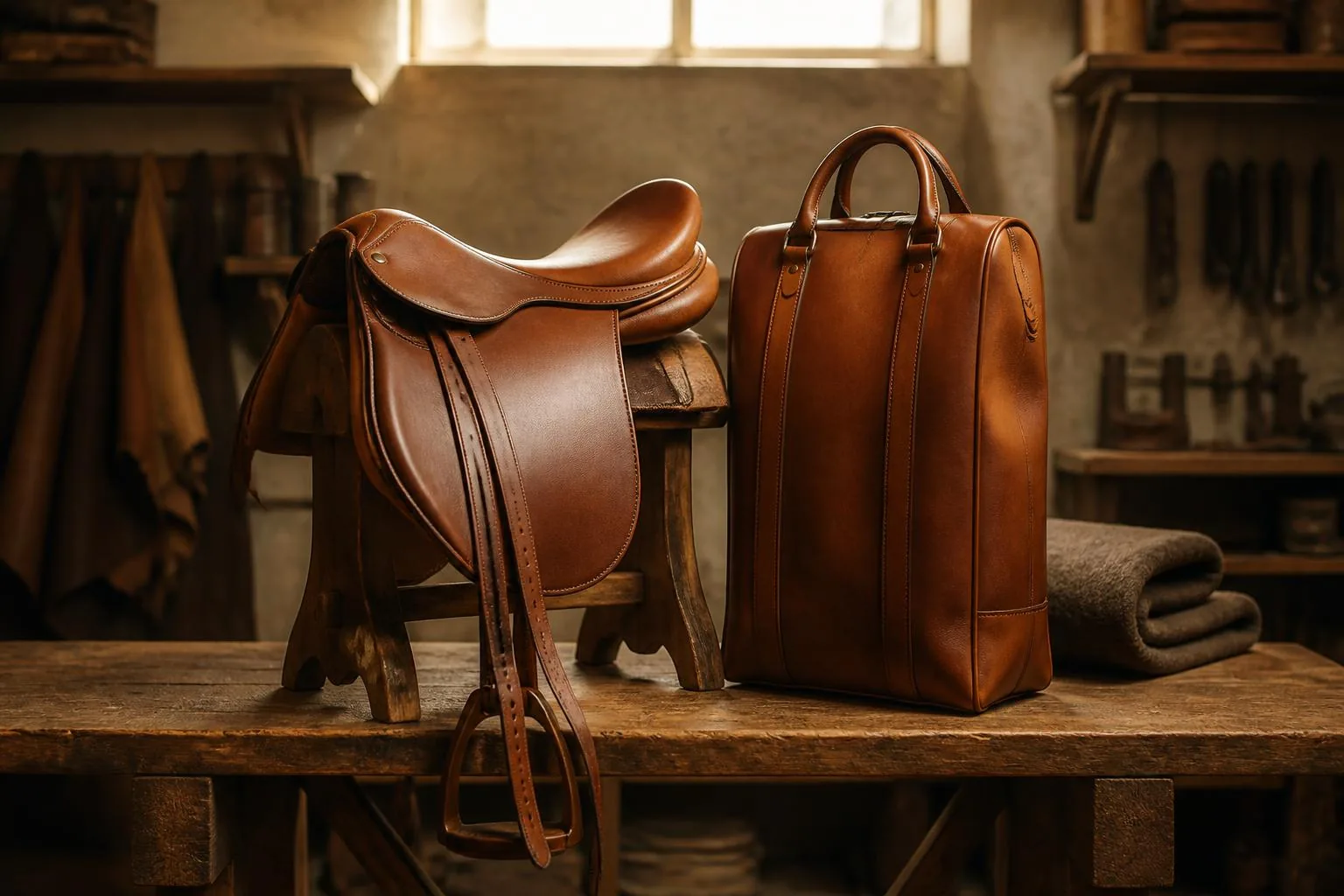
The haut à courroies: a bag made to carry a saddle and a rider’s boots
Around 1892 the workshop drew up a large, rigid leather bag with two long straps and a single handle. Its name states its purpose: haut à courroies, literally a tall bag with straps. It was nothing like a fashion accessory. It was a piece of saddlery luggage, meant to carry a saddle, a pair of boots and the small kit of a rider travelling with his belongings.
The shape of the bag is dictated by that constraint: tall enough to take the tree of a saddle, rigid so that the leather does not sag over its contents, closed by a flap and straps because a saddlery buckle holds better than a clasp, and fitted with a rolled handle stitched like a rein. Every visual code now taken for decoration was once a technical equestrian solution.
From saddle satchel to Kelly bag: Grace Kelly in 1956, the official name in 1977
Between the wars, Robert Dumas took this saddlery bag and scaled it down to a city format for carrying documents. It became the sac à dépêches, the dispatch bag. In 1954 the costume designer on Alfred Hitchcock’s To Catch a Thief chose it for Grace Kelly.
Two years later, by then Princess of Monaco and expecting her first child, she was photographed holding the bag in front of her to shield herself from the cameras. The picture went round the world, and the public renamed the object. Hermès made the name official in 1977: the dispatch bag became the Kelly bag. A satchel designed for a horse saddle had become, by photographic accident, one of the most copied objects of the twentieth century.
It is not a unique path. The riding breeches that every rider wears today followed exactly the same trajectory, from technical solution to town clothing, as we told in the story of the Indian origins of jodhpurs.
€8.58 million for the first Birkin: what the saddler’s legacy earns today
The house’s second great bag was born in 1984. Jean-Louis Dumas designed for the actress and singer Jane Birkin a softer, larger model derived from the same haut à courroies. The prototype she actually used carries her initials J.B., a fixed shoulder strap and a nail clipper attached inside.
It was this worn prototype, covered in stickers, that sold on 10 July 2025 at Sotheby’s in Paris. Starting price one million euros, ten minutes of bidding, nine bidders, hammer price €8.58 million, or about $10 million, to a Japanese buyer on the telephone. It is the most expensive handbag ever sold at auction.
The group itself reported €8.163 billion in revenue for the first half of 2026 alone and 27,107 employees at the end of June 2026. And its largest division, the one that weighs heaviest in its accounts, is still called, in its own documents, Leather Goods and Saddlery.
Why the horse in the Hermès logo pulls an empty carriage
The detail almost nobody notices is in the logo. It shows a horse harnessed to a light carriage, a duc, with a groom standing beside it in a top hat. The carriage, though, is empty. Nobody is in it.
This is no accident of drawing. The image comes from a drawing by Alfred de Dreux, a nineteenth-century French animal painter who specialised in horses, entitled Le duc attelé, groom à l’attente (the harnessed duc, groom waiting). Émile-Maurice Hermès owned the drawing in his office and chose it as the house emblem in the mid-1940s.
The house’s own reading is simple, and as commercial as it is symbolic: the turnout is ready, the horse is harnessed, the groom waits. The empty seat is the customer’s. In other words, Hermès supplies the equipment, never the driving. The customer holds the reins.
That nineteenth-century taste for horse painting was far from marginal: it supported whole careers, including the most famous of them all, whom we followed through her police permit to paint in trousers, Rosa Bonheur at the horse market.
Hermès the saddler today: hand-stitched saddles and a show-jumping event under the glass roof of the Grand Palais
Saddlery is not a heritage backdrop kept up for publicity. The house still makes jumping, dressage and trekking saddles, as well as bridles and stable accessories, on a stated principle: one saddle, one craftsman, from the first line drawn to the last stitch, in about forty hours of work. Production takes place in the workshops of the Faubourg-Saint-Honoré and in Normandy, at Louviers. The ranges and prices are set out on our page on Hermès saddlery.
The link with sport is kept alive by a competition the house funds and organises itself: the Saut Hermès, created in 2010 under the glass roof of the Grand Palais in Paris, now a five-star CSI international show jumping event. The 2026 edition was held on 20, 21 and 22 March. It is one of the few show jumping competitions in the world staged in the very centre of a capital city, inside a listed monument.
Hermès is not alone on this ground, either. French saddlery includes several houses born of the same trade and the same gesture, whose stories we have told, such as Butet and its heritage as a French saddler, and which you will find in our overview of equestrian brands.
What we still do not know about the history of Hermès the saddler
Three areas remain blurred, and it is more honest to name them than to smooth them over.
The first is the real share of saddles in the business. The Leather Goods and Saddlery division is the largest contributor to group revenue, but it lumps bags and saddlery into a single line. The share of saddles is not published separately. It is, quite clearly, marginal in value.
The second concerns manufacture. The figures of forty hours per saddle and a single craftsman come from the house’s own communication, repeated by the specialist press. They are consistent with what is seen at other top-end saddlers, but they rest on no independent audit.
The third is the authorship of the haut à courroies. The house’s historical sources attribute it sometimes to Charles-Émile Hermès, sometimes to his sons Adolphe and Émile-Maurice, with dates ranging from 1892 to the early 1900s. The bag’s function, however, is beyond doubt: to carry a saddle and boots.
What the history of Hermès the saddler tells riders buying a saddle
The lesson is not to daydream in front of a window on the Faubourg-Saint-Honoré. It is a technical one, and it holds for any saddle at any price.
Everything that gives saddlery its value comes down to three points you can check. The first is the stitching: look for saddle stitch where the leather works hardest, stirrup leathers, flaps and billet attachments. The second is the tanning of the leather: vegetable-tanned leather develops a patina and can be repaired, while corrected-grain leather cracks. The third is repairability: a saddler who takes back his own pieces ten years later is selling an object, not a consumable.
These are exactly the criteria we apply in our comparison of riding saddles, in our buying guide to the horse saddle, and in our selection of jumping saddle models. A house founded in 1837 that still stitches with two needles has not kept the gesture out of nostalgia: it has kept it because nothing better has appeared since.
Sources on Hermès the saddler, Parisian harness and the Kelly bag
The dated facts about the house come from the Hermès International corporate notice and company histories consulted on 26 September 2026. The figures on Parisian horses come from the entry on the Compagnie générale des omnibus. The history of the zip fastener and the Bolide bag is documented by Sotheby’s, the auction house that also ran the sale of the first Birkin on 10 July 2025. The financial data are those published on the group’s investor pages. The dates of the 2026 edition of the show were taken from the official Saut Hermès website. Equirider is affiliated with neither Hermès nor Sotheby’s.