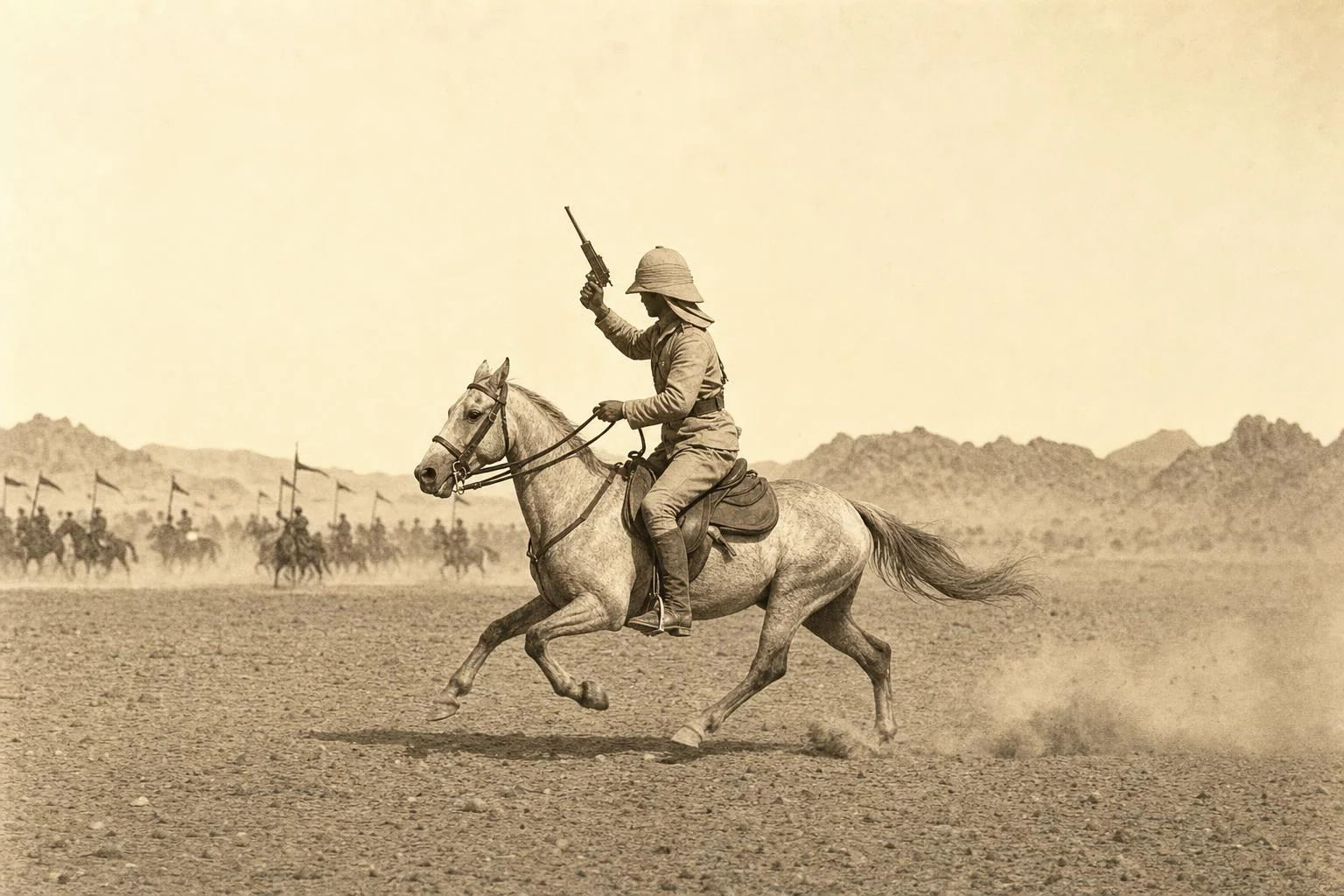

On 2 September 1898, in the Sudan, Lieutenant Winston Churchill rode in the charge of the 21st Lancers at Omdurman. A British cavalry officer is meant to fight with the sabre: he carried a Mauser pistol, and he rode a small grey Arab pony, the one he played polo on. The reason lies in a foolish accident two years earlier, on a quay in Bombay. That fragile shoulder stayed with him for the rest of his riding life, from polo in India to the racehorses of his old age. Here is the story, and what can actually be checked.
Bombay, 1896: the young cavalryman’s shoulder comes out on a quay
Churchill passed out of Sandhurst in 1894 and joined the 4th Hussars, a cavalry regiment, in February 1895. In the autumn of 1896 the regiment landed in India. As he stepped from the launch onto the quay at Bombay, the swell pushed the boat away; Churchill grabbed an iron ring set in the stonework, the boat drew back, and his right shoulder came out of its socket.
It seems a trivial mishap. It was not: the joint never fully recovered. According to his biographers, the shoulder would slip out again at the slightest awkward movement, playing polo, turning over in his sleep, reaching for a book on a high shelf. For a cavalry officer, it was the sword arm that was damaged.
Video · 119 seconds
Churchill on horseback at Omdurman
Blame a dislocated shoulder on a Bombay quay. The story.

Why a cavalry officer without a sabre bought two Mauser pistols
In 1898 Churchill was desperate to be sent to the Sudan, where Kitchener’s army was advancing up the Nile towards Omdurman, the Mahdi’s capital. Kitchener did not want him; he nonetheless managed to be attached to the 21st Lancers, while also writing for the Morning Post. Before leaving, he called on the London gunmaker John Rigby and Co. and bought two Mauser C96 pistols, then a very new weapon, holding ten rounds.
The logic is simple, and Rigby still points it out: swinging a sabre with the right hand at the gallop, with a shoulder that could give way at any moment, means disarming yourself at the instant of impact. A pistol is held close to the body and needs no great sweep of the arm. It was the choice of a horseman who knew the limits of his own body.
2 September 1898: Churchill charges at Omdurman on a grey Arab pony
On the morning of the battle, the 21st Lancers were ordered to reconnoitre the plain between the British army and the city. The troopers saw a line of fighters they put at a few hundred men, and charged. Behind it, hidden in the bed of a dry watercourse, lay a far larger force, in the order of 2,500 to 3,000 men according to British accounts.
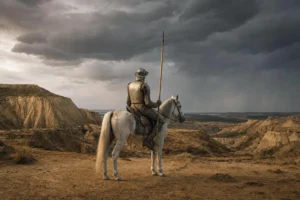
Churchill describes his mount himself in his memoirs, My Early Life: a grey Arab pony, handy and sure-footed, a polo pony. It was not the big charger of popular imagery but a small, quick horse used to turning short, which mattered in the press of the watercourse. Churchill went through the charge with his pistol in hand, came out the other side, and rallied his troop.
What the lancers’ charge cost in men and horses
The charge lasted two or three minutes. Of the 310 officers and men of the 21st Lancers, five officers and 65 men were killed or wounded, and about 120 horses were lost or injured: nearly a quarter of the regiment’s strength. Lieutenant Robert Grenfell was killed. Three men of the regiment would receive the Victoria Cross for going back to rescue comrades on the ground.
The horses paid a price at least as heavy as the riders. A wounded mount in a charge of this kind does not always get up again, and the unhorsed rider finds himself on foot in the middle of the fight. Churchill came out of the watercourse on his Arab pony, which many of his comrades could not do. Omdurman is often described as one of the last great charges of the British cavalry; in the book he drew from it in 1899, The River War, Churchill does not present it as a triumph.
Polo with the arm strapped down: Churchill in the saddle through to Meerut
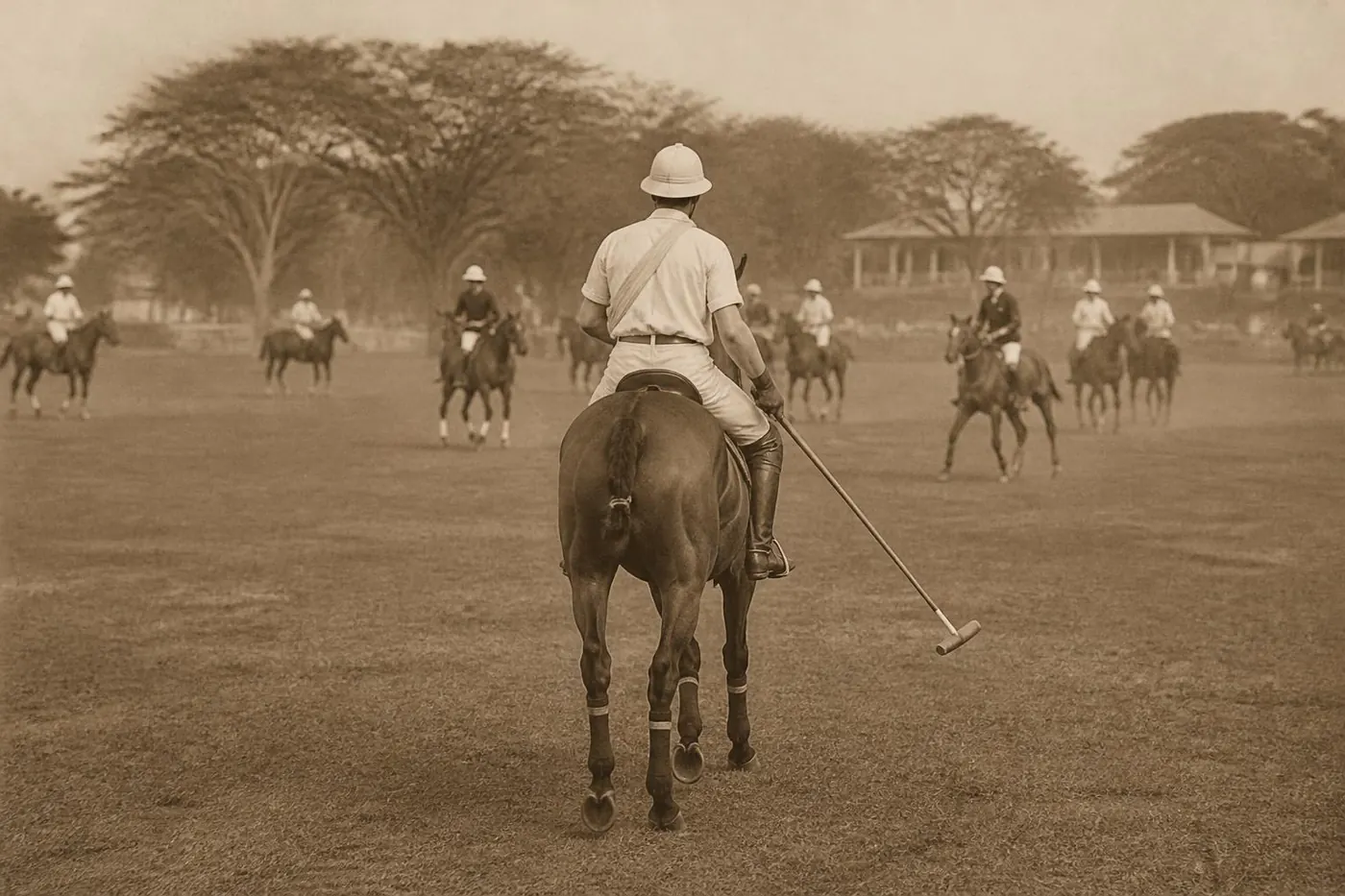
The shoulder did not keep Churchill away from horses; it only changed the way he rode. At polo he played with his right arm strapped across his chest. In February 1899 he went back to India almost solely to play for the 4th Hussars in the inter-regimental tournament at Meerut. The day before leaving he took a fall, dislocated the shoulder again and sprained both ankles.
He played anyway. The 4th Hussars beat the 5th Dragoon Guards 16 to 2, then the 9th Lancers 2 to 1, and won the final 4 to 3 against the 4th Dragoon Guards. Churchill scored three of the four goals in the final, including the winner. He would go on playing polo for almost thirty more years.
Colonist II, the grey racehorse who gave Churchill his colours back
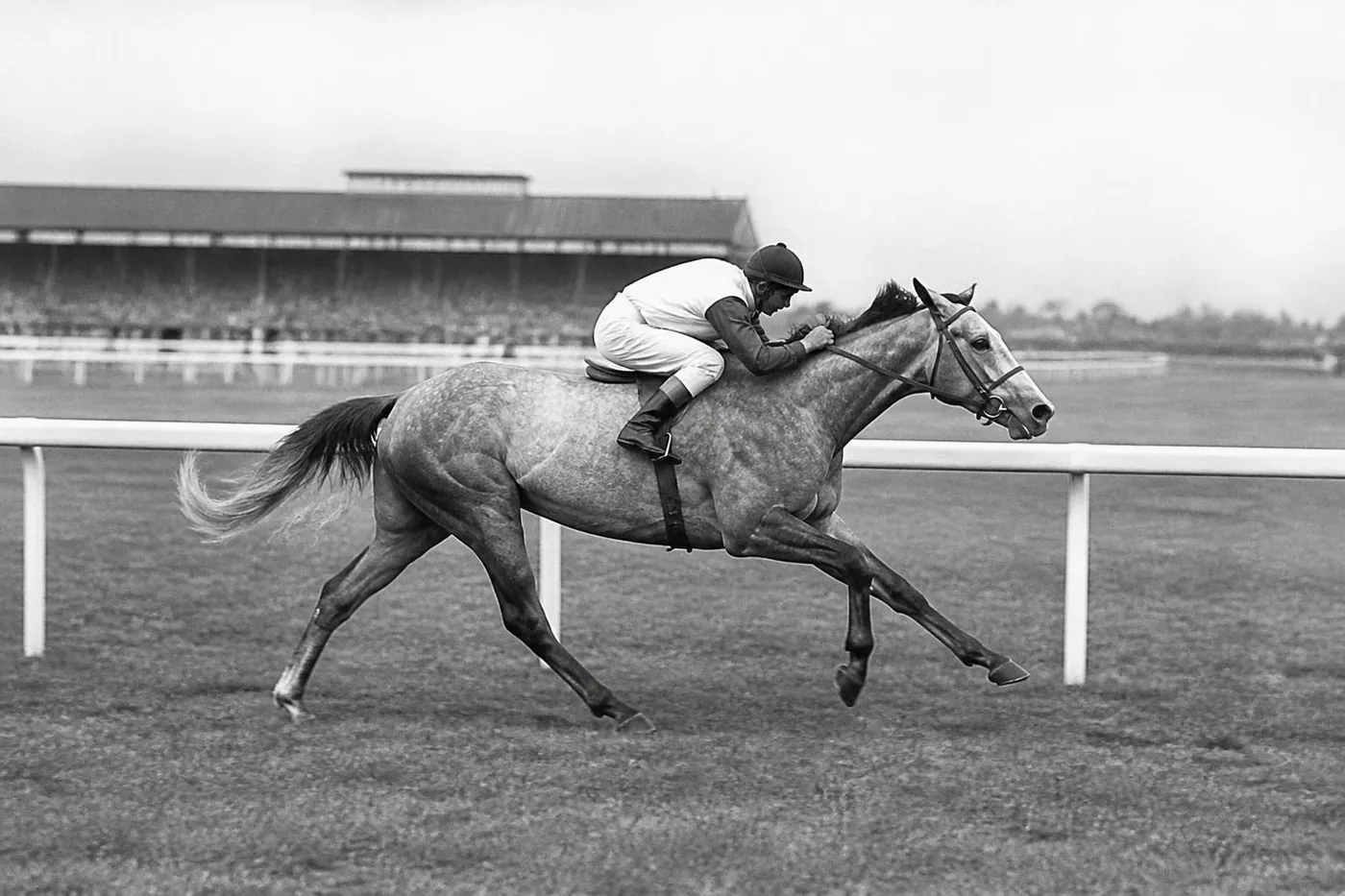
Half a century after Omdurman, Churchill returned to horses through racing. In 1949 his son-in-law Christopher Soames urged him to buy a grey colt, Colonist II, for £2,000. The horse ran in the colours registered by Lord Randolph Churchill, Winston’s father: pink jacket, chocolate sleeves and cap. He won first time out in them, in the Upavon Stakes at Salisbury on 25 August 1949.
Colonist II ran 23 races, won thirteen and was placed in five others before being retired at the age of five through injury. The old man who had charged on a grey pony thus ended his riding life as the owner of another grey. His pink and chocolate silks entered the National Museum of Racing in Saratoga Springs, in the United States, in August 1963.
Churchill’s horse and the saying wrongly attributed to him
A line about “the outside of a horse” being good for “the inside of a man” is often quoted under Churchill’s name. Churchill scholars find no written trace of it from him, and the phrase was in circulation before his time: we do not attribute it to him. His bond with horses is better told through facts than through quotations: a grey Arab pony at Omdurman, an arm strapped down at polo, a grey colt bought at 74.
That small Arab horse, hardy and handy, remains the mount that carried him out of the watercourse. To understand what lies behind its reputation, see our profile of the Arabian horse, and for the bloodlines behind Colonist II, our guide to the Thoroughbred. Another British war horse ended his days showered with honours: Copenhagen, Wellington’s horse at Waterloo.
Established: the right shoulder dislocated on landing at Bombay in 1896; the purchase of two Mauser C96 pistols from Rigby in 1898; the charge of the 21st Lancers on 2 September 1898 and its toll (310 men engaged, 70 killed or wounded, about 120 horses); the Meerut tournament of 1899; the purchase of Colonist II in 1949 and his 13 wins from 23 races.
According to Churchill himself: the grey Arab pony, described in My Early Life, and the link between the shoulder and the choice of the pistol, which he recounts as a matter of common sense.
Estimated: the number of fighters hidden in the watercourse, which varies between accounts. Rejected: the quotation about “the outside of a horse”, for want of a reliable source.
Sources for the account of Churchill and his horse at Omdurman
Winston Churchill, My Early Life (1930) and The River War (1899); John Rigby and Co., note on the two Mauser C96 pistols bought by Churchill in 1898; International Churchill Society, Finest Hour (articles on Colonist II and on Churchill and racing); Barbara Langworth, Winston Churchill and Polo; regimental histories of the 21st Lancers and the 4th Hussars.