
On Wednesday 23 September 2026, the eventing at the Aichi-Nagoya Asian Games ends with its most feared phase, and not the one the schedule promised: Typhoon Dujuan forced the organisers to reverse the order of the tests, so it is the 3,640 metres (about 2.3 miles) of cross-country at Tokyo’s Equestrian Park that will hand out the medals, one hour before the podium. At a major championship, eventing almost always finishes with the show jumping. In Tokyo, it will finish with the cross-country, on ground soaked by rain that the track crews have had an extra twenty-four hours to dry out. China’s Alex Hua Tian, the defending individual champion, starts in front on 26.9 penalties, 3.2 clear of his nearest rival: less than one fence down. Here is what is at stake, who leads, and why this Setagaya park is worth a detour in its own right.
Typhoon Dujuan: why the Asian Games eventing finishes with the cross-country in Tokyo
The original schedule followed the classic three-day progression: dressage on Monday 21 September, cross-country on Tuesday 22, show jumping and the medal ceremony on Wednesday 23. Typhoon Dujuan had other ideas. The depression swept across the Tokyo region with record-breaking rainfall in places and strong winds, making any start to competition on Monday impossible. The eventing technical delegate, Britain’s Alec Lochore, issued the official announcement of the reshuffle that day.
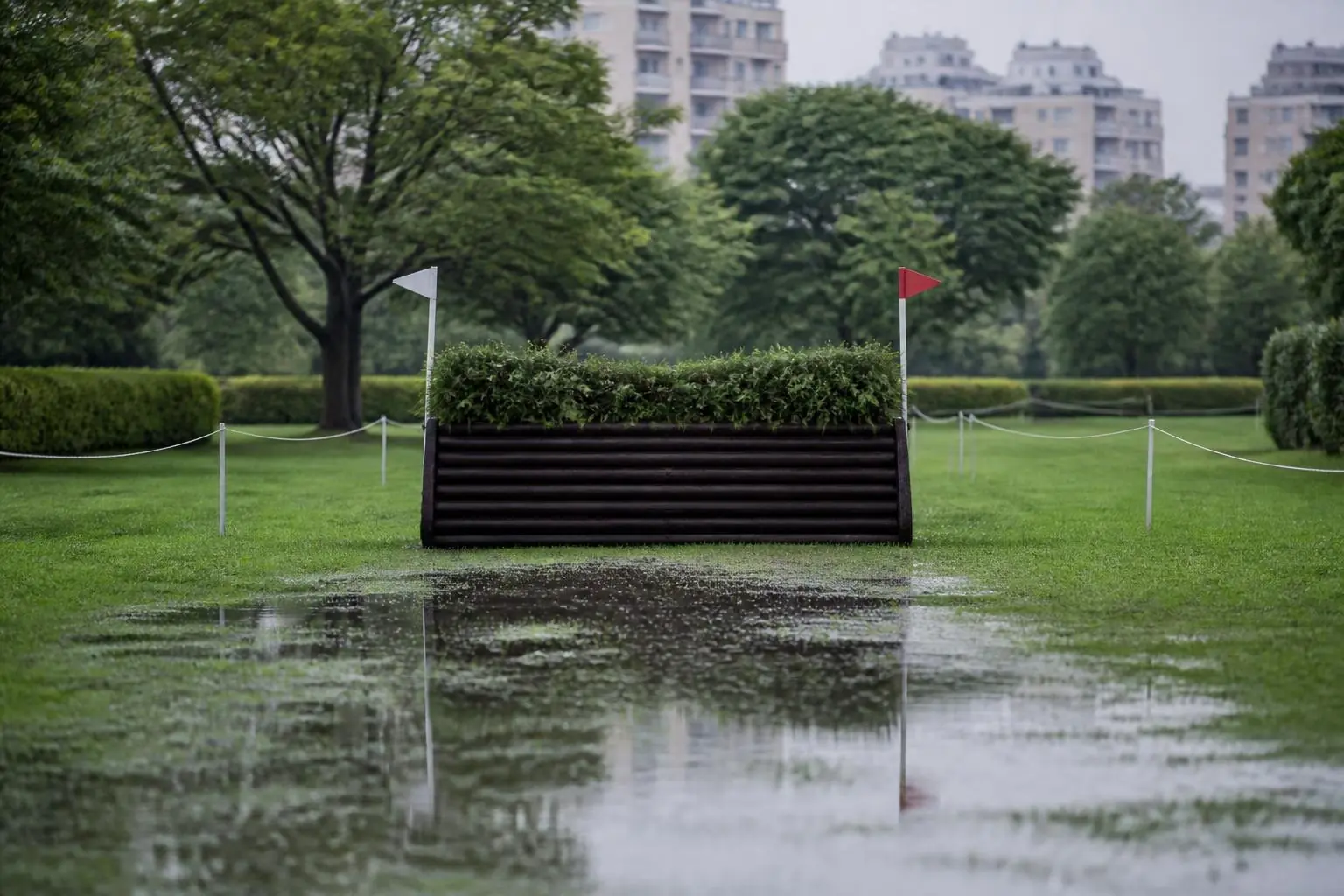
The solution came in two moves. Dressage, pushed back a day, was held on Tuesday morning; the show jumping, which was meant to close the Games, was brought forward to Tuesday afternoon, on the same ground. The cross-country, meanwhile, slid to Wednesday, to give the sodden track a further twenty-four hours to drain. The official statement notes that “this unanimous adjustment is permitted under FEI rules, which allow schedule changes in cases of force majeure and extreme weather conditions, in order to safeguard human and equine welfare”. By Tuesday morning the weather had already turned completely: bright sunshine and high temperatures over the Equestrian Park.
The sporting consequence is considerable. In the usual pattern, a rider who has flown round the cross-country goes into the final day’s jumping with a cushion of points and the fear of a single rail. Here the order is turned upside down: the two technical phases are behind the field, the standings are frozen on tiny margins, and everything will come down to speed, stamina and the clear head of a horse sent out over a seven-minute course on ground that has soaked up the rain. “The technical things are behind us,” Alex Hua Tian summed up on Tuesday evening. “I have to concentrate on tomorrow’s cross-country. I trust my horse, but it’s cross-country: anything can happen.”
On video
Asian Games 2026 eventing: the cross-country decides the medals in Tokyo
The course, the leaders, the teams, the 2021 Olympic venue.

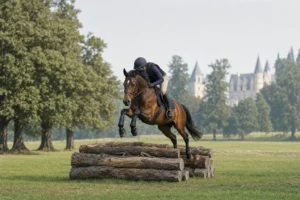
The Baji Koen cross-country: 3,640 metres, 24 fences and seven minutes for every horse
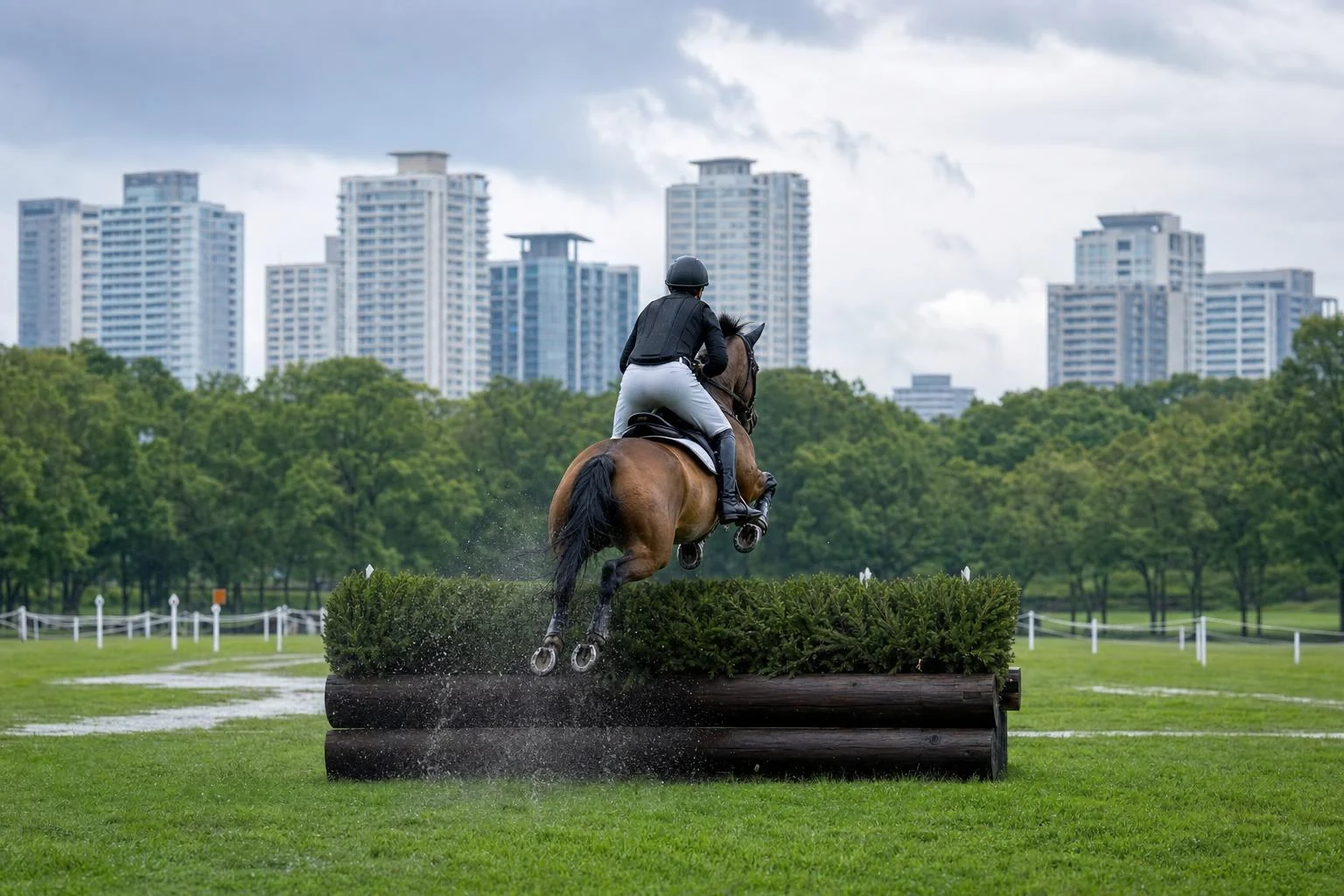
The course was designed by Poland’s Marcin Konarski, a four-star course designer and the eventing technical delegate at the Paris 2024 Olympic Games, long associated with the big event at Strzegom. His Tokyo track measures 3,640 metres (2.26 miles), has 24 fences for 30 jumping efforts, and an optimum time of seven minutes. It is a short, twisting, enclosed course that winds through an urban park and runs up against the city: the apartment blocks of Setagaya appear behind the trees.
That compactness is the real difficulty. A seven-minute cross-country leaves no long straights in which to claw back the clock; the horse is constantly turning, rebalancing and re-accelerating, and every second lost at a bend is paid for. Hua Tian, who has walked the course twice, says it plainly: “Time and technicality are going to be decisive, and I think the ground could be too. All of that together will put a lot of pressure on the riders, especially those who want to win.” On Tuesday evening he added that the ground looked “much better” than he had feared the day before, and praised the work of the track crews.
The Asian Games cross-country is run at CCI2*-L level, while the dressage and show jumping were judged at CCI3*. This hybrid format, particular to these Games, is a deliberate compromise: it allows nations whose breeding and competition pathways are still young to field combinations against the more seasoned, without imposing a world-championship-level cross-country on everyone. For the detail of the scoring, refusals, time penalties and the frangible-pin rule, our guide to eventing sets out the penalty chart phase by phase.
What the Asian Games eventing will turn on this Wednesday
- The clock above all. An optimum time of seven minutes over 3,640 metres: every second beyond it costs points, and on a twisting track, speed is lost in the turns, not on the straights.
- The state of the ground. Waterlogged turf tires a horse faster, first lengthening the stride and then shortening it, and turns a short course into a test of stamina.
- The tiny margin. 3.2 penalties separate first from second, less than the cost of a rail in the show jumping. A single second too many is enough to reverse the order.
- The number of starters per team. China and India fielded only three combinations: no score can be dropped, so the slightest mishap bears directly on the team medal.
- The horse’s freshness. Dressage and jumping were both run on the same Tuesday: the horses go into the cross-country with a concentrated workload, unusual at this level.
- The podium, one hour later. The formal ceremony is scheduled sixty minutes after the end of the cross-country: medals are awarded on the cumulative score of all three phases.
Alex Hua Tian and Manjushri lead the eventing, less than a fence ahead
China’s Alex Hua Tian, a Britain-based rider and reigning Asian Games champion, leads on 26.9 penalties, his dressage score, kept intact thanks to a clear round in the show jumping. His mount, Manjushri, is a nine-year-old Irish Sport Horse gelding owned by Adam, Angelina and Lin Guo and by Qianru Yi. The pair finished seventh in the CCI4*-S at Bramham in June, won a CCI3*-S at Burgham in July on their dressage score, took the CCI3*-L at Hartpury in 2025 and finished fourth at the Asian Championships in Pattaya the same year. Hua Tian also finished twelfth individually at the 2026 World Eventing Championships in Aachen and sits seventeenth in the FEI world rankings for the discipline.
“I brought a very competitive horse,” he explained after the dressage. “He’s only nine, but he already competes at four-star level and he has always been very reliable. I’m here to win an individual medal. Gold, silver or bronze will depend on what happens, but I hope we’ll do a good job.” The winner at Hangzhou in 2023, he completed a rare set there: silver at Incheon in 2014, bronze at Jakarta in 2018, gold in 2023. A new title would make him a double reigning champion of the discipline.
Behind him, Thailand’s Woraphat Sittiju and the eighteen-year-old gelding Uster de Chanay are second on 30.1, up from fourth place after a clear round. Japan’s Ryo Murata and Brookpark Vikenti, also eighteen and a CCI4*-S winner, are third on 30.4. Yoshiaki Oiwa and Ottawa des Desig complete this quartet on 31.3, which puts two combinations from the host nation in the top four. Kazuma Tomoto, fourth individually at the Tokyo Olympics and fifth in Paris, is riding Fer de Lance this year, an eight-year-old with whom he won the CCI3*-S at Miki, Japan, in May 2026.
Eight clear rounds out of 32: the show jumping has already sorted the field
The jumping track, which topped out at 1.20 metres (3 ft 11 in), had eleven fences for fourteen efforts. It still did damage: only eight of the 32 combinations in the ring completed it without adding a single penalty. Hua Tian’s two main challengers after the dressage paid the price. Thailand’s Korntawat Samran, individual silver medallist at Hangzhou, and Billy Elmy dropped from second to thirteenth, adding 9.6 penalties. Japan’s Toshiyuki Tanaka and Talma D’Allou fell from third to nineteenth with 12.4 penalties. This early sorting explains the tightness at the top of the standings before the cross-country: the most consistent pairs have bunched together, and the slightest difference on the clock this Wednesday will be enough to reshuffle the places.
In the team event, Japan lead the eventing ahead of Hong Kong and Thailand
The host nation goes into the cross-country at the top of the team standings on 97.3 penalties, 12.1 clear of Hong Kong, China (109.4), with Thailand just 0.5 further back (109.9). It is a strong position, and no accident: three of the four Japanese riders, Yoshiaki Oiwa, Toshiyuki Tanaka and Kazuma Tomoto, were part of the team that won Japan’s first ever Olympic eventing bronze in Paris in 2024.
“Being in front after the first day is exactly what we planned, even if the results were a little different from our forecasts,” said Japan’s team manager Atsushi Negishi. “We had hoped everyone would go above 70 per cent in the dressage, and we started with more penalties than expected. But after the dressage and the jumping, we are first with a twelve-point lead. I believe we have taken a significant advantage.” Japan are chasing a team title they have not won since Jakarta-Palembang in 2018, after silver at Hangzhou in 2023.
China, the reigning team champions, start weakened: after the withdrawal of Huadong Sun and Cadorico, they are down to three combinations and so have no score to drop. At Hangzhou in 2023 they achieved a historic double, team gold and individual gold with Hua Tian, their first Asian Games gold medals in the discipline. Equestrian sport has been on the Asian Games programme since the 1982 edition in New Delhi.
India down to two individual riders: Fouaad Mirza and Ashish Limaye
India’s team campaign ended in the show jumping, with the elimination of Arjan Singh Nagra and Cooley Goodwood. Having also fielded only three combinations, India are left without a drop score and fall out of the team standings; their two remaining riders continue as individuals. They are two names that matter. Fouaad Mirza, a two-time Asian Games silver medallist who represented India at the Tokyo Olympics, rides Camouflage 38. Ashish Limaye is the reigning Asian champion: he took individual gold with Willy Be Dun at Pattaya in 2025, where India won team silver behind Thailand.
One detail shows how long these riders last: the individual podium at the 2018 Asian Games in Jakarta-Palembang was Yoshiaki Oiwa ahead of Fouaad Mirza and Alex Hua Tian. Eight years later, all three men are back in contention at the same championship. In a discipline where partnerships take five to ten years to build, as the story of the Chilli Morning clone revealed at Blenheim or that of the Burghley favourite riding a horse bred at home reminds us, this continuity says something about the economics of Asian eventing.
Tokyo’s Equestrian Park: the horses return to the 2021 Olympic venue
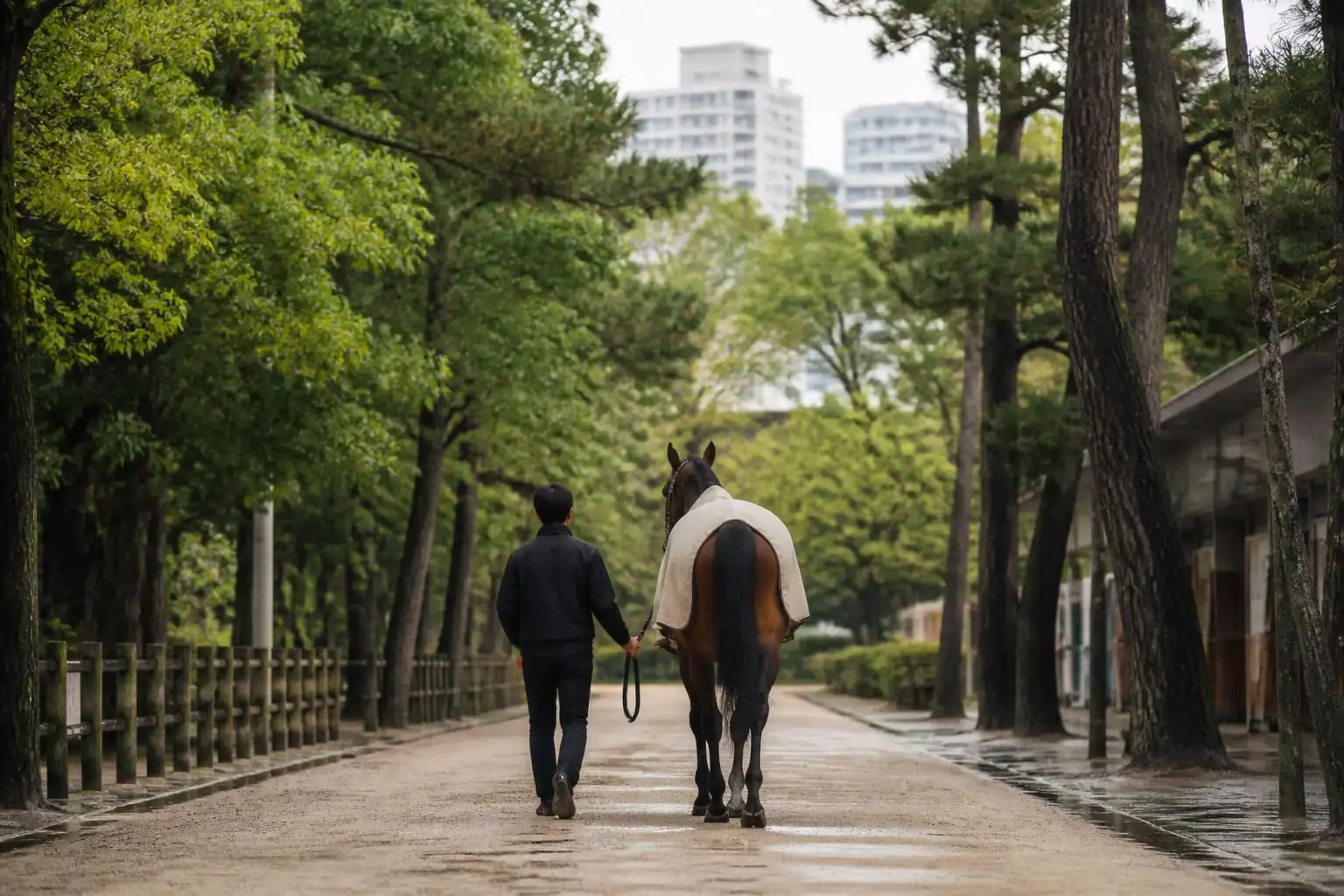
The Games are being held in Aichi-Nagoya, but the equestrian events are run some 250 kilometres (about 155 miles) away in Tokyo, in the Setagaya ward. The Equestrian Park, which the Japanese call Baji Koen, opened in 1940 and has hosted the equestrian events of two Olympic Games, those of 1964 and of Tokyo 2020, held in 2021. It reopened in 2023 after a complete renovation.
The return has a particular flavour. In 2021, the Olympic events were held behind closed doors, with empty stands because of the pandemic: nobody saw these horses other than on television. This time the park is open and the events can be watched in person. And there is a second, more technical difference: at the Olympics, only the dressage and jumping took place at Baji Koen, with the cross-country moved to Sea Forest, on reclaimed land in Tokyo Bay. For these Asian Games, all three phases are held within the park. The cross-country therefore comes into the city, which explains both its brevity and its looping course between the copses.
This venue is not done with the calendar yet: the same park hosts the Tokyo Equestrian Festival on 7 November 2026. For anyone following Japanese equestrian sport from afar, it is a chance to see the facility in a different register, more family-oriented. The other fixtures of the season, across all disciplines, are listed in our calendar of 2026 horse shows and competitions, and the equestrian history of the Games is told in our feature on equestrian sport at the Olympic Games.
Asian Games eventing: what this Wednesday 23 September decides in Tokyo
- The event: final cross-country of the eventing at the 20th Asian Games in Aichi-Nagoya, Wednesday 23 September 2026, Equestrian Park (Baji Koen), Setagaya, Tokyo.
- The upheaval: Typhoon Dujuan prevented Monday 21’s start; dressage and show jumping were run together on Tuesday 22, and the cross-country became the final phase, contrary to championship custom.
- The course: 3,640 metres, 24 fences, 30 efforts, seven-minute optimum time, designed by Marcin Konarski, at CCI2*-L level while the dressage and jumping were at CCI3*.
- In front: Alex Hua Tian (China) and Manjushri, 26.9 penalties, ahead of Woraphat Sittiju (Thailand) and Uster de Chanay, 30.1, then Ryo Murata (Japan) and Brookpark Vikenti, 30.4.
- Team standings: Japan 97.3, Hong Kong, China 109.4, Thailand 109.9; reigning champions China and India have only three combinations, so no drop score, and India are already out of the running after an elimination in the jumping.
- The podium: medal ceremony one hour after the end of the cross-country, on the cumulative score of all three phases.
The other equestrian sports followed by Equirider, from show jumping to dressage, also have their autumn news; on the eventing side, the Grande Semaine de Pompadour has just closed its young-horse season in France.
Sources: Fédération Equestre Internationale (FEI) releases of 22 September 2026, “Hua Tian sets the standard as Japan lead on home soil” and “Clear rounds prove decisive as Hua Tian stays on top in Tokyo”; FEI page for the 20th Asian Games; equestrian page of the Aichi-Nagoya 2026 organising committee; reports from Eventing Nation and Horse & Hound. The cross-country had not yet been run at the time of publication: the standings quoted are those after Tuesday 22 September’s dressage and jumping. Equirider is not affiliated with the FEI or with the Asian Games organising committee.