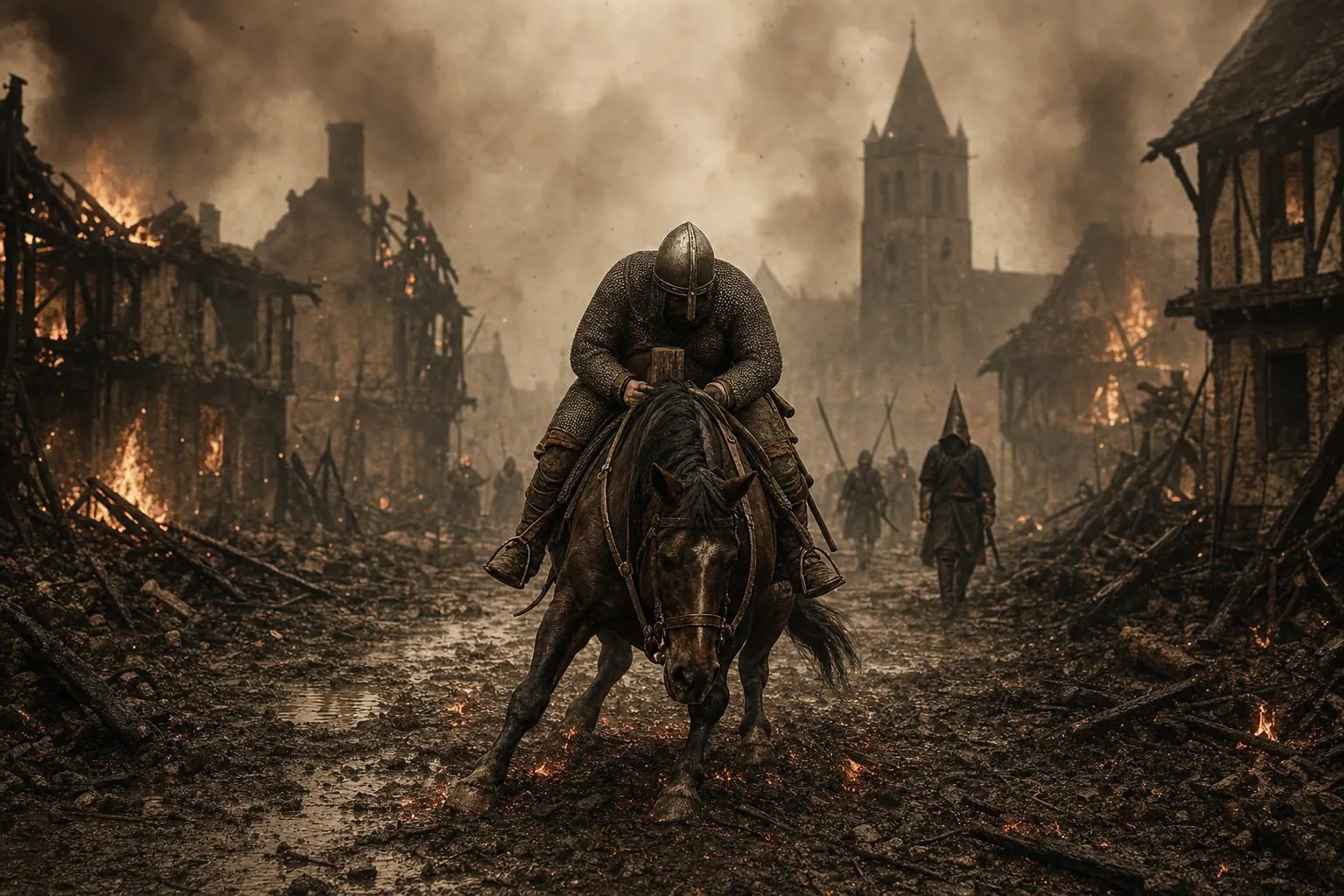

Summer 1087. William the Conqueror, King of England and Duke of Normandy, rides through the streets of Mantes, a town he has just set ablaze. His horse shies among the embers, and the king, extremely corpulent, is thrown against the pommel of his saddle. He dies a few weeks later in Rouen. His funeral at Caen turns into a disaster: a fire, a man demanding payment for the burial plot, and a body too large for its stone coffin, which bursts when forced into it. Here is the story as the chroniclers left it, and what can actually be verified.
Hastings, 14 October 1066: three horses killed under William the Conqueror
Before a horse wounded him, William won a kingdom from the saddle. On 14 October 1066, on the hill at Hastings, the Norman cavalry charged again and again at the shield wall of King Harold’s English army. His chaplain and biographer, William of Poitiers, writes that the duke had three horses killed under him during the battle, and that each time he remounted to return to the fight.
The Bayeux Tapestry shows another famous scene: at the height of the melee, a rumour spreads that the duke is dead. William lifts his helmet so that his riders can see his face, and the rout is halted. The battle ends that same evening with Harold’s death. On 14 October 2026, it will be 960 years ago.
On video · 124 seconds
William the Conqueror and his horse: why his body burst at Caen
A few weeks later, his funeral at Caen turns into a disaster. The story.

How William the Conqueror got his horses across the Channel
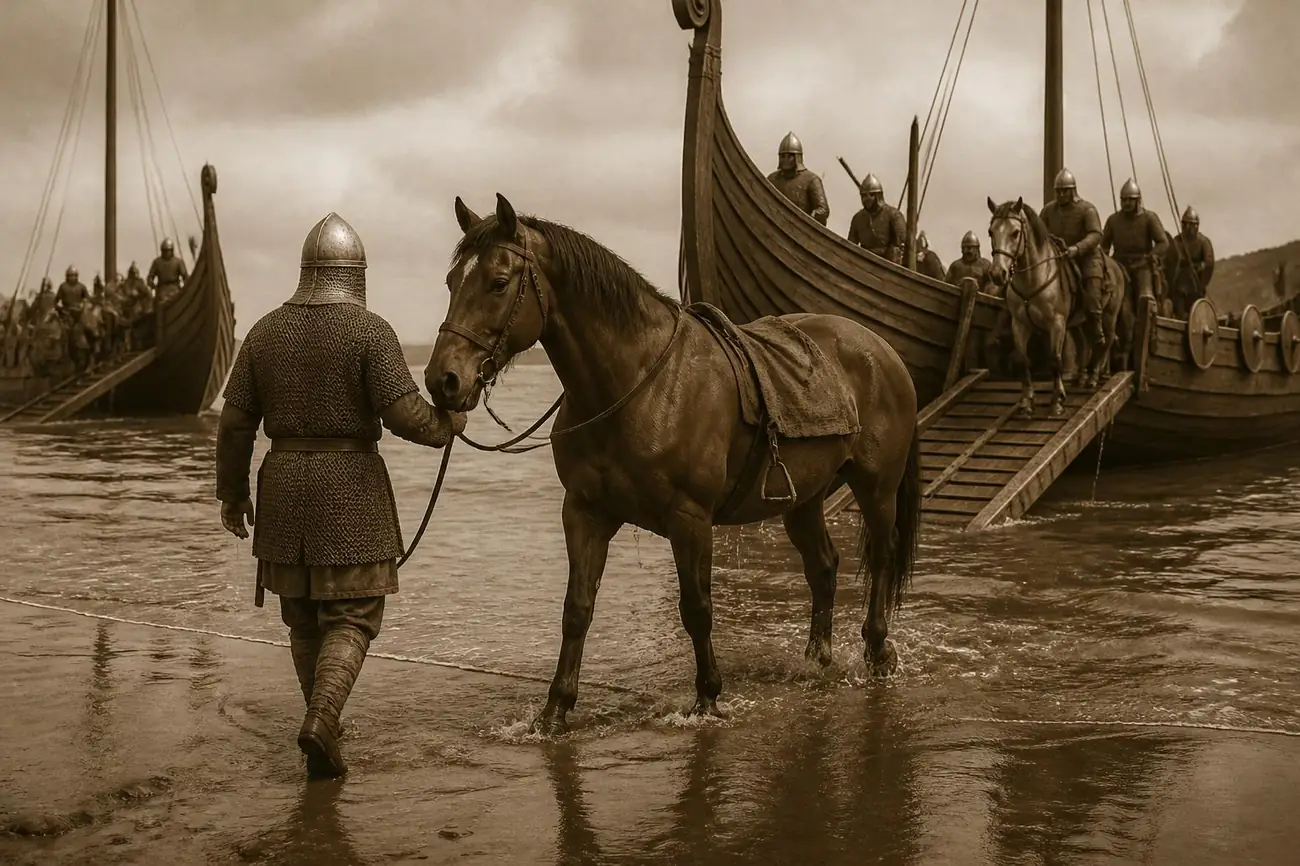
An army of knights without horses is worth nothing. To invade England, William therefore had to ship his mounts across the Channel, aboard vessels built during the summer of 1066. The Bayeux Tapestry preserves the record: it shows horses standing in the boats, then being led ashore on the beach at Pevensey, where the fleet landed on 28 September 1066.
How many were there? No document of the period gives a reliable figure. Military historians put the number at a few thousand horses, which implies purpose-fitted ships, fodder, fresh water and men to keep the animals calm during the crossing. It is one of the earliest large-scale sea transports of horses of which we have a picture.
1087: William the Conqueror’s belly and the ride on Mantes
Twenty years on, William is nearly sixty and has grown very stout. The chronicler Orderic Vitalis describes him as extremely corpulent, his belly spilling over the front of the saddle. He is quarrelling with King Philip I of France over the Vexin, the border country between Normandy and the royal domain.
According to William of Malmesbury, Philip mocked him: the King of England, bedridden at Rouen, was said to be “in childbed”. William supposedly replied that he would attend his churching in Paris, lighting a hundred thousand candles. The reprisal comes on horseback, at the end of summer 1087: he rides into the French Vexin and sets fire to Mantes, churches included.
Mantes in flames: William’s horse shies and the saddle pommel
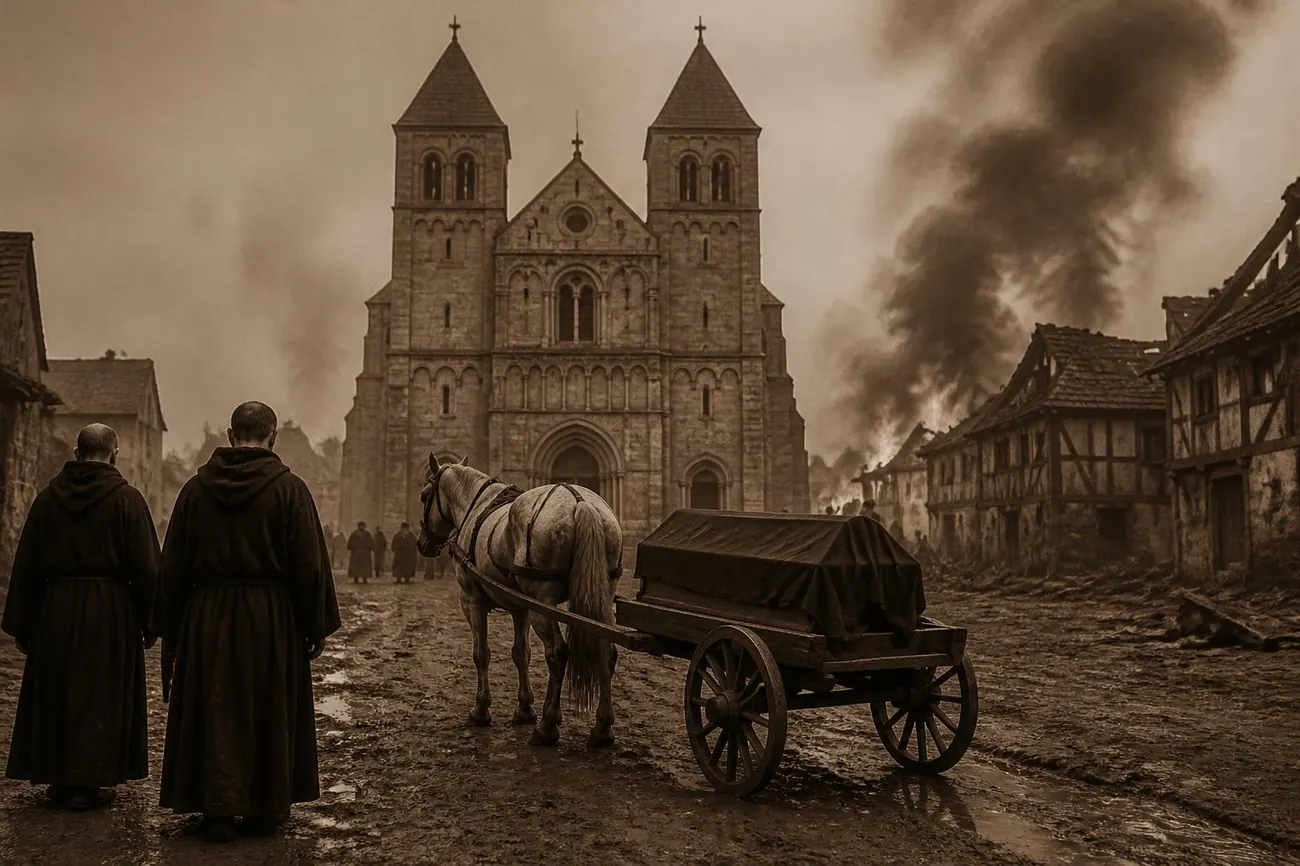
This is where everything turns. Orderic Vitalis gives two versions without choosing between them: either the king rode too close to the heat of the burning town, or his horse jumped a ditch. Tradition has kept a more precise image, that of a horse setting its foot on a still-glowing beam and shying sharply. In either case the result is the same: William is thrown forward, and his belly strikes the pommel of the saddle with great force.
The blow causes an internal injury, which Orderic describes as a rupture of the bowels. The physicians of the day can do nothing. The king is carried back to Rouen, then, because the noise of the city troubles him, to the priory of Saint-Gervais, on a height to the west of the town. Other chroniclers speak rather of heat and exhaustion: the exact cause remains debated, but all of them place the beginning of the end at Mantes.
The death of William the Conqueror at Rouen: the king’s body left almost naked
William dies on the morning of 9 September 1087, after several weeks of agony. What follows is told by Orderic Vitalis with cruel precision. The great men of the realm hurry off to protect their lands. The servants fall on the weapons, the plate, the clothes and the royal linen, and flee. The body of the man who conquered England lies almost naked on the floor of the chamber.
No one in his family takes charge of it. It is a simple local knight, Herluin, who pays out of his own pocket for the embalming and the transport. The body goes down the Seine by boat to the estuary, then travels by road to Caen, where William had asked to be buried.
Caen, Abbaye aux Hommes: why the body of William the Conqueror burst
William had founded the abbey of Saint-Étienne in Caen, the Abbaye aux Hommes, in the mid-1060s. The tomb awaits him there. The procession has not yet arrived when a fire breaks out in the town: the monks who had come out to meet it turn back to put out the blaze, which destroys a large part of Caen.
During the Mass, a townsman named Ascelin, son of Arthur, rises and interrupts the service: the ground where the grave is to be dug belonged to his father, and William took it by force to build the church. The witnesses confirm it. He is paid sixty sous on the spot for the burial place alone, with a promise that the rest will follow.
Then comes the burial itself. The stone sarcophagus has been cut too short, and the body, swollen by several days on the road in late summer, will not fit. The bearers force it. The belly bursts. Orderic writes that an unbearable stench filled the church, that incense could not cope with it, and that the priests rushed through the ceremony before fleeing.
Only a thighbone remains: the tomb of William the Conqueror at Caen
The king found no more peace afterwards. In 1522 the tomb was opened on orders from Rome; the body was found still intact, and a portrait was made of it. Forty years later, in 1562, during the Wars of Religion, Protestants ransacked the abbey and scattered the bones. Only one bone was saved: a thighbone.
The tomb suffered again during the Revolution. The slab seen today in the choir of the abbey church at Caen covers nothing but that thighbone. The conqueror of England, unhorsed three times at Hastings without a scratch, was in the end killed by a shy from his own horse, then reduced to a single bone.
The saddle pommel: what William’s accident says about the medieval saddle
The accident at Mantes is partly explained by the equipment. The war saddles of the eleventh century, the kind seen on the Bayeux Tapestry, have a high fork at the front and a raised cantle at the back. They wedge the rider in place to absorb the shock of a lance charge. The drawback is well known: when the horse stops dead or shies, the rider is pitched forward and meets a piece of hard wood at belly height.
Modern riding saddles have low pommels and shapes designed to free the rider, not to lock him in. To understand how a saddle is chosen today according to discipline and the horse’s conformation, see our guide to the horse saddle: how to choose it and what it costs.
William the Conqueror and the Norman horse, 960 years after Hastings
Normandy remains a great land of horses. This week, the Calvados celebrates the horse in several towns, including Caen, a few streets from the abbey where what is left of the king lies: the programme is in our article on the 2026 Equidays in the Calvados.
William is not the only conqueror whose life a horse cost. The oldest account of the death of Genghis Khan also begins with a fall: Genghis Khan and the horse fall of 1227. And for a war horse who, by contrast, ended his days showered with honours, read the story of Copenhagen, Wellington’s horse at Waterloo.
Established: the Battle of Hastings on 14 October 1066; the burning of Mantes in 1087; William’s death at Rouen on 9 September 1087; his burial at Saint-Étienne in Caen; the desecration of 1562; the present tomb, which holds only a thighbone.
According to the chroniclers: the three horses killed under him at Hastings (William of Poitiers); the injury against the pommel, the abandoned body, Herluin, Ascelin and his sixty sous, the bursting body (Orderic Vitalis, who was writing some fifty years later); Philip I’s taunt (William of Malmesbury).
Debated: the exact cause of the injury (a shy at an ember, the jump of a ditch, or heat and exhaustion according to other texts) and the number of horses shipped in 1066, which is only an estimate.
Sources for the account of William the Conqueror and his horse
Orderic Vitalis, Ecclesiastical History, Book VII; William of Poitiers, Gesta Guillelmi (Hastings); William of Malmesbury, Gesta regum Anglorum; the Bayeux Tapestry (Bayeux Museum); the Abbaye aux Hommes in Caen, historical notice on the tomb of William the Conqueror.