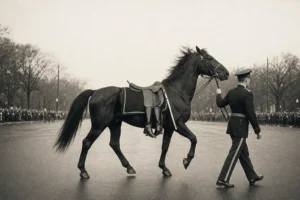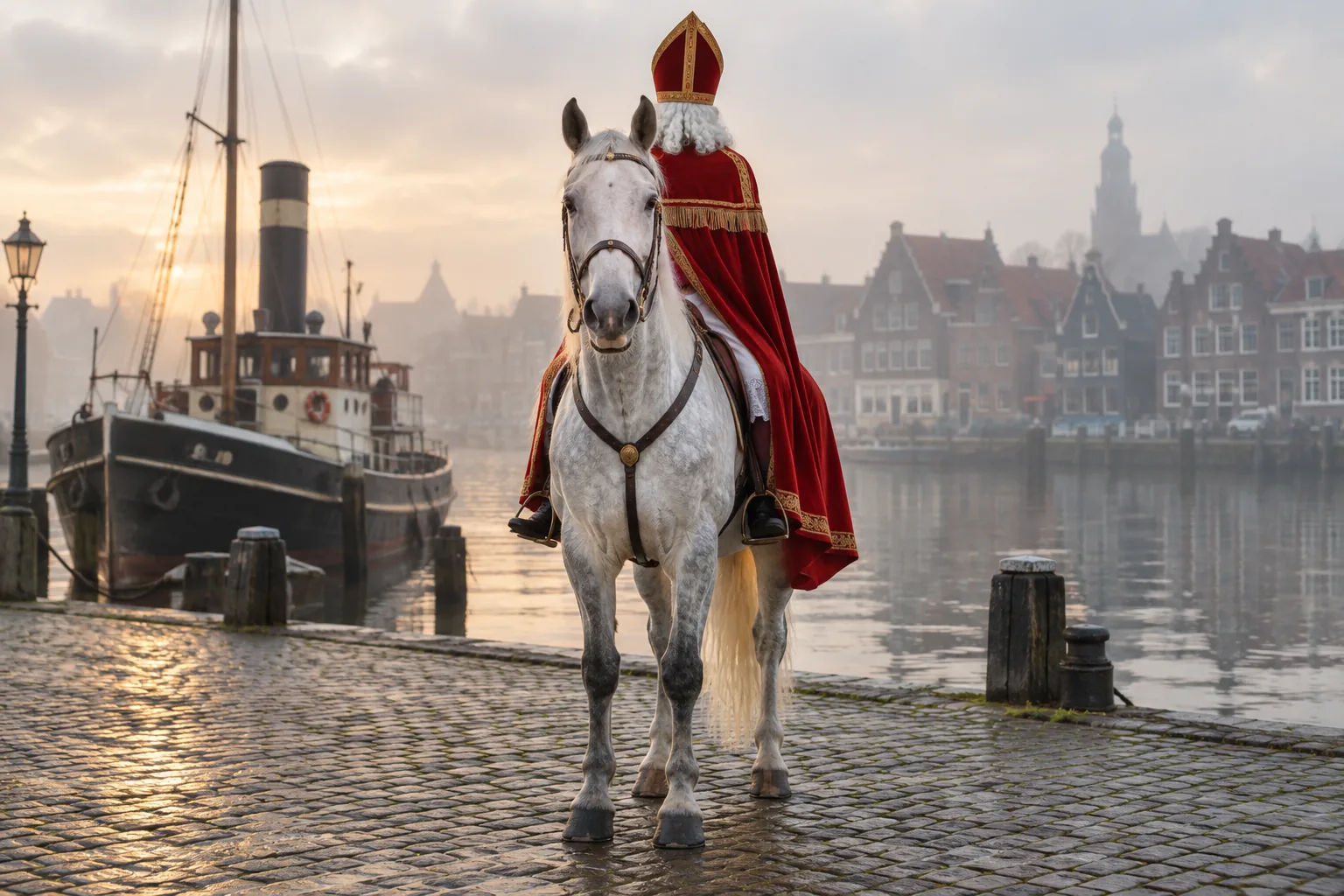

The Netherlands welcomed Saint Nicholas on Saturday 14 November in Grave, a small fortified town in North Brabant. And every year the same question comes up, among children and riders alike: where has Amerigo gone, the Saint’s white horse? The answer comes in two parts. The real Amerigo, a police horse, left the stage in 2010 along with his rider. Then, in 2019, the programme that tells the story of the festival every evening officially retired him, and his replacement turned out to be… black.
Saint Nicholas’s horse expected in Grave on 14 November
In the Netherlands, the Sinterklaas season (the Dutch name for Saint Nicholas) begins with his “intocht”, the national arrival by steamboat, broadcast live on television. This year the choice fell on Grave, in the municipality of Land van Cuijk. It is the first national arrival in Brabant since 2000, when the Saint came ashore at Woudrichem.
The town took the occasion very seriously: according to the regional broadcaster Omroep Brabant, the first episode of the Sinterklaasjournaal, the daily news bulletin devoted to the festival, drew 2.3 million viewers, a record. In neighbouring villages, the programmes invited children to bring drawings, their wish lists… and carrots for the horse. Only those carrots were not for Amerigo.
Amerigo, a police horse named after an explorer
The name dates from 1990. That year, for the national arrival at Elburg, the horse ridden by the Saint was a police horse. He was called Amerigo, after the Florentine explorer Amerigo Vespucci, the man who gave America its name. In the saddle sat the actor Bram van der Vlugt, the Saint Nicholas of an entire generation of Dutch children.
Before him, the mount had changed name almost with every holder of the role. The first television Saint Nicholas, Jan Gajentaan, rode Petra, Bianca and Bionda. His successor Adrie van Oorschot had Schimmel (“the grey”, quite simply) and then Sasmona. Bram van der Vlugt himself rode Juan and Jasper. But it was Amerigo who stuck.
Why Amerigo the horse had to retire
The reason is less romantic than you might imagine: Amerigo left with his rider. When Bram van der Vlugt hung up the mitre in 2010, the police horse stopped too. No injury, no scandal, just a partnership leaving the stage together.
The trouble is that the name itself did not retire. Children wanted Amerigo, so Amerigo carried on… ridden by other horses. For nearly ten years, the Saint’s white horse was a role, not a horse.
The understudies: a mare, a gelding and “Amerigo 2.0”
The Dutch press eventually lifted the veil, often at the saddest moment: when one of them died.
Quadis, introduced in July 2019 as “Quadis, better known as Amerigo”, was in fact a mare. The most famous horse in the Netherlands thus carried a masculine name without anyone taking offence. She had also appeared in an advert for the Dutch postal service and in the film Nova Zembla, before ending her days as a riding-school schoolmaster. She died at 30.
Mentor, a grey gelding from the Muiderberg riding school, played Amerigo for years in the Sinterklaasjournaal and the Saint Nicholas films. He had retired a few years before his death in May 2021, aged 27, from a tumour of the abdominal wall.
Number Seven, nicknamed “Amerigo 2.0”, served as the Saint’s relief horse from 2014. He spent his last three years in a retirement home for horses in Soest, and died at the end of July 2025, aged 30. “We are going to miss him enormously,” wrote the foundation that cared for him.
Thirty years for both Quadis and Number Seven: a fine age for horses who spent their winters amid brass bands and children’s shrieks. A horse past twenty needs closer monitoring (teeth, weight, vaccinations, worming), and that is the kind of schedule that is easier to keep with an online horse health record than with a notebook lost at the bottom of the tack room.
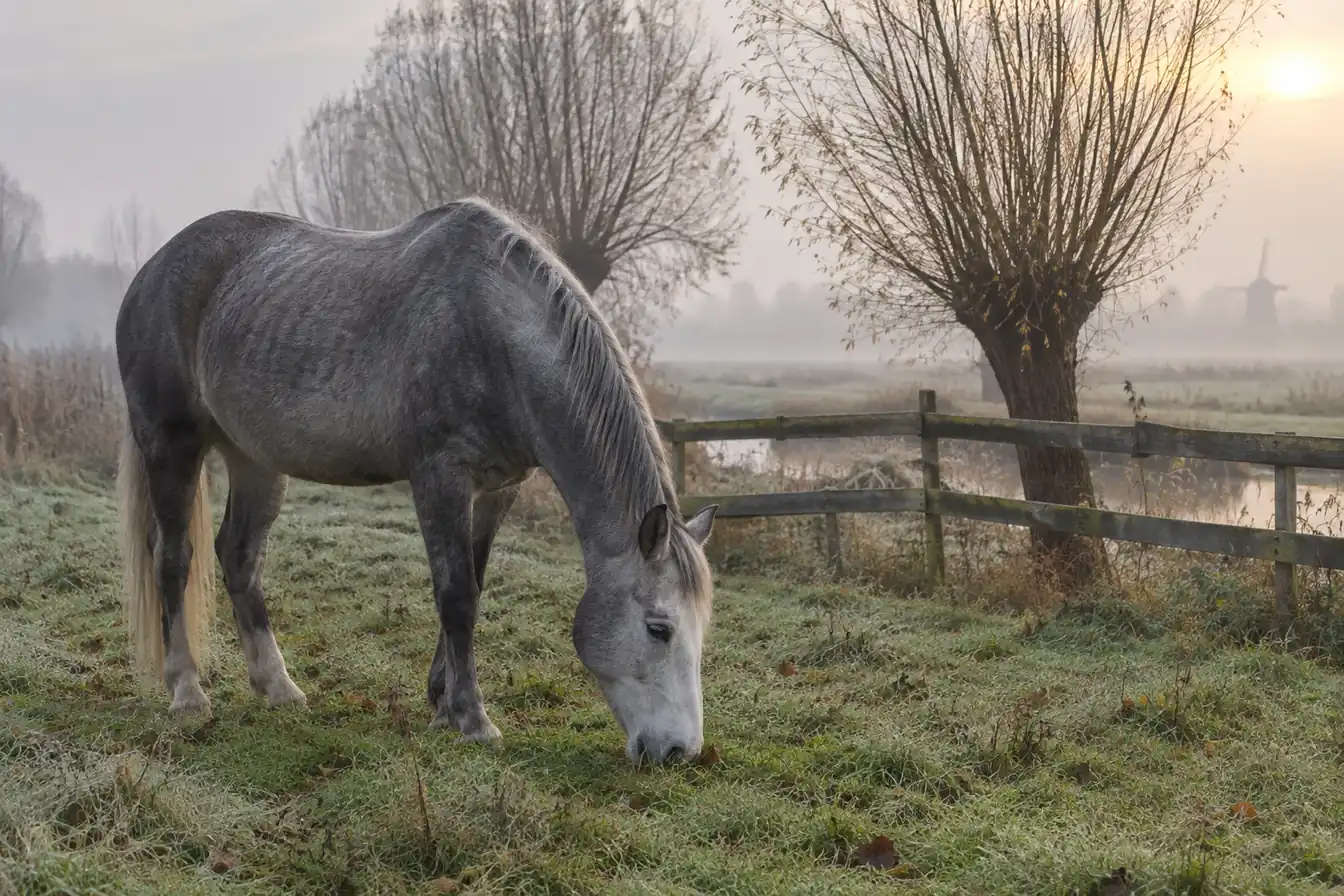
Ozosnel, Saint Nicholas’s new white horse who was actually black
In 2019, the Sinterklaasjournaal decided to close the chapter: in the storyline Amerigo officially retires, and a new horse arrives. He is called Ozosnel, a name pronounced “O zo snel”, “oh, so fast”.
And then came the twist. On 27 November 2019, the programme revealed that the new horse was black. The Paardenpiet, the assistant in charge of the horse, had been painting him white all week, convinced that the Saint’s horse simply had to be white. The paint could not stand water: which is why, that year, Ozosnel was “afraid of cold water”… and why the Saint had arrived by steam train rather than by boat.
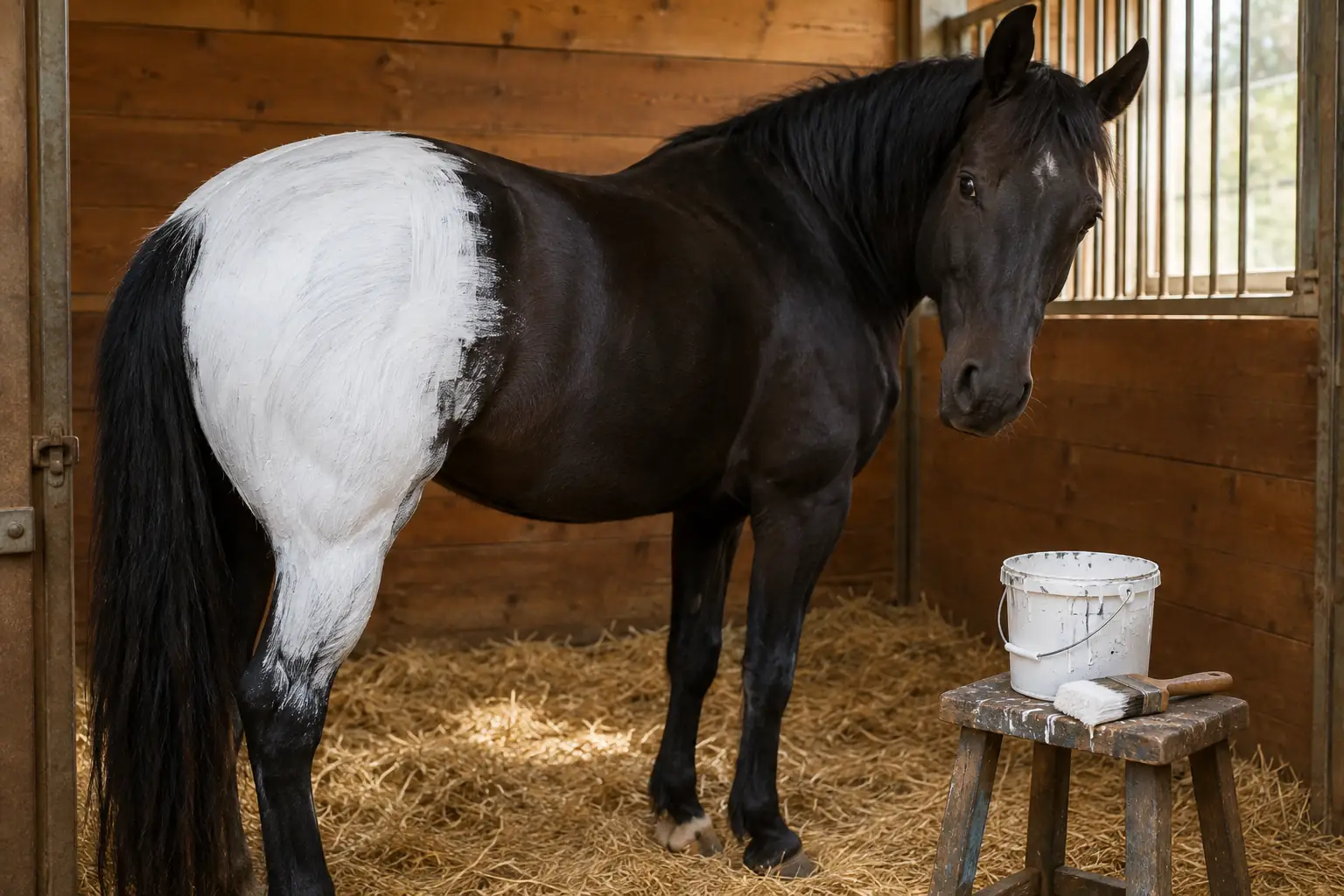
On social media, some hailed a “brilliant twist”. The Dutch press also saw it as a nod to the national debate about the colour of the characters who accompany the Saint. Since then, it is Ozosnel who gets the carrots.
In Belgium, Saint Nicholas’s horse is called “Bad Weather Today”
Across the border, Flemish children know neither Amerigo nor Ozosnel. Their Saint Nicholas rides Slecht-Weer-Vandaag, literally “Bad Weather Today”. The story goes that the Saint asked his assistant the horse’s name, and that the assistant, having misheard the question, answered with a remark about the weather. The name stuck.
A white horse is almost always a grey horse
One detail remains that every rider knows: in equestrian circles, people very rarely speak of a “white” horse. Most white horses are greys that have lightened with age. They are born dark and fade year after year, exactly like Camargue horses, which are born black. The Paardenpiet could have spared himself the paint: all he had to do was wait a few years.
And since, according to legend, Saint Nicholas comes from Spain, his horse could very well have been an Andalusian, a breed with plenty of grey coats.
What we know about Saint Nicholas’s horse, and what we rely on
What we base this on. The facts in this article come from the Dutch press: Hart van Nederland (2019, 2025, 2026), Omroep Brabant (2026), NH Nieuws and the ANP agency (2021), MAX Vandaag (2015). The names of the successive horses, their ages and the dates of their deaths are taken as published at the time they died. What we could not confirm (the exact breed of the horses, the identity of the horse playing Ozosnel on Saturday) is not stated.
Want to test what you know about the other horses that have made history? Take the famous horses quiz.