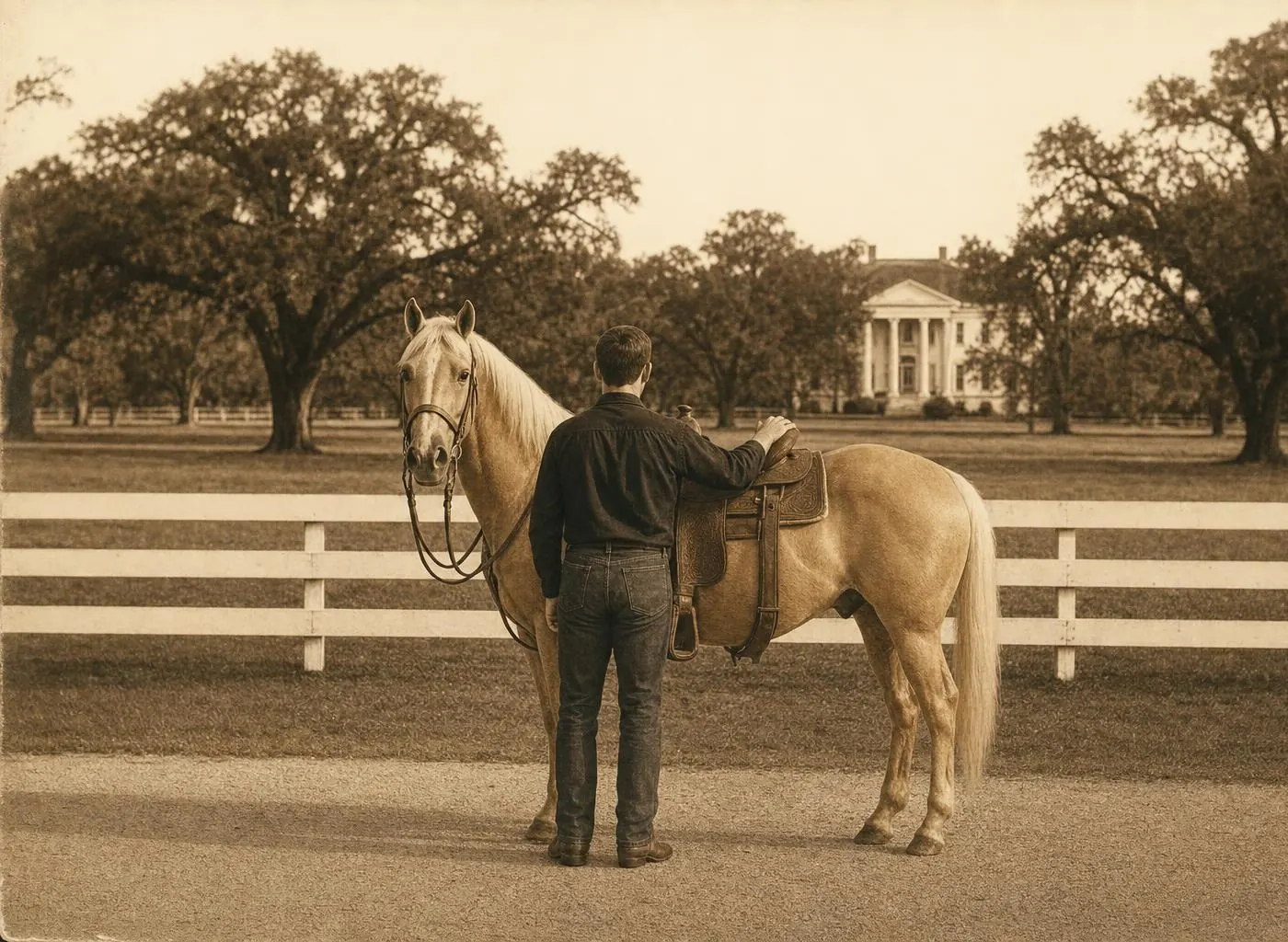

Rising Sun, Elvis Presley’s favourite horse, died in 1986, nine years after the singer. He was buried on the grounds of Graceland, in Memphis, facing east, so that he would always look towards the rising sun that gave him his name. His grave was lined with his blanket and his head was laid on a pillow of hay. No headstone marks the spot. This golden palomino, a quarter horse bought in January 1967, set off a horse craze in Elvis that cost him close to a million dollars in a matter of weeks, and an entire ranch in Mississippi.
Elvis Presley and horses: it all begins with a Christmas present for Priscilla in 1966
In December 1966, Elvis gave a horse to Priscilla Beaulieu, whom he would marry a few months later: Domino, a four-year-old black quarter horse. The present was meant to be a gesture for his fiancée. It became the first horse in a stable that would grow at breakneck speed, because Elvis got caught up in the game himself.
The singer wanted a horse of his own, and he knew exactly which kind: a golden palomino, that gold-coated horse with the near-white mane and tail that the cinema had tied to the cowboys of his childhood. Priscilla described the hunt: “He wanted a golden palomino. He would get up at three in the morning to go and look at certain farms and ranches.” For Elvis, who lived by night and slept by day, the hour was hardly a sacrifice. The stubbornness, however, was.
Video · 117 seconds
Rising Sun, Elvis Presley’s horse buried at Graceland
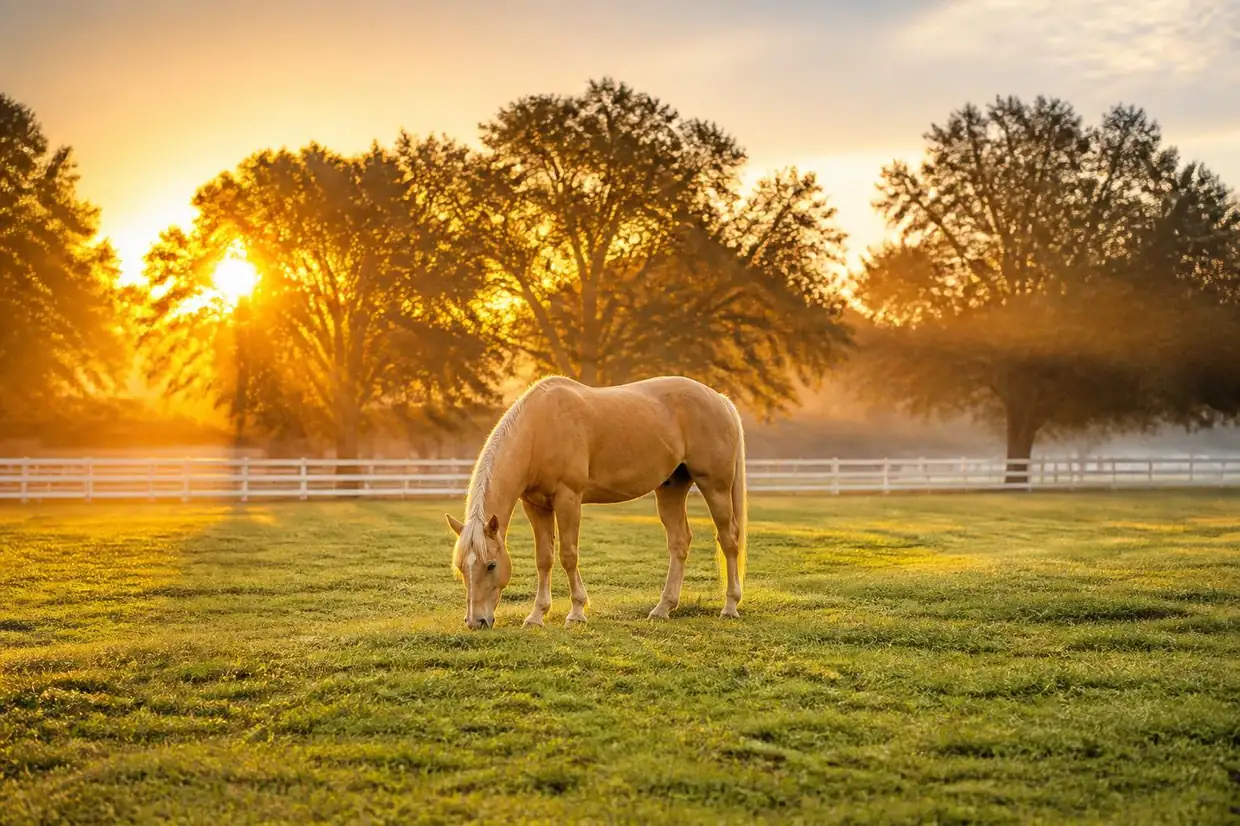
Rising Sun, Elvis Presley’s favourite palomino, bought for $3,000 in 1967, set off a horse craze worth a million dollars. He died in 1986 and lies at Graceland, facing east.

Rising Sun, the palomino quarter horse Elvis Presley bought for $3,000
He found him a stone’s throw from Memphis, in a stable in Hernando, Mississippi. According to the magazine of the American Quarter Horse Association (AQHA), the sale was concluded on 5 January 1967: $2,500, plus $500 in fees, for a palomino foaled in 1961 and registered as Midget’s Vandy. The horse had been shown in western pleasure, a western riding class in which calmness and evenness of gait are judged.
Elvis renamed him Rising Sun at once. The Graceland stable took the name House of the Rising Sun, the same title as the song popularised by the Animals in 1964. In almost every photograph of Elvis on horseback over the following years, this is the horse he is riding.
Circle G: Elvis’s horse ranch, close to a million dollars in a few weeks
One horse leads to another. Elvis wanted his circle to ride with him, so he bought horses for his friends, their wives and his father, Vernon. The few acres of Graceland were no longer enough. In February 1967 he bought a breeding ranch in Horn Lake, Mississippi, about fifteen miles (24 km) south of his home: roughly 160 acres (some 65 hectares), for $437,000 including the house, the cattle and the equipment. He renamed it Circle G, the G standing for Graceland.
On 8 February 1967 he drove out of a garage in Senatobia with three brand-new GMC pickups, then handed out more. He set up mobile homes so that his entourage could live on site. A witness from the period, quoted by the reference site Elvis Australia, sums it up: “Almost every day, we’d go off to buy another horse. Elvis spent close to a million dollars in a few weeks.” Memphis magazine gives the same order of magnitude. On 1 May 1967, Elvis married Priscilla in Las Vegas, and the couple spent their first weeks together at Circle G. The ranch was sold in 1969: the fever had passed, and his favourite horses went back to Graceland.
At Graceland, Elvis Presley rode Rising Sun to the gates, in front of the fans
In Memphis, Rising Sun became a character. Elvis rode him in western dress, sometimes down to the gates of Graceland to greet the admirers crowding the boulevard, then set off again at full gallop for the stable. The show stopped at the stall door. Priscilla recalled that after a hard ride, Elvis would walk his horse three times longer than necessary, to be certain he had properly recovered, and that he unsaddled him himself.
Alene Alexander, hired at Graceland in 1978 and later put in charge of the stables, gave the key to this passion: the stable was one of the few places where Elvis did not have to be Elvis the performer. Jerry Schilling, one of his closest friends, also remembered his fondness for Tennessee Walking Horses, the gaited horses whose “whole way of going” he loved.
Why Rising Sun is buried facing east at Graceland
Elvis died on 16 August 1977. His horses stayed on at Graceland, well cared for, and when the estate opened to the public on 7 June 1982, visitors found them out in the paddock. Rising Sun lived on for another nine years. He died in 1986, of kidney failure according to the AQHA. The Graceland staff decided to bury him on the estate, facing east: “That way, he is always facing the rising sun.” His grave was lined with his blanket, and his head rested on a pillow of hay. The location is known, but it is not pointed out to visitors.
Elvis Presley Enterprises then launched a nationwide search for a palomino of the same colour, and found one in a distant relation of Rising Sun: he would be called Sun’s Reflection. Since then Graceland has kept to one rule: there will always be a palomino in the stable, in tribute to Elvis’s horse. The last horse the singer bought himself, Ebony’s Double, a Tennessee Walking Horse acquired in 1975, died on 14 January 2005, at almost 32.
- The horse’s papers: the registered name (Midget’s Vandy), the year of birth and the bill of sale are worth more than the nickname the star gave him.
- Direct witnesses: Priscilla Presley, Jerry Schilling and Graceland’s stable manager saw the horse and his rider; the biographers did not.
- Cross-checked figures: the price of the ranch and the million dollars spent in a few weeks appear in several independent sources.
- The rider’s behaviour: cooling the horse out after work and unsaddling him by hand say more about a relationship with a horse than a publicity photograph.
- What remains unclear: when two sources disagree on a date or an age, we say so rather than choosing the prettier version.
What we still do not know about Elvis Presley’s horse
Several details remain stubborn. The year of Rising Sun’s death is given as 1986 by the AQHA and by the Elvis fan sites, but one online memorial says 1987. His age varies too: foaled in 1961 according to his registration, he would have been 25, while other accounts make him 21. The number of horses gathered at Circle G ranges from about twenty to forty depending on the witness. And the exact location of the grave, known to the staff, has never been made public. The rest stands: a palomino bought for $3,000, a singer who went looking for him at three in the morning, and a grave turned towards the rising sun.
Rising Sun belonged to the most widespread breed in the world: to understand this fast, calm and compact horse, read our profile of the Quarter Horse. His golden coat follows its own genetic rules, explained in our advice piece on cremello, palomino and their genetics. And if the idea of riding like Elvis appeals, our guide to western riding sets out the disciplines, and our comparison of the western saddle helps you choose your kit. Another star has made the horse a refuge: Kendji Girac and his Andalusian horse.
America’s Horse, magazine of the American Quarter Horse Association, “Quarter Horses for the King” (August 2019); Elvis Australia, “Rising Sun and other horses at Graceland”; Memphis Magazine, “Home on the Circle G Ranch”; Horse Illustrated, “The Horses of Graceland”; History on Horseback, “All the King’s Horses” (2013); Elvis Information Network, on the death of Ebony’s Double (2005).