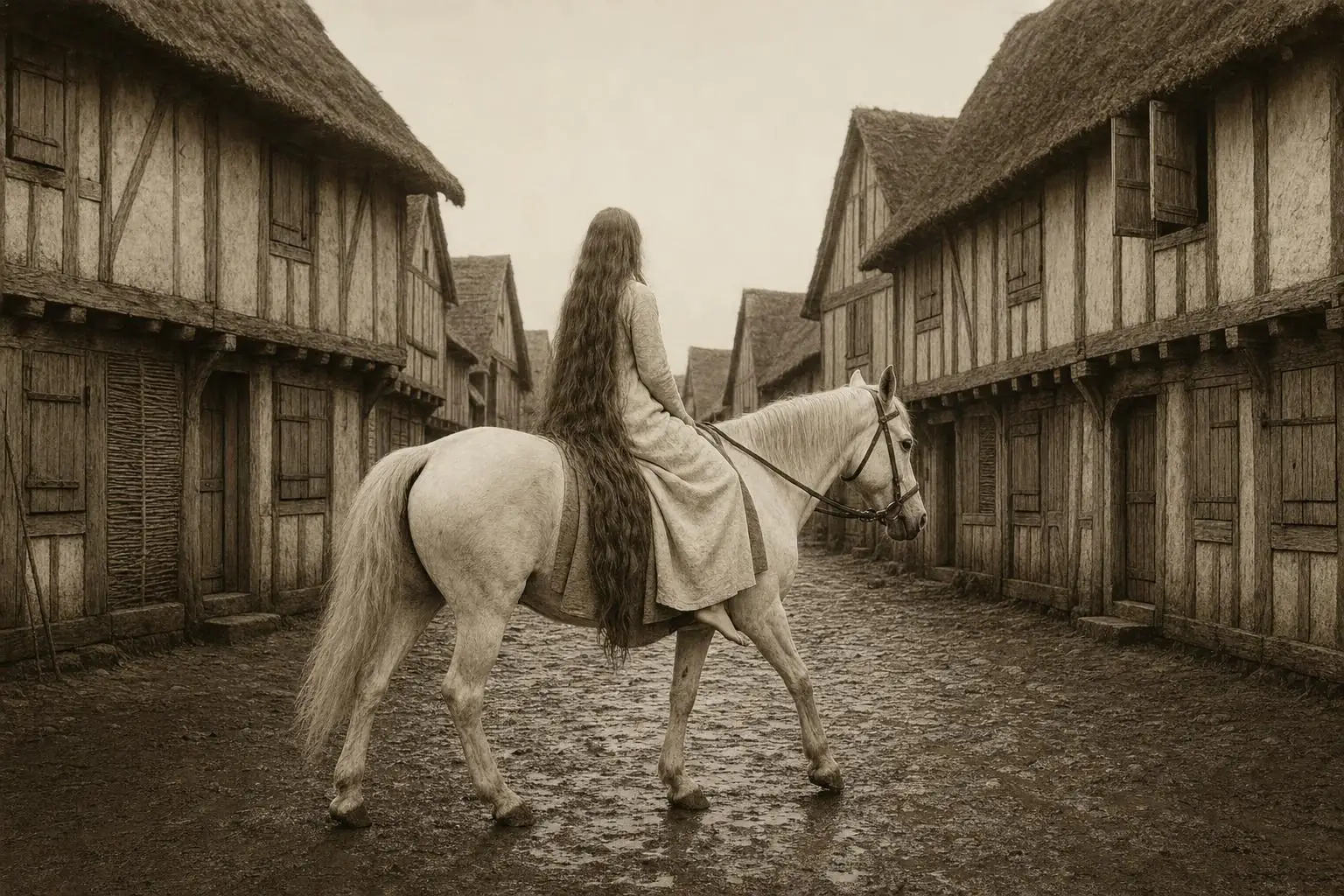

According to legend, Lady Godiva rode through Coventry on horseback, naked and covered only by her hair, to persuade her husband to abolish the taxes crushing the town. He kept his word. Almost: in the fourteenth-century version, he frees Coventry from all tolls except one, the toll on horses. That detail is no storyteller’s whim. A document from 1280 describes exactly the same exception. The chronology explains why the horse toll outlived the most famous ride in history, and why nobody in Godiva’s own lifetime ever told of that ride.
Lady Godiva and her horse: what the Coventry legend says
The first written account dates from the thirteenth century. It appears in the Flores Historiarum, the “Flowers of History”, a chronicle compiled by Roger of Wendover, a monk of St Albans Abbey who died in 1236. The story takes only a few lines. Countess Godiva begs her husband, Leofric, Earl of Mercia, to lighten the taxes weighing on Coventry. He refuses, then dares her: he will yield if she rides through the town on horseback, naked, in front of everyone.
She accepts. She loosens her hair, which covers her like a cloak, mounts her horse and crosses the marketplace from end to end, accompanied by only two riders. According to Wendover, no one sees anything of her but her legs, “very white”. Leofric, struck by her courage, keeps his promise and frees the town from its taxes.
In this first version there are no shuttered windows, no peeping onlooker and no horse toll. Those three elements arrive later, each in its own century.
Video · 104 seconds
Lady Godiva on horseback: why the only tax kept was the horse toll
All but one: the toll on horses, which a document of 1280 confirms. What the sources say.

The one tax Coventry kept: the toll on horses
In the fourteenth century another monk takes up the tale. Ranulf Higden, a Benedictine of Chester who died in 1364, folds it into his great universal chronicle, the Polychronicon. He specifies that the ride takes place in the morning, through the middle of the town, and above all he changes the reward. Leofric no longer abolishes every tax: he frees Coventry from all tolls except the one on horses.
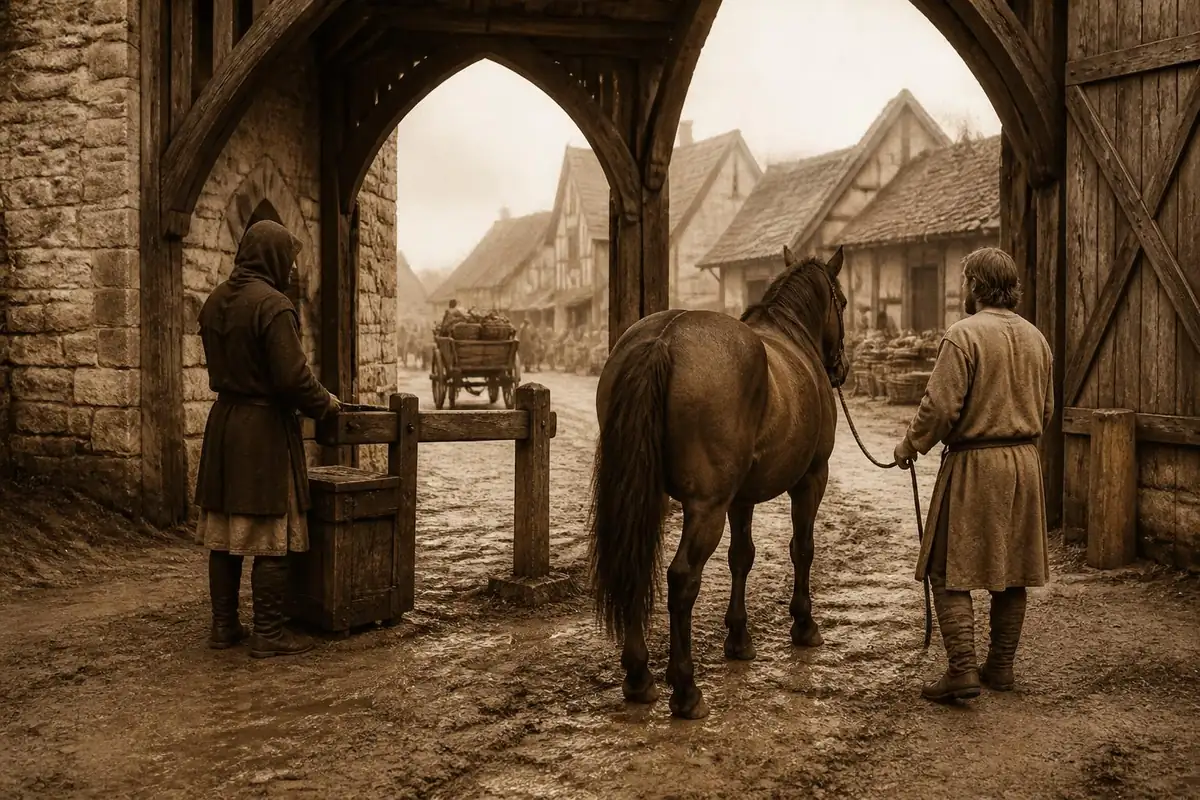
A toll, in the Middle Ages, is the sum paid to bring goods into a town or to sell them at market. Grain, wool, livestock, and horses. For a trading town like Coventry, growing fast in the twelfth and thirteenth centuries, it was a considerable source of income, and a heavy burden on the farmers of the surrounding countryside who came to sell their animals.
Why the horse toll outlived Lady Godiva’s ride
The answer lies in the town’s archives. The history of Coventry published by the Victoria County History, the great English local-history series, points to a document of 1280: at that date the town is exempt from tolls, with the exception of the toll on horses. It is the exact exception that Higden would attribute, a few decades later, to Earl Leofric’s generosity.
Let us set the dates in order. Wendover, in the early thirteenth century, mentions no exception at all. In 1280 the exemption, with its reservation on horses, is an administrative fact on record. In the fourteenth century Higden’s version explains that reservation through the legend. The simplest reading, and it is ours, is that the story adjusted itself to the reality it claimed to explain: the people of Coventry were still paying for their horses, so the earl must have meant it that way. A founding legend also serves this purpose, justifying the order of things.
Why horses, specifically? No source from the period says. We can only note that horses were an expensive commodity at the markets and fairs of medieval England, and therefore a toll that paid well. And a toll that pays well is a toll a lord holds on to. The gap in the story is filled by taxation, not by morality: Godiva’s ride would have won everything except what earned the most.
Did Lady Godiva really ride through Coventry?
The woman existed. She was called Godgifu, “God’s gift” in Old English, Godiva being the Latin form of the name. Wife of Leofric, one of the most powerful men in pre-Conquest England, she founded a richly endowed Benedictine monastery at Coventry with him in 1043. Leofric died in 1057. Godiva outlived him and died between 1066 and 1086.
The Domesday Book, the great survey of landholdings ordered by William the Conqueror in 1085, mentions her: she is one of the few Anglo-Saxons to have kept large estates after the Conquest, and the only woman to do so. A pious, wealthy noblewoman, very present in the records. And in none of those records, no chronicle of her day, no charter, is there any mention of a ride.
That is the other silence in the file: between Godiva’s death and Wendover’s account, roughly a century and a half goes by. Modern historians do not consider the story plausible as told. One hypothesis comes up often: Godiva may have crossed the town as a penitent, in a plain shift, barefoot and without her jewels, which for an eleventh-century countess amounted to appearing “stripped” in public. The Latin word would have done the rest. It is a hypothesis, not an established fact.
Peeping Tom, the clock and the chocolates: the afterlife of Lady Godiva’s white horse
The legend keeps growing after that. In the late fourteenth century a stained-glass window in Holy Trinity church, Coventry, shows Leofric and Godiva, and a small figure of a woman on a white horse, a branch in her hand. The white horse will never leave the story again.
On 31 May 1678 the town creates a Godiva procession for its great fair: the son of James Swinnerton plays the countess, and a medal is struck for the occasion. Around 1690 a traveller notices at a window the statue of an old man looking out, “in memory of one who looked out there”. The name Peeping Tom does not appear in the town accounts until 1773, in connection with a wig and paint bought for the effigy. In the version that became classic, Tom, a tailor, is the only one to have bored a hole in his shutter to watch the countess pass, and he is struck blind for it. The character therefore turns up more than seven centuries after the supposed events.
Then come Tennyson’s poem “Godiva” in 1842, John Collier’s painting in 1897, now in the Herbert Art Gallery and Museum in Coventry, William Reid Dick’s statue “Self Sacrifice”, unveiled in Broadgate square in 1949, and the Broadgate clock installed in 1953: every hour, Godiva rides past on her horse and Tom leans out of his window. Three years later, in 1956, a Brussels chocolatier, Joseph Draps, is looking for a name for his brand. His wife Gabrielle suggests the countess’s. The logo has since shown a long-haired rider on her horse.
Lady Godiva’s horse: palfrey, white horse or grey?
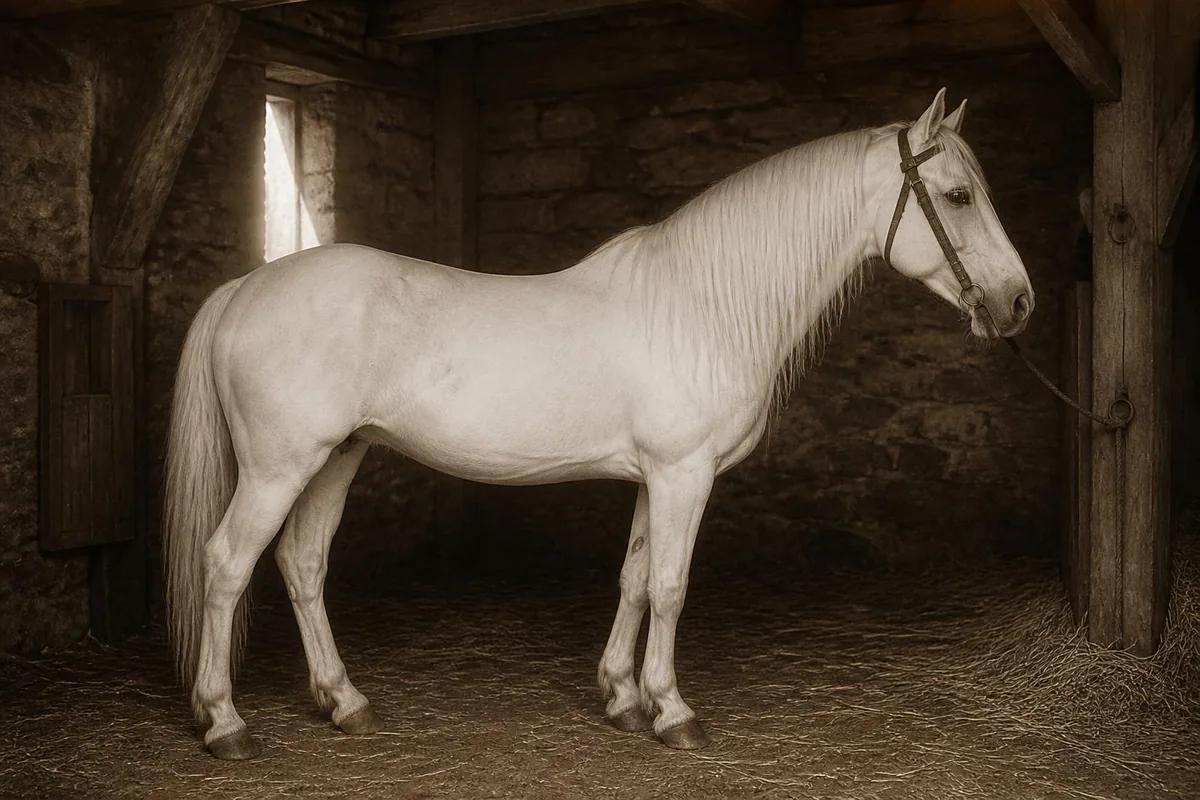
No early text describes Godiva’s horse. Not its colour, nor its breed, nor its name. But we do know what a lady of her rank rode. In the Middle Ages the nobility distinguished the destrier, the war horse, from the palfrey, the horse for travel and parade. The palfrey was often a horse that ambled or used a similar gait, a quick four-beat walk in which the two legs on the same side move almost together. For the rider the advantage is enormous: no jolting, and you can sit comfortably for hours. It was the mount of ladies, prelates and elderly lords.
These “marching” gaits have not disappeared. The Icelandic horse has kept one, the tölt, which gives the feeling of sitting in an armchair, and our profile of the Icelandic horse, its five gaits and the tölt explains how they work.
As for the white horse of the windows and paintings, it raises a question many riders ask: the horses we call white are, in the vast majority, greys, born dark and turning pale with age. A true white from birth is rare. Our guide to horse coat colours, and how to identify them all, sets out the difference.
The horse toll is gone, the cost of a horse is not
No one pays to bring a horse into Coventry any more. But Leofric’s old intuition still holds: a horse costs money, and often more than you imagine when you buy one. Livery, feed, farrier, vet, and the accident you had not planned for. Before you take the plunge, take stock with our quiz to estimate the real budget of a horse, compare the rates of horse livery yards near you, and see what horse and rider insurance, compared side by side, really covers: today it is the item that protects you from the genuinely nasty surprise.
And if eleventh-century England interests you, the king who had the Domesday Book drawn up, in which Godiva appears, has a horse story of his own, and it ends badly: William the Conqueror, injured by his horse at Mantes.
Established: the existence of Godgifu, wife of Leofric, Earl of Mercia; the founding of the Coventry monastery in 1043; Leofric’s death in 1057; her mention in the Domesday Book; the first account of the ride in Roger of Wendover (died 1236); Ranulf Higden’s version (died 1364) with the exception of the horse toll; the document of 1280 describing the same exception; the Holy Trinity window in the late fourteenth century; the procession of 31 May 1678; the first mention of Peeping Tom in the town accounts in 1773; Tennyson’s poem (1842), Collier’s painting (1897), the Broadgate statue (1949), the clock (1953) and the Draps family’s choice of the name Godiva in 1956.
According to the sources, with variations: the date of Godiva’s death (between 1066 and 1086), her burial place (Coventry or Evesham depending on the author), the details of the accounts (two knights or two soldiers, loosened hair, visible legs) and the version of Peeping Tom’s fate, struck blind or killed depending on the telling.
Uncertain or interpreted: whether the ride really happened, which historians do not consider plausible as told; the hypothesis of a crossing as a penitent, in a shift; the link between the 1280 document and Higden’s version, which is our reading of the chronology; the type of horse Godiva rode, of which no early text speaks.
Sources for the account of Lady Godiva and her horse in Coventry
Victoria County History, “A History of the County of Warwick”, vol. 8, “The City of Coventry: Godiva” (British History Online); Roger of Wendover, Flores Historiarum; Ranulf Higden, Polychronicon; “Lady Godiva” entry (English Wikipedia), with references to the Oxford Dictionary of National Biography; History Cooperative, “Lady Godiva: who was she and what’s the truth behind her ride”; “Godiva Chocolatier” entry (English Wikipedia) and the brand history published by the company.