
From Friday 9 to Sunday 11 October, the Horse and Donkey Centre (Pôle du Cheval et de l’Âne) at Lignières and La Celle-Condé, in the Cher département, hosts the Grande Semaine d’Endurance, the national finals for 4, 5 and 6-year-old endurance horses run by the Société Hippique Française (SHF). Distances are 25, 37, 50 or 62 miles (40, 60, 80 or 100 km). And the rule that surprises every newcomer fits in a single line of the rulebook: in a final, a horse that exceeds the maximum track speed, even by a whisker, finishes unplaced.
Endurance Grand Week 2026: three days of finals for young horses aged 4 to 6
The Grande Semaine d’Endurance is the end-of-season showpiece of the SHF young horse circuit. All year long, 4, 5 and 6-year-olds contest regional rides; those that collect enough placings qualify for the final of their age group. Still staged at Uzès, in the Gard, as recently as 2023, the event now takes place in the countryside of Berry, on the tracks of Lignières and La Celle-Condé.
Five finals are on the programme, split across two cycles:
- Free cycle: 4-year-olds over 25 miles (40 km), 5-year-olds over 37 miles (60 km), 6-year-olds over 50 miles (80 km).
- Classic cycle, more demanding: 5-year-olds over 50 miles (80 km), 6-year-olds over 62 miles (100 km). Horses are also scored here on conformation and paces.
There is also a one-star international ride (CEI*) over 62 miles (100 km), open to all but with priority given to 6-year-olds. The 2026 rulebook shows how high the bar is set: for the 6-year-old final over 62 miles (100 km), a horse needs at least two SHF placings during the season, one of them over 50 miles (80 km) or more, and no more than two eliminations or retirements. The SHF describes the Arabian and the part-bred Arabian as “the king of the discipline”, and the entries follow the letter of the birth year: K for 2020, L for 2021, M for 2022.
Video · 120 seconds
Endurance Grand Week 2026 at Lignières: a young horse that runs too fast will not be placed
Capped speed, a heart rate of 64 beats, a conformation score: the rules that decide the result.

Why a young endurance horse that goes too fast is not placed at Lignières
You might picture endurance as a distance race that the fastest wins. For young horses, the SHF has built the opposite: a ride where speed is capped to protect them. The national finals are run at “regulated speed”, with a track speed window of 7.5 to 9.3 or 10 mph (12 to 15 or 16 km/h) depending on the class.
The 2026 rulebook leaves no room for doubt: “No tolerance for exceeding the limit is permitted.” A pair that goes over the maximum track speed may complete the course and keeps its qualification if it passes the final veterinary inspection, but it is recorded as “finished, unplaced”. Conversely, a pair that is too slow, below the minimum speed, is eliminated. In regional rides a tolerance of 0.3 mph (0.5 km/h) exists; in the final, it disappears.
In practice, at 9.3 mph (15 km/h) on average, 25 miles (40 km) take 2 hours 40 minutes; at 10 mph (16 km/h), the 62 miles (100 km) of the 6-year-olds demand at least 6 hours 15 minutes in the saddle. The rider cannot “make it up” with a sprint at the end, since going over the limit is penalised. Nor can they walk in to settle their horse: the last section of each loop, flagged in the final kilometre (0.6 mile), must be ridden at a trot or canter, moving forward. A pair that fails to do so also finishes unplaced.
The clock keeps running for endurance horses until the vet check
If speed is capped, how are the horses separated? By what the rulebook calls the “entry time” at the veterinary inspection. The ranking adds together the time spent on the track and the time taken, at the end of each loop, to enter the inspection, final inspection included. The winner is the horse with the shortest combined time.
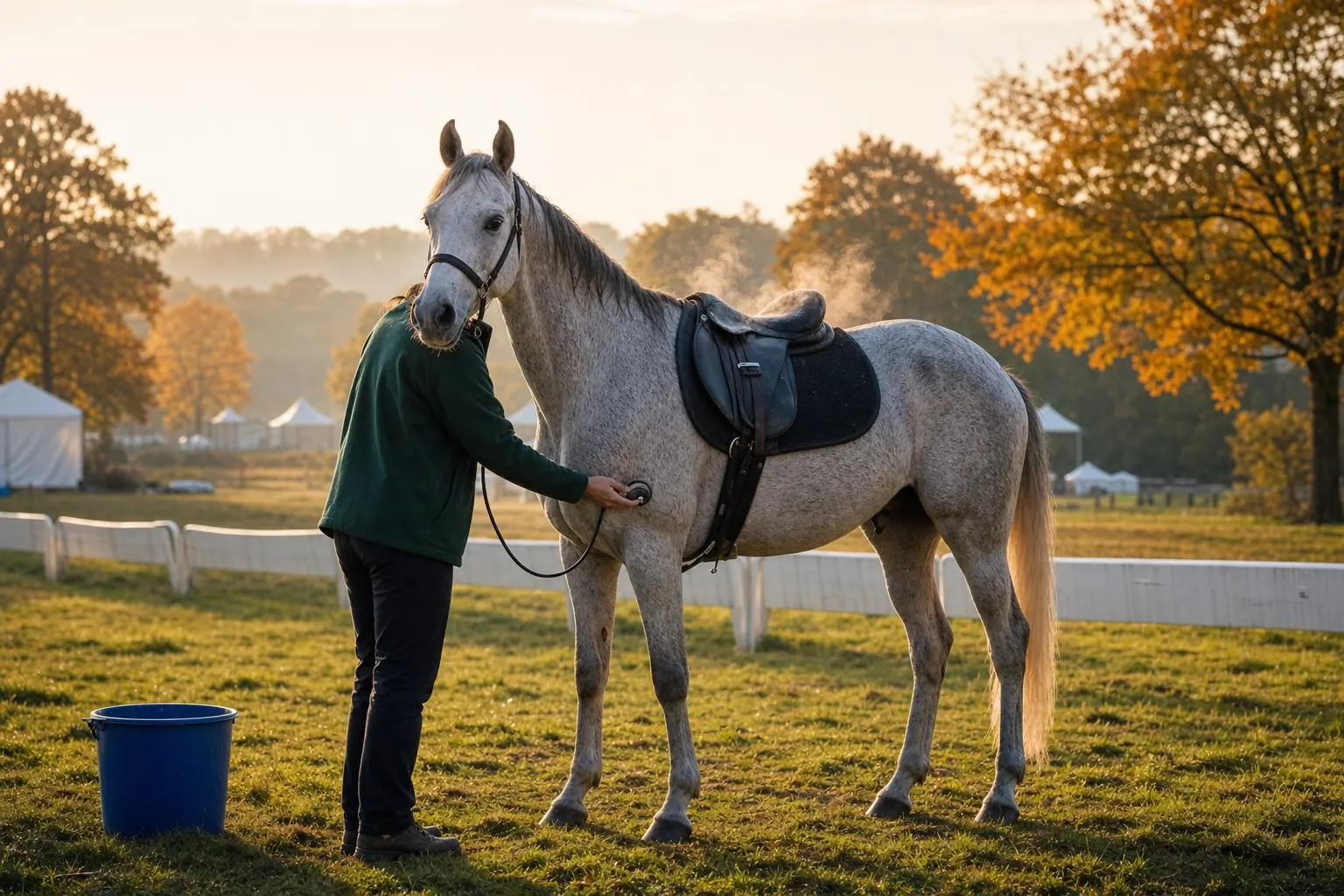
But a horse can only enter the inspection once its heart has come down: the heart rate must be 64 beats per minute or lower, within 15 minutes of finishing an intermediate loop and within 20 minutes of the final finish. A horse that recovers quickly therefore saves its rider precious minutes. That is the whole job of the crew in the grooming area: water, cooling, calm. The rule on numbers is strict: one helper per rider in that area, and only one person, helper or rider, in the veterinary area.
At an intermediate inspection a horse may be presented twice; at the final inspection, only once. Any heart rate above 64 must be rechecked by an official vet before an elimination, and the final trot-up is judged by a panel of three vets, each voting independently. Between loops the horses take a 40-minute rest, up to 50 minutes on the second break of the 62-mile (100 km) ride, which is run in three loops.
The same principle applies, in another form, in the regional rides that lead to the final. Under “imposed speed”, performance is calculated with a formula that puts the heart rate on the bottom line: ((speed x 2) minus minimum speed) x 100, divided by the final heart rate, with speeds in km/h. At 15 km/h (9.3 mph) on a ride with a 12 km/h (7.5 mph) minimum, a horse at 50 beats scores 36 points; the same horse at 60 beats scores only 30.
- Staying within the speed window: too fast and the horse is unplaced; too slow and it is eliminated.
- Heart rate recovery: 64 beats per minute at most to pass each inspection, and the time taken to enter is added to the clock.
- The horse’s condition at every loop: metabolism, lameness, trot-up judged by the vets.
- A forward finish to each loop: a trot or canter is compulsory in the last section, on pain of being unplaced.
- In the classic cycle, conformation, paces and canter: a mark out of 20 that takes 5 seconds off the ride time for every point.
- For 6-year-olds over 62 miles (100 km), weight: a minimum of 154 lb (70 kg) for the rider with equipment.
Conformation, paces, canter: the score that takes seconds off an endurance horse’s time
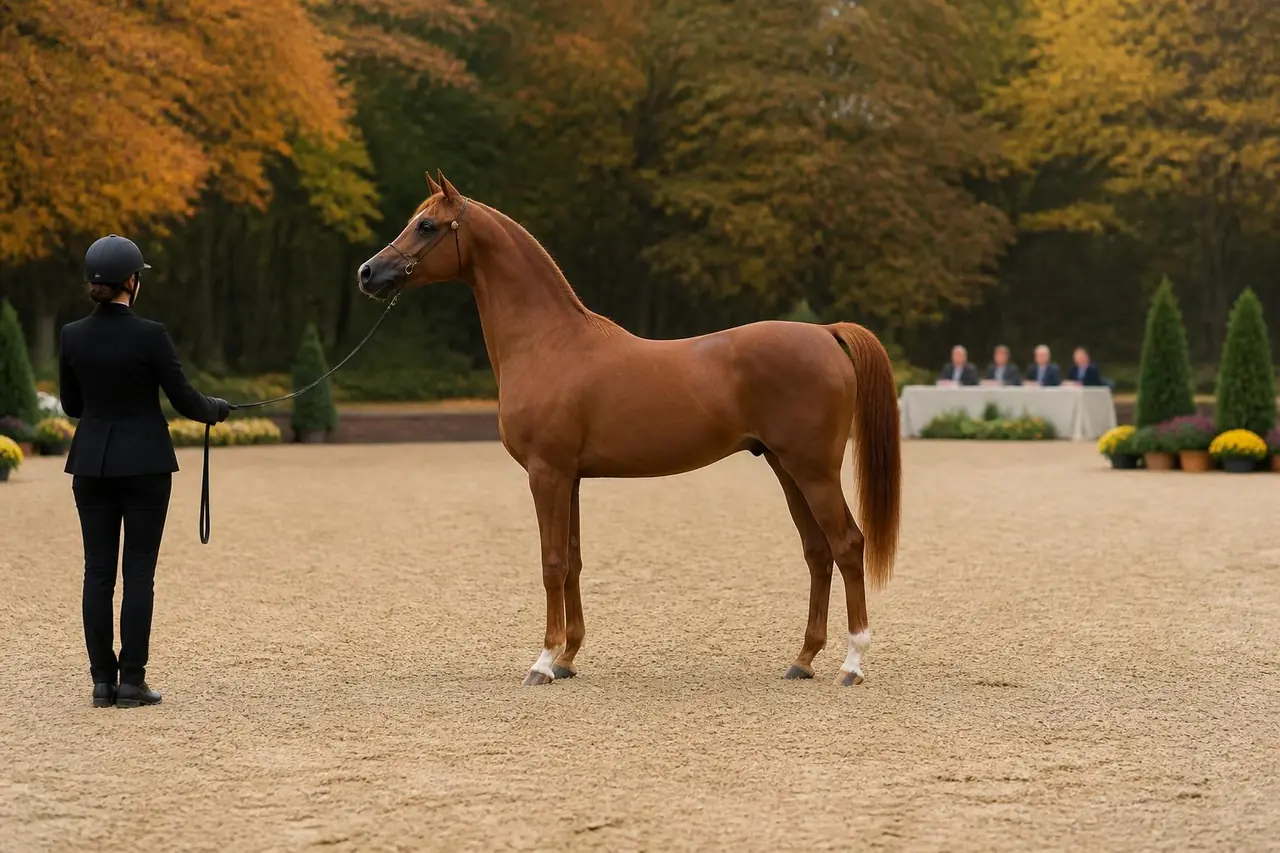
In the classic cycle, the final is not just a ride. Each horse also goes before a breeding jury, in three tests. Conformation and paces are judged in hand, on foot, in the arena; the canter test is judged ridden, during the ride itself. The rulebook sets the weight of each test: 25% for conformation, 35% for walk and trot, 40% for canter.
The SHF scoring grid shows what is sought in an endurance horse: an expressive head with a fine throat-latch, a long neck, a taut back, limbs with sound joints, feet that are “medium-sized and very symmetrical”, and straight limb alignment. The limbs count double. In the paces, the judges want a supple, ground-covering walk without exaggeration, and a trot and canter with a “rather horizontal” balance, plenty of drive and lightness.
This mark out of 20 is then converted into time: each point takes 5 seconds off the ride time. The rulebook gives the example of a horse scored 17 out of 20, whose time is cut by 85 seconds; a 20 out of 20 would be worth 100. The organiser is open about the aim: to let breeders compare their horses against precise criteria and improve the bloodlines of tomorrow.
A 154 lb (70 kg) minimum: the weight rule for 6-year-olds in the classic endurance final
One last rule applies only to the classic final for 6-year-olds over 62 miles (100 km): weight. The rider, in competition dress, with equipment and tack but without the bridle, must weigh at least 154 lb (70 kg). Lighter riders make up the difference with a weighted pad, a gel pad or a weighted saddle, and must declare their weight with and without the extra load.
Weighing is compulsory before the start, and an official may ask for another during the ride. Below 152 lb (69 kg), the pair is disqualified. Between 152 and 154 lb (69 and 69.9 kg), it finishes unplaced.
What changes in 2026 at Lignières: a black loop, GPS tracking and online horse auctions
The SHF has announced several new features for this edition:
- Two rides per day and a new loop, christened the black loop.
- Three loops instead of four for the 6-year-old final over 62 miles (100 km) and for the CEI*. Six-year-olds riding their first CEI* must do so at 10 mph (16 km/h), as in the final.
- A GPS tracker on every horse, so the ride can be followed live from the organiser’s tracking page.
- An online auction, held for the first time with the Yamamah app: final horses entered in the sale are flagged there, and bidding starts at the end of each ride.
On the breeding side, the 2026 best endurance breeder trophy was announced on 1 October to Catherine Le Bihan, of the Mouthes stud at Saint-Jean-de-Duras (Lot-et-Garonne), with 210 points thanks to Farandole Mouthes and Lyra El Khaloua. The SHF also points out that the French team won the team world title in 2023 and 2024 with French-bred horses, which explains the attention foreign buyers pay to these finals.
Watching the endurance horses at Lignières: free entry, starts from 7:30 am
Entry and parking are free, with exhibitors, catering under a marquee and entertainment. Riders set off in small staggered groups, from 7:30 am Friday to Sunday according to the event schedule; the grouped start times are published by the organiser. The best place to understand the sport remains the veterinary area, where, at the end of each loop, you can watch the crews cool their horses and wait for the moment the heart rate drops below the line.
On Friday evening, the SHF hosts a cocktail followed by a pétanque tournament with the association l’Avenir de Lignières; on Saturday evening come the traditional SHF party games, on foot and in teams. The Horse and Donkey Centre offers cottages on site, and motorhomes are welcome in the equipped car park.
What we still do not know about the young endurance horses at Lignières
Two days before the first starts, several unknowns remain. The exact number of starters in each final will only be known after the initial veterinary inspection, which takes place only in the slots on the schedule. October weather in the Cher will affect the state of the tracks, and the ground jury president may change the speed window and rest times according to conditions. Finally, no one can say which of these 4 to 6-year-olds will one day ride 100 miles (160 km) in a championship: the SHF circuit exists to train them, not to wear them out.
Société Hippique Française: SHF endurance rulebook 2026 (amendments applicable from 25 September 2026), scoring grid for the SHF endurance final, “Grande Semaine d’Endurance 2026: schedule and qualifications” (29 June 2026), “Grande Semaine d’Endurance 2026: useful information” (5 October 2026), “Online auction” (28 September 2026), “Best endurance breeder trophy” (1 October 2026); official Grande Semaine d’Endurance website, Presentation and Competitors’ area pages; JDS calendar. Equirider is not affiliated with the SHF, the French Equestrian Federation (FFE) or any of the studs mentioned.
Endurance is also a leisure pursuit, from 12 miles (20 km), with the same veterinary checks: our guide to equestrian endurance explains the levels, the rules and how to get started. To understand why the Lignières entry lists are full of Arabians, read why the purebred Arabian dominates endurance. And if you are preparing your first miles, a well-fitted saddle makes all the difference over distance: our comparison of endurance saddles details the models and brands.