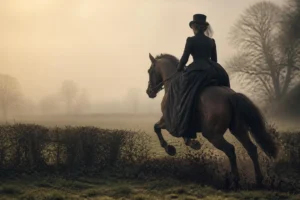

On 25 October 1854, at Balaclava in the Crimea, a chestnut Thoroughbred with white stockings leads the Charge of the Light Brigade. On his back sits James Brudenell, 7th Earl of Cardigan, the man whose name now belongs to a knitted woollen jacket. Both come back alive from the “valley of death”. And when Ronald, for that was the horse’s name, returns to England, crowds press around him to pull out strands of his hair, as if collecting pieces of a relic. Eighteen years later, his head and tail are still on display in the family’s country house. This is the story of Lord Cardigan’s horse: what the sources establish, and what belongs to legend.
Ronald, Lord Cardigan’s horse: a chestnut Thoroughbred bred at Deene Park
Ronald was born at Deene Park, the Brudenell estate in Northamptonshire, in the heart of England. The descriptions agree: a chestnut of about 15.2 hands (1.57 m) at the withers, with a star on the forehead and white stockings on both legs on the left side. The best witness is James Wightman, a sergeant in the 17th Lancers who rode in the charge at Balaclava. In his recollections, published in May 1892, he describes Cardigan “on the chestnut thoroughbred Ronald, with white stockings on the near fore and near hind, which my father, his former riding master, had broken in for him”.
The detail matters. The horse that would lead the most famous charge in British history was no anonymous cavalry remount: he was a horse of the household, broken in by a man of the household, and ridden by a colonel who took great pride in his seat. To learn how to read the white markings that made Ronald easy to pick out in the smoke, see our guide to horse coat colours, which covers socks, stars and blazes.
Balaclava, 25 October 1854: Lord Cardigan’s horse at the head of the Light Brigade
The Crimean War pits Russia against the Ottoman Empire, France and Great Britain. That morning, north of the port of Balaclava, the British commander-in-chief, Lord Raglan (FitzRoy Somerset), wants to stop the Russians from carrying off guns captured from redoubts that Ottoman troops had held. The order, drafted ambiguously, passes through an aide-de-camp, Captain Louis Edward Nolan, and then to the cavalry commander, Lord Lucan (George Bingham, Earl of Lucan). Lucan is Cardigan’s brother-in-law, and the two men barely speak.
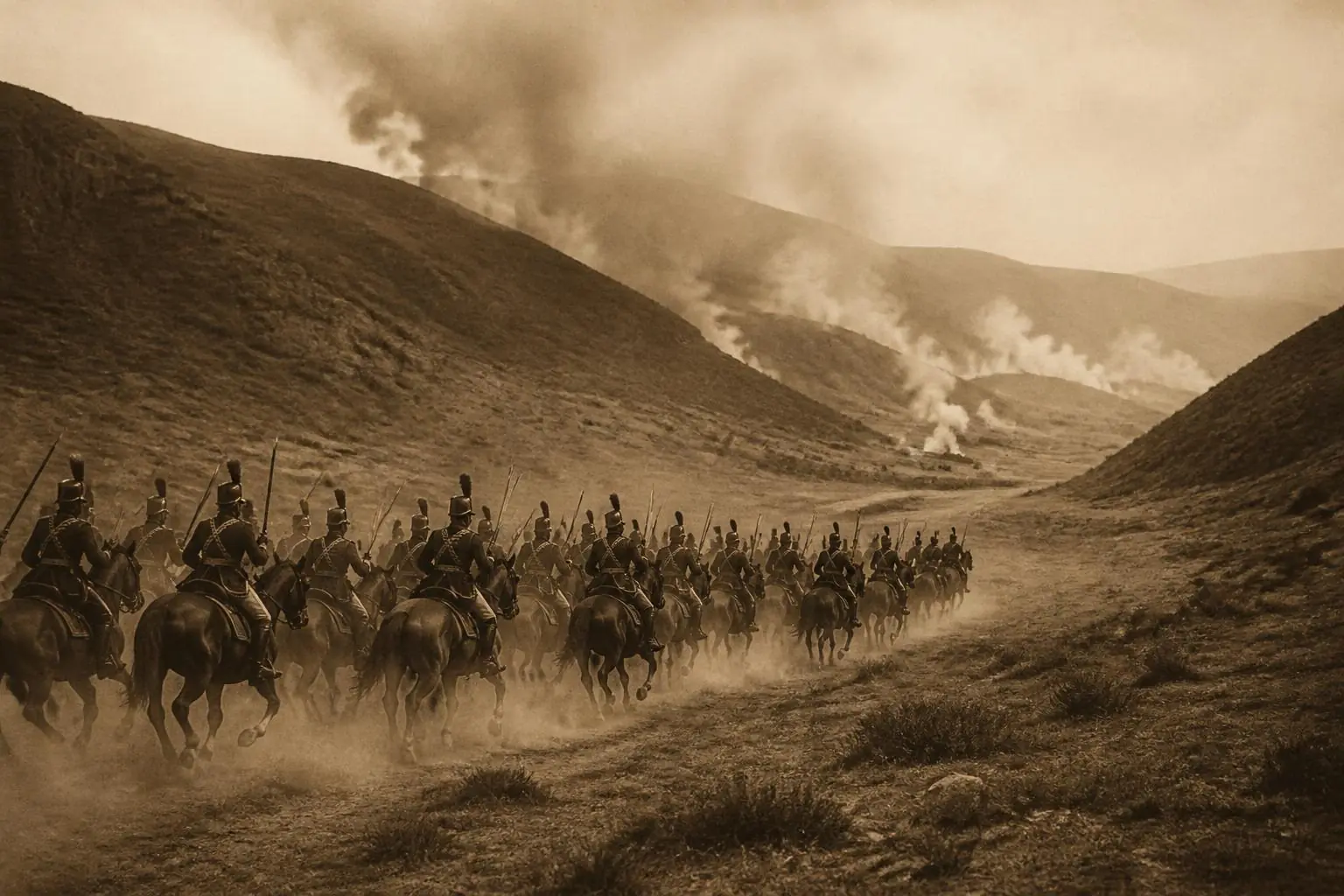
The result: the Light Brigade, about 670 horsemen according to the figures quoted by Forces News, sets off in the wrong direction, straight into a valley held by Russian artillery at the front and on both flanks. Cardigan is said to have pointed out to Lucan that there were guns in front and riflemen on each side. He rides anyway, at the head, on Ronald, in the uniform of his old regiment, the 11th Hussars, whose cherry-coloured trousers had earned its men the nickname “Cherry Pickers”. The charge lasts around twenty minutes over more than a mile (1.6 km). About 110 men are killed and 160 wounded, and several hundred horses are lost, the figures varying with the count.
Why Lord Cardigan’s horse came back from the valley of death
Ronald reaches the Russian battery. According to the account favoured by his biographers, a Russian officer recognises Cardigan and orders that he be taken alive rather than killed. The earl then turns about and rides back up the valley at a measured pace, alone, explaining later that he disdained to “fight amongst the common soldiers”. That evening he dines and sleeps aboard his yacht, the Dryad, anchored in Balaclava harbour, where he spent most of his nights during the campaign.
The horse, for his part, had passed twice through crossfire and survived the sea voyage to the Crimea, which many cavalry horses did not. He would make the journey home too. For Sergeant Wightman, the story ended differently: wounded in thirteen places, he was taken prisoner by the Russians. In June 2026, his three medals sold for £22,000 at Noonans in Mayfair, three times the estimate, according to Forces News.
Why crowds pulled the hair from Lord Cardigan’s horse
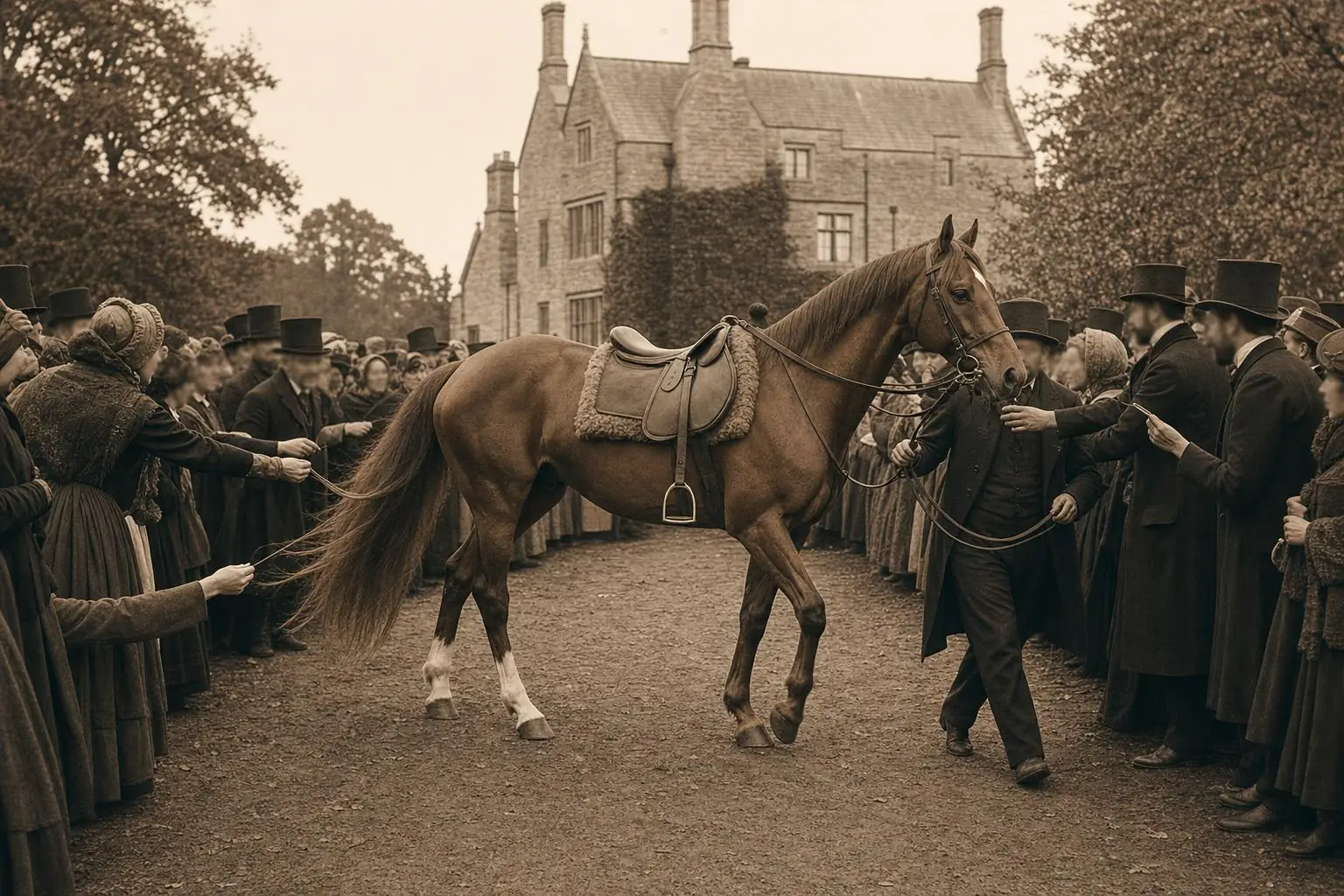
In England, the charge became legend before the survivors even returned. Alfred Tennyson’s poem “The Charge of the Light Brigade” appeared as early as December 1854. Cardigan came home in early 1855 and was welcomed as a hero. So was his horse. When Ronald reached Deene Park, crowds were waiting, and hands reached out to pull a few hairs from his tail or mane to carry away as souvenirs.
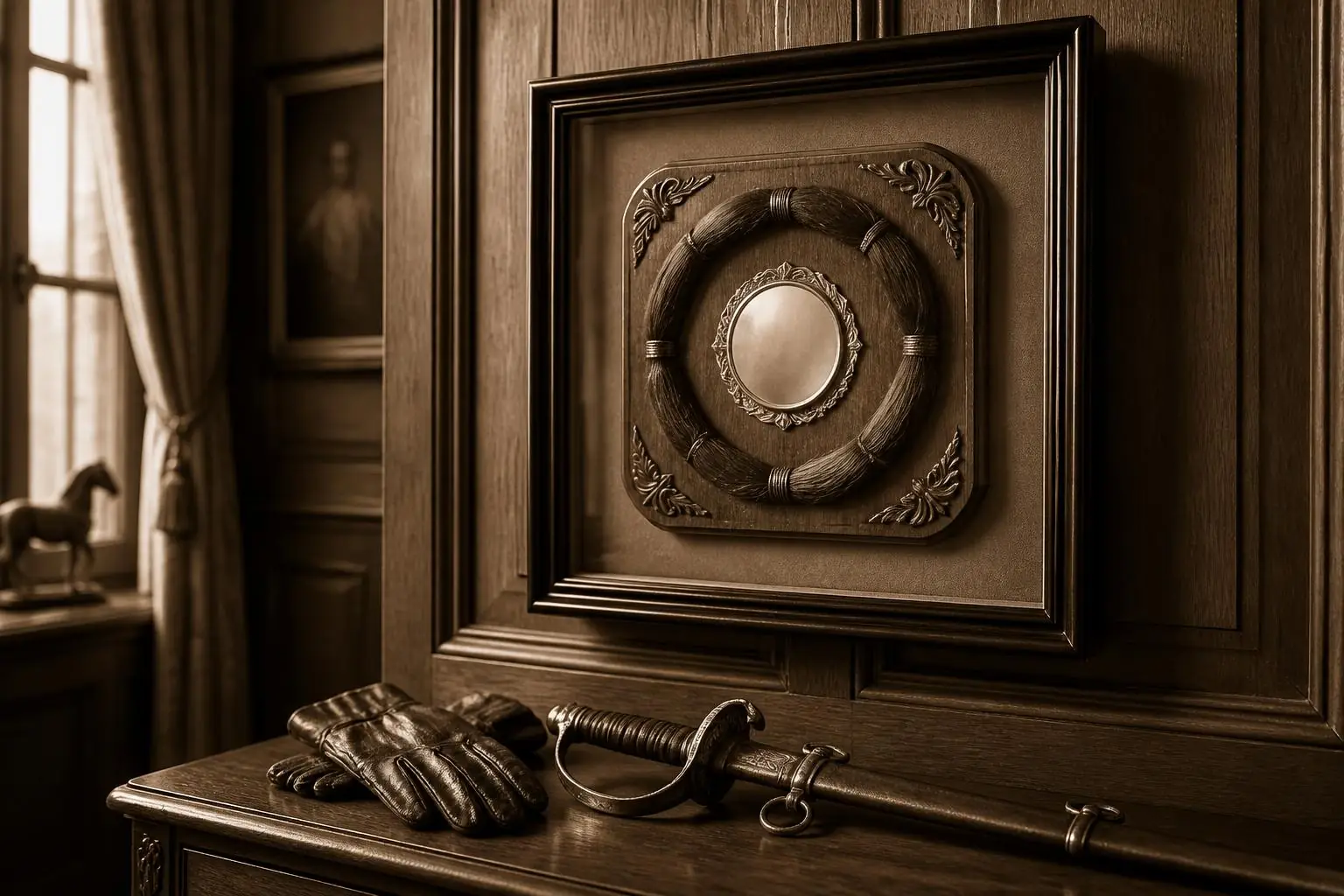
The gesture was no isolated whim. Victorian England kept the hair of its dead in lockets and mourning rings, and it treated famous horses in much the same way: hooves mounted as inkwells, locks set in silver. One of these relics has survived: a wreath of Ronald’s hair bound with silver wire around an engraved locket, fixed to a walnut plaque, with the inscription “Part of the tail of Ronald, Lord Cardigan’s charger, which jumped the Russian guns at Balaclava, October 25th 1854”. A strand from the lead horse was a piece of Balaclava you could hold in your hand.
The earl himself left another memento, longer-lasting still: the knitted woollen jacket he is said to have worn during the campaign became fashionable and took his name. The cardigan you wear at the yard comes from there.
Lord Cardigan’s horse at his owner’s funeral: the laudanum and the bugle call
Cardigan died on 28 March 1868 at Deene Park, from the effects of a fall from a horse the previous day, according to his biographical entry, on a horse reputed to be dangerous. The man who had ridden through the valley of Balaclava was killed at home, by a fall. It is reason enough never to ride without a well-fitted riding hat, even on a horse you think you know.
At the funeral, Ronald followed the coffin with an empty saddle. An anecdote, reported by the author Cheryl R. Lutring and repeated ever since, tells what happened next: the old horse, very excited by the crowd and the procession, is said to have been given laudanum to calm him. The dose was supposedly too strong, and no one could get him to move. Someone then had the idea of having the charge sounded on the bugle, and Ronald woke up and set off. We have found no contemporary source confirming this detail: treat it as tradition, not established fact.
A riderless horse behind his master’s coffin is an image that would return a century later, with Black Jack at Kennedy’s funeral.
The head and tail of Lord Cardigan’s horse, still at Deene Park
Ronald died on 28 June 1872, four years after his owner and eighteen years after Balaclava. The Brudenell family had his head preserved, under a glass case, and his tail hung on the wall close by. They are still displayed in the White Hall at Deene Park, among the souvenirs of the Crimean War, according to the estate’s official website. In the dining room, a painting by Alfred Frank de Prades shows Cardigan on Ronald at the head of the charge, and a large canvas by James Sant depicts the earl recounting Balaclava to Queen Victoria and her family at Windsor.
One of Ronald’s hooves is said to have been turned into an inkwell, topped with a statuette of the horse and his rider, in the fashion of the day. Where it is now varies from one account to another.
A legendary horse gathers anecdotes. Here is how we sorted Ronald’s:
- A direct witness: the colour, the white stockings and the breaking-in come from the recollections of Sergeant James Wightman, who charged alongside him.
- A verifiable place: the head and tail are displayed at Deene Park, as the estate itself states.
- Dates that agree: 25 October 1854, 28 March 1868, 28 June 1872, and the estate’s “18 years after Balaclava” all add up.
- An object: the silver-set hair relic, with its dated inscription.
- A single source: the episode of the laudanum and the bugle call has only one modern source, and we present it as such.
- Figures that vary: 670 or 674 horsemen, 107 or 110 killed, and a number of horses lost that changes from author to author.
What we still do not know about Lord Cardigan’s horse
Several points remain unclear. Ronald’s exact age at Balaclava is not given in the sources we have read, so we cannot say how old he was when he died. We do not know whether he was ever remounted after the Crimea, or by whom. And the inscription “which jumped the Russian guns” reads more as tribute than as record: nothing suggests that Ronald jumped the guns, only that he reached them. This Sunday, 25 October, marks the 172nd anniversary of the charge.
Other British war horses have received the same veneration, beginning with Copenhagen, Wellington’s horse at Waterloo. And if the name of the Light Brigade rings a bell from the cinema, it is also the title of the 1936 film whose making cost the lives of horses, as we recounted in the piece on Jesse James’s horse. As for Ronald’s breed, the English Thoroughbred remains the breed of the officers’ horses of his day.
Deene Park, official page “The House” (White Hall, Dining Room); Forces News, “Bidders to the right of them: Charge of the Light Brigade lancer’s medals sold at auction”, 17 June 2026 (recollections of James Wightman, May 1892); Encyclopaedia Britannica, “Charge of the Light Brigade” and “James Thomas Brudenell, 7th earl of Cardigan”; Wikipedia (English), entry for James Brudenell, 7th Earl of Cardigan; Richard Oliff, “What about Ronald?”, 2011; Suburban Militarism, “Ronald leads the Light Brigade”, 2019, citing Cheryl R. Lutring for the funeral episode.