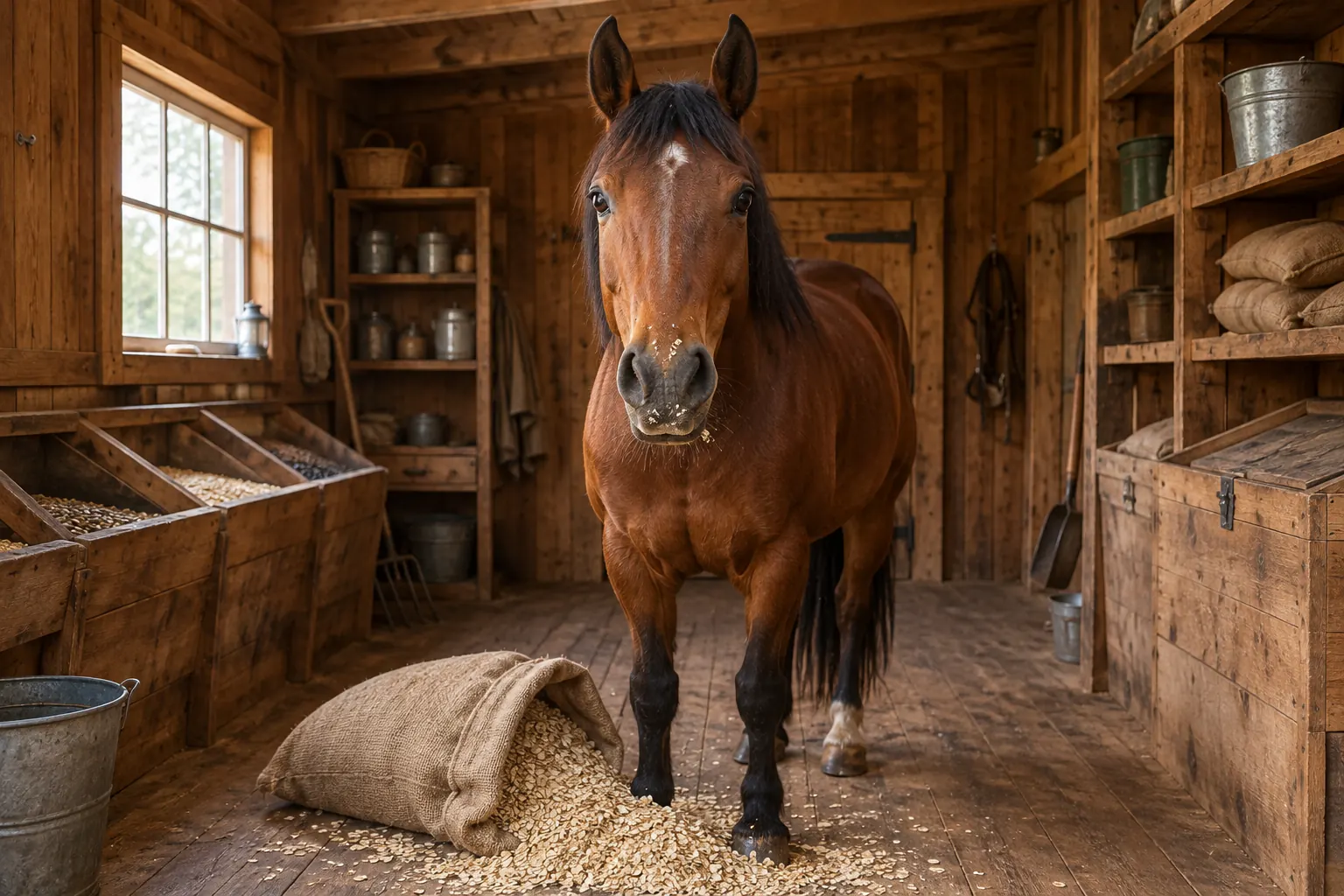

Every rider has known that morning: the feed room door left ajar, the oat sack torn open, and in the middle of the carnage a horse with a perfectly innocent expression, grains stuck to its nostrils. A human who had raided a buffet in the same way would have an escape route, inglorious but effective. The horse does not. It belongs to the very exclusive club of animals that cannot vomit, along with the rat, the mouse and the rabbit. The door of its stomach opens in one direction only. And that is exactly what turns a simple bout of indigestion into a call to the vet.
Why horses cannot vomit: a one-way stomach valve
In humans, vomiting is a small involuntary choreography. We breathe in, the airways close, the diaphragm drops and eases the pressure on the lower end of the oesophagus, then the abdominal muscles contract all at once and squeeze the stomach. The upper “doors” are open, and the contents come out. The whole sequence is directed by dedicated centres in the brain.
The horse, by contrast, is built so that food travels one way only. American veterinarian Joe Bertone, a board-certified specialist in internal medicine, set out the reasons in Equus magazine. First, the sphincter at the lower end of the oesophagus, the cardia, has far more powerful muscles than in other animals: under pressure from the stomach, it is almost impossible to force open. Second, the horse’s oesophagus meets the stomach at a much shallower angle than in many species. When the stomach swells, with gas for example, it presses on this valve and closes it even more tightly. The third lock: the stomach sits deep beneath the ribs, where the abdominal muscles cannot really squeeze it. Finally, the horse’s vomiting reflex is weak: the nerve circuits that drive it in other animals are poorly developed in the horse, if they exist at all.
In short: an armoured door, a lock that tightens when pushed, a safe out of reach and hardly any opening button. Not even a feed-room burglar can fight that.
The horse, the rat and the rabbit: the club of animals that cannot vomit
Almost all vertebrates vomit: fish, amphibians, reptiles, birds and most mammals. The notable exceptions are the horse, the rat, the mouse, the rabbit and most rodents. The rat has even had a study of its own. In 2013, an American team led by Charles Horn published a comparison in PLOS ONE between rodents and species that do vomit. Their conclusion: the inability to vomit is a general property of rodents, and the most likely cause is the absence of the nerve command centre in the brainstem. Rodents also have anatomical brakes, including a less muscular diaphragm for changing the pressure in the abdomen.
The nuance is a delight: in the rat, it is mostly the brain that fails to give the order. In the horse, the order is weak, and the door is bolted twice over anyway.
Why evolution locked the horse’s stomach: the gallop hypothesis
Nobody knows for certain, and Joe Bertone says so himself: we can only speculate. The first idea concerns the menu. The horse grazes small amounts all day and sorts what it eats; it would rarely have swallowed enough toxic plants for vomiting to be of much use. Keeping food down would have become more useful than being able to bring it up.
The second is more spectacular. When a horse gallops, its intestines slide back and forth like a piston, hammering the stomach. In almost any other species, that treatment would cause nausea. A sphincter this powerful would have allowed the horse to flee predators at full gallop without losing its lunch along the way. The lunch stays right where it is.
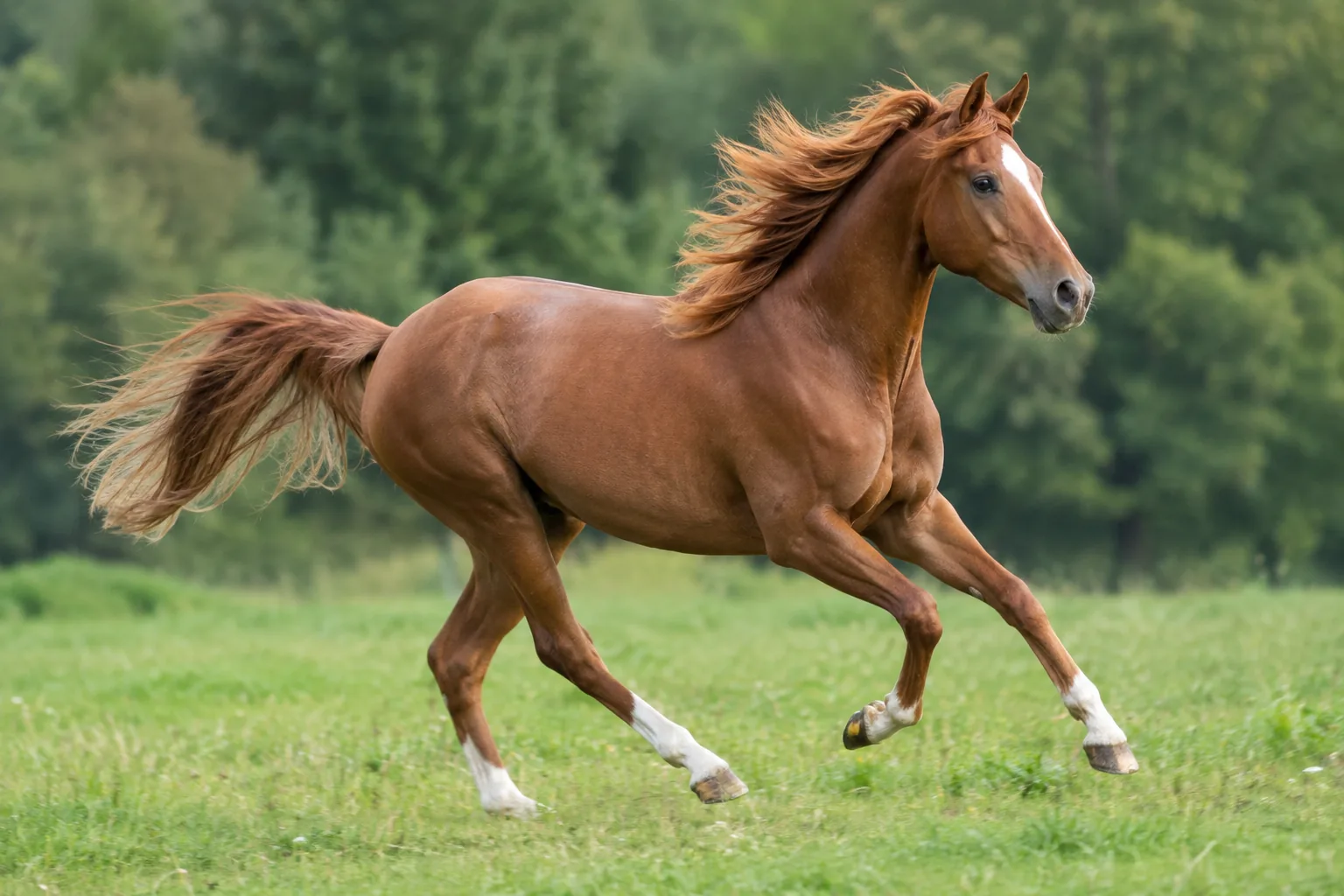
A horse’s stomach holds 4 to 5 gallons, against a large intestine ten times bigger
The lock would matter less if the stomach were large. It is not. The French Horse and Riding Institute (IFCE) describes it as “not very voluminous”: 15 to 18 litres (about 4 to 5 US gallons), against a large intestine of 180 to 220 litres (roughly 48 to 58 US gallons). A small sack at the start of a very long pipe.
This small stomach is made for a specific way of life: the horse eats often, in small amounts, about 16 hours out of 24, again according to the IFCE. The same guide sets a limit on concentrates: 2 kilos of feed as fed (4.4 lb), or 4 litres, per meal and no more, on pain of digestive risks, colic and ulcers included. The horse that emptied half a sack of oats overnight has not read the guide.
The horse that raided the feed room: when indigestion becomes an emergency
This is where the anatomy stops being amusing. The Merck Veterinary Manual, a standard reference for vets, lists among the causes of gastric dilation in the horse an excess of fermentable feeds such as grain, very rich grass or sugar beet pulp. The most frequent cause, however, remains an excess of gas or an intestinal obstruction, which stops the contents from moving on.
In us, the overflow would come back up. In the horse, it stays put. And the more the stomach stretches, the harder it presses on the cardia, which closes even more tightly. The horse is in pain, its heart rate climbs, it may retch, but nothing comes out. Left untreated, the manual notes, dilation caused by overeating can quickly lead to rupture of the stomach, which usually tears along its greater curvature. The verdict is unambiguous: for dilation, the outlook can be excellent in most cases; rupture is fatal.
Since the horse cannot empty itself through the mouth, it is the vet who opens another route: a tube passed through the nostril into the stomach, along which the accumulated fluid can flow back, what practitioners call gastric reflux. The horse’s only “vomiting”, in other words, is done for it by the vet.
Colic in horses: nearly one death in three between ages 1 and 20, according to a US survey
Stomach problems are only part of colic, the word for any abdominal pain in the horse, from stomach to intestine. But their weight is real. In its Equine 2015 survey, carried out on farms and yards in 28 states, the US Department of Agriculture (USDA) asked owners what their animals had died of. In horses aged 1 to 20, colic came first, with 31.2% of deaths, well ahead of injuries (16.3%). In horses over 20, it still accounted for 13.4%, behind the “other” category, where old age dominates.
The USDA takes care to point out that these causes were reported by owners and not necessarily confirmed by a vet or a laboratory. For everything about the different forms, their causes and their prevention, our complete guide to colic in horses goes through them one by one.
Does a horse ever vomit? What comes out of the nostrils does not come from the stomach
Cases of vomiting in horses have occasionally been reported. But according to Joe Bertone, some of them are probably due to a blocked oesophagus, what riders call “choke”: what comes back out through the nose and mouth then comes from the obstructed oesophagus, not from the stomach. A very sick horse may also regurgitate, which is quite different: vomiting is a muscular expulsion under high pressure, whereas regurgitation is passive, food flowing back when the muscles of the oesophagus give way.
In other words, a horse that “brings up” something through its nostrils is not having indigestion in the human sense. It is sending you a signal that deserves a phone call.
Colic in horses: the signs that mean calling the vet
What should make you pick up the phone. Visible abdominal pain, a racing heart, retching, food or fluid coming out of the nostrils, or a horse that has had access to a large quantity of grain. These signs do not tell you what is wrong with the horse: only the vet can say. They tell you to call, without waiting to see whether it passes. While you wait for the vet to arrive, the first steps to take when your horse has colic are explained step by step.
Faced with a horse in pain, it helps to be able to say what it ate, when, whether its ration has changed and whether it has had colic before. Dated answers beat memories, especially at three in the morning outside a stable door. That is the whole point of an online horse health record: rations, hay changes, past colics and visits are logged day by day and can be found at a glance.
What we know about the horse’s stomach, and what we rely on
What this is based on. The anatomy of the cardia, the angle of the oesophagus, the position of the stomach, the weak reflex, the evolutionary hypotheses and the difference between vomiting and regurgitation come from the answer given by Joe Bertone, a board-certified internal medicine specialist (DACVIM), in Equus magazine. The study on rodents is Horn et al., PLOS ONE, 2013. The volume of the stomach and intestine, the 16 hours of eating and the limit on concentrates come from the IFCE guide to feeding the stabled horse. The causes of gastric dilation, the risk of rupture and its prognosis come from the Merck Veterinary Manual (James N. Moore, University of Georgia). The causes of death come from the USDA’s Equine 2015 survey, published in February 2017. This article explains; it does not diagnose: faced with a horse in pain, the vet’s opinion comes before everything else.
And the next time you find the feed room door open and your horse looking innocent, remember: it will not be able to bring anything back up. Lock the door. Of the two of you, you are the one with hands.